The 70-Inch Height Requirement
It's incredibly frustrating when you're trying to figure out how to legally ride your beloved ATV or UTV on North Carolina's public roads, only to be met with a maze of highly specific rules. Among them is the often-confounding 70-inch height requirement for Modified Utility Vehicles (MUVs). This guide is here to untangle that particular thread, explaining exactly what that measurement means for your machine and why it's such a critical hurdle for road certification in the Old North State.
Understanding North Carolina's Modified Utility Vehicle (MUV) Class
Let's be real: North Carolina isn't exactly rolling out the red carpet for ATVs and UTVs on public roads. For the most part, these machines are strictly for off-road use or private land. This can be a huge headache for owners who need to cross a short stretch of pavement to get to a trail, or for those who simply want the versatility of using their machine beyond the dirt. The state's general stance is quite firm against street-legal quads or side-by-sides.
However, there is one very specific, and frankly, very narrow path for some utility vehicles to achieve road-legal status: the Modified Utility Vehicle, or MUV. This isn't a blanket permission for any UTV; it's a meticulously defined class with a host of requirements designed to ensure these machines meet a certain standard of road-worthiness. It's easy to get excited about the possibility of an MUV, but it's crucial to understand that it's an exception, not the rule, and most standard off-road machines simply won't qualify without significant, often impractical, modifications.
Why the MUV Class Exists
The creation of the MUV class really stems from a practical need to distinguish certain types of utility vehicles from typical recreational off-road machines. Lawmakers likely recognized that some larger, more robust utility vehicles, often designed for work rather than pure recreation, could potentially be made safe enough for limited road use under strict conditions. This isn't about letting your sport quad cruise down Main Street; it's about allowing a specific kind of machine, usually a heavy-duty side-by-side, to function as a road-going vehicle if it can meet a long list of safety and design criteria.
Think of it as a way to bridge the gap between a standard UTV and a traditional low-speed vehicle or golf cart, neither of which is really what most side-by-side owners are looking for. The MUV designation attempts to categorize machines that are robust enough for utility tasks but can also, theoretically, navigate public roads without posing undue safety risks to other drivers or themselves. It's a challenging classification to meet, but for those who genuinely need a street-legal utility vehicle, it offers a glimmer of hope.
The Collection of MUV Requirements
The 70-inch height requirement, which we're diving into today, is just one piece of a much larger, more complex puzzle that defines a North Carolina MUV. It's easy to focus on one measurement, but the reality is that your machine must satisfy all the criteria simultaneously to be certified. Missing even one tiny detail means your machine won't qualify. This isn't a pick-and-choose scenario; it's an all-or-nothing test.
To even begin the journey toward MUV certification, your machine also needs to meet specific criteria for engine size, length, width, and speed. It must be at least 2,400cc, a significant hurdle that immediately excludes a vast majority of common UTVs. Then there are the dimensions: it can't be longer than 142 inches, wider than 58 inches, and taller than 70 inches. On top of that, it needs to be capable of at least 40 mph and possess standard safety features like seat belts, mirrors, a speedometer, and turn signals. It's a tall order, indeed, and why so many otherwise capable side-by-sides just don't make the cut. You can find more details on these various specifications in [North Carolina MUV Dimension Requirements].
Decoding the 70-Inch Height Requirement
So, let's zero in on that crucial 70-inch height. This measurement isn't just pulled out of thin air; it's a specific limit designed to keep MUVs within certain parameters, primarily for safety and visibility on public roads. For many UTV owners, especially those who love their lifted, big-tired machines, this requirement can be a real showstopper. It forces a close inspection of your machine from the ground up, literally.
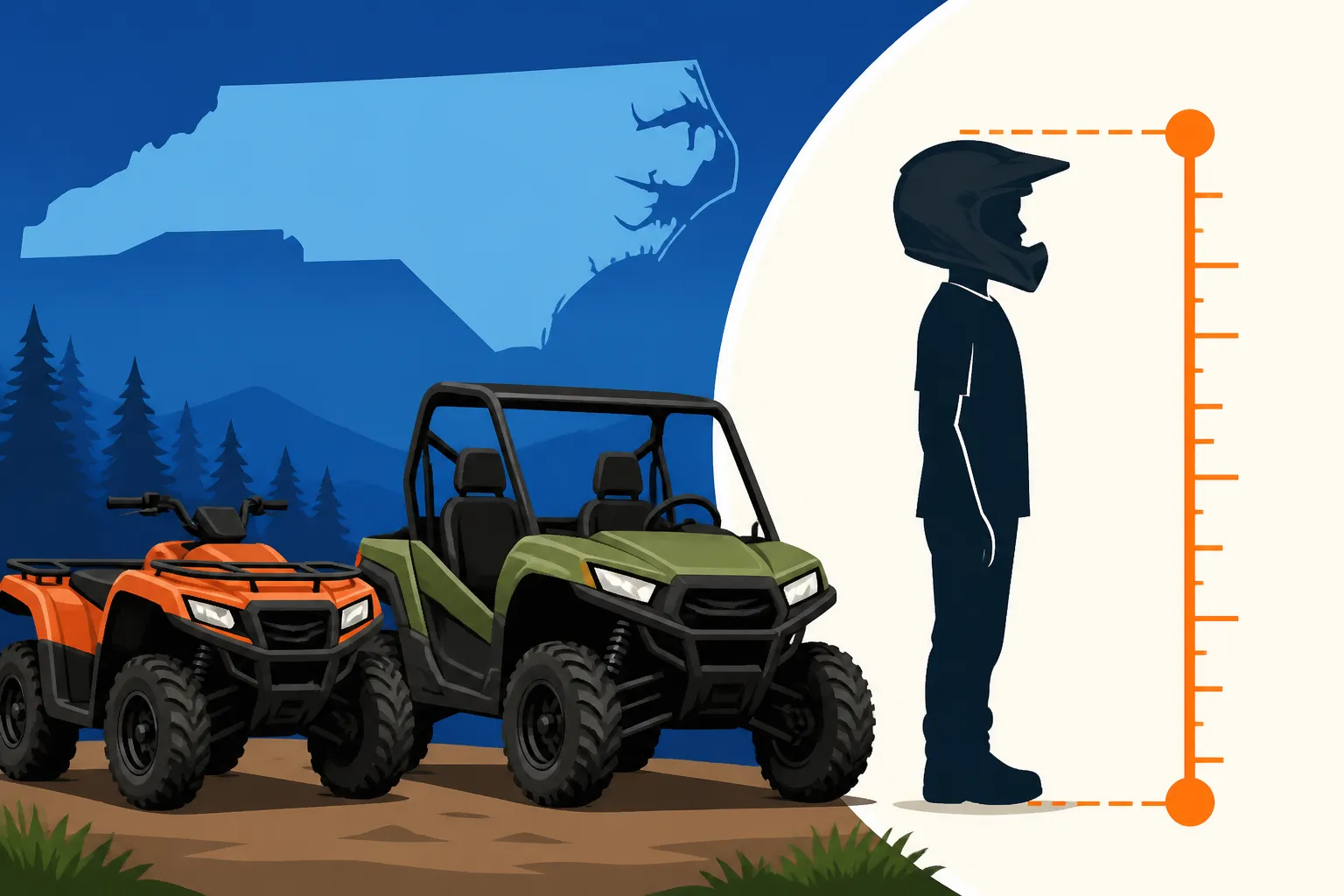
Imagine taking a tape measure and stretching it from the absolute lowest point of your tires, where they meet the ground, all the way to the very highest point of your machine. This could be the top of your roll cage, a roof rack, a light bar, or even a windshield that extends above the main structure. Every single inch counts, and there's no wiggle room. This precise measurement means you can't just eyeball it; you need to be exact, because the DMV certainly will be.
How North Carolina Defines "Height" for an MUV
When North Carolina's DMV looks at your machine for MUV certification, "height" isn't a vague concept. It means the overall vertical dimension of the vehicle, measured from a flat surface to the highest point of the vehicle's permanent structure or any accessory attached to it. This includes your tires, suspension, frame, roll cage, roof, and any mounted accessories like light bars, roof racks, or even whip flags if they're permanently installed.
This comprehensive definition is often where many UTVs stumble. A machine might have a low-profile cage, but if it's running tall tires, or has an aftermarket roof rack designed to carry extra gear, those additions could easily push it over the 70-inch threshold. The state isn't interested in just the "cab" height; they want the full vertical footprint. This means you need to consider every single element that contributes to your machine's overall stature when evaluating its MUV potential.
Practical Implications for Your Machine
The 70-inch height limit has significant practical implications, particularly for modern UTVs. Many popular side-by-sides, especially those designed for aggressive trail riding or with generous ground clearance, naturally stand taller than 70 inches right off the showroom floor. Add any aftermarket modifications like larger tires, lift kits, or even some robust aftermarket roll cages, and you're almost guaranteed to exceed the limit.
Consider a typical 4-seater side-by-side, which often comes with a factory height pushing or even exceeding 75 inches. If you've got a sportier model, or one with a pronounced roofline, you're likely even taller. This means that to qualify as an MUV, many owners would need to reduce the height of their machine. This could involve installing smaller-diameter tires, removing lift kits, or even modifying the roll cage structure. These changes, while potentially making your machine compliant, could significantly alter its off-road performance and aesthetic, which is a major trade-off for many riders. This is a common reason why [Why Most Side-by-Sides Miss the Mark] when it comes to MUV certification.
Why the 70-Inch Limit Matters for MUV Certification
Every rule within the MUV classification serves a purpose, and the 70-inch height limit is no exception. It's not just an arbitrary number; it's tied directly to the state's concerns about safety, stability, and the overall road-worthiness of these machines when they share pavement with cars and trucks. The goal is to ensure that anything deemed an MUV can operate safely in a mixed traffic environment.
A taller vehicle generally has a higher center of gravity, which can make it more prone to rollovers, especially during emergency maneuvers or at higher speeds. While a UTV might be stable on a wide trail, the dynamics change dramatically on a paved road with varying crowns, sudden turns, and the need to react quickly to other vehicles. The 70-inch limit aims to mitigate some of these inherent risks, bringing the machine closer to the stability profile of a more traditional road vehicle. It's a critical aspect of how [What Makes a Machine an MUV in North Carolina] truly road-ready.
Safety and Road-Worthiness Concerns
The primary concern behind the height restriction is undoubtedly safety. A lower-profile vehicle generally presents a smaller frontal area and a more stable stance, which is advantageous for road use. When UTVs are designed for off-road performance, they prioritize ground clearance to navigate obstacles like rocks, logs, and deep ruts. This often means taller suspension, larger tires, and overall increased height. These features, while excellent for the trails, can be detrimental to on-road stability, especially during evasive maneuvers.
The state is trying to avoid having extremely tall, top-heavy vehicles sharing the road with passenger cars, where a sudden swerve could lead to a catastrophic rollover. By imposing a 70-inch limit, North Carolina is pushing MUVs towards a design that sacrifices some off-road prowess for increased on-road stability and predictability. It's a delicate balance, and one that highlights the fundamental difference in design philosophy between a dedicated off-road machine and one intended for public highway use.
The Role of the DMV Inspection
When you submit your machine for MUV certification, it's not a mere paperwork exercise. The North Carolina DMV will conduct a thorough inspection to ensure your vehicle meets every single requirement, including all the dimensional constraints. This isn't just a quick glance; they will measure your machine precisely, from tire to roof, with little tolerance for deviation. If your machine is even a fraction of an inch over the 70-inch limit, it will not pass the inspection.
This strictness underscores the state's commitment to safety for vehicles operating on public roads. The DMV isn't just checking boxes; they're verifying that the physical attributes of your machine align with the legislative definition of an MUV. Failing this inspection means you'll have to go back to the drawing board, make the necessary modifications, and then resubmit for another inspection. This process can be time-consuming and costly, making it essential to be absolutely certain of your machine's compliance before you even bring it in. For more on the specifics of the inspection, check out [North Carolina MUV Inspection Requirements].
Challenges and Workarounds for Meeting the Height Rule
Meeting the 70-inch height requirement is often one of the biggest headaches for UTV owners hoping to get MUV certification in North Carolina. It's a hard limit that can be difficult to achieve, especially if you're starting with a machine designed for maximum off-road clearance and capability. The modifications needed can sometimes feel like they're working against the very nature of your side-by-side.
The reality is that many popular UTV models, particularly those with long-travel suspension or spacious cabins, simply exceed this height directly from the factory. Aftermarket accessories, which are so common in the UTV world – things like lifted suspensions, larger tires, or robust roof-mounted light bars – almost guarantee that your machine will be too tall. This forces a critical decision: modify your pride and joy, or accept that it won't be an MUV.
Modifying Your UTV to Comply
If you're determined to meet the 70-inch height limit, you'll likely need to consider a few modifications. The most direct ways to reduce a vehicle's height involve changing its tires or suspension. Switching to smaller diameter tires can shave off precious inches, though this will also reduce your ground clearance and potentially alter your gear ratios, impacting off-road performance. Similarly, removing any lift kits or opting for lower-profile suspension components can bring the machine closer to the ground.
Another area to scrutinize is the roll cage and any roof-mounted accessories. If your aftermarket cage is taller than the factory one, or if you have a bulky roof rack, light bar, or even a windshield that extends significantly above the cage, these will all contribute to the overall height. Sometimes, it might mean swapping out parts or carefully adjusting existing ones. While these modifications can help you comply, it's important to weigh the cost and effort against the potential loss of off-road capability that originally attracted you to the machine.
Deciding if an MUV Is Right for You
Given the stringent requirements, including the height limit, it's crucial to honestly assess if the MUV path is truly the right one for you and your machine. Are you willing to make the necessary modifications, which could be extensive and costly? Will those changes compromise the very reasons you bought your UTV in the first place? For example, if you reduce tire size and remove lift kits to meet the height, you might find your machine struggles on the rocky trails of the Uwharrie National Forest.
Sometimes, the best decision is to acknowledge that your machine is, and should remain, an off-road vehicle. If your primary use is trail riding, hunting, or working on private land, then sacrificing performance for a limited street-legal capability might not make sense. It's about balancing the desire for road access with the practical realities of your machine and your riding habits. If you're going to the trouble of certifying a unique vehicle, you might want to look at services like LawDepot for custom bills of sale if you ever decide to sell it, ensuring all its unique features and modifications are properly documented.
Beyond Height: Other Critical MUV Dimensions
While the 70-inch height requirement is a major obstacle for many UTVs, it's just one piece of the dimensional puzzle that North Carolina has laid out for Modified Utility Vehicles. To truly understand the challenge, you need to consider the full suite of measurements that your machine must meet simultaneously. It’s not enough to be short enough; you also have to be the right length and width, all while meeting engine size and speed requirements.
This interconnectedness of requirements means that even if your UTV happens to be under 70 inches tall, it could still fail MUV certification due to its length or width. The state has created a very specific box that these machines must fit into, and modern UTV designs often push the boundaries of these dimensions in multiple directions. It's truly a testament to the specificity of the [North Carolina's Modified Utility Vehicle Route].
The 142-Inch Length Requirement
Just like height, North Carolina imposes a strict limit on the overall length of an MUV: it cannot exceed 142 inches. For many utility-focused UTVs, especially multi-passenger models or those with extended beds designed for hauling, this can be another significant challenge. While many standard two-seater UTVs might comfortably fall within this limit, some four-seaters or six-seaters, or those with custom cargo configurations, could easily push past the 142-inch mark.
Measuring from the very front bumper to the very rear of the machine, including any hitches or integrated bumpers, is crucial. If your UTV has a long wheelbase or an extended bed, you'll need to measure carefully. This requirement, combined with the others, helps define the overall footprint of an MUV on the road, ensuring it's not excessively long, which can impact maneuverability and parking. Further details on this can be found in [The 142-Inch Length Requirement].
The 58-Inch Width Requirement
Perhaps the most common stumbling block for UTVs seeking MUV certification in North Carolina, even more so than height, is the 58-inch width limit. Modern side-by-sides, particularly sport models, often boast widths of 60 inches, 64 inches, or even 72 inches from the factory. This wide stance provides stability and comfort for off-road trails but makes them instantly non-compliant for MUV status.
Measuring the width means going from the widest point of the machine, which usually includes the outside edge of the tires. Even if your machine is technically 58 inches at the frame, if your wheels and tires extend beyond that, or if you have wide fender flares, those will be included in the measurement. This requirement is so restrictive that it effectively disqualifies a massive portion of the UTV market. For a comprehensive look at this specific hurdle, you might be interested in [The 58-Inch Width Requirement].
A Combined Challenge
The true difficulty in getting an MUV certified lies in meeting all these dimensional requirements simultaneously, alongside the engine size and speed capabilities, and the mandatory safety features. It's a perfect storm of specific criteria that few stock UTVs can navigate. You might have a machine with a powerful enough engine and the right top speed, but if it's 62 inches wide, it's out. Or if it's 72 inches tall, it's also out.
This complex web of requirements is why obtaining a [North Carolina MUV Street Legal Requirements] is such a rare feat. It often requires either a very specific, older utility vehicle model, or significant, expensive, and sometimes counter-intuitive modifications to a newer one. If you're seriously considering this path, make sure to thoroughly check every single dimension and specification your machine has against the state's rules before investing time and money. When dealing with such specific vehicle classifications and potential modifications, having robust documentation, perhaps created with a service like LawDepot, can be a valuable asset for future sale or ownership transfers.
| MUV Requirement | Specification | Common UTV Impact |
|---|---|---|
| Engine Size | > 2,400cc | Excludes most recreational UTVs and many utility models |
| Length | < 142 inches (11' 10") | Challenge for multi-passenger and extended-bed UTVs |
| Width | < 58 inches (4' 10") | Major hurdle, most modern UTVs are 60"+ wide |
| Height | < 70 inches (5' 10") | Challenge for lifted UTVs, large tires, roof racks |
| Speed Capability | > 40 mph | Not an issue for most UTVs |
| VIN | DMV-assigned | Required if no manufacturer VIN (rare for UTVs) |
| Safety Features | Seat belts, mirrors, | Often requires aftermarket additions for turn signals, etc. |
| speedometer, turn | ||
| signals, parking brake |
Disclaimer
This article is for general informational purposes only and does not constitute professional advice. Laws, prices and regulations vary by location and change over time. Consult a qualified professional for guidance on your specific situation.