North Carolina MUV Parking Brake Requirement
It can be incredibly frustrating to discover that the side-by-side you just bought, or have owned for years, isn't quite as road-ready as you might have hoped for North Carolina’s unique Modified Utility Vehicle (MUV) designation. Many folks assume that if their machine has a steering wheel and seatbelts, it’s good to go, only to hit a wall of specific, often surprising, requirements at the DMV. One such detail that often trips up even seasoned riders is the parking brake. This guide will walk you through North Carolina's MUV parking brake requirement, explaining what it means for you and your machine.
What Even Is a Modified Utility Vehicle (MUV) in North Carolina?
Before we dive into the nitty-gritty of parking brakes, it’s crucial to understand what North Carolina means by a "Modified Utility Vehicle" (MUV). This isn't just a fancy term for any UTV or side-by-side; it's a very specific legal classification designed to bridge the gap between off-road recreational vehicles and actual street-legal machines. If you're hoping to ride your side-by-side on public roads in the Tar Heel State, you need to know these distinctions.
Beyond Just a Side-by-Side: The Legal Definition
You might think your beloved side-by-side, quad, or utility vehicle is inherently street legal because it has four wheels and a steering wheel, but North Carolina's laws are much more nuanced. The state carved out the MUV category precisely because standard off-road vehicles don't meet the rigorous safety standards required for public road use. An MUV is an off-road utility vehicle that has been modified or manufactured to meet a specific set of criteria that allow it to be registered and operated on certain public roads. It's not a blanket approval for all UTVs, and frankly, most standard, factory-floor side-by-sides won't qualify without significant, often costly, alterations. This can be a real headache for owners who bought their machines with the assumption they could simply add a license plate.
The difference comes down to safety features and engineering designed for shared roadways, not just dirt trails. We're talking about things like proper lighting, signaling, and yes, a robust braking system that includes a dedicated parking brake. The state isn't trying to make your life harder; they're trying to ensure that when these vehicles share the asphalt with cars and trucks, they can stop, start, signal, and park safely without becoming a hazard. Understanding this fundamental difference is your first step toward getting your machine road-ready, or accepting that it might be an off-road-only champion. You can learn more about the broader requirements in [North Carolina MUV Registration Requirements].
Why the DMV Cares About Tiny Details
It often feels like the Department of Motor Vehicles (DMV) delights in bureaucratic hurdles, but when it comes to MUVs, their attention to detail stems from a very real concern for public safety. Think about it: a vehicle designed for dirt, mud, and rocks suddenly needs to perform reliably on paved roads, often at higher speeds and in mixed traffic. The DMV's role is to ensure that any vehicle granted road-legal status can safely interact with other vehicles and pedestrians. This means every component, from the engine's displacement to the length of the chassis, must meet specific engineering and safety standards.
The parking brake is a perfect example of such a "tiny detail" that has a massive impact on safety. Imagine parking on a steep hill in Asheville or Boone, only for your side-by-side to roll away because it lacked a proper parking brake. It could lead to serious injury or property damage. The DMV doesn't just want to see a brake; they want to see a parking brake that functions independently and reliably. This same logic applies to other MUV requirements like the minimum engine size of [Why an MUV Needs More Than 2,400cc] and specific dimension limits such as [The 58-Inch Width Requirement] and [The 70-Inch Height Requirement]. Each of these requirements is there to make sure an MUV can navigate public roads predictably and safely. It's a lot to consider, and it often feels like a steep learning curve for those simply wanting to connect trails or run errands on their UTV.
The Mandate: North Carolina's Parking Brake Requirement for MUVs
Now, let's get down to the brass tacks of the parking brake itself. This isn't just a suggestion; it's a mandatory safety feature for any vehicle seeking MUV designation in North Carolina. Ignoring it means your dreams of street-legal UTV adventures will remain just that — dreams.
What the Law Actually Says
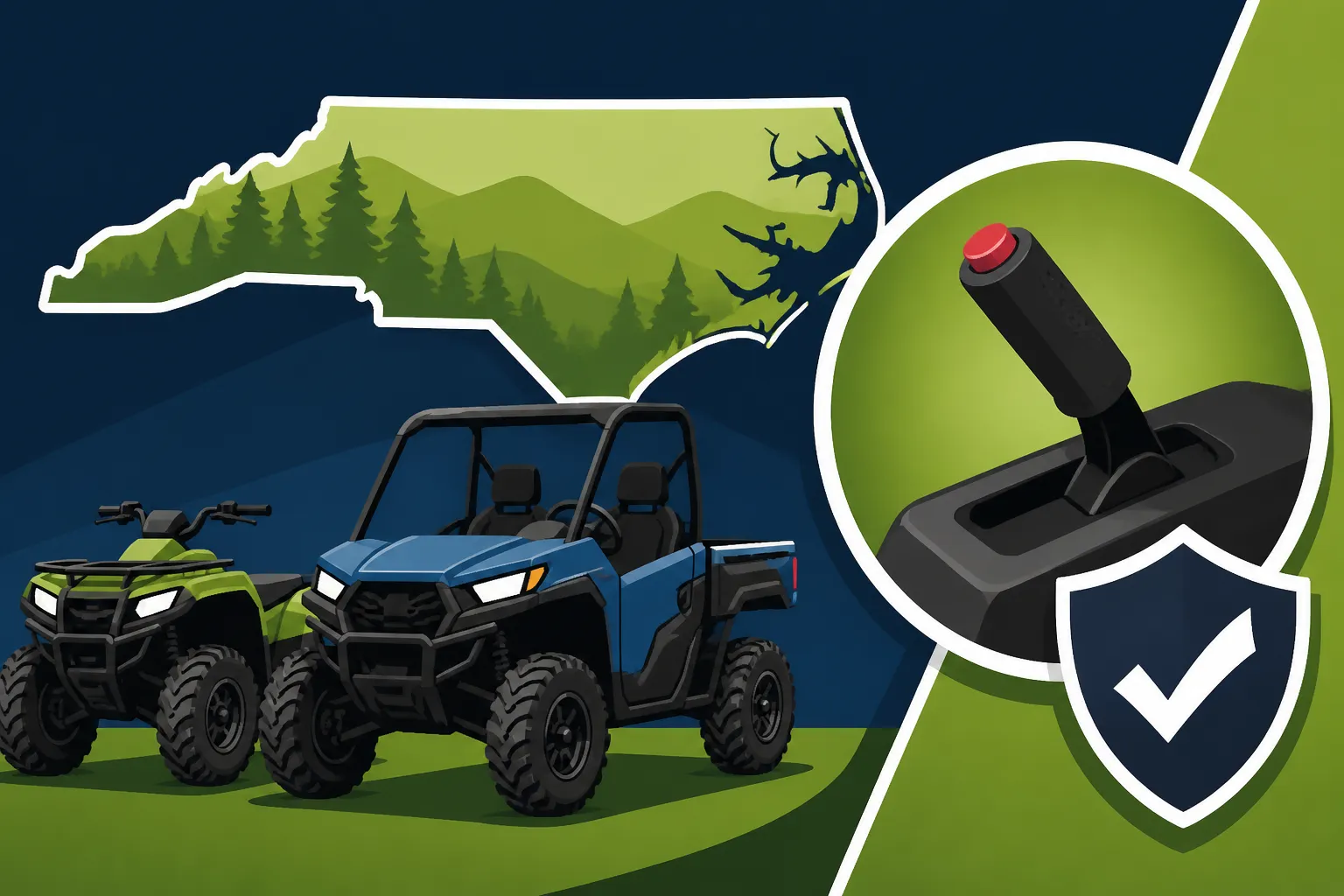
North Carolina law requires MUVs to be equipped with a parking brake that is separate from the service brake system and capable of holding the vehicle stationary on any grade on which it is operated. This means your parking brake can't just be the emergency brake lever that also acts as part of your main braking system. It needs to be a distinct, mechanical system designed specifically to keep your vehicle from moving when parked, even on an incline. Many standard side-by-sides, especially older models or those designed purely for recreation, might rely on the transmission's parking pawl or a simple, integrated handbrake that doesn't quite meet this independent, grade-holding standard.
The "why" behind this is pure common sense and safety. A proper parking brake ensures that your MUV won't roll away if you park on a slight incline or if someone accidentally bumps it. It provides an added layer of security, especially important when sharing roads with heavier, faster traffic. Without it, you're not only risking a dangerous incident but also failing a fundamental safety checkpoint for road-legal operation. For a full picture of what your MUV needs to pass muster, it’s wise to look into [North Carolina MUV Inspection Requirements].
Ensuring Your Machine Complies
So, how do you know if your current UTV's parking brake setup passes muster for MUV registration? First, consult your owner's manual. It will detail the type of braking system your machine has. Then, get under there and visually inspect it. Is there a separate lever or pedal specifically for parking? Does it engage a different part of the braking system than your foot pedal? Can it truly hold your vehicle on an incline without slipping? Many factory-installed "parking brakes" on recreational UTVs are designed for flat ground or very slight grades, not for the varied terrain you might encounter on public roads, especially in the state’s mountain regions.
A compliant parking brake usually means a mechanical system that locks the wheels (often the rear wheels) independently of the hydraulic service brakes. If your machine only has a parking pawl in the transmission, that's generally not sufficient for the MUV requirement. You might need to consider aftermarket solutions or professional modifications. This is where it's critical to work with a reputable shop that understands North Carolina's specific MUV regulations, not just general off-road modifications. They can assess your current system and recommend the necessary upgrades. The goal is not just to "have" a parking brake, but to have one that is robust, reliable, and meets the spirit and letter of the law.
Navigating the DMV for MUV Registration
Getting your MUV registered for road use in North Carolina isn't just a matter of filling out a form; it's a process that involves proving your vehicle meets a host of safety and equipment standards. The parking brake, while a single item, is a critical piece of that puzzle.
The Parking Brake on Your Inspection Checklist
When you take your MUV to the DMV or an authorized inspection station for registration, the parking brake will be a specific item on their checklist. They're not just glancing at it; they're verifying its presence and functionality. Expect them to test its ability to hold the vehicle. If it's missing, or if it doesn't function as an independent, effective parking brake, your machine will fail the MUV qualification process. This can be a real disappointment after you've invested time and money in other modifications.
The consequence of not having a compliant parking brake is simple: no MUV registration. This means no street-legal status for your side-by-side. It’s a non-negotiable safety feature, right up there with having proper headlights and turn signals. So, before you even head to the DMV, do your homework and make sure this critical component is up to snuff. Don't leave it to chance, as a failed inspection means more time, more money, and more frustration. The DMV's goal here is to keep everyone safe on the road, and a fully functional parking brake is a foundational element of that safety.
The Big Picture: Beyond Just the Brake
While we're focusing on the parking brake, it's vital to remember that it's just one piece of a much larger, intricate puzzle. North Carolina's MUV designation has numerous other requirements that your machine must meet to be deemed street legal. Missing even one of these can halt your registration process dead in its tracks. You'll need to ensure your machine adheres to strict dimensional requirements, like [The 142-Inch Length Requirement], and that it has an engine size of [More Than Twenty-Four Hundred Cubic Centimeters]. Speed is also a factor, with a minimum top speed of [40 mph to Qualify as an MUV] necessary.
Beyond these, an MUV must also be equipped with seatbelts, a speedometer, mirrors, and appropriate lighting including headlights, taillights, and turn signals. Each of these components has specific standards it must meet. For example, see [North Carolina MUV Turn Signal Requirement] and [North Carolina MUV Mirror Requirement] for more details. Essentially, the state is trying to make sure that these modified utility vehicles are as close as possible to standard passenger cars in terms of their basic road-worthiness and safety features. Getting a VIN assigned by the DMV is part of the process, too. It can feel overwhelming trying to keep track of all these regulations, which is why it's good to have a comprehensive checklist. When you purchase a used machine, ensuring all these details are in order is crucial. Even for off-road-only machines, a clear record of ownership is important, and services like LawDepot can help you create a robust [A North Carolina Bill of Sale for an ATV] to document your transactions accurately.
What if Your UTV Doesn't Have One (or a Compliant One)?
Discovering your UTV doesn't meet the MUV parking brake requirement can be a real bummer, especially if you had visions of cruising down county roads. But don't despair! You typically have a couple of routes you can take, depending on your commitment to street legality.
Options for Modification
If you're determined to make your side-by-side street-legal as an MUV, and its current parking brake setup is insufficient, modification is often the answer. Many aftermarket parts manufacturers offer kits to add or upgrade parking brake systems on various UTV models. These can range from simple lever-actuated cable systems to more complex hydraulic or mechanical setups that engage a dedicated brake caliper on the driveline or wheels.
However, this isn't a DIY job for the faint of heart, unless you have extensive mechanical experience and a deep understanding of vehicle braking systems. It's highly recommended to seek out a professional, reputable powersports shop that has experience with MUV conversions and understands North Carolina's specific regulations. They can advise you on the best and safest solution for your particular machine, ensuring the modification not only works effectively but also passes DMV inspection. Remember, safety is paramount, and a poorly installed or inadequate parking brake could be more dangerous than having none at all. Ensure any modifications are up to the task of safely holding your machine on varied grades, as this is precisely what the state will be looking for during inspection.
The Alternative: Off-Road Only
For many UTV owners, the path to MUV registration can seem too costly, too complicated, or simply not worth the effort. If modifying your machine to meet the parking brake and all the other MUV requirements feels like an uphill battle, remember that North Carolina still offers an incredible amount of off-road riding opportunities. You don't have to make your machine street-legal to enjoy it in the Tar Heel State. Places like the Uwharrie National Forest, Brown Mountain, and Wayehutta offer miles and miles of fantastic trails for ATVs and UTVs. You can explore [Where to Ride an ATV in North Carolina] for some ideas.
Choosing the off-road-only route means you skip the headache of DMV inspections for MUV status. You'll still need to follow rules for trail use, such as obtaining the necessary [North Carolina Forest OHV Permits] and ensuring you meet age and safety certificate requirements. But you won't need to worry about street-legal items like turn signals, specific dimensions, or that pesky parking brake. Ultimately, whether you pursue MUV status or stick to the trails, ensure you have proper documentation for your machine. A solid bill of sale, which you can easily generate through services like LawDepot, is always a good idea, whether you're [Buying a Used ATV in North Carolina] or selling one, as it clearly establishes ownership. Even if your machine is never going to hit the pavement, having a clear title is always worthwhile, and you can learn more about [Why a North Carolina Title Is Worth Having]. The key is to know your machine's capabilities and the legal requirements, then choose the path that best suits your riding style and budget.
Disclaimer
This article is for general informational purposes only and does not constitute professional advice. Laws, prices and regulations vary by location and change over time. Consult a qualified professional for guidance on your specific situation.