Riding the Nantahala After the First Frost
The first frost can make a Nantahala ride feel crisp and inviting, but it also changes the trail under your tires. Shaded mud may turn slick, creek crossings can be colder and higher than expected, and a route that looked simple on a map may be closed or unsuitable for your machine. This guide covers how to plan, ride, and adjust safely after a cold snap.
Plan the Ride Around Conditions, Not the Calendar
Check access before you load the trailer
A frost date does not tell you whether a particular trail is open, dry, or passable. Conditions can vary sharply across the Nantahala National Forest, which covers a large area with different elevations, drainage patterns, and access rules. A sunny approach road can be dry while a shaded trail section remains wet, icy, or damaged.
Start by checking the official notices for the specific riding area you plan to visit. Confirm that the route is open to your type of machine, then check for temporary closures, storm damage, and seasonal restrictions. The [North Carolina Trail Closures to Check] and [North Carolina Trail Status After a Storm] are useful reminders to verify conditions rather than relying on an old map, a social media post, or a report from a different part of the forest.
If you are considering Wayehutta near Cullowhee, treat it as a defined riding area—not as permission to ride anywhere in the surrounding forest. The [Wayehutta OHV in Western North Carolina] guide can help orient your planning, while [What the Nantahala Ranger District Opens to Machines] is a useful starting point for understanding that forest access depends on designated routes and current rules.
Build a map and a backup plan
Download or save the route information you need before leaving home. Cell coverage can be unreliable in remote hollows and mountain terrain, so a phone map that depends on a live connection may not be enough. Keep a paper map or an offline map available, and tell someone where you plan to ride and when you expect to return.
An app such as onX Offroad can be useful for reviewing a planned route and keeping map information available offline. Still, don’t treat any mapping app as the final authority on whether a trail is open or legal for your machine. Compare what you see in onX Offroad with posted signs and official forest information, especially where a route crosses a road, forest boundary, or restricted area.
Pick a turnaround point before you start. After frost, a muddy climb or slick descent can take longer than expected, and daylight can disappear quickly in the mountains. A good plan includes a shorter loop you can complete comfortably if the trail is slower, colder, or rougher than expected.
Understand What Frost Changes on the Trail
Expect shade and elevation to matter
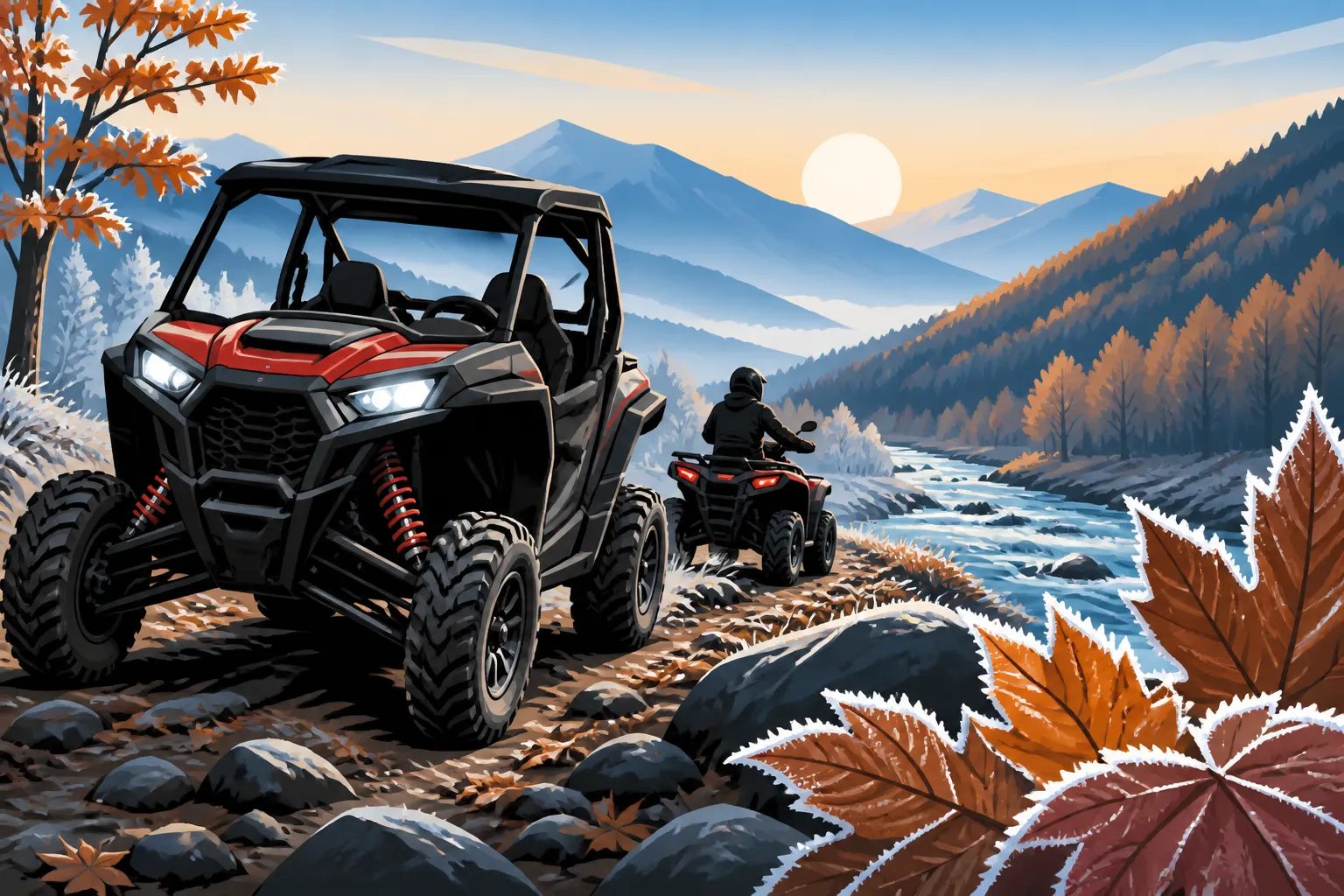
The first cold morning of the season can leave patchy frost in low spots and deeper shade, while exposed ground warms in the sun. That contrast makes conditions hard to judge from the trailhead. A route that is mostly dry may still have slick leaves, frozen puddles, or damp clay on a shaded bend.
Higher elevations and north-facing slopes often hold cold longer than sunlit, lower sections. Even when you don’t see ice, moisture under leaves can reduce traction. On an ATV, that may mean a slow, controlled approach to a turn or a hill. In a side-by-side, the extra weight and wider stance can make a slide harder to correct in a confined space.
Take the first few minutes as a conditions check. Ride gently, test braking on a safe, level section, and notice whether your tires are pushing or sliding. If the ground is slick, reduce speed and leave more room between machines. Don’t assume that a familiar trail will behave the same way it did on a dry summer ride.
Treat water, mud, and leaf cover with care
Cold weather can make creek crossings uncomfortable and risky, even when the water looks shallow. Water can hide rocks, washed-out edges, or a soft bottom. Stop and assess the crossing from a safe position before entering; if the depth, current, or exit is uncertain, turn around rather than testing it with the machine.
Wet leaves can conceal ruts and embedded rocks, and they can make a slope feel deceptively smooth. Avoid sharp acceleration, abrupt braking, and sudden steering inputs. If your machine begins to slide, stay calm and avoid making a fast correction that could send it farther off line. On a narrow trail, it is often safer to pause and let another rider pass than to squeeze around them on unstable ground.
Recent rain can compound frost-related hazards by softening trail surfaces and increasing runoff. If the route is already muddy, repeated wheelspin can damage the trail and make it harder for everyone to ride. The guidance in [North Carolina Riding After Heavy Rain] is relevant after a cold snap too: conditions underfoot matter more than whether the sky looks clear.
| Trail condition | What you may notice | Safer response |
|---|---|---|
| Frost in shaded areas | Pale ground, slick leaves, or a glazed surface | Slow down and avoid abrupt braking or steering |
| Wet leaves | Reduced grip and hidden ruts | Keep a steady pace and leave extra space |
| Muddy climbs | Tires spin or the machine drifts sideways | Avoid forcing the climb; use a safer route or turn back |
| Creek crossings | Cold water, unclear depth, or a slippery exit | Assess from shore and skip it if uncertain |
| Early darkness | Shadows deepen and landmarks become harder to see | Set a turnaround time and carry working lights |
Prepare Your Machine and Riding Gear for Cold Weather
Do a cold-weather inspection before departure
Cold temperatures can make small problems more frustrating. Check tire condition and pressure according to the machine manufacturer’s guidance, and look for cuts or damage before you reach a remote trail. Inspect brakes, throttle movement, steering, lights, and the battery. If the machine has been sitting, make sure it starts reliably before loading it for a long drive.
Pack basic recovery and repair supplies appropriate to your machine and route. A tool kit, tire repair supplies, a tow strap, and a compact first-aid kit can help with minor problems, but they do not replace riding within your ability or traveling with a capable group. Bring enough water and food for a delay, even when the ride is planned as a short outing.
Review the forest rules that apply to the exact location. Requirements can include permits and equipment rules, and they may differ between public riding areas. The [North Carolina Forest OHV Permits] guide is a practical place to start. If your ride is on forest land, also check relevant equipment guidance such as [North Carolina Spark Arrester Rules on Forest Land]. Confirm that your machine and route meet the applicable requirements before leaving the staging area.
Dress for the ride and the stop
A machine’s speed can make a mild day feel cold, especially when your hands, face, and feet are exposed. Dress in layers that let you adjust as the sun comes out or you stop to check a route. Gloves that keep your hands warm while allowing you to operate controls comfortably are more useful than bulky gloves that make braking and throttle control awkward.
Use a helmet and eye protection that fit properly. Keep a dry layer available in case you get wet at a crossing or during a sudden shower. A spare pair of gloves and socks can make a big difference if the ride runs long or a machine needs attention on the trail.
Cold can also affect judgment. Riders who are shivering, tired, or focused on getting back to the truck may make rushed decisions. Take a break before you feel worn down, and be willing to shorten the ride. That is especially important when you are with children or newer riders who may not recognize how quickly cold hands and fatigue can affect control.
Ride Conservatively and Know When to Turn Back
Match your pace to visibility and traction
After frost, the safest pace is the one that lets you stop within the distance you can see and control. Keep extra space between riders, particularly where leaves or mud hide the trail surface. Avoid tailgating on climbs and descents; if the rider ahead loses traction, you need room to react without creating a second problem.
Use a spotter when a group is working through a steep or uneven section, but keep the spotter in a safe place where the rider can see them. Agree on simple signals before the ride. In a side-by-side, make sure passengers are seated and restrained as designed, and don’t let the group’s fastest rider set the pace for everyone else.
A map can help you follow the route, but it cannot tell you whether a slope is slick beneath a layer of leaves. Use onX Offroad or another offline map to stay oriented, then make the decision based on what is physically in front of you. If a route looks different from the map, stop and confirm your location rather than continuing in the hope that it will reconnect farther ahead.
Turn around early when the trail stops making sense
Turning around is not a failed ride. It is a sound decision when you encounter ice, a washed-out section, a blocked route, poor visibility, or a crossing you cannot assess with confidence. On a narrow mountain trail, reversing may be difficult, so stop before entering a feature that leaves no safe way out.
Watch for signs that your group is getting behind schedule: slower progress, repeated wheelspin, cold or tired riders, and uncertainty about the route. Check your remaining daylight and fuel before pressing on. If you have a choice between a shorter familiar route and a questionable extension, the shorter loop is usually the better call after a first frost.
Before heading home, let someone know you are off the trail. Check the machine for mud packed around moving parts, note any damage, and make sure everyone is warm and dry before the drive. A little extra time at the trailhead is preferable to discovering a preventable problem on the road.
A Nantahala ride after the first frost can be memorable for the clear air, quiet woods, and changing mountain light. The key is to treat the cold snap as a change in trail conditions, not just a change in temperature. Check access, carry reliable maps, ride within your limits, and turn back when the ground or the route gives you a reason.
Disclaimer
This article is for general informational purposes only and does not constitute professional advice. Laws, prices and regulations vary by location and change over time. Consult a qualified professional for guidance on your specific situation.