The Brown Mountain Season Permit Runs to January 1
Brown Mountain’s season permit can be confusing because the riding season and the date printed on a pass are easy to treat as the same thing. They are related, but the printed expiration date controls how long your pass is valid. Here’s how to read the January 1 endpoint, plan your ride, and avoid arriving with a pass that no longer covers you.
What January 1 means for the Brown Mountain permit
The Forest Service lists Brown Mountain’s season of use as running from April 1 to January 1. That seasonal window tells you when the area is open for use; it does not replace the expiration date printed on your individual pass. The Forest Service says passes are valid until midnight on the date written on them.
In practical terms, look at the pass itself rather than guessing from the season name or assuming it follows a calendar year. If your pass shows January 1 as its expiration date, it remains valid until midnight on that date. If it shows an earlier date, that earlier date governs. For the precise seasonal dates, see Brown Mountain’s April to January Season.
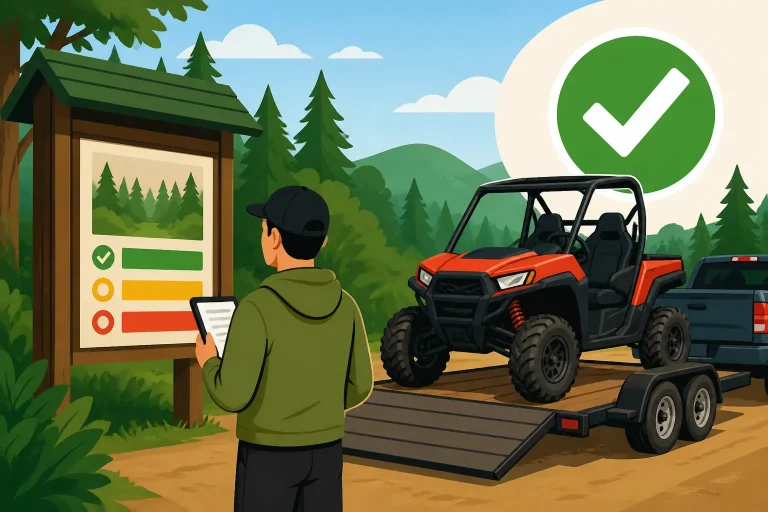
This distinction matters if you are planning a late-season ride. A pass described as a “season” pass does not necessarily mean it will cover every ride you want to take, or that it stays valid through some later date in January. Check the printed date before you load your machine, especially if your trip is close to the season’s closing period.
| What to check | What it tells you |
|---|---|
| Brown Mountain season dates | The Forest Service lists the use season as April 1 to January 1. |
| Expiration date on your pass | The Forest Service says the pass is valid until midnight on the date written on it. |
| Pass type and vehicle coverage | Confirm that the pass applies to the Brown Mountain OHV area and the vehicle you plan to ride. |
| Current trail status | Check for closures or other changes before driving to the trailhead. |
A season pass is different from a promise that every trail will be open on every day within the listed season. Trail conditions, closures, and other operating notices can affect where you can ride. Check North Carolina Trail Closures to Check before setting out, and use North Carolina Forest OHV Permits for a broader look at how Forest Service permits work across the state.
Buying and carrying the right pass
The Forest Service requires a valid pass for the specific OHV area where you are riding. A pass for a different riding area should not be treated as a substitute for a Brown Mountain pass. The Forest Service says passes for OHV riding in North Carolina’s national forests are sold through Recreation.gov; confirm the current purchase process and the pass details before you leave.
Brown Mountain’s listed day-use fee is $5 per vehicle per day, and its season vehicle pass is $30 per vehicle per season, according to the Forest Service as of November 2026. Fees and purchase arrangements can change, so check the official information before buying rather than relying on an old receipt, saved screenshot, or details from a past trip.
Pay attention to the vehicle wording. The Forest Service describes the season pass as being per vehicle, so do not assume a single pass covers every machine in a group. Confirm what you need for each vehicle and whether the pass you are buying is for the intended area and period. For general purchasing details, see Where to Buy a North Carolina OHV Permit.
Once you have a pass, keep it with you on the trail. The Forest Service says trail riders must carry a valid pass while riding and have a state driver’s license available to show during a law-enforcement compliance check. Carrying the pass is a separate practical step from buying it: a record of payment alone may not be enough to satisfy the requirement to have the valid pass with you.
A simple pre-trip check can prevent avoidable problems:
- Confirm the pass is specifically valid for Brown Mountain.
- Check the pass’s printed expiration date and compare it with your ride date.
- Confirm how many vehicles the pass covers.
- Carry the pass and have your state driver’s license available.
- Check the Forest Service’s current notices for closures or changes before leaving.
If you are visiting from outside North Carolina, do not assume that another state’s registration or permit automatically replaces a local forest pass. Requirements can differ by riding area. North Carolina Rules for a Visiting Rider covers the broader question of what visiting riders should verify.
Planning a ride before the season ends
Brown Mountain offers 34 miles of designated trails, according to the Forest Service. That is enough trail mileage to make a little planning worthwhile, especially if you are riding near the beginning or end of the operating season. Check a current forest map and trail notices before choosing your route; North Carolina Forest Trail Maps can help you prepare.
Not every trail has the same character. The Forest Service lists the Daniel Off Highway Vehicle Trail as 2.1 miles long and rated Extremely Difficult. It is marked with orange diamond markers and identified as TR390. That rating is a useful warning for riders who are choosing a route based on their machine, experience, and group—not just the total mileage they hope to cover.
The Forest Service also lists Dutch John Trail as 2.1 miles long and rated Difficult. It is marked with orange diamond markers and identified as TR90. The differences between a trail’s rating and a pass’s validity are important: having the correct pass allows you to use the area, but it does not mean every route is appropriate for every rider or machine.
Before you go, consider:
- The date of your ride. A trip close to January 1 deserves an especially careful check of the pass expiration date and current operating notices.
- The route’s difficulty. Choose trails that match the capabilities of your vehicle and the experience of your group.
- The day’s available time. Allow room for stops, slower sections, and a change of plan if trail conditions are not suitable.
- The trip home. Make sure your vehicle and trailer are ready before you head out, rather than counting on roadside or trail assistance.
- Conditions and closures. Trail status can change, so verify it close to departure.
For a more detailed day-planning approach, see Riding Brown Mountain for a Day. The aim is not to cover as much ground as possible; it is to choose a route your group can ride safely and finish with enough time to return.
Rules to remember on the trail
The pass is only one part of preparing for Brown Mountain. Forest Service rules also apply to how you ride, what your machine carries, and the equipment it must have. Riders must stay on designated trails; driving off trail is prohibited. Follow the marked route rather than taking an informal shortcut or treating an unmarked path as an approved connection.
The Forest Service requires ATV and motorcycle operators and passengers to wear helmets and eye protection that meet U.S. Department of Transportation motorcycle safety standards. It also requires a working spark-arresting device on internal or external combustion engines. Before setting out, check that required equipment is present and functioning, rather than waiting until a trailhead inspection or mechanical problem brings it to your attention.
Passenger rules depend on the vehicle. The Forest Service does not allow an OHV operator to carry passengers unless the manufacturer specifically designed the vehicle for that purpose. A seat or a place where someone can physically sit does not by itself establish that the machine is intended to carry a passenger. Check the manufacturer’s configuration and follow the applicable rule.
The Forest Service also says children under 16 must be under continuous visual supervision by an adult over 18. This is a close-supervision requirement, not a reason to let a young rider travel out of sight and assume they will meet the rule by regrouping later. Keep the adult able to see the young rider while operating.
Finally, ATVs cannot be registered in North Carolina and are not allowed on Forest Service roads, according to the Forest Service. Plan to trailer the ATV to the trailhead instead of riding it along a forest road to reach the trail. This point is easy to overlook when loading up, but a trail permit does not make an ATV legal on a road where it is otherwise prohibited.
A quick equipment and compliance check before loading can include:
- The correct Brown Mountain pass for your ride date.
- The pass with you while riding, plus a state driver’s license available for a compliance check.
- A compliant helmet and eye protection for each ATV or motorcycle operator and passenger.
- A working spark arrester, along with required mufflers and brakes.
- A passenger setup allowed by the vehicle manufacturer.
- A planned route that stays on designated trails.
The best way to avoid a last-minute permit problem is to treat the date on the pass as the controlling deadline and verify it before your trip. Brown Mountain’s season runs to January 1, but the Forest Service says each pass remains valid only until midnight on the date printed on it. Confirm that date, carry the pass, and check current trail information before you ride.
Sources
- Forest Service — National Forests in North Carolina | Off-Highway Vehicles (OHV) | Forest Service (checked November 3, 2026)
- OSFM — ATV Safety | OSFM (checked November 3, 2026)
- Forest Service — National Forests in North Carolina | Black Swamp OHV Trailhead | Forest Service (checked November 3, 2026)
- Forest Service — National Forests in North Carolina | Brown Mountain OHV Trail System | Forest Service (checked November 3, 2026)
- Forest Service — National Forests in North Carolina | Daniel OHV Trail | Forest Service (checked November 3, 2026)
- USDA Forest Service — National Forests in North Carolina | Dutch John OHV Trail | Forest Service (checked November 3, 2026)
- Forest Service — National Forests in North Carolina | Off-Highway Vehicles (OHV) | Forest Service (checked November 3, 2026)
- USDA Forest Service — National Forests in North Carolina | Off-Highway Vehicles (OHV) | Forest Service (checked November 3, 2026)
Disclaimer
This article is for general informational purposes only and does not constitute professional advice. Laws, prices and regulations vary by location and change over time. Consult a qualified professional for guidance on your specific situation.