Written Permission on Private Ground in North Carolina
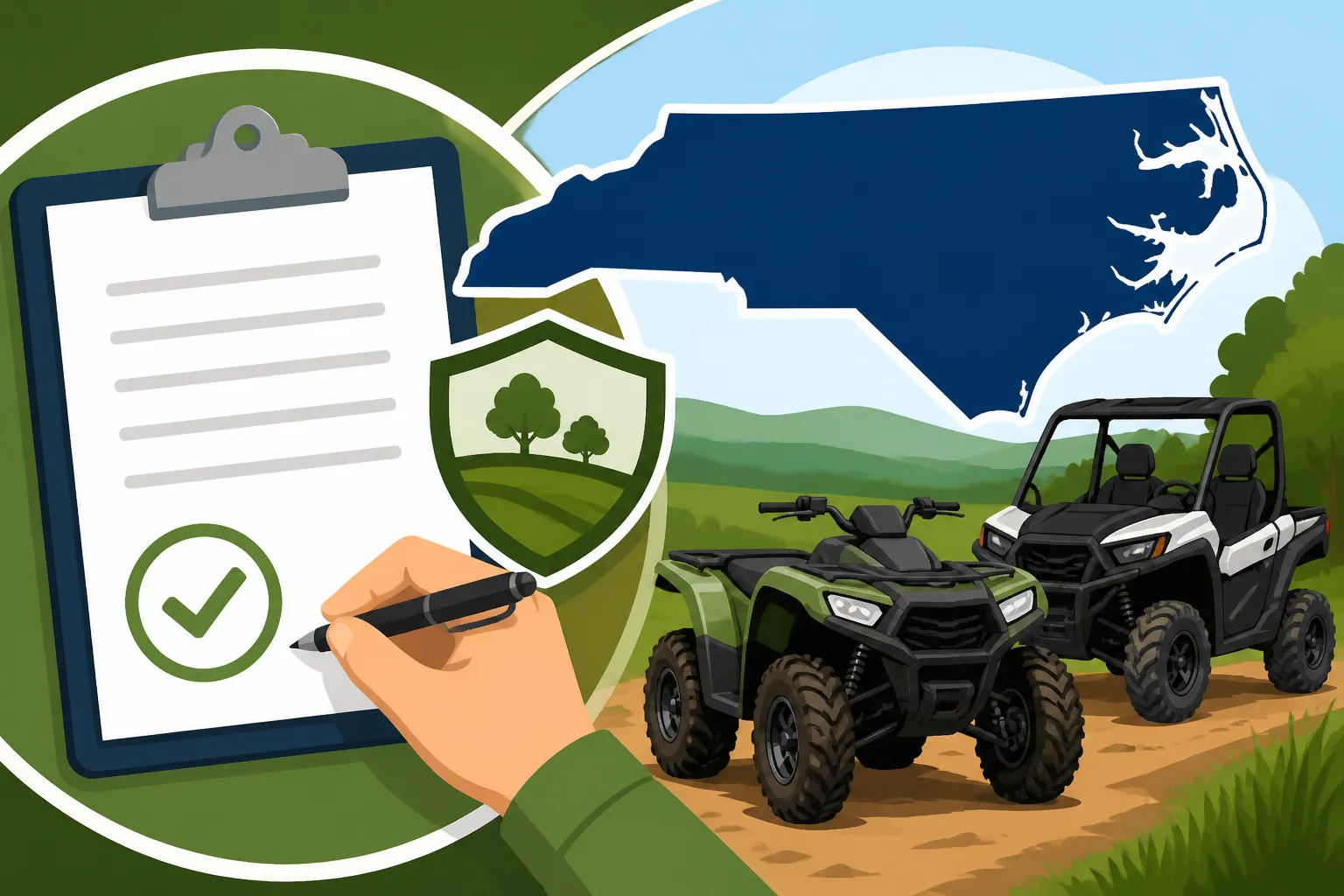
Permission to ride on private land in North Carolina can prevent a trespass dispute, but a casual “go ahead” may leave important details unclear. A written agreement helps identify who may ride, where and when they may go, and what limits apply. It does not replace a public-land permit or make a road-legal ride lawful.
What written permission does and does not do
If you plan to ride an ATV or UTV on someone else’s private ground, get clear approval from the person who has authority to grant access. A conversation may establish consent, but a written note, text, or email creates a record of what was agreed. That can help prevent misunderstandings about boundaries, dates, riders, vehicles, or permitted activities.
Permission is not a general license to ride anywhere nearby. A landowner might allow access to one field or trail while excluding a house, pasture, timber area, or neighboring parcel. Permission may also be limited to a particular group, time, route, or purpose. Treat those limits as part of the agreement, not as optional suggestions.
Written permission also has limits. It does not:
- Give you access to adjoining land or a public trail.
- Replace a permit required for an off-highway vehicle area or other managed land.
- Turn a private road into a public road, or make an ATV or UTV street legal.
- Cancel safety or operating rules that apply to your vehicle, age, or activity.
- Automatically cover guests, children, club members, employees, or anyone else not included in the agreement.
For a broader overview of riding on land that is not yours, see North Carolina Rules for Riding Private Land and North Carolina Landowner Permission Rules. The central point is simple: the landowner’s consent must match the place and activity you intend to use.
| Question | What to clarify in writing |
|---|---|
| Who is granting access? | Name the owner or the person authorized to approve riding |
| Who may ride? | List the riders, household, guests, or group covered |
| What land is included? | Describe the parcel, entrance, trails, or excluded areas |
| Which machines may be used? | Identify ATVs, UTVs, or other vehicles allowed |
| When is access allowed? | State dates, hours, season, and any notice requirement |
| What activities are allowed? | Specify riding, parking, unloading, camping, or other uses |
| What restrictions apply? | Note speed, noise, gates, passengers, fires, or trail limits |
| Can permission be withdrawn? | Confirm how the landowner will communicate a change |
How to make the permission specific and useful
A short written agreement does not need complicated legal language to be practical. It should answer the questions that could otherwise lead to a disagreement. Use ordinary wording, keep a copy accessible, and ask the landowner to confirm any important limits.
Identify the person and the land
Write down the name of the person granting permission and how they are connected to the property. If the person is a tenant, caretaker, farm manager, or leaseholder rather than the owner, confirm that they have authority to allow vehicle access. Do not assume that someone who can enter the property can also approve recreational riding.
Describe the authorized area as clearly as possible. A street address alone may not be enough for a large or irregular parcel. You can identify a specific driveway, field, marked trail, or entrance, and note areas that are off limits. If both parties agree, a simple map can help; label it with the date and make sure the boundaries are understandable. Avoid relying on a map that includes land the grantor does not control.
Be especially careful around shared driveways, farm lanes, utility corridors, creek crossings, and trails that appear to continue onto another property. A route crossing a boundary does not mean you have permission to cross it. For related concerns, see North Carolina Trespass Rules for Riders.
Name the riders and machines
Specify who is covered. “The family” or “our club” can be vague if the owner has not met every participant. A more useful agreement lists named riders or defines the group clearly, such as the named household and invited guests who receive the owner’s approval before arriving.
Identify the machines allowed, particularly if the property has restrictions on vehicle size, noise, or the number of riders. If a UTV has multiple seats, do not assume permission for the driver automatically includes every passenger. Ask whether passengers, children, or visitors may ride, and whether the owner expects adult supervision.
Include the purpose of access. Permission to cross a field to reach a work area may not include recreational riding, riding in circles, racing, or using a trail for repeated trips. Likewise, permission to ride may not include camping, hunting, fishing, target practice, or retrieving another person’s equipment. Make each activity explicit rather than treating one approval as permission for everything.
Set the dates, route, and conditions
State when access begins and ends, and whether the owner wants advance notice before each visit. If permission applies only during a particular season or on certain days, write that down. Seasonal conditions can change the land: a trail may be too soft after rain, a field may be planted, or livestock may be moved into an area.
Clarify entry, parking, and unloading. Identify where to park a truck and trailer, which gate to use, and whether gates must be closed or locked behind you. Ask where riders may stop and whether anyone may leave equipment on the property. Keep vehicles and trailers out of driveways, fields, or work areas that were not included in the permission.
List practical restrictions that matter to the owner. These may include staying on marked routes, keeping speeds low near buildings or animals, avoiding wet ground, not riding after dark, limiting noise, or leaving a gate as found. The landowner may also require riders to avoid certain weather conditions or to stop riding when asked. Do not treat silence as approval for an activity that was never discussed.
Keep a usable record
The permission can be recorded in a signed document, an email, or a text exchange, as long as the terms are clear and both sides can keep a copy. Include the date, names, property description, approved riders, time period, and restrictions. If the owner changes the terms, save the update and make sure every rider receives it.
Carry the agreement or a copy when practical, especially if a group includes people who do not know the landowner. A screenshot may be convenient, but it should show enough of the conversation to identify who gave permission and what they approved. A vague message such as “sure, come ride sometime” may not resolve a later disagreement about where, when, or who was allowed.
Private-land permission is not a public-land permit
The difference between private ground and managed public riding areas matters. Permission from a private landowner applies only to that land and only under the terms granted. It does not authorize you to continue onto a national forest trail, state-managed area, game land, or another parcel.
Managed riding areas can have their own permits, seasonal closures, equipment rules, and access conditions. Before heading to a public trail system, confirm its current requirements separately. See Do You Need a Permit for North Carolina Forest Trails? and North Carolina Forest OHV Permits for the distinct permit system that applies to certain forest trails. A private-land agreement is not a substitute for those requirements.
The reverse is also true: a forest permit or trail pass does not grant access across private land on the way to a trailhead. Check the route from your parking or staging point to the authorized riding area. If it crosses private property, get permission for that section too.
Likewise, permission to use a private lane does not make it a public road or make an off-road machine legal for ordinary street travel. An ATV or UTV may be subject to separate road-use restrictions, and a landowner cannot waive those rules. For a road-use overview, see Are ATVs Street Legal in North Carolina?. If the route involves a farm lane, public road, or road crossing, clarify the route and check the rules that apply to that specific use.
Private property does not necessarily mean every safety rule disappears. Requirements can depend on factors such as the rider’s age, the machine, and the activity. Permission from the owner addresses access; it does not grant an exemption from applicable state requirements. If children will ride, check North Carolina Rules for Riders Under 16 and North Carolina Rules for Riding Private Land rather than assuming the landowner’s approval settles every issue.
Common problems to prevent before the ride
The most frequent disputes begin with an assumption: that a friendly invitation covers the whole property, that a guest may bring additional riders, or that a trail remains open after the landowner’s plans change. A few checks before unloading can avoid an unpleasant conversation or a trespass allegation.
- Confirm the grantor’s authority. Ask whether the person approving access controls the land and can permit recreational vehicle use. If the property is leased or shared, make sure the right person has agreed.
- Confirm the exact route. Identify the entrance, authorized trails, turnaround points, and any boundaries. Do not follow tire tracks or an open gate onto land that has not been included.
- Confirm every rider is covered. Tell the owner how many people and machines will arrive. Do not bring additional guests without asking.
- Check for changed conditions. Before each visit, confirm that the route is still open and that no work, livestock, hunting activity, or weather condition has changed the plan.
- Follow the agreed restrictions. Stay on approved routes, respect speed and noise limits, and leave gates and property as requested.
- Stop when permission ends. If the owner revokes or narrows access, leave the affected area and do not return unless permission is renewed.
Permission does not settle every question about responsibility if someone is injured or property is damaged. Do not assume a written note waives liability or guarantees insurance coverage. If the ride involves a business, club, organized event, paid guide, or regular access by a large group, the landowner and organizer may need more formal arrangements than a brief personal message. Riders should also check whether their own insurance applies to off-road use; see North Carolina ATV Insurance Requirement for background on insurance questions.
A useful rule of thumb is to get approval before arriving, write down the boundaries and conditions, and ask again when the plan changes. That approach respects the landowner’s control and gives riders a clearer basis for knowing where they may go.
Disclaimer
This article is for general informational purposes only and does not constitute professional advice. Laws, prices and regulations vary by location and change over time. Consult a qualified professional for guidance on your specific situation.