North Carolina Rules for Riding a Parkway Crossing
A trail reaching the Blue Ridge Parkway can look like a simple place to cross, but a trail map or forest permit does not automatically authorize an ATV or UTV to enter Parkway property. The safe approach is to treat the crossing as closed unless signs or the responsible land manager confirm that it is specifically allowed, and never ride along the Parkway or its shoulder.
Can you cross the Blue Ridge Parkway on an ATV or UTV?
There is no blanket permission for ATVs or UTVs to cross the Blue Ridge Parkway in North Carolina. The Parkway is managed by the National Park Service, and its rules are separate from the rules that apply to nearby national forest roads and trails. A state-law exception that may allow an ATV to cross certain public roads does not, by itself, establish that a particular crossing of the Parkway is permitted.
That distinction matters because a route can pass through public land managed by one agency and meet a road or property managed by another. A forest OHV permit covers only the use it is issued for; it does not grant access to every road the trail encounters. Likewise, a line on a map does not prove that motorized crossing is authorized, open, or safe.
For practical planning, do not assume you may cross just because:
- A forest road or trail appears to meet the Parkway.
- Your machine has a permit for an adjacent riding area.
- Other riders have crossed at the same spot.
- There is no gate or barrier visible from where you are standing.
- The Parkway looks quiet enough to cross.
A marked crossing, posted restriction, gate, or official route notice is more meaningful than an apparent gap in the landscape. If the crossing is not clearly authorized, stop and find out before riding there. If you cannot confirm that it is allowed, turn around rather than entering the Parkway or its right-of-way.
| What you see | What it tells you | What to do |
|---|---|---|
| A trail map shows a route near the Parkway | The route may approach the Parkway, but the map alone may not establish crossing permission | Check the current map and the land manager’s guidance |
| A sign identifies an authorized crossing | The crossing may be permitted subject to posted conditions | Follow the sign and any limits on vehicle type or direction |
| A gate, closure notice, or “no motor vehicles” sign | Access is restricted at that location | Do not pass the restriction |
| No signs, gate, or clear route marking | Permission is uncertain, not automatically granted | Stop, verify with the responsible agency, or turn around |
| Your forest permit is valid nearby | It applies to the area and routes covered by that permit | Do not treat it as Parkway authorization |
For the general state-law rules that may apply when an ATV crosses a road, see North Carolina Rules for Crossing a Road. Parkway access still needs to be considered separately.
Why Parkway crossings are different from ordinary road crossings
A road crossing has two issues: whether state law allows the machine to cross a public road, and whether the land manager allows that route at that location. With a Parkway crossing, the second question cannot be skipped. The National Park Service manages the Parkway and its right-of-way, while nearby trails may be managed by a different agency or landowner.
North Carolina’s general ATV road rules do not make every crossing legal. They describe limited circumstances for crossing certain roads; they do not convert a road into an ATV route or override a closure. Even where a road crossing is allowed under state law, a rider still needs to know whether that specific road and crossing are open to that vehicle.
A Parkway is also not interchangeable with a nearby forest road. A forest road may be open to certain motor vehicles under land-management rules, while the Parkway’s roadway, shoulder, and adjoining property are subject to separate restrictions. A machine’s ability to travel on an adjacent trail does not establish permission to use a Parkway lane, shoulder, pullout, or roadside area.
This is why a forest permit and a Parkway crossing should be treated as separate questions. North Carolina forest OHV permits apply to designated riding areas and their rules. They do not serve as a general pass to cross federal property or ride a road outside the permitted system. For a broader explanation of where forest permits apply, see Do You Need a Permit for North Carolina Forest Trails? and North Carolina Forest OHV Permits.
A simple decision rule helps: if the exact crossing is not identified as open to your type of machine, do not use it until the responsible land manager confirms permission. Do not infer permission from a neighboring trail, from a prior trip, or from the absence of a barrier.
How to check a crossing before you ride
Make the crossing check part of trip planning, not a decision you leave until you reach the pavement. Parkway access points can be affected by closures, construction, storm damage, land-management boundaries, and restrictions that are not obvious from a general trail map.
- Identify the exact location. Use a current map to determine where the trail meets the Parkway. A nearby road junction or parking area may look similar on a small map, so note the specific trail, road, and crossing point.
- Check the map’s legend and route notes. Confirm what the map says about motorized use, vehicle types, and connections. A line showing a trail does not necessarily mean it is open to every ATV or UTV.
- Look for current notices. Check for closures or restrictions from the agency responsible for the trail and the National Park Service information for the Parkway. A map can be useful for planning but may not reflect a recent closure.
- Ask the responsible land manager if the status is unclear. Give them the trail name and the location of the proposed crossing. Ask specifically whether an ATV or UTV may cross there, not just whether the trail is open.
- Follow posted directions on site. Signs and gates may reflect a restriction or change that is not shown on the map you brought. If signs conflict with what you expected, obey the restriction and verify the route later.
The map and status check are useful even when the route is described as open. You still need to confirm that the opening applies to your machine and to the point where the route meets the Parkway. For additional trip-planning help, see North Carolina Forest Trail Maps and North Carolina Trail Closures to Check.
Pay attention to the boundary between the Parkway and surrounding public land. A route may be open up to that boundary but not beyond it. Similarly, a road that runs close to the Parkway is not necessarily a Parkway crossing. If the route leaves one managed area and enters another, each segment may have its own access rules.
If you are relying on a guidebook, an older map, or information from another rider, check it against current official information. Old directions can remain easy to find after a route changes or closes. The same is true of informal tracks saved on a phone: they can show where someone traveled without showing whether that travel was permitted.
What to do at the Parkway and what to avoid
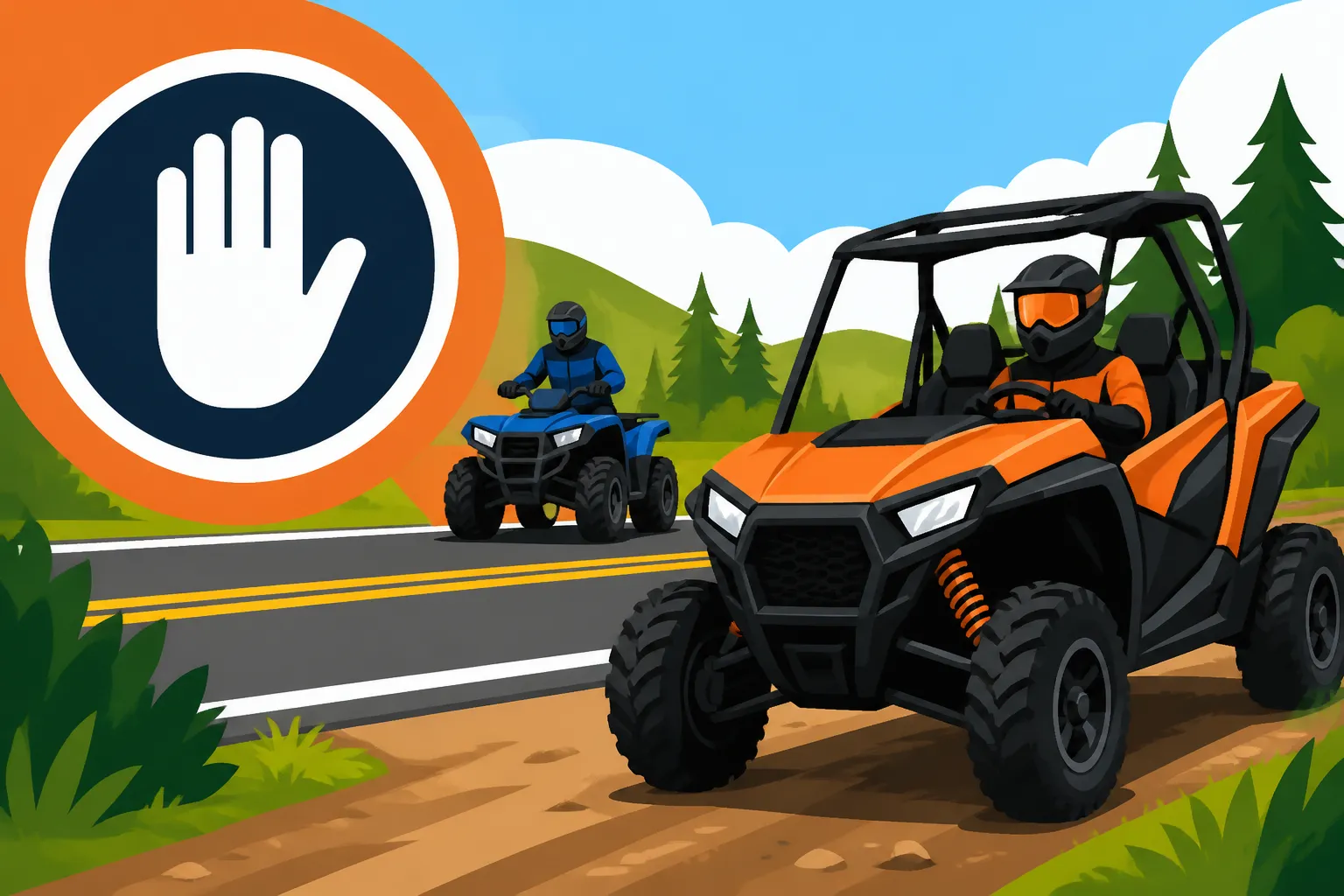
If you reach the Parkway and do not have clear confirmation that your crossing is authorized, stop before entering the road or right-of-way. Keep your machine on the permitted side of the boundary while you decide what to do. Do not ride onto the shoulder to look for a way through, and do not travel along the road to find another crossing.
If a crossing is clearly signed as open to your vehicle, follow the posted instructions exactly. Stop where directed, look for traffic, and cross only at the identified point. Do not linger on the roadway, ride parallel to traffic, or use a nearby pullout as a staging area unless it is expressly allowed. A sign authorizing one crossing does not authorize travel along the Parkway or entry onto other Parkway roads.
Do not treat the following as safe substitutes for confirmation:
- Crossing at a spot where the pavement seems easiest to reach.
- Following tire tracks or another rider’s route.
- Riding on a shoulder to reach a trail on the other side.
- Using a public vehicle entrance or visitor pullout as an ATV access route.
- Crossing around a closed gate or barrier.
- Assuming that a short distance on the road is harmless.
A machine that cannot legally travel on the Parkway does not gain permission to use it simply because the rider intends to cross and leave immediately. Nor does a permit for a nearby forest trail make an otherwise restricted road section available. For related rules about travel on public roads, see North Carolina Rules for Riding a Public Street and North Carolina Rules for Riding a Mountain Forest Road.
If a crossing is unavailable, plan a legal alternative before you set out. That might mean choosing a route that stays within one authorized riding area, arranging a legal trailer transfer, or changing the trip to avoid the Parkway boundary. Do not attempt to connect two trail systems by using a road segment that has not been approved for your machine.
Keep the permit question separate
Permits, access, and crossing permission are related but not interchangeable. A permit may be needed for a forest riding area, while an individual crossing can still be closed or restricted. A visitor’s permit or out-of-state registration does not change the status of a Parkway road. See Does North Carolina Honor Out-of-State Registration? for the separate question of out-of-state credentials.
The practical takeaway is straightforward: confirm the exact crossing, confirm that your type of machine is allowed, and follow posted directions. If any part is uncertain, do not cross. A short detour or revised route is preferable to entering a restricted area or riding beside Parkway traffic.
Disclaimer
This article is for general informational purposes only and does not constitute professional advice. Laws, prices and regulations vary by location and change over time. Consult a qualified professional for guidance on your specific situation.