Does North Carolina Honor Out-of-State Registration?
If your ATV or UTV is registered in another state, it’s natural to assume that paperwork travels with you. In North Carolina, it doesn’t work that way: the state has no general ATV registration system to recognize. What you need instead depends on where you plan to ride, including whether a trail permit or safety certificate applies.
Does North Carolina recognize an out-of-state ATV registration?
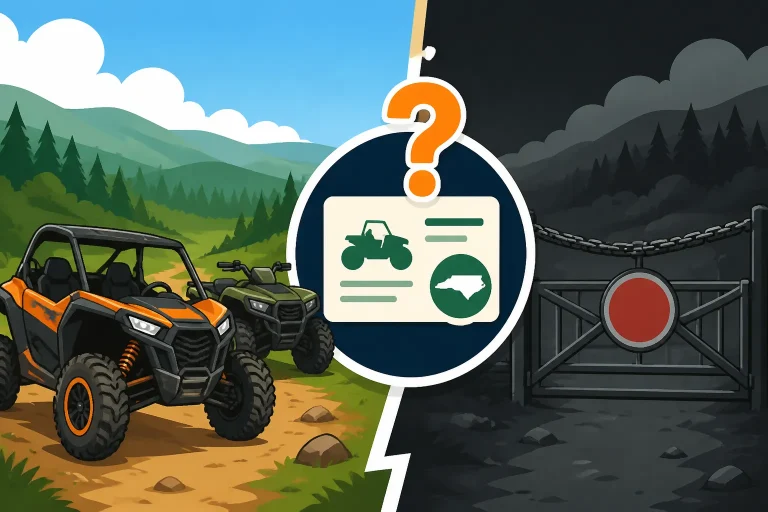
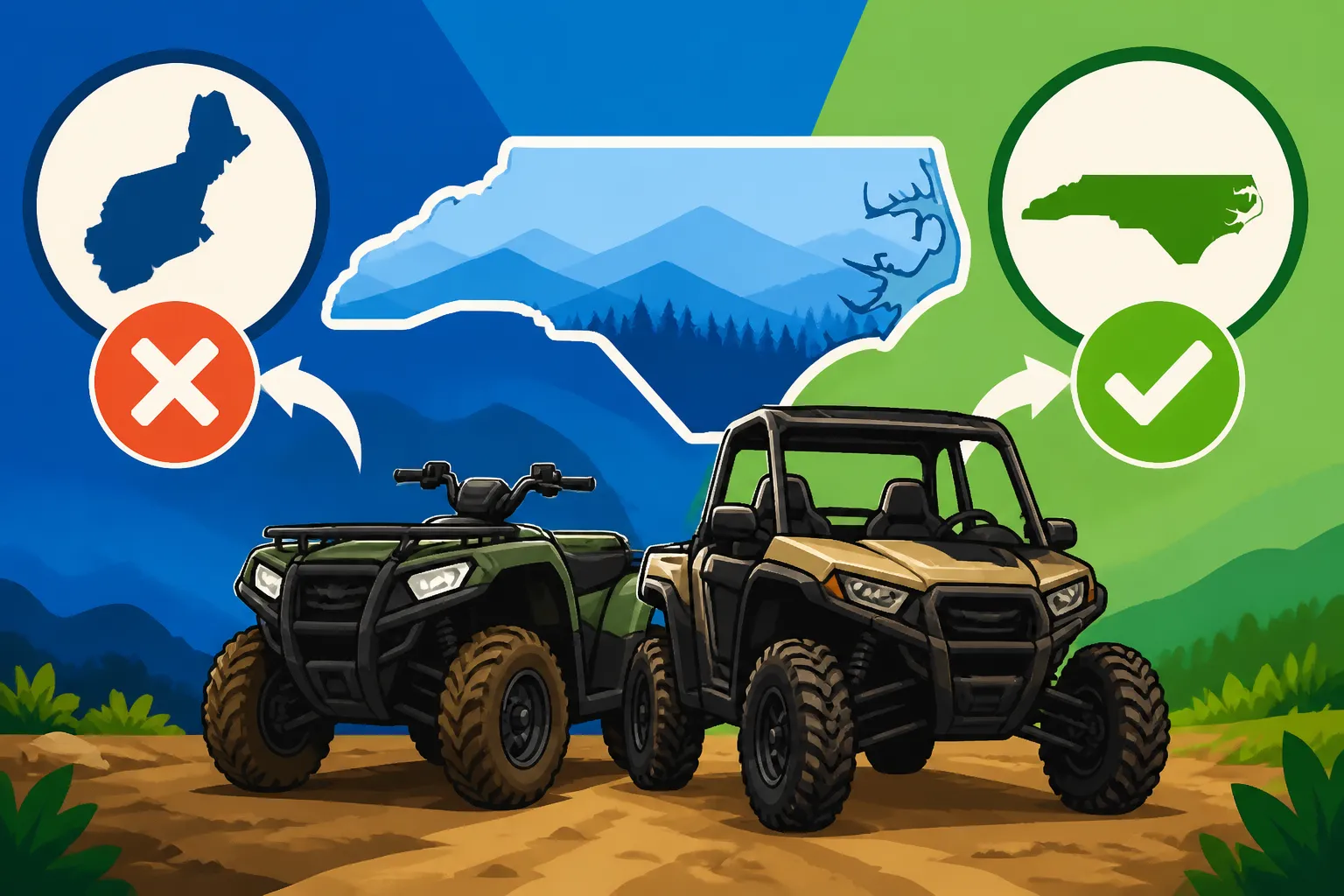
No. North Carolina does not have a general off-road ATV registration program, so it has no equivalent registration for visitors’ paperwork to substitute for. An out-of-state registration may document that your machine is registered where you live, but it does not serve as a North Carolina trail permit or make an ATV legal to ride on a North Carolina public road.
This is different from traveling between two states that both issue off-road vehicle registrations. In that situation, each state may have rules about accepting the other state’s registration. North Carolina’s system is not based on reciprocity: its off-road requirements apply whether your machine is from North Carolina or somewhere else. The practical explanation is covered in Why North Carolina Has Nothing to Reciprocate.
| What you bring or need | What it does in North Carolina |
|---|---|
| Out-of-state ATV registration | Does not replace a North Carolina forest or trail permit |
| North Carolina forest OHV permit, when required | Covers the applicable permitted riding area and vehicle, subject to local rules |
| Required safety-course certificate | Applies to riders who meet North Carolina’s birth-year rule; out-of-state registration does not replace it |
| Title or bill of sale | May help establish ownership, but is not a riding permit |
| Road registration for another vehicle type | Does not automatically make an ATV street legal in North Carolina |
The distinction matters because “registration” can mean different things. In some states, it refers to a state-issued decal or document for off-road use. In North Carolina, you should not assume that a comparable document from home provides access to designated riding areas. Nor should you assume that North Carolina’s lack of general ATV registration means you can ride anywhere without other requirements.
If you are bringing a machine from another state, the visitor-specific rules are summarized in [North Carolina Rules for a Visiting Rider]. For ownership documents and state title questions, see Nonresident Machines in North Carolina. Those issues are separate from permission to ride.
What to check before riding a North Carolina trail
Start with the exact place you plan to ride. North Carolina forest OHV areas can require a permit, and the permit rules are tied to the riding area rather than to whether your machine is registered in another state. A permit for one area should not be assumed to cover another, and a registration card from home does not take its place.
The rules can differ by location, season, permit type, and machine. For example, the permit system for a designated OHV area may offer day-use and season options, with separate conditions for the area. Confirm the current requirements for your destination before traveling. North Carolina Forest OHV Permits explains the broader permit system, and Do You Need a Permit for North Carolina Forest Trails? can help you determine when one applies.
Before you leave, check:
- Whether the route is open to your type of machine. Not every forest road, trail, or public-land route is open to ATVs or UTVs. Follow posted signs and the current area map.
- Whether a permit is required. Confirm the permit type, where it is valid, and whether each machine in your group needs its own.
- Whether the permit must be displayed or carried. Follow the instructions for that area. Do not rely on a photo of your home-state registration as proof of a local permit.
- Whether there are seasonal closures or temporary notices. Weather, maintenance, or other conditions can change access. Check the relevant official notice before loading the trailer.
- Whether your rider needs a safety certificate. North Carolina has a birth-year-based requirement for certain riders using public land. A registration document does not satisfy it.
- Whether your machine meets the area’s operating rules. Width limits, equipment requirements, and trail restrictions may apply even if the machine is registered elsewhere.
Keep the paperwork separate in your mind: an out-of-state registration relates to your home state’s system; a North Carolina forest permit relates to access at a particular riding area; and a safety certificate relates to the rider. One document does not automatically cover the others.
A permit also does not grant general access to every public property. State parks, game lands, private property, and designated forest OHV areas can each have different rules. Confirm that the specific route is open to the specific kind of machine you are bringing.
Does an out-of-state safety certificate count?
Do not assume it does. North Carolina’s safety-certificate requirement is separate from vehicle registration, and the state does not simply treat an out-of-state registration as proof that a rider has met it. Riders who fall under the state’s birth-year rule should check what course and proof North Carolina accepts before heading to a public riding area.
The age or birth-year rule is about the rider, not where the ATV is registered. A visitor can bring a properly registered machine and still need to meet North Carolina’s rider requirements. Conversely, a rider who does not fall under the requirement does not need a certificate just because the machine came from another state. See North Carolina ATV Safety Certificate Requirements for the certificate rules and Does North Carolina Accept an Out-of-State Certificate? for the reciprocity question.
If the certificate applies to you, carry acceptable proof while riding. Having completed a course is not as helpful at a trailhead or during a check if you cannot show the required documentation. Confirm the accepted course and proof requirements with the relevant official authority rather than relying on a card or online record from another state without checking.
It is also useful to distinguish a safety certificate from a permit. A certificate shows that a rider met a training requirement; it does not purchase access to a riding area. A forest permit, where required, applies to the machine and area under that permit’s terms. You may need both, depending on the rider and destination.
Does out-of-state registration let an ATV use North Carolina roads?
No. Registration in your home state does not make an ordinary ATV or UTV street legal in North Carolina. A public-road exception or a separate vehicle classification has its own requirements, and an out-of-state registration does not override them.
North Carolina has a specific route for a qualifying modified utility vehicle, or MUV, but a standard ATV or side-by-side should not be treated as an MUV just because another state has issued it road-related paperwork. The machine must meet North Carolina’s classification and equipment rules, and any required registration and insurance obligations are separate from off-road forest access. For the distinction, see North Carolina’s Modified Utility Vehicle Route and North Carolina Rules for Riding a Public Street.
Even when a route allows an ATV to cross a road under limited conditions, that is not permission to travel along the road as though the machine were a registered passenger vehicle. A permit for an off-road area does not change road rules either. Before using a public road, check the precise rule for the road and the machine; do not rely on a registration sticker issued elsewhere.
For a visiting rider, the safest way to think about North Carolina is that each requirement stands on its own:
- Your home-state registration does not replace a North Carolina OHV permit.
- A North Carolina OHV permit does not make a machine street legal.
- A safety certificate does not authorize access to a closed trail.
- A title or bill of sale does not grant permission to ride on public or private land.
Confirm the current rules with the official authority responsible for the place you intend to ride, and check any road-use question separately. That small bit of planning can prevent a valid home-state document from being mistaken for permission it does not provide.
Disclaimer
This article is for general informational purposes only and does not constitute professional advice. Laws, prices and regulations vary by location and change over time. Consult a qualified professional for guidance on your specific situation.