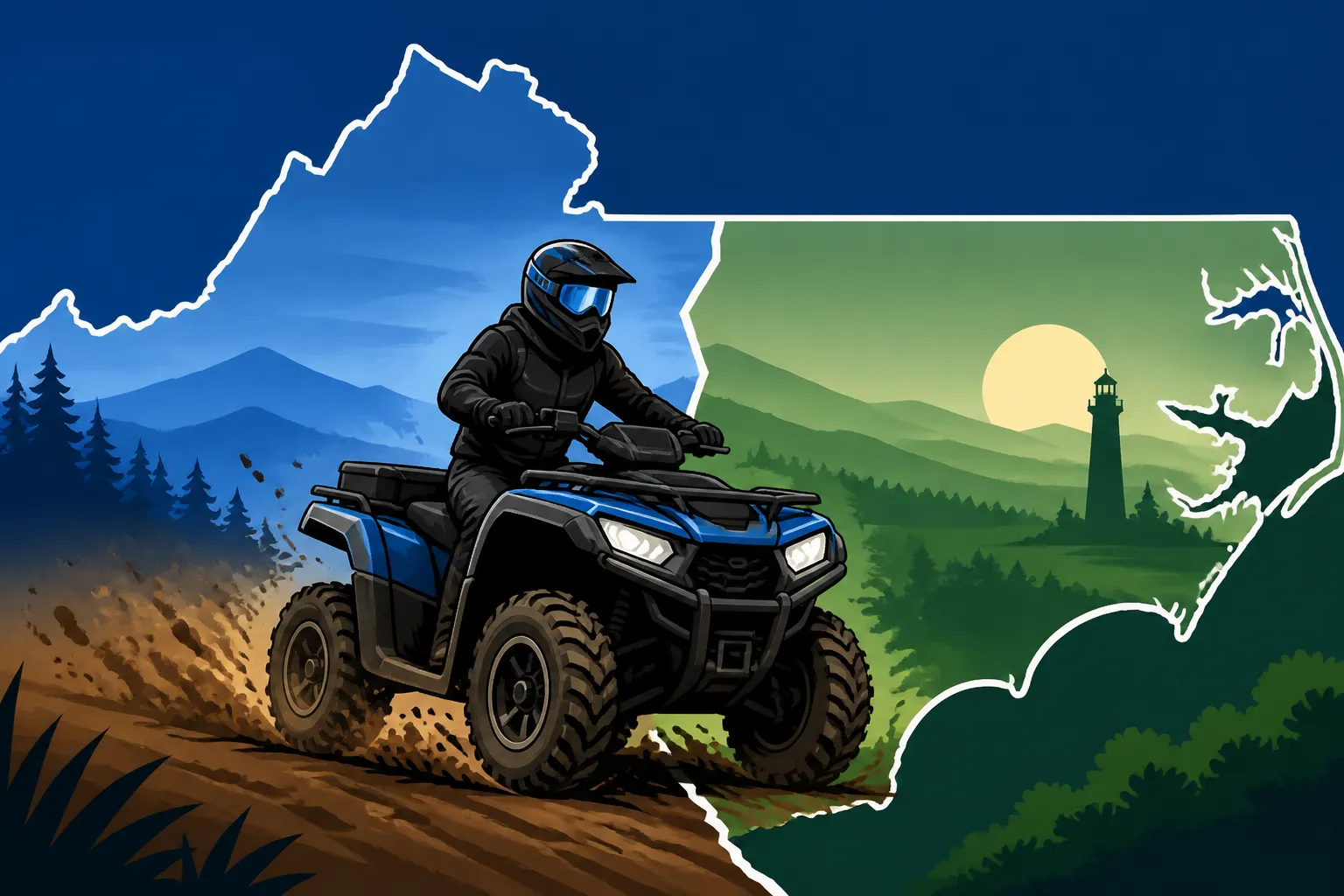
A Virginia Rider Crossing Into North Carolina
A Virginia rider can cross into North Carolina with the same ATV or UTV, but a Virginia registration or other state paperwork does not automatically cover every North Carolina riding requirement. The key is to separate vehicle documents from trail permits and rider qualifications, then check the rules for the specific place you plan to ride.
What changes when you cross into North Carolina
North Carolina does not use a statewide ATV registration system like some states. That means there is generally no North Carolina registration for a Virginia registration to substitute for, and your Virginia paperwork does not automatically serve as a North Carolina trail permit. For the distinction, see Does North Carolina Honor Out-of-State Registration? and Why North Carolina Has Nothing to Reciprocate.
A machine’s title, registration, trail permit, and rider safety certificate are different things:
| Item | What it is for | Does Virginia paperwork replace it in North Carolina? |
|---|---|---|
| Title or ownership documents | Helps establish who owns the machine | No. Keep your ownership documents available, but they are not a trail permit. |
| Virginia registration or decal | Follows the requirements of the state that issued it | It does not automatically satisfy North Carolina trail rules. |
| North Carolina OHV permit | Provides access where a designated riding area requires one | No. Check the specific trail system’s current requirements. |
| Safety certificate | Shows that a rider meets an applicable training requirement | Do not assume an out-of-state card qualifies; verify acceptance and carry proof. |
| Road registration and equipment | Relates to operating a vehicle on public roads | It does not make an ATV or UTV street legal in North Carolina. |
The practical takeaway is that you should not treat a Virginia plate, sticker, registration card, or trail pass as a universal permission to ride in North Carolina. A permit is tied to the place and activity it covers. A machine that is allowed on a private property or Virginia trail may still need a separate permit to use a North Carolina OHV trail.
Likewise, carrying a title or bill of sale can help document ownership, but it does not authorize riding on public land. If you bought the machine in Virginia and have not completed title paperwork, bring whatever ownership documents you have and check the requirements for your situation. Does a North Carolina Permit Work in Tennessee? explains the same general issue in the other direction: permits and requirements do not automatically travel across state lines.
Permits for North Carolina riding areas
North Carolina does not have one all-purpose OHV permit that grants access to every trail. Permit requirements depend on the riding area. Designated OHV trail systems may require a permit for each machine, even if the rider has a permit for another North Carolina system. A pass for one riding area is not necessarily valid at another.
Before leaving Virginia, identify the exact trail system and check its current rules, operating dates, permit instructions, and any closures. The permit process can differ by location, and access details can change. Start with Do You Need a Permit for North Carolina Forest Trails? and Where to Buy a North Carolina OHV Permit?, then confirm the information for the destination itself.
This matters at popular destinations such as Brown Mountain, Badin Lake, and Wayehutta. Do not assume that a permit purchased for one system covers another, or that a Virginia registration or riding-area pass is accepted instead. For system-specific planning, see Brown Mountain OHV Trail System, Badin Lake OHV Trail Complex, or Wayehutta OHV in Western North Carolina.
A permit may be needed even when the machine is already registered in Virginia. Conversely, having a North Carolina trail permit does not give you permission to ride wherever you choose. The permit applies only under the conditions set by the relevant riding area. Stay on trails open to your machine, follow posted signs, and do not use a closed trail or an unmarked route as a shortcut.
| Before the trip | What to verify |
|---|---|
| Destination | The exact trail system and its current open or closed status |
| Permit | Whether the site requires one, how it is issued, and whether it applies to each machine |
| Dates | The system’s current season or operating schedule |
| Machine | Any restrictions affecting vehicle type, width, equipment, or trail access |
| Rider | Whether a safety certificate or other proof is required |
| Payment and access | Where permits are sold and how the site handles arrival outside staffed hours |
Check close to your departure date, not only when you first plan the trip. Storm damage, maintenance, seasonal schedules, and other closures can affect access. A permit does not override a closure, and an old screenshot or a pass from a previous ride is not a reliable way to confirm current conditions.
If the destination is private land, the public-land permit rules may not apply, but you still need permission from the landowner and must follow any rules the property sets. Public roads are a separate issue. A Virginia registration does not make an ATV or UTV legal on North Carolina streets, and a forest trail permit is not road authorization. If your plan involves a road, check the relevant rules before riding or crossing it.
Safety certificates and documents for Virginia riders
North Carolina has a rider safety certificate requirement tied to birth year for certain ATV use on public land. The important point for visitors is not to assume that being licensed in Virginia, having ridden for years, or holding a Virginia-issued card automatically settles the North Carolina requirement. Check the current North Carolina rule and the destination’s requirements before the trip. North Carolina’s Birth-Year Safety Certificate explains the state’s birth-year rule and what riders should confirm.
If the requirement applies to you, carry proof while riding. Keeping the certificate in a secure place on your person or with your riding documents makes it easier to show if asked. Do not leave the only copy in a vehicle parked far from the trail. A photo may be useful as a backup, but do not rely on a phone image unless the applicable authority confirms it is accepted.
It is also sensible to carry ownership paperwork, especially if the machine was recently purchased or is being transported by someone other than its owner. Depending on the situation, that might include a title, bill of sale, or other documents that help explain who owns the machine. These documents are not a substitute for a permit or safety certificate, but can help answer questions about the vehicle.
Virginia registration documents can be worth bringing if they apply to your machine in Virginia. Just keep their role clear: they do not automatically grant access to a North Carolina trail. If the machine has a lien, a recent ownership transfer, or incomplete paperwork, resolve any questions before traveling rather than expecting a trailhead to settle them.
For a side-by-side, check machine-specific restrictions as well as the permit requirement. A trail system may limit the machines it accepts or impose equipment and width rules. A road-legal label or registration from another state does not guarantee the vehicle can use every North Carolina OHV trail. Check the destination’s instructions for your exact type of machine.
A practical checklist before crossing the state line
Use this sequence to avoid confusing registration with permission to ride:
- Choose the exact riding area. Confirm that it allows your type of ATV or UTV and identify the trails you intend to use.
- Check current access information. Look for closures, seasonal operating dates, storm notices, and any restrictions that apply to your machine.
- Confirm the permit rule. Find out whether the area requires a permit, whether it is issued per machine, and how to obtain it. Do not rely on a Virginia pass or registration as a substitute.
- Check the rider requirement. Review whether the North Carolina birth-year safety certificate rule applies to you and whether the site has additional requirements.
- Pack proof. Carry the required certificate and useful ownership documents. Keep them accessible and protected from water and damage.
- Plan the route to the trailhead. Transport the machine on a trailer unless you have confirmed that a particular road use is lawful. Trail access does not authorize public-road riding.
- Recheck before driving. Confirm that the gate or trail system remains open and that permit instructions have not changed.
If you are riding with a group, check every machine and rider individually. One person’s permit does not necessarily cover several vehicles, and one rider’s safety certificate does not satisfy another rider’s requirement. Make sure each machine is permitted for the destination and that each rider has any required proof.
A simple way to avoid a frustrating arrival is to keep two separate checks in mind: Does the rider meet the requirements? and Does this machine have permission to use this specific riding area? Virginia registration addresses neither question by itself. Once those checks are complete, it is much easier to plan a legal North Carolina ride without mistaking an ownership document for trail access.
Disclaimer
This article is for general informational purposes only and does not constitute professional advice. Laws, prices and regulations vary by location and change over time. Consult a qualified professional for guidance on your specific situation.