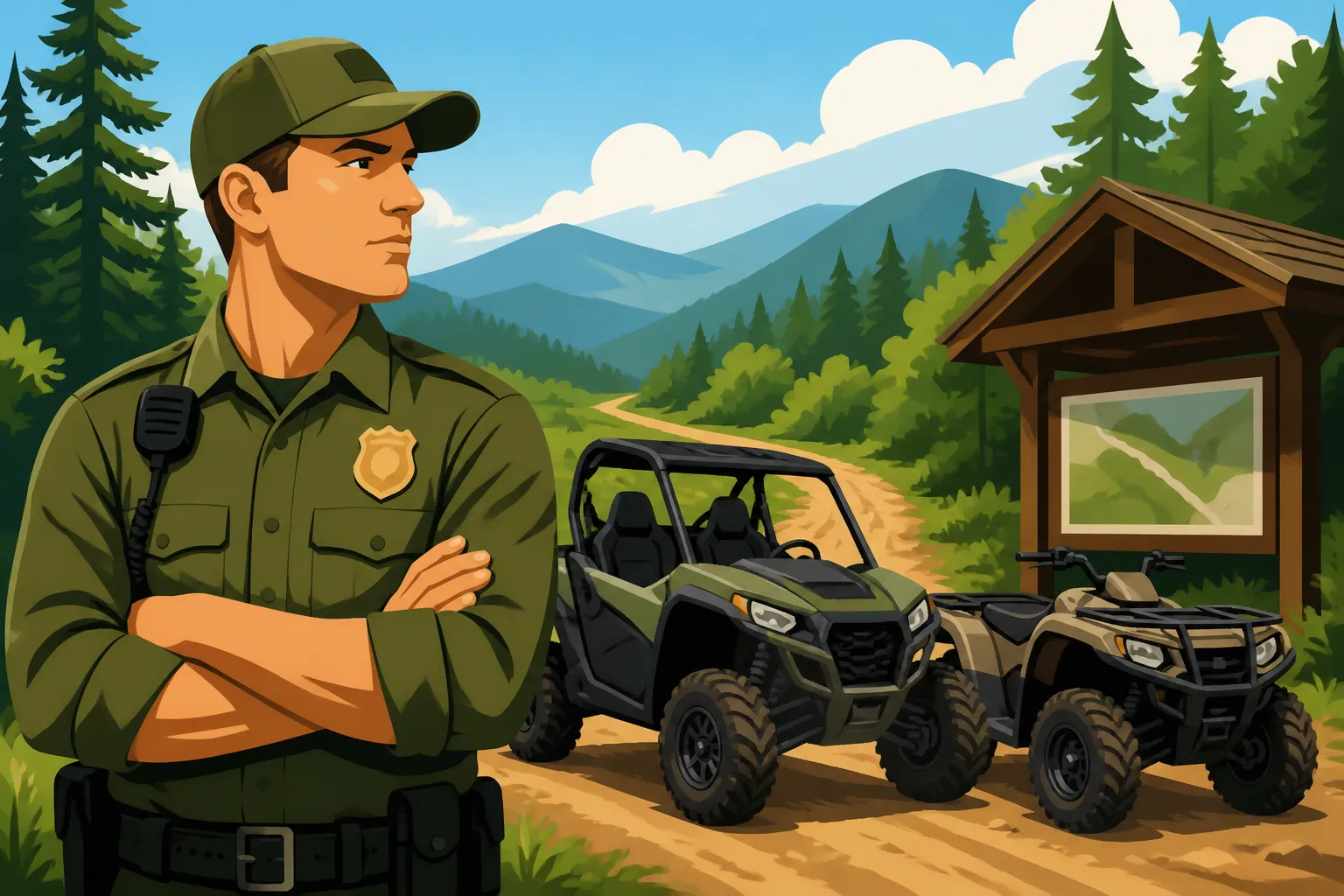
A Ranger at a North Carolina Trailhead
A stop at a North Carolina trailhead can raise practical questions: who is checking your machine, which documents matter, and whether an out-of-state registration counts. The answer depends on where you are riding and what applies to your vehicle and birth year. Here is what to have ready, how to handle a check, and what to confirm before leaving home.
Why a ranger may check riders at a North Carolina trailhead
On designated off-highway vehicle trails in North Carolina’s national forests, a ranger or other forest staff member may check whether riders are following the rules for that area. The purpose may be to verify a permit, check a required safety certificate, explain a closure, or address unsafe riding. A check can also be a quick request to show that your machine and group are permitted to use that trail.
A trailhead is a natural place for these checks. Riders often gather there before entering the trail system, and posted signs or gate notices may set out current access rules. A ranger might approach a parked machine, speak with the group as it unloads, or stop riders along a route. Checks are not necessarily conducted at every trailhead or on every ride, so do not treat a quiet entrance as proof that no permit or other requirement applies.
It also helps to distinguish forest access requirements from vehicle paperwork. North Carolina generally does not use ordinary ATV registration as the way to authorize riding on a national forest trail. A forest OHV permit is a separate access requirement, and an ATV title is not a trail permit. For the difference between a permit and other paperwork, see North Carolina Forest OHV Permits and Do You Need a Permit for North Carolina Forest Trails?.
A ranger may also be trying to prevent riders from entering a closed trail or an area where machines are not allowed. A valid permit does not give you permission to ride every road or track in a forest. Pay attention to the trail map, posted signs, gates, and any temporary notices. If an entrance is marked closed, do not assume you can ride through because you already bought a permit.
| What may come up at a check | What to have ready | What it does not prove |
|---|---|---|
| Forest OHV permit | The required permit for the specific riding area and machine | Permission to ride closed or unmarked routes |
| Safety certificate | The certificate, if the birth-year rule applies to you | That every other rider in the group meets the rule |
| Trail and closure information | A current map or notice for the area | That a route is open just because it appears on an older map |
| Out-of-state registration | Your state’s paperwork, if you have it | That North Carolina accepts it instead of a local forest permit |
| Machine identification | Information that helps identify your machine if asked | A substitute for a permit or safety certificate |
The exact requirements can depend on the forest, trail system, rider, and machine. Before your trip, review North Carolina Rules for a Visiting Rider and the current information for the specific riding area. A permit for one forest or trail system should not be assumed to cover another.
What to carry and how to prepare
Make it easy to show the documents that apply to your ride. Keep the forest permit where you can reach it without emptying a gear bag or leaving your machine unattended. Follow the instructions for how it must be displayed or carried; requirements can vary by permit type and riding area. For instance, a permit intended to be displayed on a machine may not be useful tucked away in a truck.
If a safety certificate applies to you, bring the card or other accepted proof rather than relying on a photo you have not confirmed will be accepted. North Carolina’s certificate rule is tied to a rider’s birth year, not simply to whether someone is a child or an adult. Check the applicable cutoff and accepted course requirements before the trip. The related details are covered in North Carolina ATV Safety Certificate Requirements and Carrying a Safety Card on a North Carolina Ride.
For a visiting rider, home-state registration is not a substitute for checking North Carolina’s requirements. North Carolina does not necessarily reciprocate another state’s registration or permit system for access to its forest trails. If you are crossing a state line, check Does North Carolina Honor Out-of-State Registration? and confirm what the particular North Carolina riding area requires.
A useful pre-ride check takes only a few minutes:
- Identify the forest and trail system you plan to ride. Do not rely on a general search result or an old trip note.
- Confirm the current permit requirement, how to obtain the permit, and how it must be displayed.
- Check whether anyone in the group needs a safety certificate, then pack the required proof.
- Review current trail openings, closures, and access restrictions before you load.
- Keep your documents accessible, and make sure each rider understands which rules apply to them.
Current conditions matter. Storm damage, maintenance, seasonal schedules, and other restrictions can affect access. A permit does not guarantee that a specific trail will be open on the day you arrive. Before driving, check Checking a Forest Notice Before You Load and any official notice for the relevant district or trail system.
If you are unsure whether a document on your phone will be accepted, ask the permit provider or the responsible forest office before traveling. A clear photo can help you keep a record, but it should not be treated as a replacement for an original card or displayed permit unless the current instructions say it is acceptable.
How to handle a ranger’s check
A check is usually easier when the group stays calm, listens, and answers the question being asked. Stop in a safe place if directed, keep the machine under control, and avoid crowding the ranger with several people talking at once. If you are riding in a group, one person can handle the conversation while others remain safely parked.
You can ask what the ranger needs to see if the request is unclear. For example, ask whether they are checking the permit, certificate, trail access, or a particular machine. Show the requested item without handing over extra personal documents unnecessarily. If you do not have something with you, be straightforward about that; do not claim that an out-of-state registration or a trail pass for another area meets a requirement unless you have confirmed that it does.
A practical response looks like this:
- Stop safely and follow directions.
- Ask politely what documentation or information is needed.
- Show the applicable permit or certificate, and answer questions about your group or route.
- Listen to any instruction about a closure, trail boundary, or equipment issue.
- If you disagree with a decision, ask how to obtain clarification or contest a citation later rather than arguing beside the trail.
A ranger may give directions or explain a rule; a law enforcement officer may have authority to enforce applicable laws and issue a citation. The person checking riders may not be able to resolve every question about a permit or a complicated ownership issue at the trailhead. If you need a definitive answer, note the agency or office involved and follow up through its official contact channel.
If you receive a citation, keep the paperwork and read it carefully. It should explain the next steps and any response deadlines. Do not assume that an informal discussion at the trailhead changes what the citation says. For questions about a particular penalty or how to respond, consult the issuing agency or a qualified professional.
Common misunderstandings about permits and checks
“I have a title, so I can ride.” A title can help establish ownership, but it is not authorization to ride a national forest OHV trail. Check the separate access rules for your destination.
“My state registration means I do not need a North Carolina permit.” Do not rely on that assumption. Home-state paperwork and a North Carolina forest permit serve different purposes, and another state’s registration may not satisfy local trail requirements.
“The ranger did not ask for a permit, so I do not need one.” A check may not happen on every visit. Requirements apply whether or not someone checks your group.
“The permit lets me use any forest road.” Permits do not open every road or trail. Some routes are closed to OHVs, restricted to other uses, or subject to temporary closures. Stay on routes where your machine is allowed.
“One permit covers all the machines in the group.” Permit rules may apply per vehicle. Verify the requirement for each machine rather than assuming a group purchase or one rider’s pass covers everyone. Why a Permit Is Per Vehicle in North Carolina explains why checking this detail matters.
“A ranger’s verbal answer overrides the posted closure.” If you receive an instruction that seems to conflict with a sign or map, ask for clarification before proceeding. Do not ride through a closed gate while trying to sort out the difference.
A smooth trailhead check starts before the trip: know which area you are visiting, confirm the permit and certificate requirements, and check for closures. If a ranger does stop your group, having the relevant items ready makes it easier to resolve the immediate question and get back to riding safely when the route is open.
Disclaimer
This article is for general informational purposes only and does not constitute professional advice. Laws, prices and regulations vary by location and change over time. Consult a qualified professional for guidance on your specific situation.