North Carolina Safety Certificate Birth Year Rule
North Carolina’s ATV safety certificate rule can be confusing because it depends on when a rider was born, not how old they are today. If you’re planning a ride, the key is knowing whether the cutoff applies to you, what proof to carry, and why a certificate does not replace a trail permit or other access requirements.
How North Carolina’s birth-year rule works
The rule applies to ATV riders born on or after January 1, 1990: they must complete an ATV safety course approved by the North Carolina Commissioner of Insurance before operating an ATV on public land. The cutoff is a birth date, not a minimum age. A rider born on December 31, 1989 falls on one side of the line; a rider born on January 1, 1990 falls on the other.
That distinction matters because two riders of the same age might have different obligations if their birthdays fall on opposite sides of the cutoff. Conversely, riders of very different ages may both be subject to the rule if they were born on or after the cutoff. Turning a certain age does not make the requirement disappear.
The requirement is about operating an ATV on public land. It is not a general state driver’s license rule, and it does not mean every person who owns or rides a machine on private property must hold a certificate under this specific rule. Private landowners can set their own conditions, and other safety or access rules may still apply. For more on the age cutoff and the course requirement, see North Carolina ATV Safety Certificate Requirements and Why the Certificate Binds by Birth Year.
| Rider’s birth date | Certificate under the birth-year rule | Practical takeaway |
|---|---|---|
| Before January 1, 1990 | Not required by this birth-year rule | Other riding rules and land-access conditions still apply |
| January 1, 1990 or later | Required to operate an ATV on public land | Complete an approved course and be prepared to show proof |
The date itself is easy to misread. The rule does not say “born after 1990” or “born in 1990 or later” in the ordinary calendar-year sense. The dividing line is January 1, 1990. A rider born at any point during 1990 is on the certificate-required side.
The rule also does not change based on whether the ATV belongs to the rider, a parent, a friend, or a rental company. It focuses on the person operating the machine. If a family is sharing an ATV, check each operator’s birth date and certificate status rather than assuming the owner’s paperwork covers everyone.
This requirement is separate from the rules that determine where a machine may be ridden. A safety certificate does not make a public road legal for ATV use, grant permission to use private property, or authorize riding on a closed trail. It addresses rider training, not machine registration or trail access.
What the certificate proves, and what it does not
The certificate is evidence that the rider completed an approved safety course. It is not the same thing as a driver’s license, an ATV title, a vehicle registration, or a forest permit. Treating these documents as interchangeable is a common source of confusion.
North Carolina generally does not register ATVs for ordinary off-road use in the same way it registers road vehicles. A title may be useful for proving ownership, but it does not function as permission to ride on a particular trail. If you are sorting out the difference between ownership paperwork and registration, Why North Carolina Has No ATV Registration and Do You Need a Title for an ATV in North Carolina? cover those separate questions.
A certificate also does not replace any required access permit. Some riding areas require a permit for each machine, while other locations have different access arrangements. The certificate belongs to the rider; the permit or pass is tied to the riding area and its rules. Before heading out, confirm what the specific forest or riding area requires. See Do You Need a Permit for North Carolina Forest Trails? for the distinction between training proof and trail access.
Nor does the certificate authorize a rider to operate every kind of off-road machine in every setting. North Carolina has separate rules for ATVs, modified utility vehicles, road use, equipment, passengers, and riders who are under 16. For example, a machine that might qualify for a road-use category has different requirements from an ATV being ridden off-road. A certificate does not satisfy those separate requirements.
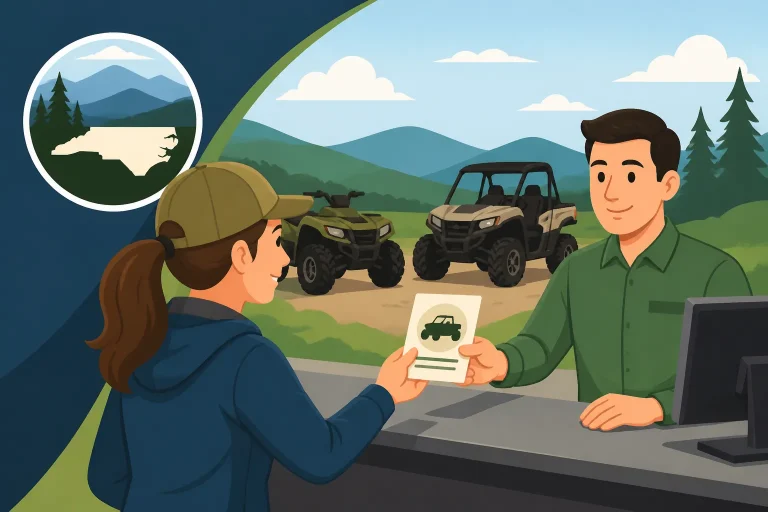
Keep the certificate available when you ride. A digital image may be convenient as a backup, but do not assume a photo will be accepted wherever proof is requested. Carry the original card or other official proof in a form you can present, and check with the relevant land manager if you are unsure what they accept. The practical advice in Carrying the Certificate on a North Carolina Ride is useful for keeping the document accessible without confusing it with a permit.
The certificate is best understood as one part of a ride-readiness check:
- Rider eligibility: Does the operator’s birth date put them under the certificate rule?
- Training proof: Has the operator completed a course that qualifies?
- Machine rules: Is the ATV permitted on the route, and does it meet applicable requirements?
- Access: Is the trail or property open to this type of machine?
- Area paperwork: Does the location require a permit, pass, or other documentation?
Each answer solves a different problem. Having the certificate addresses training proof, but it cannot make an otherwise closed or unauthorized route available.
Visitors, out-of-state cards, and family rides
Visitors should not assume that a certificate, registration, or riding credential from another state automatically satisfies North Carolina requirements. North Carolina does not have broad reciprocity that makes every out-of-state credential interchangeable with its own requirements. The important question is whether the course and certificate meet the applicable North Carolina standard, not simply whether another state issued a card.
If you already have an out-of-state certificate, check whether the course is approved for this purpose before relying on it. Course approval and acceptance can be more specific than a general claim that a class is “ATV safety training.” Ask the course provider or the appropriate North Carolina authority whether that exact course and proof meet the rule. Does North Carolina Accept an Out-of-State Certificate? explains why visitors should verify rather than presume acceptance.
Out-of-state machine registration is a separate issue. A registration decal from another state does not itself replace North Carolina’s safety-course requirement, and the safety certificate does not create registration or trail privileges. Likewise, a visiting rider may need an area-specific permit even when they have all the required training proof. For the broader visitor question, see Why North Carolina Has Nothing to Reciprocate and [North Carolina Rules for a Visiting Rider].
Families should check operators individually, especially when children or teens will take turns riding. One person’s certificate does not cover the other riders. A parent or adult supervising a young operator should also check the rules that apply to the rider’s age, supervision, helmet use, passengers, and the type of machine. A certificate is not a substitute for these protections.
For a family planning a public-land ride, a simple preparation process helps prevent a last-minute problem:
- List every person who may operate an ATV. Include anyone who might take the controls during the ride, not just the person who made the booking or owns the machine.
- Check each operator’s birth date against January 1, 1990. Do not use current age as a shortcut.
- Confirm the course and proof for each rider who falls on or after the cutoff. If a certificate is from outside North Carolina, verify that it meets the relevant requirement.
- Check the destination’s access rules. Confirm that the area is open and allows the type of machine you plan to ride.
- Confirm separate permits or passes. Do not assume a safety certificate includes trail access.
- Pack the documents where they can be shown. Keep rider training proof separate from machine ownership papers and area permits.
This process is especially useful when renting. A rental shop may have its own age, license, training, or supervision policies, and those can be stricter than the basic state requirement. A rental agreement or a machine provided by an outfitter does not automatically waive the rider’s obligations. Ask the business what it requires and separately check the rules for the destination.
Common mistakes and a pre-ride check
The most frequent mistake is treating the cutoff as an age threshold. It is not. A rider born before the date does not become subject to this particular requirement merely by getting older, and someone born on or after it does not avoid the rule because they are a minor or because an adult is nearby.
Another mistake is assuming that completing any ATV course is enough. The relevant issue is whether the course is approved for the North Carolina requirement and whether the rider has proof of completion. If the course provider cannot confirm approval, do not rely only on the course title or a generic completion email. Verify before making the trip.
Riders also sometimes treat the certificate as a universal riding pass. It is not. Public-land access may require a separate permit, and a permit does not prove course completion. A machine can be properly titled but still not be allowed on a particular trail; a rider can have a valid certificate but still be stopped from using a closed route. Check the destination’s current notices and rules before loading the ATV.
Finally, do not assume that private-property permission settles every question. Permission from a landowner is important, but it does not override safety rules that apply to the rider or machine. The rules for private land and public trails are not identical. For a separate look at that distinction, see North Carolina Rules for Riding Private Land.
Before departure, use this short check:
- Does every operator’s birth date fall before or on/after January 1, 1990?
- If required, does each operator have proof of a qualifying safety course?
- If a course was completed outside North Carolina, has its acceptance been verified?
- Is the destination open to the machine and type of riding planned?
- Are separate permits or passes required for the area?
- Are the riders following applicable age, supervision, helmet, passenger, and equipment rules?
If any answer is uncertain, resolve it before setting out. A few minutes spent checking the rider’s certificate, the machine’s paperwork, and the destination’s rules can prevent a wasted trip or an avoidable enforcement problem. The birth-year rule is straightforward once the cutoff is understood: determine the operator’s birth date, obtain approved training when required, and treat the certificate as only one part of lawful, prepared riding.
Disclaimer
This article is for general informational purposes only and does not constitute professional advice. Laws, prices and regulations vary by location and change over time. Consult a qualified professional for guidance on your specific situation.