Does North Carolina Accept an Out-of-State Certificate?
An out-of-state ATV safety card can be confusing: North Carolina does not simply exchange one state’s certificate for another’s. The key question is whether the course behind your card meets North Carolina’s approval requirement. Here’s how to check that, who needs proof, and what the certificate does not replace.
The short answer: course approval matters more than the state on your card
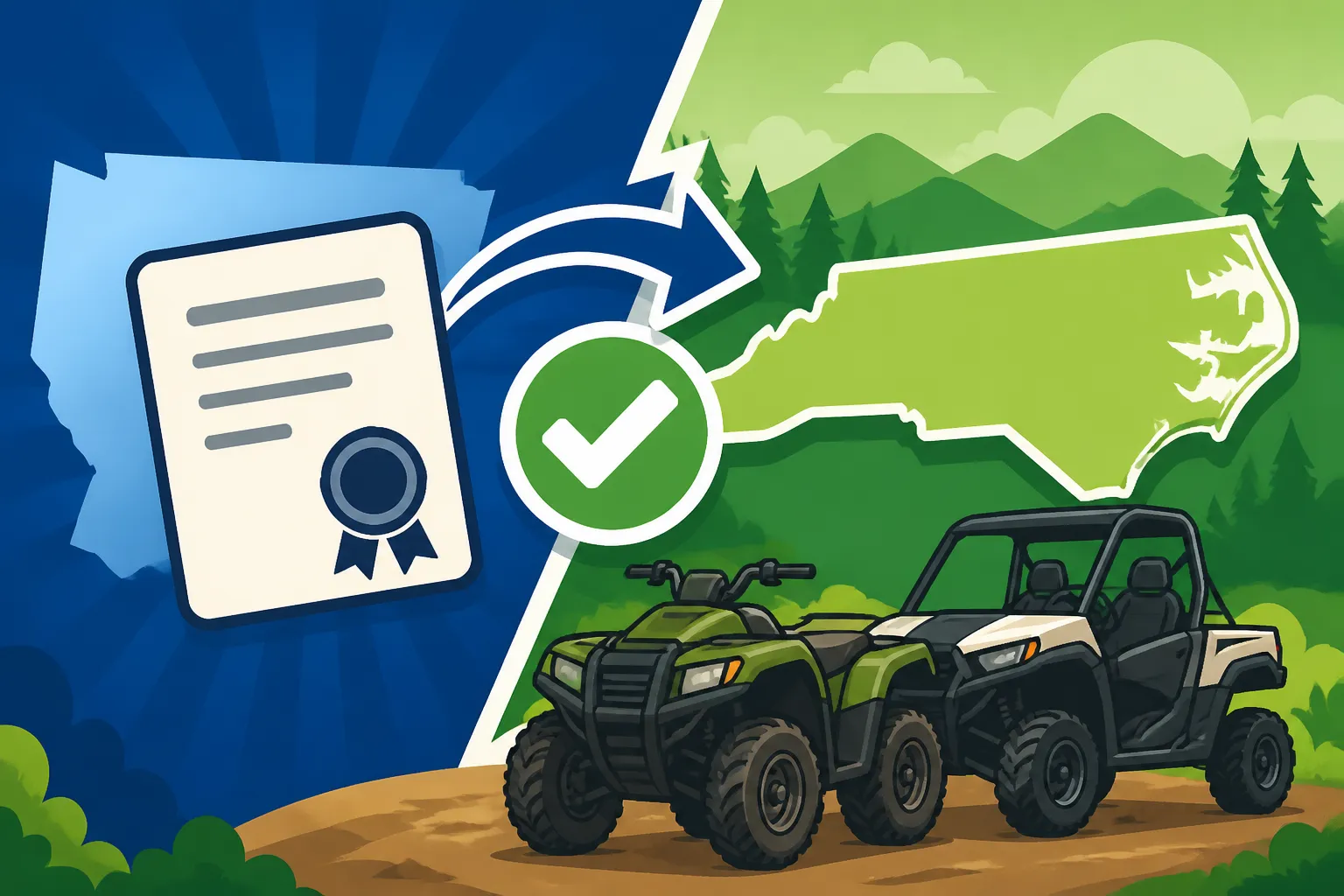
North Carolina’s rider-training requirement is tied to completing an ATV safety education course approved by the state’s Commissioner of Insurance. It is not simply a rule that every rider must take a course inside North Carolina or hold a card printed by North Carolina.
That means an out-of-state certificate may satisfy the requirement if it documents completion of a qualifying course. A certificate issued by another state is not automatically accepted just because it is official there, though. The course itself is what matters.
There is an important distinction between accepting a course and having reciprocity. Reciprocity would mean North Carolina automatically recognizes another jurisdiction’s credential. For this requirement, don’t assume that a different state’s card qualifies without checking the course approval. The broader issue is covered in Why North Carolina Has Nothing to Reciprocate.
North Carolina’s birth-year rule applies to riders born on or after January 1, 1990 who operate an ATV on public land where the requirement applies. A rider born before that date generally does not need the certificate under this specific rule, but may still need to follow other age, equipment, land-access, and permit requirements. See North Carolina Safety Certificate Birth Year Rule for more on the cutoff.
| Your situation | What to check |
|---|---|
| Your out-of-state card names a course | Confirm that the course is approved for North Carolina’s requirement |
| Your card shows only a state credential | Ask what course it represents and whether that course is approved |
| You were born before January 1, 1990 | The birth-year requirement generally does not apply, but other rules still may |
| You were born on or after January 1, 1990 | Check whether the riding location requires the approved course certificate |
| You are visiting North Carolina | Do not assume your home-state card, registration, or permit substitutes for North Carolina requirements |
The practical takeaway is to verify the course before your ride, not just the name of the state or agency printed on the card. If approval is unclear, contact the course provider or the North Carolina agency responsible for the requirement and ask whether that specific course qualifies. Keep the answer and your certificate available when you ride.
Who needs the certificate, and where the rule applies
The certificate requirement is not a universal rule for every ATV ride in every setting. The birth-year requirement concerns operating an ATV on public land. The term “public land” can cover places managed by different public agencies, and a particular riding area may add conditions of its own. Check the rules for the place you plan to ride as well as the statewide requirement.
A private property ride is different. The state’s public-land certificate rule may not apply simply because a rider is on an ATV, but the property owner or private park can still require training, a signed waiver, age limits, or other conditions. A private riding area can set access rules that are stricter than the minimum statewide rule.
Also keep ATV rules separate from rules for other vehicles and activities. The safety-certificate requirement discussed here is for ATV operation. If you plan to use a UTV, rent a machine, join an organized event, or ride on land with its own access program, confirm which requirements apply to that vehicle and location. [North Carolina Rules for a Visiting Rider] is useful for sorting out what applies to nonresident riders.
The certificate does not replace an area permit. Some public riding areas require a separate permit for each machine, even if the rider has completed an approved course. A permit can be tied to a particular forest, trail system, or season, while the safety certificate documents rider training. They serve different purposes.
Nor does the certificate authorize riding anywhere an ATV is otherwise prohibited. It does not make a closed trail open, grant permission to cross private land, or allow a machine onto roads where ATVs are not permitted. Review the rules for the destination before treating a valid card as proof that you can ride there.
For a broader overview of the training rule, see North Carolina ATV Safety Certificate Requirements. If you are traveling from another state, [North Carolina Rules for a Visiting Rider] can help you identify obligations that are separate from the certificate.
How to check whether an out-of-state course qualifies
Before relying on a card, identify the course it represents. A plastic card, digital record, or certificate from a state agency may not spell out the course approval clearly. Look for the course name, provider, completion date, and a way to verify the record.
Use this process:
-
Read the certificate carefully. Note the exact course title and the organization that provided or administered it. A generic statement that you completed “safety training” may not be enough to establish that it was an approved ATV course.
-
Ask the provider about North Carolina approval. Contact the course provider and ask whether the specific course you completed is approved for North Carolina’s ATV safety education requirement. Ask for confirmation in writing if the approval is not clear on the certificate.
-
Check with the relevant state agency if needed. If the provider cannot answer, ask the North Carolina agency responsible for the approval requirement whether that course qualifies. Give the exact course name and provider rather than asking only whether “out-of-state certificates” are accepted.
-
Keep proof with you. Carry the card or a readable digital copy while riding, and keep a backup of the course record somewhere accessible. A screenshot can be helpful, but do not assume every officer, land manager, or event organizer will accept a screenshot in place of the actual proof.
-
Confirm the riding area’s rules separately. Check whether the area requires a permit, has a minimum age, or imposes other conditions. Course approval does not settle those questions.
If the course is approved, the fact that you took it in another state is not, by itself, the reason to reject it. If the course is not approved, a card from a state agency may still fail to meet North Carolina’s requirement. That is why the approval status matters more than the issuing state.
If you cannot get a clear answer before the trip, the lower-risk option is to complete a course you can confirm is approved before riding in a place where the certificate is required. Avoid relying on assumptions such as “my state accepts it, so North Carolina must too” or “I have a card, so it has to count.” Which Safety Courses North Carolina Accepts explains the approval question in more detail.
What the certificate does not replace
A safety certificate proves training completion; it is not an all-purpose riding credential. Visitors often mix it up with registration, trail access permits, or age permissions. Those requirements can be independent of one another.
For example, a card from your home state does not automatically provide a North Carolina forest permit. North Carolina may require its own permit for a specific public riding area, and a permit for one area does not necessarily work at another. Check the current requirements for the trail system before traveling. North Carolina Forest OHV Permits explains how area permits differ from rider training.
Likewise, a certificate does not remove age restrictions. Riders under 16 have separate rules, including supervision requirements in some situations. A trained young rider is not automatically allowed to operate any machine anywhere. The rider’s age, the machine, and the location all matter; see North Carolina Rules for Riders Under 16.
A certificate also does not make an ATV street legal, satisfy vehicle equipment standards, or authorize a road crossing beyond what the law permits. If your trip includes public roads, check those rules independently rather than treating safety training as permission to ride on pavement.
For visiting riders, a useful pre-trip check is to confirm four separate things:
- Whether your birth year makes the safety certificate requirement apply.
- Whether the course behind your out-of-state certificate is approved.
- Whether the destination requires a separate permit or has its own access conditions.
- Whether your machine and riding plans comply with age, equipment, and land-use rules.
That approach avoids the most common mistake: treating one card as proof that every rule has been satisfied. If the course is approved, retain proof of completion. If it is not, or approval cannot be confirmed, resolve that before riding on land where the certificate is required.
Disclaimer
This article is for general informational purposes only and does not constitute professional advice. Laws, prices and regulations vary by location and change over time. Consult a qualified professional for guidance on your specific situation.