Does a North Carolina Safety Certificate Ever Expire?
A North Carolina ATV safety certificate does not usually come with a renewal date, so completing the course is generally a one-time step. The confusing part is knowing whether the rule applies to you, which courses count, and whether the certificate replaces a forest permit or other requirement. Here’s how to think about its validity and what to check before riding.
Does a North Carolina ATV safety certificate expire?
Generally, no. North Carolina’s safety-course requirement is based on when a rider was born, not on a certificate that must be renewed every few years. If you completed a qualifying course and received proof of completion, the certificate generally does not expire just because time has passed.
That does not mean every document labelled “safety certificate” automatically meets North Carolina’s requirement. The course must be one the state recognizes for this purpose. If you took a course outside North Carolina, or your document does not clearly identify the course and its provider, confirm that it qualifies before relying on it.
It also helps to separate the certificate’s validity from the documents needed for a particular ride. A safety certificate is evidence that you completed a course. It is not an ATV registration, ownership title, trail permit, or permission to ride on land. Those requirements can apply separately and may differ by riding area.
For the birth-year rule, the important date is January 1, 1990. Riders born on or after that date may need to complete an approved ATV safety course before operating an ATV in the circumstances covered by North Carolina’s rule. The certificate is not something they have to renew each year. Riders born before that date are generally outside that specific course requirement, though taking a course can still be useful.
If you are unsure whether your record qualifies, ask the course provider whether the course was approved for North Carolina’s requirement and whether it can reissue proof of completion. You can also check with the relevant state or land-management authority before your trip. A card from another state, an online training record, or a course-completion email may be perfectly useful, but the format alone does not establish that the course is accepted.
For a closer look at who the birth-year rule covers, see North Carolina ATV Safety Certificate Requirements and North Carolina Rules for Riders Born On or After 1990.
Who needs the certificate, and when does the rule apply?
The main dividing line is the rider’s birth date, not the ATV’s age, its engine size, or the year it was bought. A rider born on or after January 1, 1990 should check the safety-course requirement before riding an ATV in a setting where North Carolina’s rule applies. A rider born before that date is generally not required to complete the course under that particular birth-year rule.
The setting matters. The course requirement is associated with ATV operation on public land, so do not assume the rule works exactly the same way on every private property, public road, trail system, or managed forest. Rules for public riding areas can include additional conditions, and land managers may set requirements for access that are separate from statewide law.
A practical way to check is to answer three questions:
- When were you born? If it was on or after January 1, 1990, treat the course requirement as something to verify before riding an ATV on public land.
- What kind of machine are you riding? ATV and UTV definitions are not interchangeable in every rule. If you ride a side-by-side or another off-highway vehicle, check the specific requirements for that machine and the land you plan to use.
- Where will you ride? A private property owner, a public trail system, and a national forest can have different access rules. Confirm the requirements for the exact location rather than relying on what applied somewhere else.
The birth-year rule is not the only safety rule that can apply to younger riders. North Carolina has separate requirements and restrictions concerning age, supervision, protective equipment, and passengers. Completing a course does not waive those rules. A young rider may have a valid certificate and still need to meet age or supervision conditions before operating a machine.
That distinction is especially important for families. A parent may have a certificate, but it does not satisfy a child’s individual training requirement. Nor does supervising a young rider make an otherwise-required certificate unnecessary. Check the age and supervision rules as well as the course rule before taking a child onto a public riding area. The related guidance in [North Carolina Supervision Rules for Young Riders] and North Carolina Minimum Age to Ride an ATV can help clarify those separate questions.
The rule is tied to a rider, not a machine
A certificate belongs to the person who completed the course. It does not transfer when an ATV is sold, lent, or passed between family members. If several riders use the same machine, check each rider’s eligibility and course status individually.
Likewise, owning a titled or well-maintained ATV does not establish that its rider has completed a required course. The machine’s paperwork and the rider’s safety record answer different questions.
A UTV may need a separate check
People often use “ATV” as a catch-all for off-highway machines, but state rules may define ATVs and utility vehicles differently. A side-by-side’s size, seating, or classification can affect which requirements apply. Before assuming an ATV certificate settles the matter for a UTV, confirm the applicable rule with the land manager or responsible authority. For road use, an MUV classification is a separate issue from completing an ATV safety course.
Which courses and certificates count?
The key is not simply whether a course was called “ATV safety training.” It is whether the course satisfies North Carolina’s requirement. Look for clear proof identifying the rider, the course, the provider, and the completion status. If the certificate leaves out important details, keep any supporting records, such as a completion email or course account record.
If you are choosing a course, ask the provider these questions before paying or enrolling:
- Is this course accepted for North Carolina’s ATV safety-course requirement?
- Does it issue proof of completion that identifies the rider?
- How can a replacement certificate be requested if the original is lost?
- Does the course cover the type of machine you plan to ride?
- Is the course recognized for the land or riding program you intend to use?
Do not assume that a course qualifies simply because it is widely offered, has a familiar name, or provides a wallet card. The relevant question is whether it is approved or recognized for the North Carolina requirement. When in doubt, confirm acceptance with the appropriate authority before relying on it.
What if you took the course in another state?
An out-of-state card is not automatically accepted just because it came from a government agency, a riding organization, or a recognized training provider. At the same time, the state where you took the course does not, by itself, tell you whether the course is acceptable in North Carolina. Approval of the course is the issue to verify.
Gather the details before contacting anyone: the provider’s name, course title, date of completion, and a copy of the certificate. Ask whether that specific course meets North Carolina’s requirement. A clear answer about the course is more useful than a general assurance that another state’s cards are accepted.
This also applies to visitors. If you ride in more than one state, each state may set its own training rules. A certificate that satisfies one state’s requirements should not be treated as a universal ATV license. North Carolina’s rule is not necessarily the same as another state’s rule, and a visitor should check the North Carolina requirement rather than rely on local practice at home. See Does North Carolina Accept an Out-of-State Certificate? for more on that distinction.
What if you cannot find the original?
A lost card does not necessarily mean you must repeat the course. First, contact the provider that issued it. Many providers keep course records and can explain whether they can supply a replacement or confirm completion. If the provider is no longer available, collect any records you still have, such as a confirmation email, receipt, or account history, and ask the relevant authority what evidence it will accept.
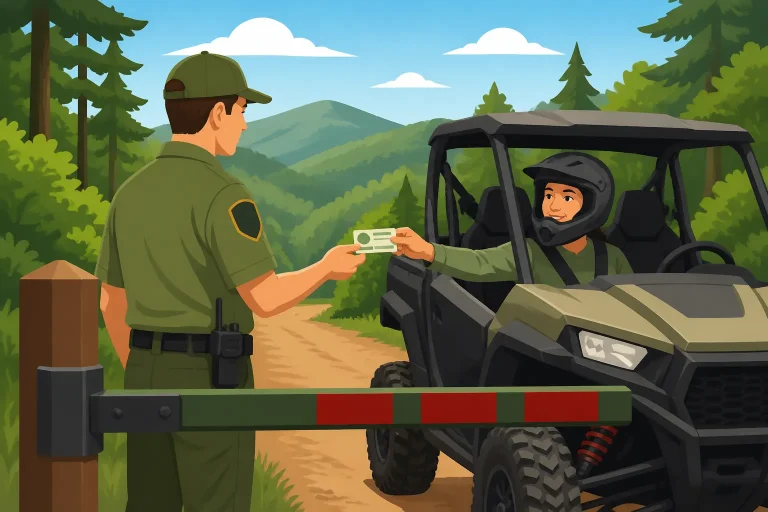
Avoid relying only on a photo of a card unless the agency or land manager confirms that it is acceptable. A digital copy can be convenient, but an officer or trail administrator may ask for specific proof. If you have time before riding, resolve that question in advance rather than discovering at the trailhead that your record is incomplete.
How should you carry and prove your certificate?
Keep your certificate or other accepted proof somewhere you can retrieve it during a ride. If the card is small, a secure wallet or document sleeve can help protect it from water, mud, and wear. A digital copy stored on your phone may serve as a useful backup, but do not assume it replaces the original or another required form of proof unless the relevant authority says so.
A sensible preparation routine is:
- Check the original document. Make sure the name is readable and the course and provider are identifiable.
- Save a backup. Keep a photo or scan in a secure place, and retain any provider email or account record.
- Confirm what the riding area accepts. Ask whether a physical certificate, digital record, or another form of proof is sufficient.
- Carry the proof when required. If the rules or land manager expect you to show it, have it available during the ride rather than stored at home.
- Replace a damaged or missing record promptly. Contact the course provider before your next trip if the original cannot be read or has been lost.
A certificate may be checked during a compliance stop or as part of access procedures, but the exact practice can vary by site. Do not interpret the absence of a check on one ride as proof that the requirement does not apply. It is better to have the documentation ready than to depend on not being asked.
For a public-forest ride, remember that proof of training is only one piece of your preparation. You may also need to satisfy the applicable permit and vehicle rules. Read Carrying a Safety Card on a North Carolina Ride and Showing a Card to a Forest Officer for practical details on having proof available.
If you are travelling with a group, each rider should have their own proof when the requirement applies to them. One person’s certificate cannot cover the rest of the group. Before leaving, check that riders know where their documents are and that the documents match the people carrying them.
What the certificate does not replace
The most common mistake is treating the safety certificate as a general permission slip. It is not. It shows that a rider completed a qualifying course; it does not establish ownership, authorize road use, or grant access to a trail.
| Requirement | What it generally addresses | Does an ATV safety certificate replace it? |
|---|---|---|
| Safety-course proof | Whether the rider completed a qualifying course when required | It is the proof for the course requirement, not for other rules |
| Title or ownership records | Who owns the machine and how ownership is documented | No |
| Trail or forest permit | Access to a particular managed riding area | No |
| Registration or vehicle classification | Whether a machine qualifies for a particular road-use category | No |
| Landowner permission | Whether the rider may use private property | No |
| Age, supervision, and protective gear rules | Whether a rider may operate and what precautions are required | No |
A certificate is not a forest permit
Public riding areas may require a permit for the vehicle, a day-use authorization, or another access credential. The training certificate does not pay for, include, or replace that permission. Requirements can vary by trail system and may change, so check the land manager’s current instructions before travelling.
In North Carolina’s national forests, do not assume that one permit covers every location or every vehicle. Check the rules for the specific riding area and whether the permit is issued per machine. Do You Need a Permit for North Carolina Forest Trails? explains the separate permit question, while North Carolina Forest OHV Permits covers the broader system.
It is not registration or a title
North Carolina does not use an ATV safety certificate as a registration sticker or proof of ownership. A title, when obtained, is an ownership document; a safety certificate is a record of training. If you are trying to settle a purchase, transfer, or ownership question, the course certificate will not resolve it. See Do You Need a Title for an ATV in North Carolina? for the separate title issue.
It does not make an ATV street legal
Completing training does not authorize an ATV to travel on a public road. Road-use rules are a different topic, and an ATV’s equipment or the rider’s certificate does not automatically make it legal for street use. North Carolina has a separate route for certain modified utility vehicles, with its own classification and requirements. Check Are ATVs Street Legal in North Carolina? before planning any road travel.
It does not guarantee access to private land
A course certificate cannot replace permission from the landowner. Private property may have its own conditions, and permission to ride does not exempt a rider from applicable safety or age rules. Confirm the property owner’s requirements and the state rules that apply to your situation. For background, see Written Landowner Permission in North Carolina.
A practical checklist before your next ride
Before loading the machine, use this short check to avoid confusing a lasting certificate with trip-specific requirements:
- Check your birth date against the January 1, 1990 threshold.
- Confirm whether the course requirement applies to the machine and riding area.
- Verify that the specific course you completed is accepted for North Carolina.
- Carry proof in the form accepted by the authority or land manager.
- Check the riding area’s current access, permit, and trail conditions.
- Review any separate rules for age, supervision, passengers, helmets, and eye protection.
- Get written permission before riding private property.
- Check road-use rules separately if your planned route includes public roads.
If your certificate is several years old but clearly documents completion of an accepted course, its age alone generally should not make it invalid. If the course provider, certificate format, machine type, or riding location is uncertain, verify that detail before the ride. That is the safest way to avoid turning a straightforward training requirement into a problem at the gate.
Frequently Asked Questions
Does a North Carolina ATV safety certificate need renewal?
Generally, no. The requirement is based on the rider’s birth year and completion of a qualifying course, rather than a recurring renewal date. Confirm that your specific course is accepted.
What birth date matters for the course requirement?
The relevant threshold is January 1, 1990. Riders born on or after that date should check the requirement before operating an ATV in a setting where the rule applies.
Does an out-of-state certificate count?
Do not assume that it does. Ask whether the specific course and provider are accepted for North Carolina’s requirement, and keep the certificate and supporting records available.
Does the certificate cover every ATV or UTV rider in a group?
No. The certificate is tied to the individual who completed the course. Each rider must meet the requirements that apply to them, and UTV rules may need a separate check.
Is the certificate also a permit for a North Carolina forest trail?
No. Training proof and trail access are separate. Check whether the riding area requires a permit and what conditions apply to your machine.
Disclaimer
This article is for general informational purposes only and does not constitute professional advice. Laws, prices and regulations vary by location and change over time. Consult a qualified professional for guidance on your specific situation.