Are ATVs Street Legal in North Carolina?
You've just bought a shiny new ATV or UTV, or maybe you're a seasoned rider moving to the Tar Heel State, and one of the first questions on your mind is often, "Can I ride this thing on the road?" It’s a completely fair question, filled with hope and perhaps a bit of frustration when you see conflicting information or local riders doing things you're not sure are legal. The short answer in North Carolina is usually "no," but like many things in life, there are layers of nuance and very specific exceptions that can make it confusing. This guide will cut through the fog, explain the strict rules, highlight the rare exceptions, and help you understand how to enjoy your machine legally and safely here in North Carolina.
The Short Answer: Generally, No, But There Are Nuances
Let's get right to it: For the vast majority of all-terrain vehicles and utility task vehicles, riding them on public roads in North Carolina is simply not allowed. The state views these machines as off-highway vehicles, designed for dirt, trails, and private land, not for sharing asphalt with cars and trucks. This isn't just a bureaucratic decision; it stems from inherent differences in how these machines are built and how they perform on paved surfaces. Understanding this fundamental distinction is key to navigating the rules.
Why ATVs Aren't Designed for Pavement
Think about your ATV or UTV. What makes it so capable off-road? Those knobby, low-pressure tires grip dirt and rocks beautifully, but on asphalt, they offer poor traction and wear down rapidly. The suspension, designed to soak up bumps and ruts, often makes for a bouncy, unstable ride at road speeds. Most ATVs lack a differential, meaning the rear wheels turn at the same speed, which can cause tire scrub and make turning difficult and even dangerous on hard surfaces. Then there's the lighting – often adequate for trails but not always bright enough or properly aimed for road visibility, especially at night. Mirrors, turn signals, and even a speedometer are often absent or rudimentary, making communication with other traffic impossible. These aren't minor details; they're fundamental safety features required for any vehicle sharing public roads. Trying to adapt an ATV for this environment is often a losing battle, and dangerously so. [Street Legal ATVs in North Carolina: The Short Answer]
The Core Prohibition and Common Misconceptions
The core law in North Carolina is clear: ATVs and UTVs are generally prohibited from operating on public streets, roads, and highways. This includes city streets, county roads, and state routes. This blanket prohibition catches many new riders by surprise, especially if they're coming from states with different regulations or if they've heard anecdotes from friends. The phrase "street legal" often conjures images of simply slapping a license plate on your quad, but in North Carolina, it's far more complex and stringent. There's no such thing as a "trail sticker" or a universal "OHV decal" that grants you road access here. It's not about simple registration either; [Registering an ATV in North Carolina] isn't a requirement for most machines, and thus doesn't grant road privileges. You might hear stories of people riding on certain roads, but these are almost always either exceptions that don't apply to most machines, or instances of illegal activity that simply haven't been caught yet. Don't base your actions on hearsay; understand the actual regulations.
North Carolina's Limited Exceptions for On-Road ATV Use
While the general rule is "no," North Carolina does have a few very specific and highly conditional exceptions where an off-highway vehicle might find itself on a public road. These exceptions are often misunderstood, leading to confusion and, sometimes, trouble. It's crucial to understand these distinctions thoroughly, as they apply to a very small percentage of machines and situations.
The Modified Utility Vehicle MUV Route
This is the only pathway in North Carolina to genuinely make an off-road machine, typically a side-by-side (UTV), "street legal" in the traditional sense. But let me tell you, it's not for the faint of heart, or for most factory ATVs. The state created the Modified Utility Vehicle (MUV) designation to allow heavily modified UTVs to operate on certain public roads. The requirements are incredibly strict, turning your beloved trail machine into something far different.
For a UTV to qualify as an MUV, it must meet several criteria:
- Engine Size: It needs an engine larger than 2,400 cubic centimeters (cc). This immediately rules out virtually all standard ATVs and even many common UTVs.
- Dimensions: It must be at least 142 inches long, 58 inches wide, and no more than 70 inches high. These are precise measurements that most off-the-shelf machines simply do not meet without significant, often structural, modification.
- Speed: It must be capable of exceeding 40 miles per hour on a paved, level surface.
- Safety Equipment: This is where the modifications truly come into play. An MUV must have:
- Headlamps and taillamps.
- Turn signals.
- A speedometer.
- A parking brake.
- A horn.
- A rearview mirror and exterior mirrors.
- A safety-belt system for all seating positions.
- A Vehicle Identification Number (VIN) assigned by the North Carolina DMV if it doesn't have one from the manufacturer that meets MUV specs.
As you can see, this isn't just adding a few blinkers. This is a complete overhaul, essentially turning your UTV into a low-speed vehicle that meets automotive-grade safety standards. Even after all these modifications, MUVs are generally restricted to roads with a posted speed limit of 55 mph or less. [North Carolina's Modified Utility Vehicle Route] is a path less traveled for a reason, requiring significant investment and technical know-how. Some enthusiasts turn to aftermarket parts manufacturers like SuperATV for components like full cab enclosures, turn signal kits, and mirrors, but even with these, getting your machine to meet all the MUV criteria, especially the engine size and dimensions, is a monumental task that very few UTVs manage to achieve. It’s far more common for people to buy a purpose-built, street-legal side-by-side from the factory if they truly need road capabilities.
The Farming Operations Exception
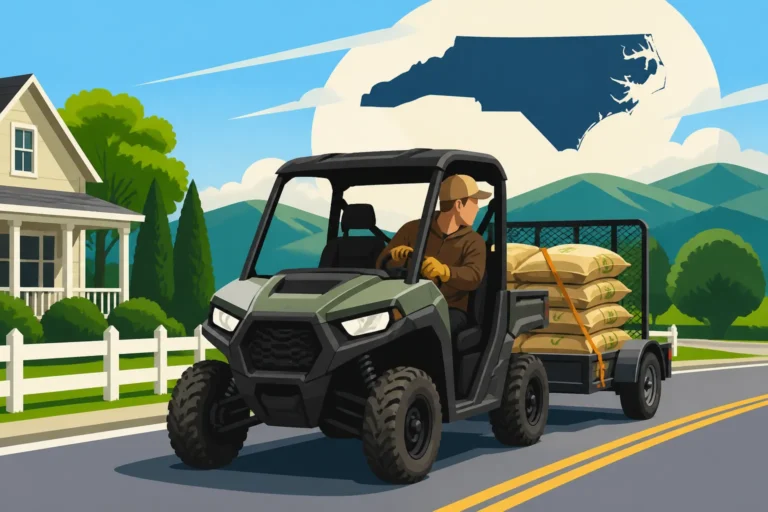
North Carolina law does provide a very narrow exception for ATVs used in conjunction with farming operations. However, this is one of the most misunderstood and abused exceptions out there, and it's vital to grasp its limits. This isn't a free pass to ride your quad to the feed store or down the street for groceries.
The law states that an ATV or UTV may be operated on a public road only when actually engaged in farming operations. This means:
- The machine must be used solely for farming purposes.
- It can only be ridden on a public road for the purpose of traveling from one field or portion of a farm to another, or to access equipment or materials necessary for the farming operation.
- The distance traveled on the public road must be the shortest practical distance.
- The operator must yield to all other traffic.
Think of it this way: if you're pulling a sprayer to a different field across a county road, or moving a fence post from one pasture to another, you might be covered. If you're riding your quad to town for lunch, you are absolutely not covered by this exception, even if you own a farm. This exception is about the task you're performing, not your identity as a farmer. It also doesn't negate the need for proper lighting if you're operating after dark. [North Carolina's Farming Operations Exception] exists for practical agricultural needs, not as a loophole for recreational riding.
The Ocean Beach Area Rule
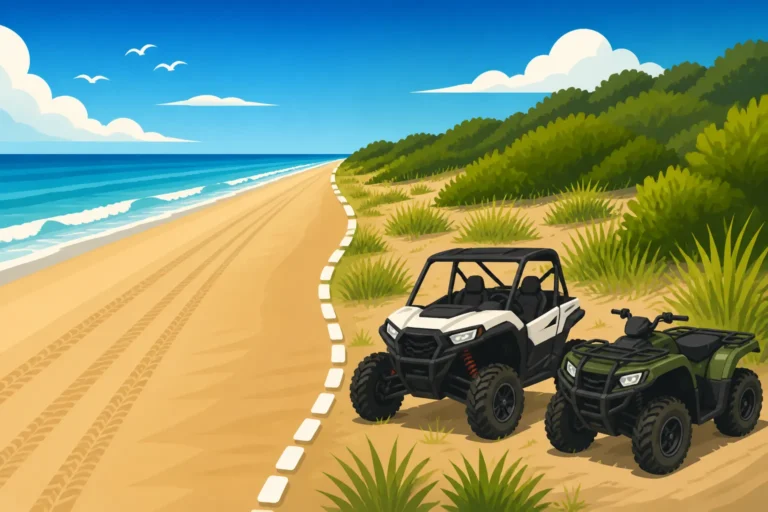
If you live along North Carolina's beautiful coast, you might have seen ATVs or UTVs on the beach. This is another highly specific exception, and it's crucial to note that it's not a statewide rule, nor does it apply to all beaches. Each coastal municipality or county has its own ordinances regarding vehicle access on its beaches, and these rules are often very strict, changing with the seasons and environmental concerns.
Generally, where allowed, you'll find:
- Designated Areas: Riding is typically restricted to specific sections of the beach, not the entire coastline.
- Permits Required: You almost always need a special permit from the local authority (town, county, or state park) to drive any vehicle on the beach, including ATVs. These permits often come with fees and specific regulations.
- Seasonal and Time Restrictions: Many areas only allow vehicles during certain times of the year (often off-season) or specific hours of the day.
- Age Requirements: There might be specific age restrictions for who can operate a vehicle on the beach, sometimes stricter than general ATV riding age laws. For example, some areas might require operators to be 16 and over. [North Carolina's Ocean Beach Rule] is something you absolutely must research with the local authorities for the specific beach you intend to visit before you even think about driving your ATV onto the sand. Don't assume anything.
Crossing a Road, and Nothing More
This is less of an "exception" and more of a common scenario that people often mistake for limited road legality. In some rural areas, you might have private property that is bisected by a public road. In such cases, if you need to move your ATV from one side of your property to the other, you may be able to make a direct, perpendicular crossing of the public road.
The key here is "crossing, and nothing more." This means:
- Direct Path: You must cross the road at a 90-degree angle, taking the shortest possible route.
- Yield to Traffic: You must yield to all vehicular and pedestrian traffic on the public road.
- Minimal Travel: You cannot travel along the road, even for a short distance. It's strictly about getting from point A on one side of the road to point B directly opposite on the other side.
This is a very precarious situation, as law enforcement has discretion. While often tolerated in very specific, rural circumstances, it doesn't make your ATV "street legal" for even that short stretch. You are essentially bringing an off-highway vehicle onto a highway for a moment, and any incident could still leave you vulnerable to citations or liability. [Crossing a Road on an ATV in North Carolina] is not a license to ride down the street, and it's always safer to trailer your machine if possible.
Consequences of Illegal On-Road ATV Use
Riding an ATV or UTV illegally on North Carolina public roads isn't just frowned upon; it carries real, significant consequences. It's not worth the risk, both legally and financially, to ignore these rules. Law enforcement agencies, from local police to county sheriffs and state troopers, are generally well-versed in the state's ATV laws.
Fines, Penalties, and Machine Seizure
If you're caught operating an ATV illegally on a public road, you could face a range of penalties. At the very least, you're looking at a traffic citation, which comes with a fine and potential court costs. These aren't cheap "slap on the wrist" tickets; they can add up quickly. More seriously, depending on the specifics of the offense (e.g., reckless driving, operating under the influence, causing property damage), the charges could escalate significantly.
In some cases, law enforcement has the authority to seize your machine. Imagine having your prized ATV impounded, incurring towing fees, storage fees, and potentially losing it if you can't pay the associated costs and fines. This is a very real possibility in North Carolina. Furthermore, if you're involved in an accident while riding illegally on a public road, the legal ramifications can become far more severe, potentially including criminal charges. [North Carolina Fines for an ATV Violation] can be a harsh lesson, and it's one you definitely want to avoid.
Insurance and Liability Nightmares
Perhaps one of the most overlooked and terrifying consequences of illegal on-road ATV use is the gaping hole it creates in your insurance coverage and personal liability. Your standard ATV insurance policy is almost certainly designed to cover off-road use, not incidents that occur on public streets. If you're involved in an accident on a public road and your ATV is not legally operating there (i.e., it's not a registered MUV, or you're not strictly adhering to a farm or beach exception), your insurance company will likely deny any claims related to that incident.
This means:
- No Coverage for Damages: Your insurance won't pay for repairs to your ATV, damage to other vehicles, or damage to public or private property.
- Personal Liability: You will be personally on the hook for all damages and injuries. If you hit a car, a pedestrian, or even a mailbox, you could be sued for tens or hundreds of thousands of dollars, potentially wiping out your savings, assets, and future earnings.
- Medical Bills: If you or your passengers are injured, your health insurance might even push back if the activity causing the injury was illegal.
This is not a hypothetical worst-case scenario; it's a very real and devastating possibility. The financial risk alone should be a powerful deterrent. Always understand what your [North Carolina ATV Insurance Requirement] actually covers, and under what circumstances.
What North Carolina Riders Do Instead of Street Riding
So, if you can't ride your ATV on most public roads, what's a rider to do? North Carolina offers plenty of incredible opportunities for legal, exhilarating off-road adventures. The key is to direct your energy and your machine toward designated riding areas and responsible practices.
Embracing North Carolina's OHV Trails
North Carolina is home to some fantastic opportunities for off-highway vehicle riding, primarily within its national forests and through various private parks. These are the places where your ATV or UTV truly belongs and where you can ride legally and safely.
- National Forests: The Uwharrie, Pisgah, and Nantahala National Forests all offer designated OHV trail systems. The Uwharrie National Forest, for example, boasts the Badin Lake OHV Trail Complex, which is a rider favorite. The Pisgah National Forest has the Brown Mountain OHV Trail System, and the Nantahala National Forest includes the Wayehutta OHV Trail System. These trails are maintained, have clear rules, and often require a permit to ride, but they provide countless miles of legal, exciting terrain. They offer varying levels of difficulty, from easy forest roads to challenging rock crawling. [Where to Ride an ATV in North Carolina] will tell you more about these incredible places.
- Private Parks: Beyond the national forests, North Carolina also has a growing number of private off-road parks. These parks often cater to all skill levels, from beginners to experienced riders, and many offer amenities like camping, wash stations, and even rentals. These private ventures are fantastic because they're specifically designed for off-road recreation, providing a safe and legal environment to push your machine's limits.
When you ride on these trails, you’re contributing to their upkeep and ensuring they remain open for future generations of riders. Always check the specific rules, permit requirements, and seasonal closures for any trail system before you load up your trailer and head out.
Focus on Private Land and Landowner Permission
For many riders, especially those in more rural parts of the state, private land offers the most accessible riding opportunities. This is perfectly legal, provided you have explicit permission from the landowner.
- Get Written Permission: While verbal permission might seem sufficient, having something in writing can save a lot of headaches down the road. A simple signed note from the landowner stating that you have permission to ride your ATV on their property can be invaluable if questions ever arise. It protects both you and the landowner.
- Respect the Land: When riding on private land, always be mindful of the property. Stay on designated trails, avoid tearing up fields, respect fencing, and clean up after yourself. Your responsible actions reflect on the entire riding community and help maintain good relationships with landowners, which is crucial for continued access.
- Know the Boundaries: Be absolutely certain of the property lines. Accidentally straying onto neighboring land without permission is trespassing and can lead to legal trouble.
Riding on private ground, with permission, is a cornerstone of the North Carolina ATV experience. It allows for flexibility, exploration, and often a more relaxed atmosphere than organized trail systems. It's a fantastic way to enjoy your machine responsibly and legally. [North Carolina Rules for Riding Private Land] are straightforward: get permission, and respect it.
Here's a quick comparison of North Carolina's on-road ATV use exceptions:
| Exception Category | Primary Purpose | Key Conditions | Machine Type | Typical Restrictions |
|---|---|---|---|---|
| Modified Utility Vehicle (MUV) | Street-legal road use | Engine > 2400cc, specific dimensions (length, width, height), top speed > 40 mph, full road-legal equipment (lights, turn signals, mirrors, horn, speedometer, seatbelts, parking brake), DMV-assigned VIN if needed. | Heavily modified UTVs (very few ATVs) | Roads 55 mph or less; extensive and costly modifications required. |
| Farming Operations | Agricultural business only | Used solely for farming operations; shortest practical distance on public roads; traveling between fields or for farm equipment/materials; must yield to traffic. | ATVs/UTVs used for farm work | Not for recreational use or personal errands; strict interpretation of "farming operations." |
| Ocean Beach Area | Recreational access on designated beaches | Highly localized to specific coastal areas; requires local permits; often seasonal/time restrictions; specific age requirements; strict adherence to local ordinances. | ATVs/UTVs where permitted locally | Only on designated beaches; must check specific local rules; heavy fines for violations. |
| Crossing a Road | Connecting private property | Direct, perpendicular crossing; shortest possible distance; must yield to all traffic; cannot travel along the road. | Any ATV/UTV (with caution) | Not a "street legal" status; risky; best avoided if possible; subject to law enforcement discretion. |
This article is for general informational purposes only and does not constitute professional advice. Laws, prices and regulations vary by location and change over time. Consult a qualified professional for guidance on your specific situation.