Where the Vegetation Line Puts the Beach Boundary
Many ATV and UTV enthusiasts in North Carolina dream of the wind in their hair and the sand beneath their tires, imagining cruising along the state's picturesque coastline. However, the reality of riding off-highway vehicles on North Carolina's beaches is far more complex than a simple "yes" or "no." One of the most critical, yet often misunderstood, aspects of this puzzle is the role of the "vegetation line" in defining where you can and cannot legally operate your machine. This guide will meticulously break down what the vegetation line means in the eyes of North Carolina law, how it impacts your ability to ride, and what you need to know to avoid a costly misstep on the state's precious coastal environment.
Understanding North Carolina's "Ocean Beach Area" for OHVs
The allure of riding an ATV or UTV on a wide-open beach is undeniable, but in North Carolina, this isn't a casual affair. The state has specific legal definitions that govern what constitutes an "ocean beach area," and understanding these is your first step to staying on the right side of the law. It's not just about what looks like sand; it's about what the law says the sand is for recreational vehicle use.
The Legal Definition of the "Ocean Beach Area"
When we talk about riding an OHV on a North Carolina beach, we're not just using a general term. North Carolina statutes lay out a very precise definition of what constitutes an "ocean beach area," and this definition is absolutely crucial for any rider hoping to bring their machine near the coast. The law defines this area as the dynamic land adjacent to the ocean that is subject to wave action and includes the unvegetated zone between the mean low water line and the vegetation line. This isn't just a technicality; it's the foundation of all beach riding regulations.
Why does this matter so much? Because outside of very specific, narrowly defined exceptions, operating an ATV or UTV within this designated "ocean beach area" is generally prohibited for recreational purposes. The state's primary concern is protecting the fragile dune systems and the wildlife that depend on them, like nesting sea turtles and shorebirds. What many people mistakenly think of as an open, sandy playground is, in fact, a delicate ecosystem protected by stringent rules. Failing to grasp this fundamental legal distinction can quickly turn a scenic ride into a legal headache, complete with fines and potential damage to your machine or the environment. It’s a stark contrast to other off-road environments like forest trails, which have a completely different set of rules.
How the Vegetation Line Establishes the Boundary
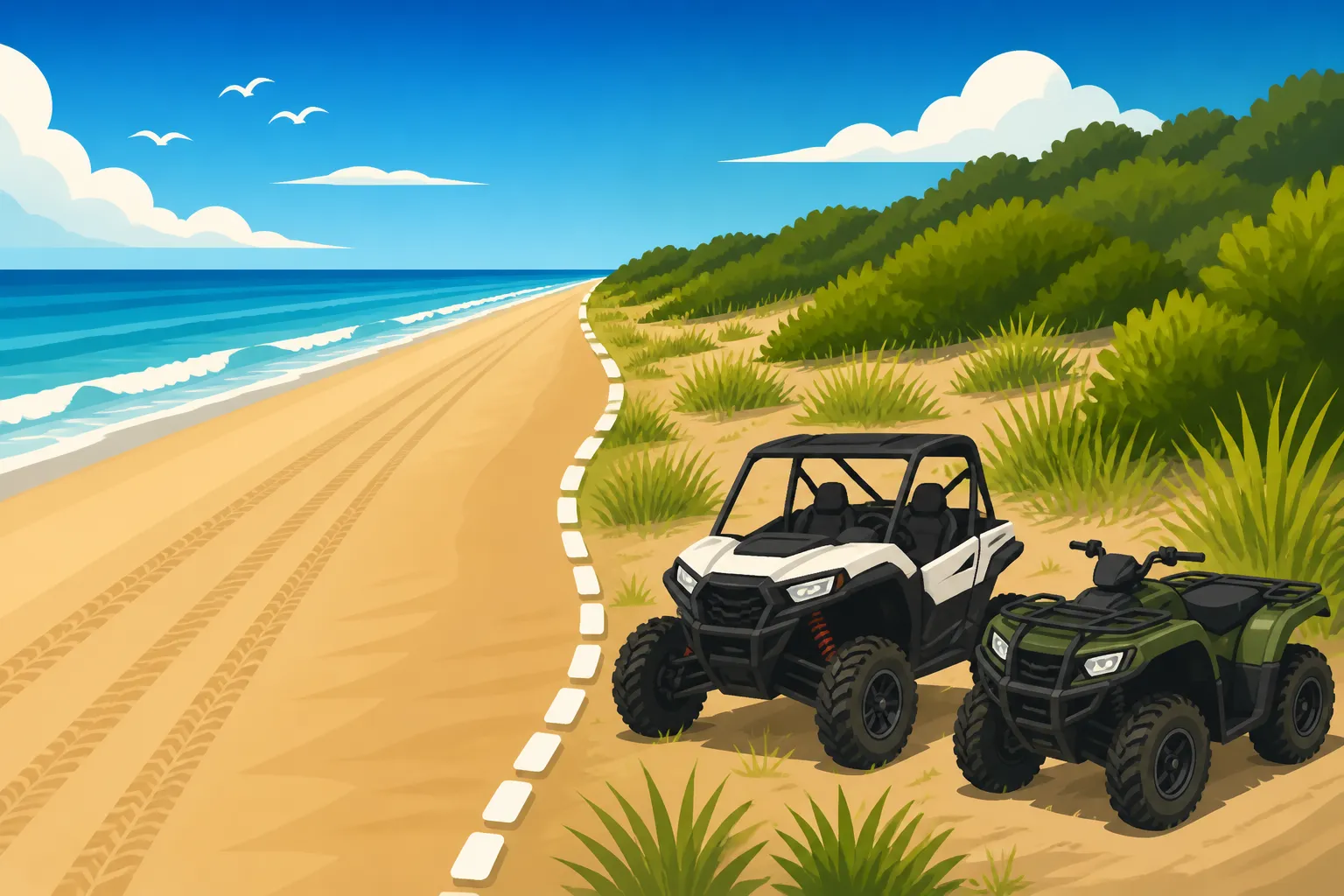
The most critical component of defining the "ocean beach area" is the "vegetation line." This isn't some arbitrary marker; it's a living boundary that plays a pivotal role in where you can legally drive an OHV, if at all. Simply put, the vegetation line is the line marking the seaward extent of permanent vegetation. Think of it as where the sand stops being just shifting beach and starts supporting stable plant life, like sea oats, dune grasses, and other hardy coastal flora.
In practice, this line is often visibly identifiable. It's where the relatively flat, barren sand of the active beach transitions into the slight rise of the dunes, covered by grasses that help stabilize the sand. This distinction is vital because the law views the areas landward of the vegetation line – that is, towards the dunes and beyond – as even more environmentally sensitive and strictly off-limits to recreational OHV traffic. While some local ordinances might permit very limited, specific types of vehicles (often for fishing access or specific events) in the unvegetated zone seaward of the vegetation line, the vegetation line itself serves as a clear, unmistakable boundary beyond which recreational riding is almost universally forbidden. For an ATV rider, crossing this line without explicit legal authorization is a direct violation of environmental protection laws, designed to prevent erosion and preserve critical habitats. It’s important to familiarize yourself with [North Carolina's Ocean Beach Area Definition] to fully grasp these nuances before even contemplating a trip to the coast with your machine.
Riding Within North Carolina's Beach Boundaries: What's Allowed (and Not)
Knowing where the vegetation line is located is just one piece of the puzzle. The next, and perhaps more important, step is understanding the very strict regulations that govern what, if any, ATV or UTV riding is permitted on the beaches of North Carolina. It's crucial to disabuse yourself of any notion that North Carolina beaches are open-access zones for your off-road machine.
The General Rules and Age Restrictions for Beach Riding
Let's be absolutely clear: recreational ATV and UTV riding on most North Carolina beaches is generally not permitted. The state's environmental protection laws are very strict when it comes to coastal areas, especially concerning motorized vehicles. The default position is prohibition, with very narrow exceptions. This isn't like riding on private land with permission or designated [North Carolina Rules for Riding a Logging Road]; beach environments are fundamentally different in their legal status.
Even in the rare instances where some motorized vehicle access is allowed (often for specific purposes like surf fishing access in designated areas, or for official duties), these exceptions come with their own set of stringent rules. For example, some areas might require specific permits, adhere to strict time-of-day restrictions, or limit access to certain types of vehicles. When it comes to age, North Carolina has specific rules for riders under 16, and on beaches, these are often layered with local restrictions. In areas where permitted, the minimum age to operate a vehicle on the beach for permitted activities is often 16, and sometimes requires a valid driver's license, even if it's not a street-legal machine. This is a common misconception, as many assume off-road means no license needed. This is not the case in the highly regulated coastal zone. It’s always best to check [North Carolina Beach Riding Age Requirement] for comprehensive details, but prepare for very limited options.
The Role of Local Ordinances and Permits
While state law provides the overarching framework for what constitutes the "ocean beach area" and general prohibitions, it's often the local ordinances that dictate the highly specific rules about beach access for vehicles. This is where things can get confusing because regulations can vary significantly from one coastal town or county to the next. What's allowed in one municipality might be strictly forbidden just a few miles down the coast in another.
Many coastal towns, recognizing the delicate balance between public access and environmental protection, have enacted their own bylaws governing vehicles on their beaches. These local ordinances might specify:
- Designated Access Points: Only allowing vehicles onto the beach at certain ramps or crossings.
- Permit Requirements: Requiring a special permit, often annual, which can be expensive and have strict eligibility criteria.
- Vehicle Types: Limiting access to certain types of vehicles, often privileging traditional 4×4 trucks over ATVs or UTVs, or restricting engine sizes and dimensions.
- Seasonal Restrictions: Prohibiting vehicles entirely during peak tourist seasons or during nesting seasons for shorebirds and sea turtles.
- Time of Day Restrictions: Only allowing vehicles during certain hours, often tied to low tide or daylight hours.
- Speed Limits: Enforcing very low speed limits to protect beachgoers and wildlife.
Because of this patchwork of regulations, the single most important piece of advice is to always check with the local municipal or county authorities for the specific stretch of beach you plan to visit before you even load your machine onto the trailer. A quick phone call to the local police department or visitor's bureau can save you from a hefty fine or having your vehicle impounded. Ignorance of local law is no excuse, and wardens are vigilant about protecting these sensitive areas. For more general information on this topic, consider reading [North Carolina Rules for Riding a Beach].
Practical Implications for Riders and Avoiding Missteps
Navigating the complexities of North Carolina's beach riding rules means being incredibly vigilant and prepared. The state's coastal environment is both beautiful and fragile, and the laws are designed to keep it that way. For OHV riders, this means exercising extreme caution and understanding the real-world consequences of ignoring the rules.
Identifying the Vegetation Line in Practice
For riders who might find themselves in one of the very limited areas where beach access is permitted, being able to accurately identify the vegetation line is paramount. This isn't an academic exercise; it's a real-time assessment you need to make on the ground. The vegetation line isn't always a perfectly straight, obvious boundary, and it can shift with storms, erosion, and natural growth patterns.
Here are some practical tips for identifying it:
- Look for Stable Plant Life: The clearest indicator is the presence of established, rooted plants. Sea oats, marsh grasses, and other dune-stabilizing vegetation are the key. If you see a cluster of these plants, you've likely reached or crossed the vegetation line.
- Observe Dune Formations: The vegetation line often coincides with the toe of the primary dune system. Where the flat, shifting beach sand starts to gently rise into a more stable dune, you'll usually find vegetation taking hold.
- Impact of Tides and Weather: Be aware that high tides can temporarily inundate the unvegetated beach area, making it seem like the vegetation line is closer to the water. Always base your assessment on the permanent vegetation, not temporary water levels. Similarly, after a major storm, the line might be less distinct due to sand shifts or damage. In such cases, err on the side of caution.
- When in Doubt, Don't: If you're unsure where the line is, assume you're too close to the protected area. It's better to stay well clear of any ambiguous zones than to risk a citation.
Many riders invest in robust aftermarket parts from brands like SuperATV to ensure their machines can handle diverse terrain, from sandy trails to rocky climbs, which might be useful for off-road areas in other parts of the state. However, on the beach, technical capability is irrelevant if legal access is denied or strictly bounded by natural markers.
Consequences of Riding Beyond the Legal Boundary
The temptation to explore just "a little bit further" or to ignore an ambiguous boundary can be strong, but the consequences of riding beyond the legal beach boundary in North Carolina are severe. This isn't just about a slap on the wrist; it can hit your wallet hard and potentially damage your reputation as a responsible rider.
- Fines and Penalties: Violations of coastal area management laws can result in significant fines, often in the hundreds or even thousands of dollars. These aren't minor traffic tickets; they are serious infractions aimed at protecting fragile environments. In some cases, repeated offenses or severe damage could lead to more substantial legal action. For specific figures, you’d need to consult current local ordinances and state statutes, as they can change, but anticipate them being substantial enough to deter anyone. You can also gain insight from reading about [North Carolina Fines for an ATV Violation] for other types of OHV infractions.
- Environmental Damage Charges: Driving over dunes, through sensitive vegetation, or disturbing nesting wildlife can lead to additional charges related to environmental damage. These charges can be even more severe than basic trespassing fines, often involving restitution for restoration efforts. The state takes its coastal protection very seriously, and OHVs can cause significant erosion and habitat destruction if not used responsibly.
- Vehicle Impoundment: In serious cases, particularly if you are riding in a clearly prohibited area or causing significant damage, your ATV or UTV could be impounded. The costs associated with impoundment, storage, and retrieval can quickly add up, easily exceeding the cost of the initial fine.
- Loss of Public Access: Every instance of illegal riding contributes to negative public perception of OHV riders. This can lead to further restrictions, stricter enforcement, and the closure of even legitimate riding areas, ultimately harming the entire OHV community.
It’s crucial to remember that coastal wardens and local law enforcement are well-versed in these regulations and are often highly visible in sensitive areas. They are there to protect the environment and enforce the law, not to just issue warnings.
When Local Exceptions or Permits Might Apply
While the general rule is strict prohibition for recreational ATVs and UTVs on North Carolina beaches, there are indeed rare and highly specific exceptions, almost always governed by local ordinances and requiring special permits. These exceptions are typically not for general recreational cruising but for essential services or highly regulated activities.
Some common scenarios where you might see motorized vehicles on a North Carolina beach include:
- Local Government and Emergency Services: Town staff, police, fire, and emergency medical personnel regularly use specialized vehicles on the beach for patrol, rescue operations, and maintenance. These vehicles are clearly marked and are operating under official authority. [Why City Crews Can Ride Where You Cannot] explains this dynamic.
- Fishing Access: Some municipalities, particularly those with a strong fishing culture, might issue permits for vehicles (often 4×4 trucks, less commonly ATVs/UTVs) to access specific stretches of beach for surf fishing. These permits are usually highly regulated, have strict dates and times of use, and require adherence to speed limits and designated routes.
- Commercial Activities: Certain commercial operations, such as those involved in beach renourishment, shellfishing, or specific event setup, may receive temporary permits for vehicle access.
- Handicapped Access: In some areas, designated access points and limited driving zones might be provided for individuals with disabilities, often requiring a special permit and specific vehicle modifications.
It is absolutely imperative to understand that these exceptions are not a loophole for general recreational riding. If you do not have a specific, current, and valid permit issued by the relevant local authority for a clearly defined purpose and location, assume you are not allowed to drive your ATV or UTV on the beach. Do not rely on anecdotal evidence or what you see others doing; always verify directly with local officials. Trying to blend in with legitimate users without proper authorization is a sure way to incur fines.
Beyond the Beach: Other Road and Public Land Considerations
Given the extreme restrictions on beach riding, it’s worth briefly touching on where ATVs and UTVs can typically be ridden in North Carolina, just to provide a broader context and highlight the stark differences in regulation.
The General Rule: No Street Legal ATVs (with MUV Exception)
Outside of very specific, permitted scenarios on beaches, North Carolina generally considers ATVs and UTVs off-road machines, meaning they are not street legal for use on public roads. You cannot simply drive your quad down Main Street or on state highways. The law is designed to separate these vehicles from traditional automobiles due to differences in safety features, size, and intended use.
However, there is a notable exception: the Modified Utility Vehicle (MUV). An MUV is a specific class of UTV that, through a series of modifications and meeting strict dimensional and performance requirements, can become street legal in North Carolina. These machines must have a valid VIN assigned by the DMV, meet specific engine size (more than 2,400cc) and dimension criteria (length, width, height), and be capable of speeds over 40 mph, among other requirements. This is the closest an OHV can get to being a fully road-legal vehicle in the state. If you're interested in this route, a good starting point is to explore [Are ATVs Street Legal in North Carolina?].
Forest Trails and Private Land Riding
Away from the highly regulated coastline and public roads, North Carolina offers a wealth of opportunities for ATV and UTV riding. The state boasts several national forest OHV trail systems, such as those in the Uwharrie, Pisgah, and Nantahala National Forests. These areas require riders to purchase permits, often for a day or a season, and adhere to specific trail rules, including safety gear requirements and designated riding seasons. Brands like SuperATV offer a huge range of aftermarket parts, from lift kits and tires to winches and lighting, that are perfectly suited for enhancing a machine's performance and durability on these rugged forest trails, where challenging terrain is the norm.
Additionally, riding on private land is a popular option, provided you have explicit permission from the landowner. This is often the most straightforward way to enjoy your machine without navigating complex public land regulations. However, even on private land, common sense and responsible riding practices apply, including respecting property boundaries, minimizing environmental impact, and adhering to noise regulations. Understanding [North Carolina Rules for Riding Private Land] is key for any rider utilizing private property. The regulations governing these inland riding areas are distinct from beach regulations, underscoring the importance of understanding the specific rules for each environment.
Disclaimer
This article is for general informational purposes only and does not constitute professional advice. Laws, prices and regulations vary by location and change over time. Consult a qualified professional for guidance on your specific situation.