Carrying a Safety Card on a North Carolina Ride
If you ride an ATV in North Carolina, you may need a safety training certificate—but that card is not the same as a trail pass or driver’s license. The confusing part is knowing who needs the certificate, what proof to bring, and what forest officers may ask to see. Here’s how to keep the requirements straight before you unload.
Who needs a North Carolina ATV safety certificate
The state requirement is tied to the operator’s birth date. According to the North Carolina General Assembly, ATV operators born on or after January 1, 1990, must possess an approved safety training certificate. The requirement took effect on October 1, 2006.
That rule is specific to ATV operators. It does not mean every person riding any type of off-highway vehicle automatically needs the same certificate under this provision. Forest land, a beach driving area, a private riding park, and other locations can also have separate rules. Check the requirements for the machine and riding area you plan to use, rather than assuming one card covers every situation.
If you are not sure whether the birth-year rule applies to you, Who Needs a North Carolina Safety Certificate is a useful place to start. The connection between the requirement and a rider’s birth year is also explained in Why the Certificate Binds by Birth Year.
What counts as an approved course
The North Carolina General Assembly says ATV safety courses must be sponsored or approved by the All-Terrain Vehicle Safety Institute, or approved by the Commissioner of Insurance. A course that merely discusses safe riding is not necessarily enough; check that it meets one of those approval routes before relying on its certificate.
The North Carolina Community College System is authorized to provide approved ATV safety training to people under 18. That gives younger operators a possible training option, but it does not replace other age, supervision, helmet, or riding-area rules that may apply.
For help checking whether a particular course qualifies, see Which Safety Courses North Carolina Accepts and North Carolina ATV Safety Certificate Requirements. If you have a certificate from another state, do not assume it automatically satisfies the North Carolina requirement. Check Does North Carolina Accept an Out-of-State Certificate? for the separate reciprocity question.
Possess a certificate does not automatically mean carry a card
The law described by the North Carolina General Assembly requires covered operators to possess a safety certificate. The facts do not establish a separate statewide rule that every ATV rider must carry a physical certificate card on every ride. Those are different questions: having completed an approved course and holding a certificate is not the same as a specific requirement to display a card during every roadside or trail check.
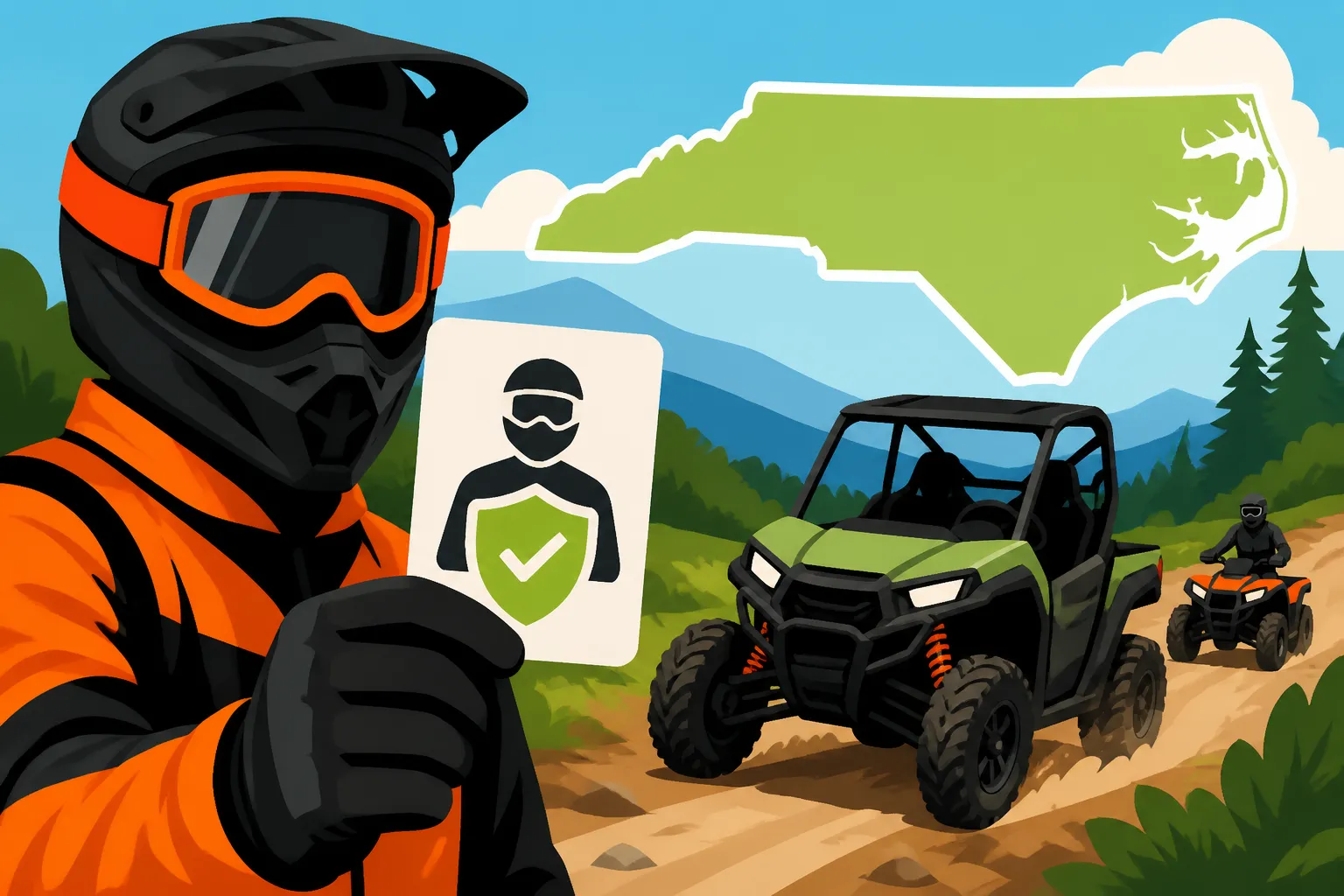
Still, carrying proof is sensible. A physical card, an official digital certificate, or other documentation issued by the approved course provider can help show that you completed the training if someone asks. Before relying on a digital record, confirm that it is accessible where you ride and that the issuing provider can verify it. Keep your proof available without treating it as a substitute for any required trail pass or identification.
If your certificate is missing, damaged, or only available through an online account, contact the course provider before the trip to ask how to retrieve replacement proof. Don’t wait until you are at a trailhead with weak service or an inaccessible account.
Keep the safety certificate separate from a trail pass and license
A frequent source of confusion is that several documents may matter on the same ride, but they serve different purposes. A safety certificate documents approved training. A trail pass authorizes access to a particular riding area. A state driver’s license is identification that may need to be shown during a compliance check.
The Forest Service says visitors need a valid pass for the specific area where they are riding, and trail riders must carry that pass while on the trails. The Forest Service also says a state driver’s license must be available to show during a law enforcement compliance check. Those requirements are separate from North Carolina’s ATV safety certificate rule.
| Item | What it is for | What to do before a ride |
|---|---|---|
| ATV safety certificate | Shows that a covered operator has completed approved safety training | If the birth-year rule applies, complete an approved course and keep proof accessible |
| Area-specific trail pass | Provides access to the riding area covered by that pass | Get the correct pass for the site and carry it on the trail |
| State driver’s license | Identification for a law enforcement compliance check on Forest Service land | Have it available to show when requested |
A pass for one location is not a general North Carolina riding permit. According to the Forest Service, riders need a valid pass for the specific area where they are recreating. Passes for riding in the National Forests in North Carolina are sold through Recreation.gov, and a pass remains valid until midnight on the date written on it.
The Forest Service also says each designated OHV area has its own access requirements. There are only four designated OHV areas within the National Forests in North Carolina, according to the Forest Service. Before setting out, confirm the correct pass and current access rules for the area you chose. The overview in Do You Need a Permit for North Carolina Forest Trails? can help you distinguish a site pass from a state safety certificate.
If you are visiting from another state, your home-state registration or certificate does not necessarily replace the North Carolina site pass. Review North Carolina Rules for a Visiting Rider and Does North Carolina Honor Out-of-State Registration? before traveling.
What Forest Service checks may involve
According to the Forest Service, a rider on a designated trail must carry a valid pass and have a state driver’s license available to show during a law enforcement compliance check. Those are the specific document requirements stated for the trail setting in the supplied Forest Service rules. They do not say that the Forest Service trail pass is a safety certificate, or that carrying a certificate replaces the pass.
The Forest Service also says OHVs must be trailered to the trailhead, and that ATVs cannot be registered and therefore are not allowed on Forest Service roads. That matters when planning how to reach a trail: a safety card in your pocket does not authorize you to ride the ATV on a road that is closed to it. For more on the distinction between land access and documents, see Why North Carolina Has No ATV Registration.
What to bring and check before you ride
A simple pre-ride check can prevent a document mix-up from disrupting your day. Start with the person operating the ATV, then check the destination and the machine. Keep the certificate, pass, and identification together but clearly separate so you can quickly show the item that applies.
- Check whether the certificate rule applies to the operator. According to the North Carolina General Assembly, ATV operators born on or after January 1, 1990, must possess an approved safety training certificate.
- Confirm that the course was approved. The North Carolina General Assembly recognizes courses sponsored or approved by the All-Terrain Vehicle Safety Institute, or approved by the Commissioner of Insurance.
- Bring proof you can access. Even though the stated state rule is to possess a certificate, carrying a card or reliable proof is a practical precaution. If your proof is digital, make sure you can open it before you leave.
- Check the site’s pass requirement. According to the Forest Service, the pass must be valid for the specific area, and riders must carry it on the trail.
- Have identification available. The Forest Service says a state driver’s license must be available to show during a compliance check.
- Review the riding rules, not just the paperwork. A certificate does not override requirements for supervision, protective equipment, vehicle condition, or staying on designated trails.
The last point is important for rides with young people. According to the Forest Service, children under 16 must be under continuous visual supervision by an adult over 18 while operating on the Forest Service OHV areas covered by those rules. The Forest Service also requires ATV and motorcycle operators and passengers to wear helmets and eye protection that meet US DOT motorcycle safety standards. These site rules are distinct from the training certificate requirement.
North Carolina law also has separate ATV operating rules. According to the North Carolina General Assembly, operators on public streets, highways, or public vehicular areas must wear eye protection and a safety helmet meeting United States Department of Transportation standards for motorcycle helmets. The same agency says a person under 18 may not operate an ATV off a public street, highway, or public vehicular area without that eye protection and helmet. Check the requirements for your specific riding area, since local site rules may apply alongside state law.
If you cannot find your card
If you completed an approved course but cannot locate the card, contact the course provider to ask whether it can issue replacement proof or confirm your completion. Keep any confirmation the provider supplies, but do not assume that a screenshot or email will be accepted in every situation. Requirements for a site pass are separate, and the Forest Service specifically requires riders to carry a valid pass on the trail.
If you have not taken a course and the state birth-year rule applies to you, arrange an approved course before riding. A friend’s card, a pass issued for the machine, or a driver’s license does not demonstrate that you personally completed the required safety training.
If you’re planning a Forest Service ride, check the area’s current pass instructions as well as its trail and equipment rules. A tidy document setup is helpful, but it is only one part of being prepared. You still need a pass for the correct area, your identification available for a compliance check, and a machine and rider that meet the applicable rules.
Sources
- Forest Service — National Forests in North Carolina | Off-Highway Vehicles (OHV) | Forest Service (checked November 3, 2026)
- OSFM — ATV Safety | OSFM (checked November 3, 2026)
- Forest Service — National Forests in North Carolina | Black Swamp OHV Trailhead | Forest Service (checked November 3, 2026)
- Forest Service — National Forests in North Carolina | Brown Mountain OHV Trail System | Forest Service (checked November 3, 2026)
- Forest Service — National Forests in North Carolina | Off-Highway Vehicles (OHV) | Forest Service (checked November 3, 2026)
- USDA Forest Service — National Forests in North Carolina | Off-Highway Vehicles (OHV) | Forest Service (checked November 3, 2026)
Disclaimer
This article is for general informational purposes only and does not constitute professional advice. Laws, prices and regulations vary by location and change over time. Consult a qualified professional for guidance on your specific situation.