Why the Safety Certificate Depends on Your Birth Year
North Carolina’s ATV safety-certificate rule can seem confusing because it turns on a fixed birthday, not the rider’s current age. The practical question is whether an operator was born before or on the cutoff date, and whether their training meets the state’s approval rules. Here’s how to read that requirement and keep it separate from trail permits, helmets, and other riding rules.
The birth-date cutoff, explained
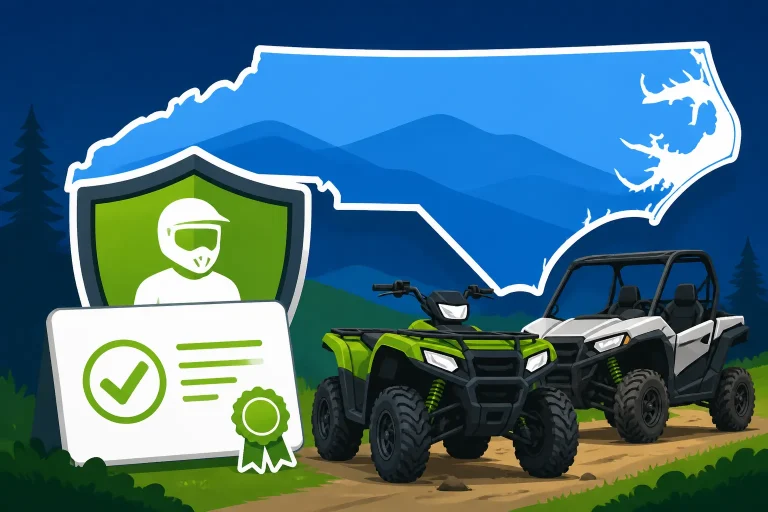
According to the North Carolina General Assembly, all-terrain vehicle operators born on or after January 1, 1990, must possess a safety certificate. The requirement took effect on October 1, 2006, also according to the North Carolina General Assembly.
That means the key question is the operator’s date of birth, not whether they are currently a child, teenager, or adult. If the rider was born before January 1, 1990, this particular birth-year rule does not require them to have a certificate. If they were born on January 1, 1990, or later, the requirement applies when they operate an ATV.
| Operator’s birth date | Certificate under the birth-year rule |
|---|---|
| Before January 1, 1990 | Not required by this cutoff |
| January 1, 1990, or later | Required when operating an ATV |
According to the North Carolina General Assembly, the law calls for a safety certificate for operators who fall on or after the cutoff. This is different from a rule that applies only until someone reaches a certain age: getting older does not move a rider’s birth date to the other side of the line. For more on how the cutoff works, see North Carolina Safety Certificate Birth Year Rule and January 1990 and the North Carolina Line.
The certificate requirement is also not a general permit to ride anywhere. It does not by itself authorize trail access, replace an area-specific pass, or make an ATV legal on a public road. Those are separate questions with separate rules.
A useful starting point is to identify the machine and the place where it will be ridden. The state certificate rule concerns ATV operators, while a public riding area may impose its own access conditions. Forest Service trail riders, for example, must have a valid pass for the specific area and carry it while on the trail, according to the Forest Service. A certificate and a trail pass serve different purposes.
If you are not sure whether a particular machine is treated as an ATV for a rule, don’t rely on its marketing name alone. The Forest Service describes an ATV as a machine with a seat the operator straddles and handlebars for steering, with three, four, or six wheels and a width under 60 inches. That Forest Service description is useful for understanding its trail rules, but a machine’s classification can matter across different legal contexts. What North Carolina Counts as an ATV offers more context on the state’s terminology.
What counts as approved safety training
Having taken a course is not necessarily enough. According to the North Carolina General Assembly, an ATV safety course must be sponsored or approved by the All-Terrain Vehicle Safety Institute or approved by the Commissioner of Insurance. The important point is that the course needs to fall within an authorized approval route.
Before enrolling, confirm that the course provider can tell you which approval applies. A course that covers useful riding skills may still not satisfy the certificate requirement if it does not meet the state’s stated approval standard. If you already completed training, check the course documentation or contact the provider to confirm its status rather than assuming that any ATV course qualifies.
The North Carolina Community College System is authorized to provide approved ATV safety training to people less than 18 years of age, according to the North Carolina General Assembly. That authority does not mean every course offered through every location automatically meets the requirement. Ask whether the specific course is approved and whether it results in the certificate you need.
For a closer look at the accepted training routes, read Which Safety Courses North Carolina Accepts. If you are comparing courses, focus on approval first, then check practical details such as scheduling, course format, and what documentation the provider issues. Those practical details can differ, so confirm them directly with the course provider.
A certificate requirement is easy to confuse with training that is merely recommended. The birth-year rule is not described as optional for operators who meet its cutoff. If it applies to you, choose an approved course and retain the documentation you receive. If you are arranging a ride for someone else, such as a family member, don’t assume that your own training or certificate covers another operator.
It is also sensible to resolve this before arriving at a riding area. A safety certificate does not substitute for a Forest Service pass, and having a pass does not establish that the operator meets North Carolina’s certificate rule. Forest Service passes are area-specific, according to the Forest Service; check the applicable area’s requirements before planning the ride. Do You Need a Permit for North Carolina Forest Trails? explains that separate access issue.
The certificate is only one part of riding legally
The birth-year rule is just one safety obligation to consider. It does not cancel rules about protective gear, supervision, passengers, road use, or trail access.
For ATV operators and passengers, the North Carolina General Assembly requires eye protection and a safety helmet that meets United States Department of Transportation standards for motorcycle helmets when operating on public streets, highways, or public vehicular areas. The General Assembly also requires people under 18 to wear that eye protection and helmet when operating an ATV off those public areas. These equipment rules are separate from the certificate requirement: meeting one does not automatically meet the other.
Age-related supervision rules are another separate matter. The North Carolina General Assembly states that vehicle owners may not authorize an ATV to be operated in a way that violates the law. Separately, the Forest Service requires continuous visual supervision by an adult over 18 for children under 16 riding on its OHV trails. That Forest Service rule applies to its trail setting; it should not be treated as a replacement for checking the state rules that apply to a particular ride.
The Forest Service also requires ATV and motorcycle operators and passengers on its OHV trails to wear compliant helmets and eye protection, and requires a working spark-arresting device on an OHV. Riders must remain on designated trails, according to the Forest Service. Those trail conditions are not safety-certificate rules, but they may apply on top of the state requirement when riding in a National Forest OHV area.
Road access requires particular care. According to the North Carolina General Assembly, operating an ATV on a public street, road, or highway is prohibited except to cross it, and ATVs may not be operated on an interstate or limited-access highway. The General Assembly also requires a lighted headlamp and taillamp when an ATV is operated during darkness or when visibility is reduced. A safety certificate does not make a machine street-legal or create an exception to those rules.
Keep these requirements distinct when preparing for a ride:
- Certificate: Does the operator’s birth date fall on or after the cutoff, and is the training course approved?
- Protective equipment: Does the operator have the helmet and eye protection required for the location and circumstances?
- Supervision: Does the relevant state or land-manager rule require an adult to supervise the rider?
- Area access: Does the riding area require its own pass, and must the rider carry it?
- Machine and route: Is the vehicle allowed on the selected trail or road, and does it meet the area’s equipment rules?
If any answer is uncertain, check the rule for the specific machine and riding location before setting out. The certificate requirement can be straightforward once you know the operator’s birth date, but it does not answer every question about where or how that operator may ride. North Carolina ATV Safety Certificate Requirements covers the certificate topic more broadly, while [Carrying a Safety Card on a North Carolina Ride] can help with the separate question of keeping proof available.
A practical way to check your situation
Use this process before an ATV ride:
- Check the operator’s date of birth. If the operator was born on or after January 1, 1990, the North Carolina General Assembly’s safety-certificate requirement applies.
- Confirm the course approval. Make sure the training was sponsored or approved by the All-Terrain Vehicle Safety Institute, or approved by the Commissioner of Insurance, as required by the North Carolina General Assembly.
- Keep the certificate documentation. Retain the record provided after completing the approved course. If you are unsure what proof the provider issues or how to replace it, ask the provider.
- Check the riding location’s rules. A trail system may require a separate pass or impose equipment and supervision conditions. The Forest Service requires riders to carry a valid pass on its OHV trails.
- Review the machine and route. Verify that the ATV is allowed on the intended trail and do not assume a certificate permits public-road use.
If the rider was born before the cutoff, that only answers the certificate question. It does not waive helmet, eye-protection, road-use, or riding-area requirements. Likewise, completing an approved course does not automatically satisfy a trail system’s pass requirement.
For visitors, the distinction between state training requirements and area permits matters too. North Carolina does not make an area pass interchangeable with an out-of-state credential. For the separate issue of certificates from another state, see Does North Carolina Accept an Out-of-State Certificate?. For broader permit and reciprocity questions, Why North Carolina Has Nothing to Reciprocate explains why those are not the same as the birth-year rule.
The clearest way to avoid a last-minute problem is to check the birth-date cutoff first, verify the course approval second, and then look up the rules for the place where you plan to ride. That keeps the certificate question in its proper lane: it is a training requirement for operators who meet the stated cutoff, not a universal riding permit.
Sources
- Forest Service — National Forests in North Carolina | Off-Highway Vehicles (OHV) | Forest Service (checked November 3, 2026)
- OSFM — ATV Safety | OSFM (checked November 3, 2026)
- North Carolina General Assembly — G.S. 20-171.20 (checked November 3, 2026)
- North Carolina General Assembly — GS_20-171.19.pdf (checked November 3, 2026)
- Forest Service — National Forests in North Carolina | Black Swamp OHV Trailhead | Forest Service (checked November 3, 2026)
- Forest Service — National Forests in North Carolina | Brown Mountain OHV Trail System | Forest Service (checked November 3, 2026)
- Forest Service — National Forests in North Carolina | Off-Highway Vehicles (OHV) | Forest Service (checked November 3, 2026)
- USDA Forest Service — National Forests in North Carolina | Off-Highway Vehicles (OHV) | Forest Service (checked November 3, 2026)
Disclaimer
This article is for general informational purposes only and does not constitute professional advice. Laws, prices and regulations vary by location and change over time. Consult a qualified professional for guidance on your specific situation.