Retrieving Game by ATV in North Carolina
A successful hunt can end with a long, difficult pack-out—but needing to retrieve an animal does not automatically make an ATV route legal. In North Carolina, the answer depends on who manages the land, which routes are open to motor vehicles, and whether you have permission. Here’s how to think through those rules before riding in to recover game.
The key question is where you plan to ride
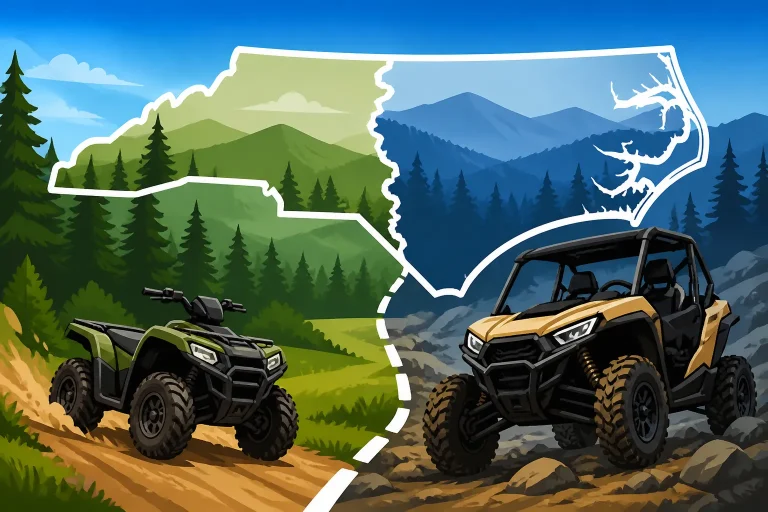
There is no single statewide permission that lets hunters take an ATV off-road to retrieve harvested game. The rules that matter are usually tied to the land: private property, a wildlife game land, or national forest land may each have different vehicle restrictions. A hunting license, access permit, or forest OHV permit does not by itself authorize riding anywhere you choose.
Start by identifying the exact parcel and its manager. A boundary can be easy to miss in the woods, and a route that looks continuous may cross from private property to public land. Check the current regulations, maps, signs, gates, and land manager instructions for the section you intend to travel. If the route or retrieval rule is unclear, ask the managing agency before the hunt rather than assuming that a practical need creates an exception.
| Where the animal is | What to verify before riding | A safer assumption |
|---|---|---|
| Private land | The owner’s permission, the permitted route, and any conditions on vehicle use | Permission to hunt is not automatically permission to drive an ATV |
| State game land | Current game-land rules and which roads are open to motor vehicles | Do not ride off a route specifically open to motor vehicles |
| National forest | The motor-vehicle map, route designation, seasonal closures, and any permit requirements | A trail or road must be open to your vehicle; a permit does not open closed routes |
| Land with mixed ownership | Parcel boundaries and rules on each side of them | Stop before crossing onto land with different rules |
For state game lands, review North Carolina Rules for Riding Game Lands and Game Land Access for North Carolina Riders. Game-land access is not the same as unrestricted motorized access. Routes may be limited, and a hunter should not treat a footpath, wildlife opening, gated road, or unmarked track as an ATV route simply because it leads toward the animal.
On national forest land, check the applicable motor-vehicle map and the current district notices. Some routes are designated for particular vehicle types or seasons, while others are closed to motor vehicles. Rules for recreational riding and rules for hunting access can also differ. A trail permit, where required, does not let a rider leave the authorized route to reach a downed animal. For background, see North Carolina Forest OHV Permits and North Carolina Rules for Riding Off the Trail.
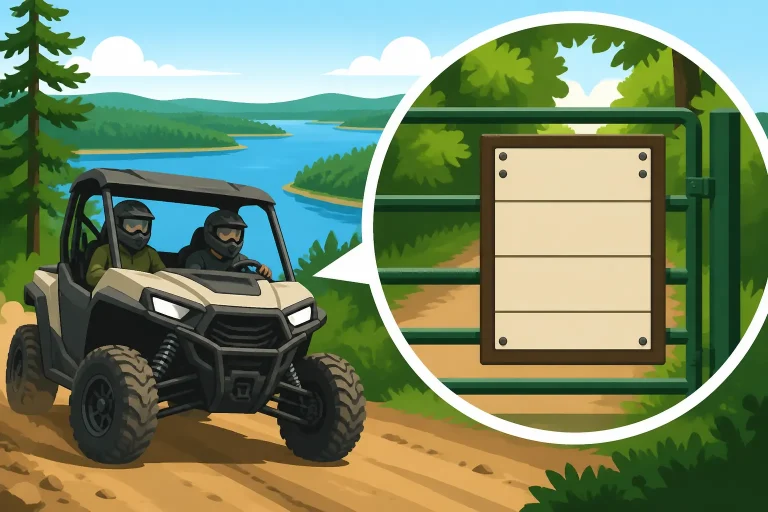
Treat gates, signs, and closures as meaningful boundaries. A gate may mark a road closed to public motorized use even if the road looks passable. Do not go around it, drive through an opening beside it, or assume that a retrieval need changes the restriction. If an animal is beyond a closed route, contact the land manager for direction and use a lawful nonmotorized method unless you receive specific authorization.
What changes on private land
Private land gives an owner more control over access, but it does not make every ATV trip lawful or safe. If you hunt with permission, clarify separately whether you may use a machine to reach the hunting area and whether you may use it to retrieve game. Ask about the specific route, gates, fields, trails, and crossings—not just whether “ATVs are okay.”
Get clear permission from the person who has authority over the property. A hunting invitation from a tenant, club member, or family acquaintance may not include authority to approve motorized access. If the land is leased or managed, confirm who can grant permission and whether the owner or manager has set limits. Written Permission on Private Ground in North Carolina explains why permission should be explicit rather than inferred.
Good permission answers practical questions:
- Which machine may be used, and who may operate it?
- Which route is allowed, and are there areas the ATV must avoid?
- May the machine be used only on established roads, or also on fields or woods trails?
- Are gates to be left open or closed, and who is responsible for closing them?
- Are there limits because of wet ground, livestock, timber work, or neighboring property?
- Does permission apply to the whole hunting party, or only to named riders?
The permission should cover the actual retrieval plan. An owner who allows a hunter to walk in may not want tire damage, ruts, noise, or a machine crossing a planted field. Wet soil is especially vulnerable: an ATV can make a short access trip into lasting damage, and spinning tires can deepen ruts quickly. If the route is soft, steep, or close to a stream, consider packing the animal out or using a hand cart instead.
Property permission also does not excuse unsafe or prohibited riding on a public road. North Carolina’s rules for ATVs on roads are separate from a landowner’s permission to cross a parcel. If the retrieval route approaches or crosses a road, check the applicable restrictions rather than assuming that the owner’s approval carries over to the public right-of-way. North Carolina Rules for Crossing a Road covers that separate issue.
If the machine will be used on a public OHV trail during the trip, check the trail’s requirements too. A forest permit is for access under the applicable forest rules; it is not a general license to use every road or cut across the woods. Learn which forests take a day permit and what the relevant route restrictions are through Which North Carolina Forests Take a Day Permit. Confirm current instructions with the land manager before relying on a permit as part of a hunting plan.
Use the authorized route and keep hunting rules separate
Even when you are entitled to be on the land, the route and the hunting activity have to be considered separately. Being allowed to hunt does not necessarily mean being allowed to drive. Likewise, being allowed to ride a designated trail does not necessarily mean hunting or retrieving game from that trail is permitted.
On game lands, use only routes the current rules allow for motor vehicles. Do not ride into a wildlife opening or through cover simply because the animal is nearby. A wildlife opening may be open to hunters on foot while remaining unavailable to motor vehicles. The same is true of many footpaths and access tracks. See [North Carolina Rules for Riding a Wildlife Opening] for the distinction between an area’s hunting access and vehicle access.
On national forest land, stay within the routes authorized for your vehicle and follow seasonal closures. If a designated OHV trail is open, that does not mean a rider may leave it to reach a carcass. Also check whether the forest route is open to the type and size of machine you plan to use. Forest rules can limit where machines may travel, and an access permit does not override those limits.
Handle firearms and other hunting equipment carefully during any ATV trip. Secure firearms safely, follow applicable firearm laws, and do not assume that a riding permit settles questions about carrying a firearm. For that separate issue, review North Carolina Rules for Carrying a Firearm on a North Carolina Trail. Hunting regulations also apply to the harvest and transport of game; consult the current rules for the species, season, tagging, and reporting requirements.
A practical pre-hunt plan can prevent a difficult decision in the field:
- Identify the land manager and property boundaries on a current map.
- Check current hunting rules and motor-vehicle restrictions for that land.
- Confirm that every part of the intended route is open to the machine.
- Obtain specific permission for private-land ATV use, including retrieval.
- Check closures, gates, and permit requirements shortly before the trip.
- Decide on a nonmotorized backup in case the ATV route is unavailable.
If the animal falls somewhere that cannot lawfully be reached by ATV, do not improvise a route through closed land. Ask the land manager whether there is an authorized access option. If none is available, use a legal pack-out method or seek help from the property owner or hunting party.
Plan a retrieval that does not depend on riding off-route
A machine can be useful for moving gear or carrying an animal along an authorized route, but it may not solve the hardest part of a recovery. The animal may be downhill, across wet ground, in thick brush, or beyond a boundary. Before the hunt, decide how the group will handle those conditions without relying on an unauthorized shortcut.
A lightweight game cart, drag, or pack frame can help move an animal over ground where a vehicle cannot go. For a longer recovery, divide the load into manageable trips and make sure the group has enough people, water, and light to finish safely. If the animal is large or the terrain is steep, getting help is usually better than trying to tow it with a machine.
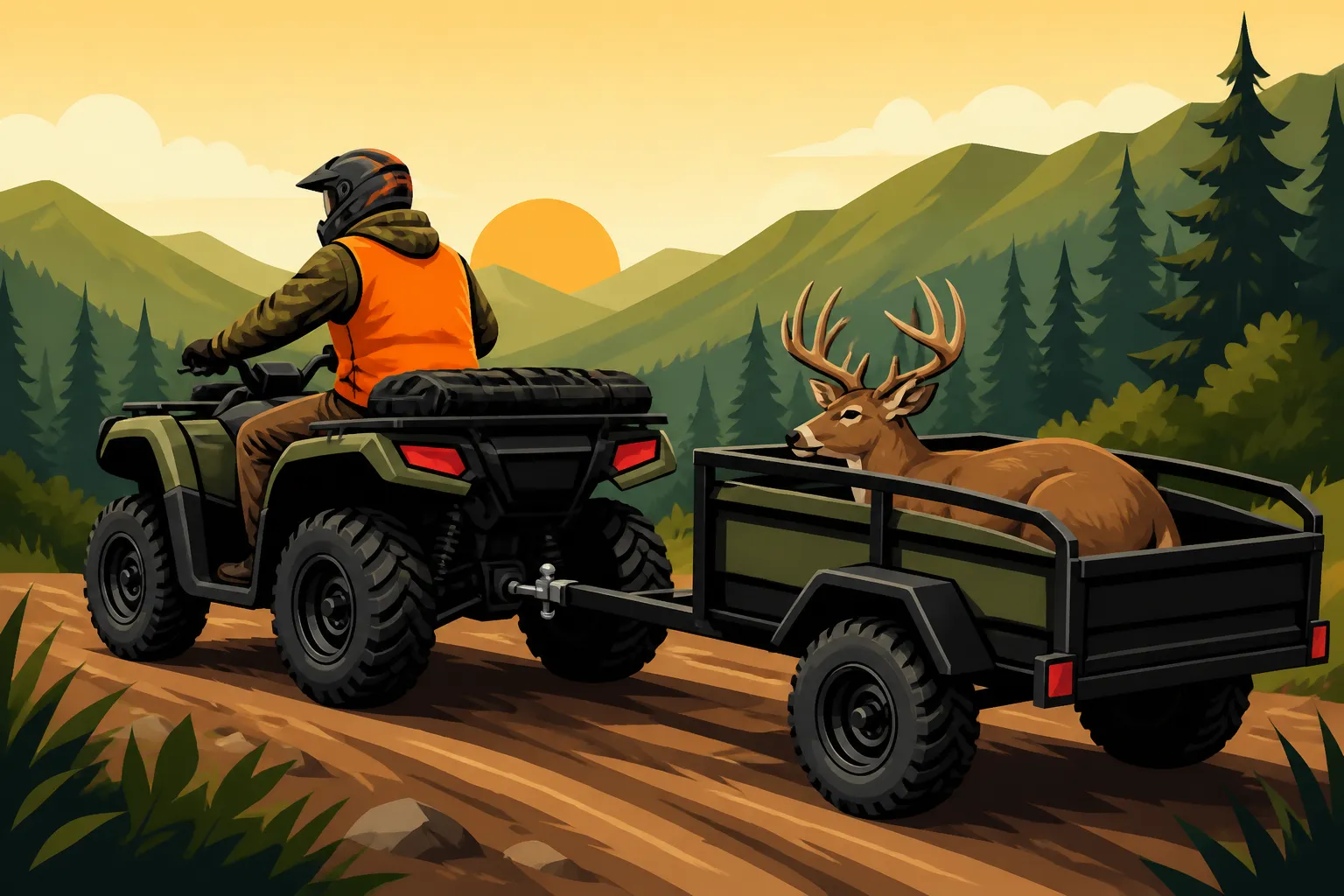
Avoid using an ATV to drag an animal across a trail, road, or slope unless the land manager permits the route and the method is safe. A tow strap can snag, a machine can lose traction, and an animal or load can shift unexpectedly. Keep riders clear of the tow line, follow the manufacturer’s towing guidance, and do not overload the ATV or its rack. A passenger should not ride on a machine that is not designed and equipped for one.
Be especially cautious near water, steep banks, and soft ground. A machine that can travel forward may not be able to turn around or climb back out with a load. If the route is muddy, steep, or unfamiliar, leave the ATV on firm ground and use a hand-carried method where permitted. Protecting the route matters too: avoid creating ruts, widening a trail, or disturbing a stream bank.
Nightfall can turn a manageable recovery into a risky one. Bring a charged phone or communication device, a light, basic first aid supplies, and a way to tell the group where the machine is parked. Do not count on cell service in remote areas. Set a time to turn back if conditions worsen, and make sure someone knows the planned route and expected return.
If a retrieval requires crossing a boundary, contact the landowner or manager before crossing. A boundary line is not a formality: the permission and vehicle rules can change as soon as the machine leaves one parcel. When in doubt, park, confirm access, and proceed only by a route that is clearly allowed.
The most reliable rule is simple: plan the recovery around the routes you are authorized to use, not around the route that seems shortest. On private land, get clear permission for ATV retrieval. On game lands and national forests, verify the current motor-vehicle rules and stay on designated routes. When no lawful ATV route reaches the animal, use a nonmotorized method or ask the land manager for direction.
Disclaimer
This article is for general informational purposes only and does not constitute professional advice. Laws, prices and regulations vary by location and change over time. Consult a qualified professional for guidance on your specific situation.