North Carolina ATV Safety Certificate Requirements
North Carolina riders can confuse an ATV safety certificate with a trail permit, registration, or proof of ownership. The key question is usually your date of birth and where you plan to ride. Here’s how to understand the requirement, find an approved course, carry proof, and avoid assuming that another state’s certificate automatically counts.
Who Needs a North Carolina ATV Safety Certificate
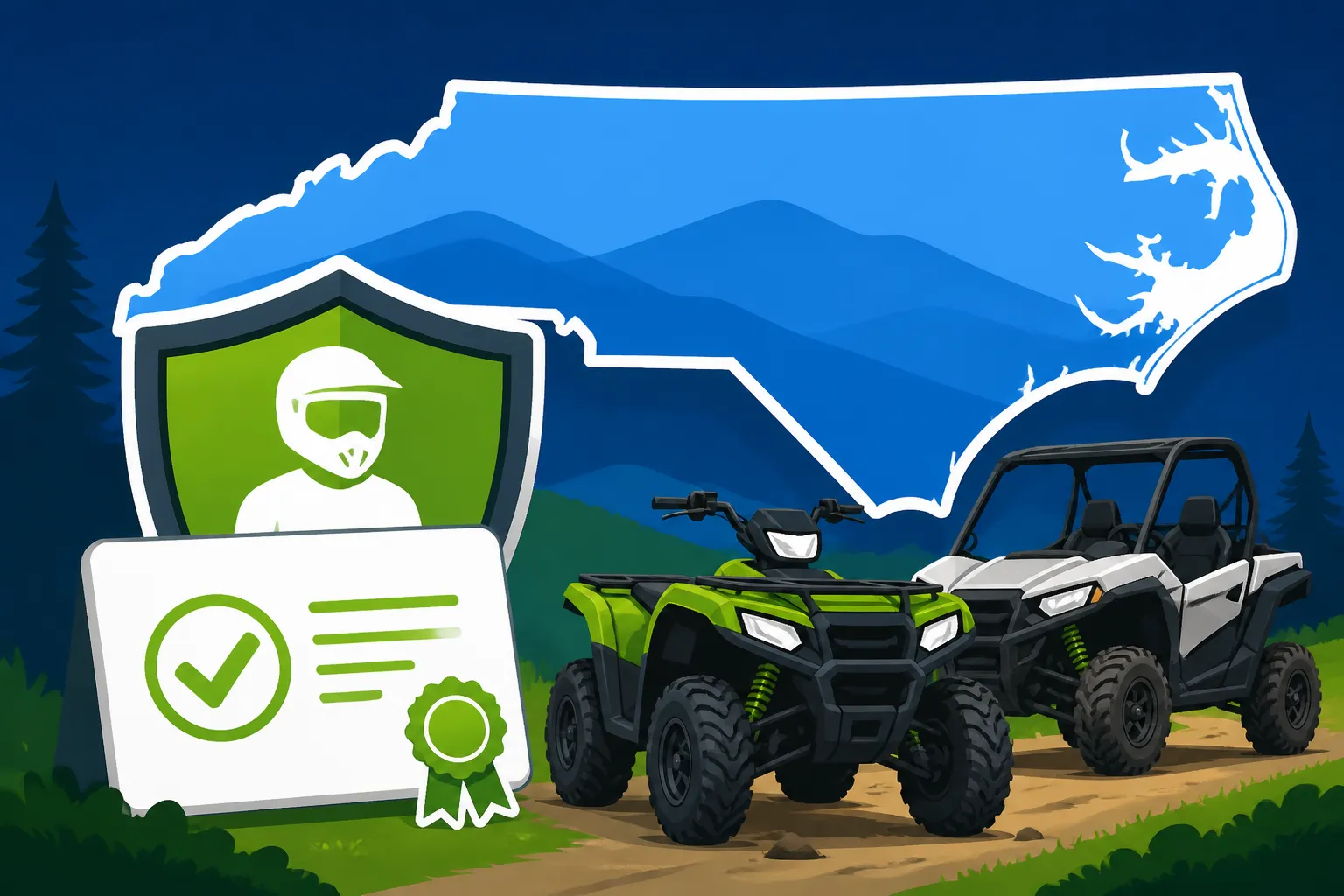
North Carolina’s birth-year rule generally requires an ATV operator born on or after January 1, 1990, to complete an ATV safety course approved by the Commissioner of Insurance when riding on public land. The rule is based on your date of birth, not whether you are currently a minor or an adult.
That makes the January 1990 cutoff important. Someone born on January 1, 1990, falls on the “on or after” side of the line. Someone born in 1989 does not fall under this particular birth-year requirement. For more on that cutoff, see January 1990 and the North Carolina Line and Why the Certificate Binds by Birth Year.
| Your birth date | What the birth-year rule means |
|---|---|
| Before January 1, 1990 | You are not covered by this specific birth-year requirement |
| January 1, 1990, or later | You generally need an approved ATV safety course to ride an ATV on public land |
| Any birth date, private property | The public-land certificate rule may not apply, but permission and other safety or legal rules still matter |
This certificate requirement is not the same as North Carolina’s age and supervision rules. A younger rider may need adult supervision or may be prohibited from riding in certain situations even if they have completed a course. Conversely, an adult born before the cutoff is not automatically exempt from every rule that applies to the trail or riding area. Review North Carolina Rules for Riders Born On or After 1990 and [North Carolina Supervision Rules for Young Riders] if a minor will be riding.
The rule also does not make every public road or public property open to ATVs. A certificate is a training credential, not permission to ride anywhere. You still need to follow the land manager’s access rules, stay on routes open to your machine, and meet any applicable permit or equipment requirements. For instance, a national forest trail can have separate permit and route rules even when a rider has the required certificate.
What counts as public land
“Public land” can include riding areas managed by a government agency, but access rules are not identical everywhere. A forest, state-managed area, or other public site may have its own rules about eligible machines, open trails, passes, operating seasons, and required documents. Do not assume that the word “public” means every road or trail is available for ATV use.
Private property is different, but it is not a free-for-all. Get the landowner’s permission and follow any local rules that apply. A landowner’s invitation does not authorize riding onto neighboring property or using a public road illegally. See North Carolina Rules for Riding Private Land for the separate permission question.
How to Meet the Requirement
To comply, take an ATV safety course that is approved for North Carolina’s requirement. The important detail is approval, not simply whether a class is called a safety course. Before enrolling, confirm that the course qualifies under the state requirement and that you will receive documentation showing completion.
Use this process:
- Check your birth date against the cutoff. If you were born on or after January 1, 1990, plan to meet the course requirement before riding an ATV on public land.
- Confirm that the course is approved. Ask the course provider whether its training satisfies North Carolina’s ATV safety certificate requirement. If the provider is unclear, check with the relevant state office or the land manager where you intend to ride.
- Complete the course and keep the proof. Save the certificate or other completion record in a place you can access during the trip. A confirmation email may be useful for your records, but do not assume it replaces the certificate if an officer or land manager asks for formal proof.
- Check the riding area’s rules separately. Confirm whether a permit is required, which trails are open, and whether the rules apply to your specific machine.
- Carry the documentation when you ride. Keeping proof with you avoids relying on a phone connection or trying to retrieve records at a trailhead.
Course content can cover practical topics such as operating controls, safe riding practices, protective equipment, and how to respond to common hazards. The exact format, availability, and documentation offered can vary. Check Where to Take a North Carolina ATV Safety Course for help finding a course, and North Carolina ATV Safety Course Cost for what to confirm about course expenses. For a broader overview of the certificate rule, see North Carolina ATV Safety Certificate Requirements.
The certificate does not replace a permit. A permit is tied to access at a specific riding area, while the safety certificate addresses the operator’s training requirement. A rider may need both. North Carolina’s public riding areas can have different permit systems, and some areas may require a pass for each machine rather than each rider. Check the local rules before leaving home.
A certificate also does not register or title the ATV. North Carolina’s paperwork for ownership and public-land access serves different purposes. If you are sorting out ownership documents, start with Do You Need a Title for an ATV in North Carolina?. If your question is whether you need to register the machine, see Do You Need to Register an ATV in North Carolina?.
Visitors, Reciprocity, and UTVs
Visitors should not assume that a safety card, registration, or trail credential from another state automatically satisfies North Carolina’s requirements. North Carolina does not offer broad reciprocity for these requirements. If you were born on or after the cutoff, verify whether your out-of-state course documentation is accepted before traveling. The course’s name or the state that issued a card does not, by itself, prove that it meets North Carolina’s approval standard.
If you ride in North Carolina regularly, it is often simplest to confirm directly with the course provider or the agency responsible for the riding area, and to keep clear proof of course completion. Ask specific questions: Does this course meet the state requirement? What documentation will I receive? Will the land manager accept that documentation for this ride? A quick check is better than discovering a problem after arriving with a trailer and machine.
A visiting rider must also comply with rules that apply to the location, not just the rider’s home state. A home-state registration or permit may have no bearing on whether a North Carolina trail is open to that vehicle. For the broader visitor issue, see [North Carolina Rules for a Visiting Rider] and Does North Carolina Accept an Out-of-State Certificate?. For the limits of reciprocity, see Why North Carolina Has Nothing to Reciprocate.
The term “ATV” can also cause confusion when a group includes a side-by-side or other off-road vehicle. A course requirement written for ATVs should not automatically be assumed to settle every rule for every UTV or utility vehicle. The machine’s classification and the riding area’s rules matter. Check whether the land manager treats your vehicle as an ATV, UTV, or another category, and ask which training documentation it expects.
This distinction matters because a UTV may have different trail access, permit, or equipment conditions from a quad. A safety certificate does not make a vehicle eligible for a trail that excludes its size or type. Before riding, confirm both the operator requirement and the vehicle requirement. North Carolina Rules for a Rented Machine can help if you are using a rental rather than your own ATV.
What to Carry and What the Certificate Does Not Do
Carry proof of course completion whenever you ride somewhere the requirement applies. A paper certificate is useful, and a digital copy can serve as a backup if the riding area accepts it. Keep the original or official record safe; a phone photo is not guaranteed to satisfy every person checking documents. For more on proof, see Carrying the Certificate on a North Carolina Ride.
It also helps to keep your trip documents organized together. Depending on the riding area and machine, that could mean your safety-course documentation, an area permit, permission for private land, and any paperwork related to the vehicle. These documents answer different questions:
- Safety certificate: Has the operator completed the required training?
- Trail or forest permit: Has the rider paid for or received access under that area’s rules?
- Title or ownership paperwork: Who owns the machine?
- Registration or road credentials: Is the machine authorized for a particular type of road use?
- Landowner permission: Has the owner agreed to let you ride on private property?
A certificate does not grant access to closed trails, authorize riding on a public street, or excuse unsafe operation. It does not override a posted restriction, a seasonal closure, or a land manager’s machine limits. Nor does it automatically satisfy helmet, supervision, passenger, or equipment rules. Check North Carolina Helmet Rules on Forest Trails and North Carolina Rules for Riding a Closed Trail when those issues are relevant.
If you are unsure what a site will accept, contact the land manager before the trip and describe your situation plainly: your birth date, the course you completed, the machine you will operate, and the location where you plan to ride. Ask what proof to bring and whether that machine can use the planned route. Confirming both points helps prevent a certificate from being mistaken for an all-purpose riding pass.
Disclaimer
This article is for general informational purposes only and does not constitute professional advice. Laws, prices and regulations vary by location and change over time. Consult a qualified professional for guidance on your specific situation.