Packing a Deer Out by Machine in North Carolina
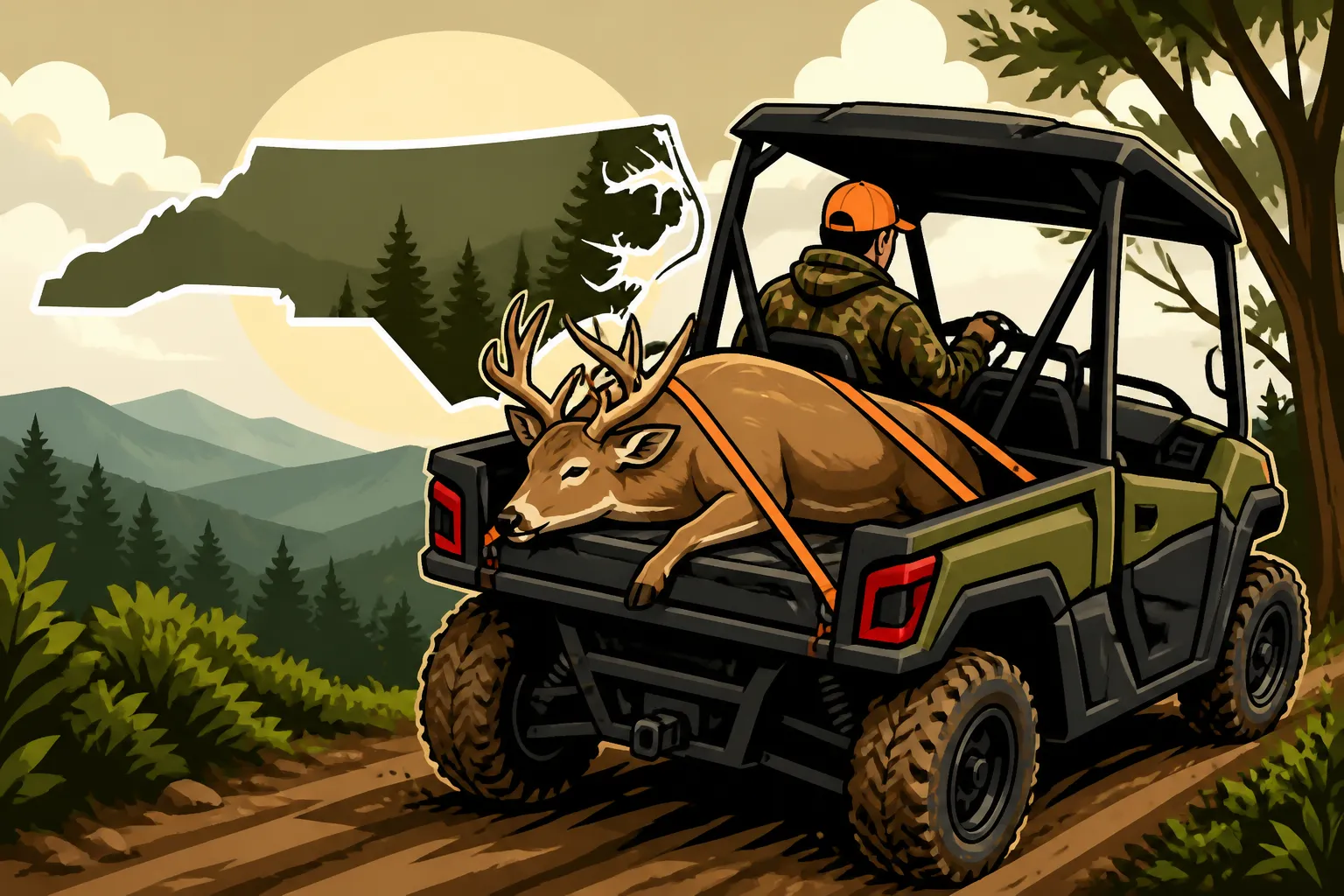
Packing a deer out by ATV or UTV can save a long, difficult carry, but the machine does not automatically have permission to go wherever the animal fell. In North Carolina, the answer depends on who controls the land, which routes are open to motor vehicles, and the rules for that hunting area. Here’s how to plan a recovery without turning a successful hunt into a trespass or trail violation.
Check the land rules before the hunt
The first question is not whether your machine can reach the deer. It is whether you are allowed to ride it to the recovery site. Hunting access and motorized access are separate permissions, and permission to hunt does not by itself authorize off-road travel.
On private land, get the landowner’s agreement for both hunting and machine use. Ask which roads, lanes, or fields you may use, and whether the permission covers recovery after dark or when the ground is wet. A landowner may be comfortable with foot access but not with an ATV crossing a field, cutting through timber, or widening a muddy track. If permission is limited, stay within its boundaries. Written Landowner Permission in North Carolina and Riding Private Ground in North Carolina explain why the details matter.
On public land, check the managing agency’s current rules for the exact property. A game land, national forest, state park, and private off-road park may have different boundaries and vehicle rules, even when they sit next to one another. On many public properties, motor vehicles are limited to roads or routes specifically open to them. A harvested deer’s location does not create an automatic right to leave an open route and drive cross-country.
For game lands, consult the current site-specific rules before the season or trip. Do not assume that a road visible on a map is open to ATVs, or that a footpath, fire line, gated road, or logging road is a motorized route. The general principles in North Carolina Rules for Riding Game Lands and North Carolina Rules for Riding Off the Trail are useful starting points, but the property’s posted rules and current official notices control.
| Where the deer is | What to confirm before riding in |
|---|---|
| Private land | The owner’s permission for the machine, route, and recovery activity |
| Game land | Whether motor vehicles are permitted on the specific route and under the current property rules |
| National forest | Which roads or trails are open to your machine, plus any permit or seasonal requirements |
| Public road or shoulder | Whether the machine may use that road; do not treat a short trip as an automatic exception |
| Boundary between properties | Which agency or owner controls each part of the route |
If your hunt is near a national forest OHV area, keep hunting access separate from trail access. A forest riding permit, where required, is for the permitted riding use; it does not grant permission to leave a designated route to reach a deer. Check North Carolina Forest OHV Permits and North Carolina Rules for Riding a Closed Trail before relying on a nearby OHV trail or forest road. Closures can change, and a route that was open on an earlier visit may not be open when you return.
It also helps to check the rules for the hunting activity itself. The regulations that apply while hunting may differ from those that apply to transporting a legally harvested animal. Review North Carolina Rules for Riding While Hunting and the current hunting regulations for the season, including any rules about weapons, vehicle use, and the area where you plan to hunt.
Plan a legal recovery route
A good recovery plan starts before the shot. Identify the likely exit route, not just the nearest point on a map. A short, direct line across a creek, wet bottom, posted boundary, or closed trail may be less practical—and less lawful—than a longer route on an approved road.
- Identify who manages the land. Check parcel or property information and confirm the boundary in the field. When the boundary is unclear, do not ride across it based on assumption.
- Confirm the route is open to your machine. Look for current agency maps, notices, gates, and signs. A route open to trucks or authorized personnel may not be open to recreational ATV or UTV use.
- Ask about recovery access specifically. If you have permission to hunt or ride, make sure it covers retrieving game by machine. On private property, settle the route and any restrictions with the owner. On public land, ask the managing office if the posted rules do not answer the question.
- Choose a fallback. Be ready to recover the deer by hand, use a sled or cart where allowed, or arrange help if machine access is not permitted. Do not plan on forcing a route through brush or around a locked gate.
- Check road crossings separately. A permitted trail does not necessarily let you ride along a public road to reach another route. Follow the specific rules for crossing and road use; Crossing a North Carolina Road and Nothing More covers the distinction.
The key practical distinction is between traveling on a route that is open to your machine and leaving that route to reach the animal. If the deer is down beyond the approved route, do not assume that a brief detour is allowed because the purpose is recovery. Ask the land manager or landowner about legal options. In some places, the answer may be to carry or drag the deer to an authorized route rather than take the machine to it.
If a gate is closed, a trail is posted as closed, or a route is marked for nonmotorized use, do not treat the situation as an invitation to make an exception. A closure may protect the road surface, wildlife, habitat, or public safety. A hunting license, forest permit, or landowner’s permission for another area does not override a separate closure.
For details on the relationship between hunting and vehicle access, see Retrieving Game by ATV in North Carolina. The useful takeaway is to verify the specific route and land rules rather than rely on a broad claim that hunters may use machines to recover deer.
Prepare the machine and the load
Once the route is settled, prepare the machine for a slow, controlled trip. A deer is bulky, can shift, and may add substantial weight. Follow the ATV or UTV manufacturer’s load limits and use approved racks, a trailer, or other equipment designed for the machine. Do not put the animal where it blocks the driver’s view, controls, lights, or access to an emergency stop.
A practical recovery kit can include:
- A drag rope or game sled suited to the terrain
- Ratchet straps or other secure tie-downs
- Gloves and a clean tarp or game bags
- A knife and basic field-dressing supplies
- A small first-aid kit and a charged phone or radio
- A headlamp or flashlight for packing and unloading
- Water and a way to keep the carcass clean and cool
Choose gear that fits the route. A sled may work well on open ground but snag in thick brush or be difficult on steep, rocky terrain. A winch can help with recovery in some situations, but it is not a reason to enter a prohibited area or pull a machine beyond safe limits. If comparing straps, sleds, or storage gear, Amazon may be one place to check product options; confirm compatibility and load ratings rather than choosing by appearance.
Keep the cargo low and secure. A high, uneven load can make a machine unstable, especially on a side slope. Balance weight across the machine where possible and avoid overloading a single rack. Do not tow a deer with a rope attached to a rider, passenger, or part of the machine where it could snag. If the terrain is steep or the load makes steering or braking uncertain, stop and use another method.
Field dressing and cooling are also part of a good pack-out. Follow safe game-handling practices, keep the carcass away from dirt and exhaust, and avoid leaving it in a warm enclosed space. If a long haul is needed, plan how you will keep the meat clean and cool after reaching the vehicle. For food-safety questions, follow current wildlife and public-health guidance for handling wild game.
Before moving, check that straps are snug and clear of tires, tracks, exhaust, and moving parts. Have a second person check the load if one is available. Travel slowly, avoid sharp turns, and stop after the first short stretch to check whether anything has shifted. Do not carry a passenger on a machine that is not designed for one, and do not let the load compromise safe seating.
Avoid common pack-out mistakes
A frequent mistake is treating the reason for the ride as permission to ride. Recovering a deer is a legitimate need, but it does not automatically cancel a trail closure, access restriction, or landowner boundary. If a route is not clearly open, pause and verify instead of proceeding on a guess.
Another is confusing a public road with a private farm lane or forest road. Different routes can have different rules, and a road that looks drivable may be closed to your type of machine. Do not ride along a public street simply because it is the quickest connection between a hunting spot and an open trail. Check the applicable road rules and keep any crossing within the rules described in Crossing a North Carolina Road and Nothing More.
Avoid these other problems:
- Assuming a permit covers every nearby trail. A permit may apply only to specified areas or uses. Confirm its scope and keep any required proof available.
- Following old maps or word of mouth. Gates, damage, seasonal access, and land boundaries can change. Check current notices and signs before unloading.
- Making a new trail through wet ground. Tires can cause lasting damage, and the route may not be authorized. Use an open route or another recovery method.
- Leaving the carcass unattended on the machine. Secure it, keep it clean, and avoid parking where it blocks a road or trail.
- Driving faster to beat darkness. A secured load and clear route matter more than saving a few minutes. If visibility is poor or the route is unfamiliar, stop somewhere safe and reassess.
- Assuming an ATV or UTV can use a road because it is registered or equipped. Vehicle status does not settle whether a particular road is open to it.
If you reach a barrier or an official tells you to turn back, comply and ask where machine use is allowed. When the legality of a route is uncertain, a call to the land manager before the hunt is much easier than sorting out a violation, damaged ground, or a stranded machine afterward.
A simple plan makes the recovery safer: know the property boundary, confirm the route, carry gear that suits the terrain, and have a non-motorized backup. That way, the machine helps with the work without creating a new problem.
Disclaimer
This article is for general informational purposes only and does not constitute professional advice. Laws, prices and regulations vary by location and change over time. Consult a qualified professional for guidance on your specific situation.