Riding a Game Land With a Hunting License
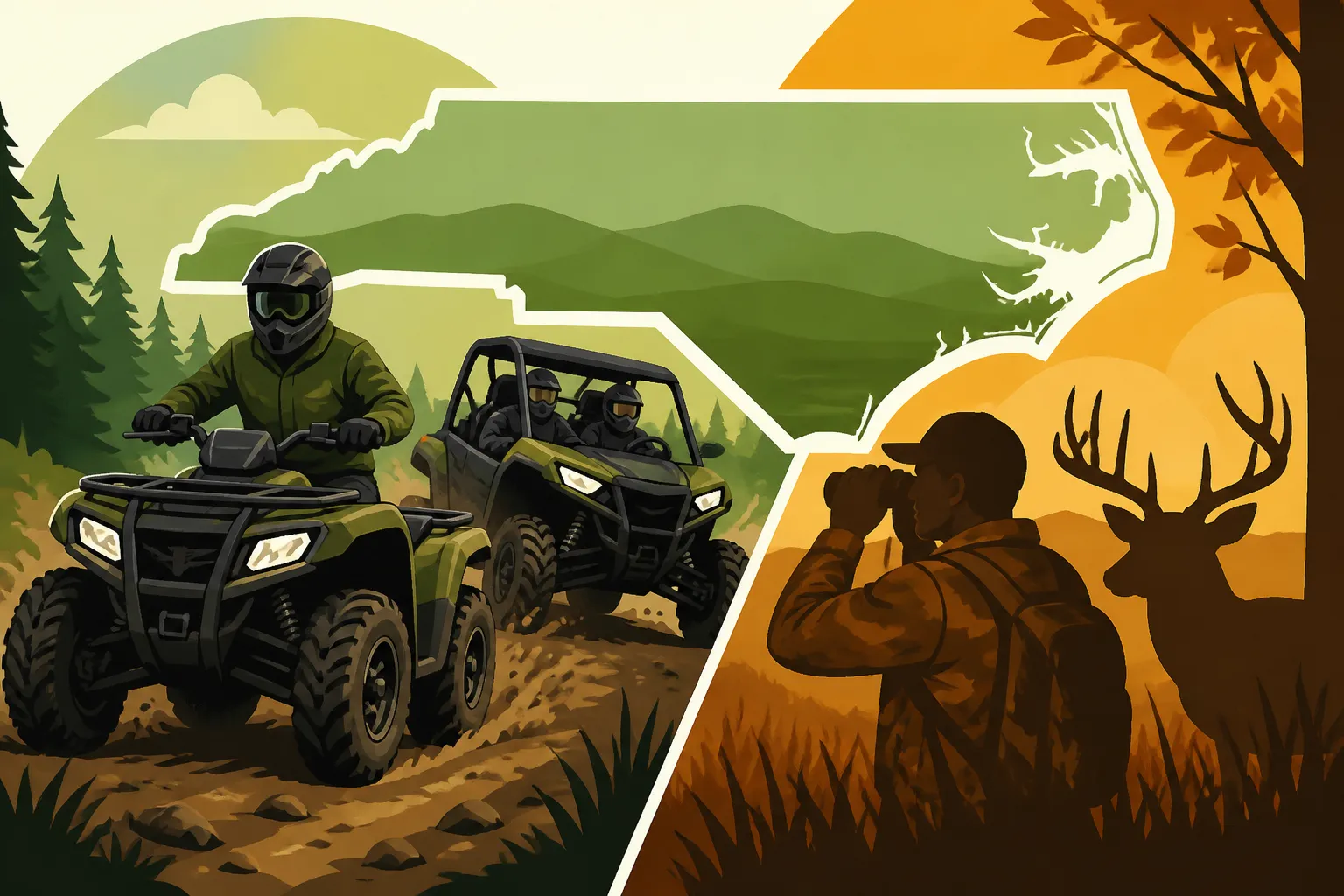
A North Carolina hunting license lets you hunt where its terms allow, but it does not automatically let you ride an ATV or UTV across game lands. That distinction can be easy to miss when a trail, access road, and hunting area sit close together. Here’s how to separate hunting authorization from vehicle access, identify limited exceptions, and check what you need before unloading a machine.
A hunting license is not permission to ride
The direct answer is no: possessing a valid hunting license does not, by itself, grant permission to operate an ATV or UTV on North Carolina game lands. The North Carolina Wildlife Resources Commission says ATVs are generally prohibited there unless a specific exception applies.
A hunting license and permission to use a vehicle are different kinds of authorization. The license relates to hunting. It does not automatically open every road or tract within a game land to motorized travel, even if you plan to hunt there or need to reach a hunting spot. The same caution applies to a vehicle title, a pass for a different riding area, or permission from someone who does not manage the land.
Some exceptions may apply, including on designated National Forest lands or for people with specific disabled-access or hunt permits, according to the North Carolina Wildlife Resources Commission. But an exception is not a general invitation to ride. You need to confirm that it covers your vehicle, the particular place, and the purpose of your trip. Don’t assume a permit for a disabled hunter applies to every rider in a group or authorizes travel anywhere on the game land.
This distinction matters because boundaries and land management can be complicated. A hunting area may adjoin federal forest, private property, or a marked OHV trail, and the rules for one parcel do not automatically carry over to the next. A route that appears to connect two public areas may cross land where riding is not allowed.
For a broader overview of access, see Game Land Access for North Carolina Riders and North Carolina Rules for Riding Game Lands. Those topics help frame the key question: not merely whether you may hunt in the area, but whether the land manager allows your vehicle on the specific route.
How game lands differ from designated Forest Service OHV trails
A common source of confusion is that North Carolina has game lands as well as motorized trails in National Forests. These designations can overlap geographically, but they are not interchangeable. A hunting license does not stand in for an OHV pass, and an OHV pass does not automatically authorize hunting.
The Forest Service says there are only four designated OHV areas within the National Forests of North Carolina. That limited network is a useful reminder that a National Forest is not open to unrestricted off-road driving. Forest Service motorized riding is confined to designated places and trails, and riders must follow the rules for the particular area.
| What you have or want to do | What it authorizes | What it does not automatically authorize |
|---|---|---|
| North Carolina hunting license | Hunting as allowed under the license and applicable rules | Riding an ATV or UTV across game lands |
| Specific disabled-access or hunt permit | The access described by that permit, if its terms apply | General riding outside the permitted access |
| Forest Service OHV pass | Riding in the designated area covered by the pass | Riding on other game lands or unmarked routes |
| ATV or UTV title or ownership papers | Evidence relating to ownership | Permission to ride on public land |
| Private landowner permission | Access within the scope of the permission | Access across neighboring or public land |
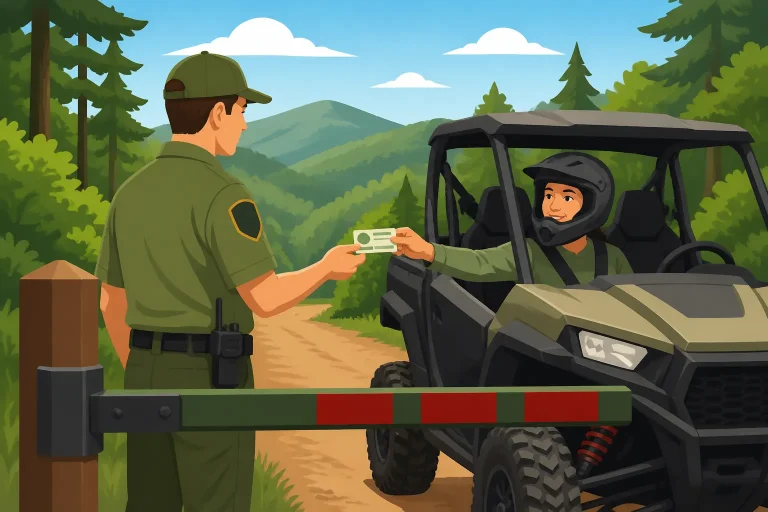
According to the Forest Service, a valid pass is required for the specific area where you are recreating, and trail riders must carry the pass while on the trails. Passes for riding in the National Forests in North Carolina are sold through Recreation.gov. The Forest Service also says a state driver’s license must be available during a law enforcement compliance check, and a pass is valid until midnight on the date written on it.
Those requirements are separate from game-land access rules. If your intended route passes through or next to game lands, check the boundary and the applicable restrictions before you ride. Do not treat a National Forest boundary, a hunting area map, or a trailhead sign as proof that every connecting route is open to ATVs.
If the destination is a Forest Service OHV trail, start with North Carolina Forest OHV Permits and Do You Need a Permit for North Carolina Forest Trails?. For the separate question of why a machine’s paperwork is not the same as trail access, see Why North Carolina Has No ATV Registration. An ownership document may matter for a transaction, but it does not grant land-use permission.
Check the exact location and any exception before you go
Before loading your ATV or UTV, identify the exact place you want to ride—not just the nearest game land, campground, or trail system. Then confirm which agency manages the land and what that agency allows for your activity. If you have a special permit, read its conditions rather than relying on its name or on a verbal summary.
A practical check looks like this:
- Mark the intended route. Identify the starting point, destination, and every road or trail between them. If a map does not clearly show whether riding is allowed, treat that as a reason to confirm, not as permission.
- Identify the land manager. Game lands and Forest Service OHV trails may have different rules, even when they are near each other. Ask the agency responsible for the specific parcel or trail.
- Explain your situation clearly. Say whether you have a hunting license, a disabled-access or hunt permit, or a Forest Service OHV pass. Ask whether that document authorizes the particular machine, route, and purpose.
- Check for limits and closures. Confirm which trails are designated for motorized use, whether access is currently open, and whether any conditions apply to your vehicle or trip.
- Carry the required documents. If riding a Forest Service OHV trail, the Forest Service requires riders to carry a valid pass and have a state driver’s license available for a compliance check.
- Stay within the authorization. A permitted route does not mean nearby unmarked roads or connecting ground are also open. Turn around rather than continuing onto land where access is unclear.
This process is especially important if the trip combines hunting and riding. You may be permitted to hunt in an area but not ride there, or you may be allowed to ride on a designated trail without being authorized to hunt from it. Treat each activity as a separate question and verify both.
Do not rely on a hunting license as a substitute for a vehicle permit, trail pass, or landowner permission. Likewise, a Forest Service pass does not create access across private property or make a prohibited game-land route legal. If different land managers control different parts of your route, confirm each segment with the appropriate manager.
Riding safely and avoiding common assumptions
Even when you have confirmed that a particular trail is open to your machine, riding rules still apply. The Forest Service requires ATV and motorcycle operators and passengers to wear helmets and eye protection that meet US DOT motorcycle safety standards. It also requires a working spark-arresting device for an OHV with an internal or external combustion engine. Forest Service rules prohibit riding off designated trails, and ATVs cannot be registered for use on Forest Service roads, so they must be trailered to the trailhead.
Age and supervision requirements are another reason to check the rules for the specific site. The Forest Service says children under 8 may not operate an ATV, UTV, or motorcycle; children under 12 may not operate an ATV or UTV 70cc or larger; and children under 16 may not operate an ATV or UTV 90cc or larger. It also requires children under 16 to remain under the continuous visual supervision of an adult over 18. These requirements do not create access where riding is otherwise prohibited.
A few assumptions are worth avoiding:
- “I have a hunting license, so I can ride to my hunting spot.” The license does not automatically authorize ATV or UTV use on game lands.
- “It’s National Forest land, so off-road riding is allowed.” The Forest Service designates specific OHV areas and trails; the broader forest is not a blanket riding area.
- “My machine is titled, so it is legal on the road or trail.” Ownership paperwork is not an access permit.
- “The route is open to another vehicle, so my ATV can use it too.” Rules may differ by vehicle type and road designation.
- “A pass for one riding area works nearby.” Forest Service passes apply to the specific area where you are recreating.
- “A hunting-related exception covers everyone in the group.” Confirm who and what the permit covers; do not extend its terms by assumption.
The most reliable answer comes from matching your documents to the specific activity and place. If you are going to hunt, confirm the hunting authorization and applicable game-land rules. If you are going to ride, confirm that motorized use is allowed on the exact trail and obtain any required area-specific pass. If the trip involves both, verify both before setting out.
That may take an extra call or map check, but it is safer than discovering at the access point that a hunting license does not cover the ride. For a Forest Service trail, use the trail-specific information and pass requirements; for game lands, ask the Wildlife Resources Commission or the land manager about the precise access exception you believe applies.
Sources
- Forest Service — National Forests in North Carolina | Off-Highway Vehicles (OHV) | Forest Service (checked November 3, 2026)
- OSFM — ATV Safety | OSFM (checked November 3, 2026)
- Forest Service — National Forests in North Carolina | Black Swamp OHV Trailhead | Forest Service (checked November 3, 2026)
- Forest Service — National Forests in North Carolina | Brown Mountain OHV Trail System | Forest Service (checked November 3, 2026)
- Forest Service — National Forests in North Carolina | Off-Highway Vehicles (OHV) | Forest Service (checked November 3, 2026)
- USDA Forest Service — National Forests in North Carolina | Off-Highway Vehicles (OHV) | Forest Service (checked November 3, 2026)
Disclaimer
This article is for general informational purposes only and does not constitute professional advice. Laws, prices and regulations vary by location and change over time. Consult a qualified professional for guidance on your specific situation.