Badin Lake’s Season Permit
Badin Lake’s season permit can make repeat rides simpler, but it is easy to mistake it for a statewide ATV registration or assume it covers every trail system. The key is knowing which riding area it applies to, how each machine must display it, and what else riders need before unloading. This guide explains how to plan around the permit and what to verify before heading out.
What the Badin Lake season permit covers
Badin Lake OHV Trail Complex is a designated off-highway vehicle riding area in the Uwharrie National Forest. Riders using the complex need to follow its access and permit rules. A season permit is the multi-visit option: instead of arranging a separate day permit for every ride, you obtain a permit for the applicable season and use it according to the instructions that come with it.
The permit is for access to the designated riding area, not a general license to ride anywhere in North Carolina. It does not give permission to use closed trails, ride off marked routes, cross private property, or take an ATV onto public roads. It also does not replace any safety certificate or other requirement that applies to you or your machine.
The distinction matters because several things riders call “registration” or “a trail sticker” are separate:
- A forest OHV permit is tied to recreational access to a specific public riding area.
- A vehicle title is ownership paperwork. It does not by itself provide trail access.
- A state registration or road plate is a different type of credential. A forest permit does not make an ATV street legal.
- A safety certificate, when required for a rider, is separate from the permit.
- A sticker or placard issued with a permit is evidence of access; it is not a universal North Carolina trail decal.
For a closer look at how forest access permits work across the state, see North Carolina Forest OHV Permits. If you are trying to sort out whether a permit is needed for a particular outing, Do You Need a Permit for North Carolina Forest Trails? explains the broader distinction between public forest riding, private riding areas, and other kinds of land access.
It applies to a riding area, not every forest road
Badin Lake’s trails are not interchangeable with every road or trail in the Uwharrie National Forest. The complex has its own marked riding routes and access points. A permit for the OHV area should not be treated as authority to ride a nearby road, a closed route, or a trail in another forest district.
The same caution applies when you ride elsewhere. A Badin Lake permit should not be assumed to cover Brown Mountain or Wayehutta. Each riding area can have its own permit arrangement, season, operating dates, and trail status. Check the rules for your destination rather than carrying one permit and assuming it works throughout the state.
The Badin Lake OHV Trail Complex page is a useful place to start planning the riding area itself. For route choices, trail names, and the way the trail network is organized, see Badin Lake’s Eight Named Trails. A permit does not make a route suitable for every machine or rider, so look at the current map and difficulty information as well.
It is not a road-use permit
A forest OHV permit is for riding where OHV use is allowed. It does not authorize riding an ATV on a public street to reach a trailhead, or using an open public road as a shortcut between routes. Where a road is open to a particular kind of vehicle, the rules for that road still apply.
This is one reason to plan the trip as a trail outing rather than a road ride. Trailer the machine to an authorized staging area, unload where permitted, and stay on routes open to your vehicle. For the separate question of whether an ATV can be used on a North Carolina street, see Are ATVs Street Legal in North Carolina?.
Season permit or day permit
The practical choice is usually about how often you expect to ride at Badin Lake and whether the season dates fit your plans. A day permit is straightforward for an occasional visit. A season permit can be more convenient if you expect to return, but it still has limits: it applies to the stated season and riding area, and it has to be used in the way the issuing authority specifies.
| Question | Season permit | Day permit |
|---|---|---|
| Best fit | Riders planning multiple visits during the permit season | A one-time or occasional visit |
| Validity | The season and location stated for that permit | The date or period stated for that permit |
| Machine coverage | Confirm whether a separate permit is required for each machine | Confirm the day-permit rules for each machine |
| Trail access | Only routes open to OHVs at the covered area | Only routes open to OHVs at the covered area |
| Other requirements | Still applies; does not replace safety or equipment rules | Still applies; does not replace safety or equipment rules |
| Main thing to verify | Current season dates, purchase method, and display instructions | Current payment method, where to obtain it, and proof to carry |
Do not choose a season permit just because you expect to ride “through winter” or “all year.” Forest riding seasons and permit periods do not necessarily follow the calendar year. Badin Lake’s season permit has been listed with a mid-December end date, but dates and procedures can change. Confirm the current end date and whether any scheduled closure affects the trip. The article The Badin Lake Season Permit Ends December 15 covers why the listed end date matters, but the current official notice should control your plan.
A season permit also does not guarantee that the trails will be open every day of the season. A closure can result from weather, trail damage, maintenance, staffing, or another forest-management decision. If a gate is closed or a route is posted as closed, the permit does not override that restriction.
Compare the cost by expected visits
Forest agencies may set different prices and sales arrangements for day and season permits, and those details can change. Check the official information for current figures instead of relying on an old receipt, a forum post, or what a riding partner paid previously.
To decide which option makes sense, compare the current season-permit cost with the cost of the day permits you would actually buy. Be realistic about how many trips you will make. Consider travel distance, seasonal closures, weather, and whether your riding group will still be able to use the complex on the dates you have in mind. A season permit may be convenient even when it does not produce a large saving; for another rider, a day permit may be the simpler choice.
The permit is generally associated with the vehicle rather than being a group pass for everyone in a truck or trailer. If your family or riding group brings more than one machine, confirm the per-machine rule before purchasing. The related article Every Machine Needs Its Own Trailhead Box Permit explains the practical difference between paying for one vehicle and covering several.
Check for a change in dates or access
Before buying, make sure the season window covers the rides you want to take. Before each trip, check current forest notices again. A permit’s printed season dates answer “when may this permit be used?” They do not answer “is the trail open today?”
That check is especially useful after heavy rain, a storm, or a period of trail work. A low spot, creek crossing, or steep section may become difficult or unsafe even when the rest of the complex remains open. For a general pre-trip routine, see North Carolina Trail Conditions Before You Ride.
Buying, carrying, and displaying the permit
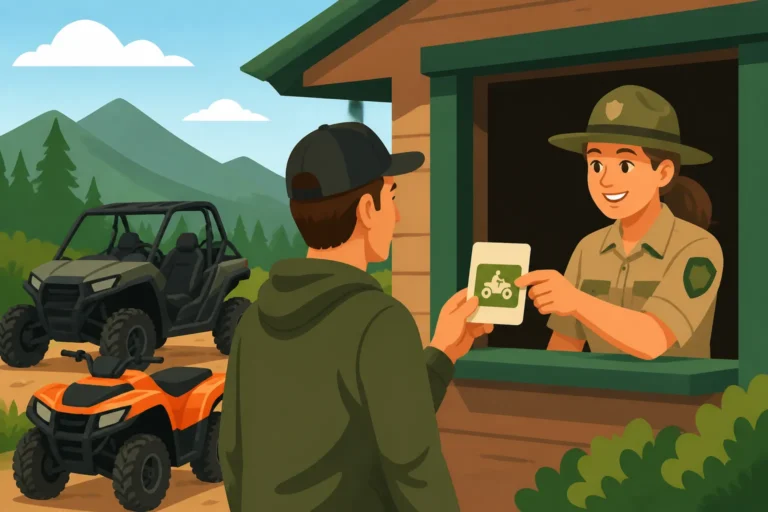
The method for obtaining a Badin Lake permit can depend on the permit type and the current sales arrangements. Forest permits may be available through approved local sellers, a district office, or a designated self-service process. Do not assume every seller carries season permits, or that the process for a day permit is the same. Check the current official instructions before you leave home, particularly if you are arriving outside normal business hours.
For the broader state-level question of where permits may be sold, see Where to Buy a North Carolina OHV Permit. That overview can help you understand the usual options, but confirm that the seller or method you choose actually handles Badin Lake season permits.
When you obtain the permit, read the accompanying instructions before mounting it. Placement and proof requirements matter. If a physical sticker or permit document is issued, attach or display it exactly as directed. If the permit is recorded another way, keep the confirmation or other proof available as instructed. Do not decide that a phone photo is sufficient unless the issuing authority says it is.
A clear, weather-resistant holder can protect paper permit information from rain, grit, and repeated washing. If you buy a holder through a local outdoor shop or Amazon, choose one that does not hide required information or interfere with the placement instructions. The holder is just protection; it does not substitute for the permit itself.
A few practical steps can prevent a last-minute problem:
- Confirm the permit type is for Badin Lake and for the current season.
- Check whether the permit covers one machine or more than one. If the rule is per vehicle, obtain a permit for each eligible machine.
- Read all placement instructions before affixing anything. Avoid putting a sticker where it can be scraped off by loading ramps, mud, or straps.
- Keep any receipt, confirmation, or associated paperwork in a safe place. Carry it if the instructions say you must.
- Photograph the machine and permit after installation for your own records. A photo can help document what you purchased and where you placed it, but should not be treated as a replacement for required display.
- Recheck the permit dates and trail status before the next outing, especially if you purchased early in the season.
A small waterproof document pouch can be useful for keeping a receipt, map, emergency contact information, and other trip papers together. Amazon is one possible source for that kind of basic organizer, but any durable pouch that suits your setup will do. Keep important paperwork out of places where it can get soaked, torn, or lost during a recovery.
Do not place a permit on a trailer and assume it covers the machine being hauled. The permit is for riding access, and the issuing instructions determine how it is tied to the OHV. Likewise, a passenger’s permit, another rider’s confirmation, or a vehicle title is not a substitute for the required permit on your machine.
If the permit is damaged, lost, or difficult to read, contact the issuing office or seller for direction. Do not try to recreate a sticker, alter one, or use an old permit from a previous season. Keep the machine off the trail until you have confirmed what proof is accepted.
What the permit does not replace
A season permit solves one narrow problem: access to the covered riding area under its rules. Riders still have to meet other requirements that apply to the machine, the operator, and the route.
Rider safety rules still apply
A forest permit is not an age exemption. North Carolina’s rules for young riders, helmets, eye protection, and safety certificates may apply independently of forest access conditions. Some rules depend on the rider’s age or birth year; others depend on where and how the machine is being ridden.
If you ride with a child or teenager, check the requirements before the outing rather than assuming that an adult’s permit covers the younger rider’s obligations. North Carolina ATV Safety Certificate Requirements explains the certificate rules, while North Carolina Rules for Riders Under 16 covers age-related requirements in more detail. Carry any required certificate in the manner specified, and make sure the rider understands the trail rules before leaving the staging area.
A permit also does not make an unsafe machine acceptable for trail use. Check brakes, throttle return, tires, steering, lights where applicable, and any required equipment before riding. A machine that is not working properly can become a serious hazard on a narrow trail, particularly where a group has limited room to pass or turn around.
Trail boundaries and closures still apply
Stay on routes designated for OHV use. A nearby fire road, utility corridor, game land, creek bed, or forest road is not automatically open to ATVs because it lies within or near the national forest. Do not ride around a barrier, move a closure sign, or create a bypass around a muddy section.
If a trail is closed, turn around and choose an open route. Riding around a closure can damage the trail and may expose riders to hazards such as unstable slopes, washed-out crossings, or work crews. It can also result in a citation or loss of access privileges. A season permit is not permission to ride wherever the terrain looks passable.
The route map and notices are part of trip planning, not optional extras. Carry a map or a reliable offline copy if phone coverage may be limited. Keep the group together at junctions, and agree in advance on a meeting point if someone becomes separated. A map pouch from a local store or Amazon can help keep a paper map readable, but make sure the map itself is current.
It does not establish ownership or legal road status
A permit is not proof that you own the machine, and it does not resolve a title issue. If you bought a used ATV, keep the ownership documents separate from the trail permit. The same goes for a borrowed or rented machine: confirm that you have the owner’s permission and that the permit arrangement is clear before riding.
Nor does the permit turn an ATV into a registered road vehicle. A forest trail may connect to a public road or cross one, but the permit does not authorize riding along the road. Follow the applicable crossing rules and use only routes where your machine is allowed. The broader state rules are covered in North Carolina Rules for Crossing a Road.
Planning a Badin Lake ride around the permit
A little preparation is especially valuable when you are trailering in from outside the area. A permit is only one piece of the trip. You also need to know where you are allowed to stage, which trails are open, whether your machine fits the routes you intend to ride, and what to do if conditions change.
Start with the current forest information, then plan a route that matches the least experienced rider and the least capable machine in the group. If your party includes several machine types, check width and route restrictions rather than assuming every trail is suitable for every ATV or side-by-side. Give the group a realistic turnaround time and leave room for stops, mechanical issues, and recovery.
Before leaving, review this checklist:
- Permit: Verify that it is valid for Badin Lake and covers the intended trip dates.
- Machine count: Confirm the permit requirement for every machine in the group.
- Trail status: Check official notices for closures, damage, or changed access.
- Map: Carry a current map and know how to identify trail junctions.
- Equipment: Inspect tires, brakes, throttle, steering, fuel, and recovery gear.
- Rider requirements: Check age, helmet, eye protection, supervision, and certificate rules that apply to each rider.
- Staging: Confirm where parking and unloading are allowed, and do not block gates or access roads.
- Communication: Agree on a route, regrouping points, and a plan if someone is delayed.
- Weather: Account for rain, heat, cold, and changing trail conditions.
- Trip proof: Keep any required permit confirmation or paperwork accessible.
If you ride Badin Lake often, keep the permit information with your trip gear and make a reminder to check its end date before planning late-season outings. A season permit can make repeated visits less complicated, but it is easy to forget that it has a defined validity period. The date on the permit and current official guidance—not an old decal or last year’s schedule—should determine whether it is still usable.
For riders who only visit once, a day permit may be easier to manage. For regular riders, the season option can reduce repeated purchase steps. Either way, treat the permit as a location-specific access credential, not a promise that the forest will be open or that every route will suit your machine.
When in doubt, contact the responsible forest office or permit seller before loading. Ask clearly whether the permit is for Badin Lake, which machines it covers, how it must be displayed, and what the current season dates are. Those few questions can prevent arriving at the trailhead with the wrong permit or discovering that your planned outing falls outside the permitted season.
Disclaimer
This article is for general informational purposes only and does not constitute professional advice. Laws, prices and regulations vary by location and change over time. Consult a qualified professional for guidance on your specific situation.