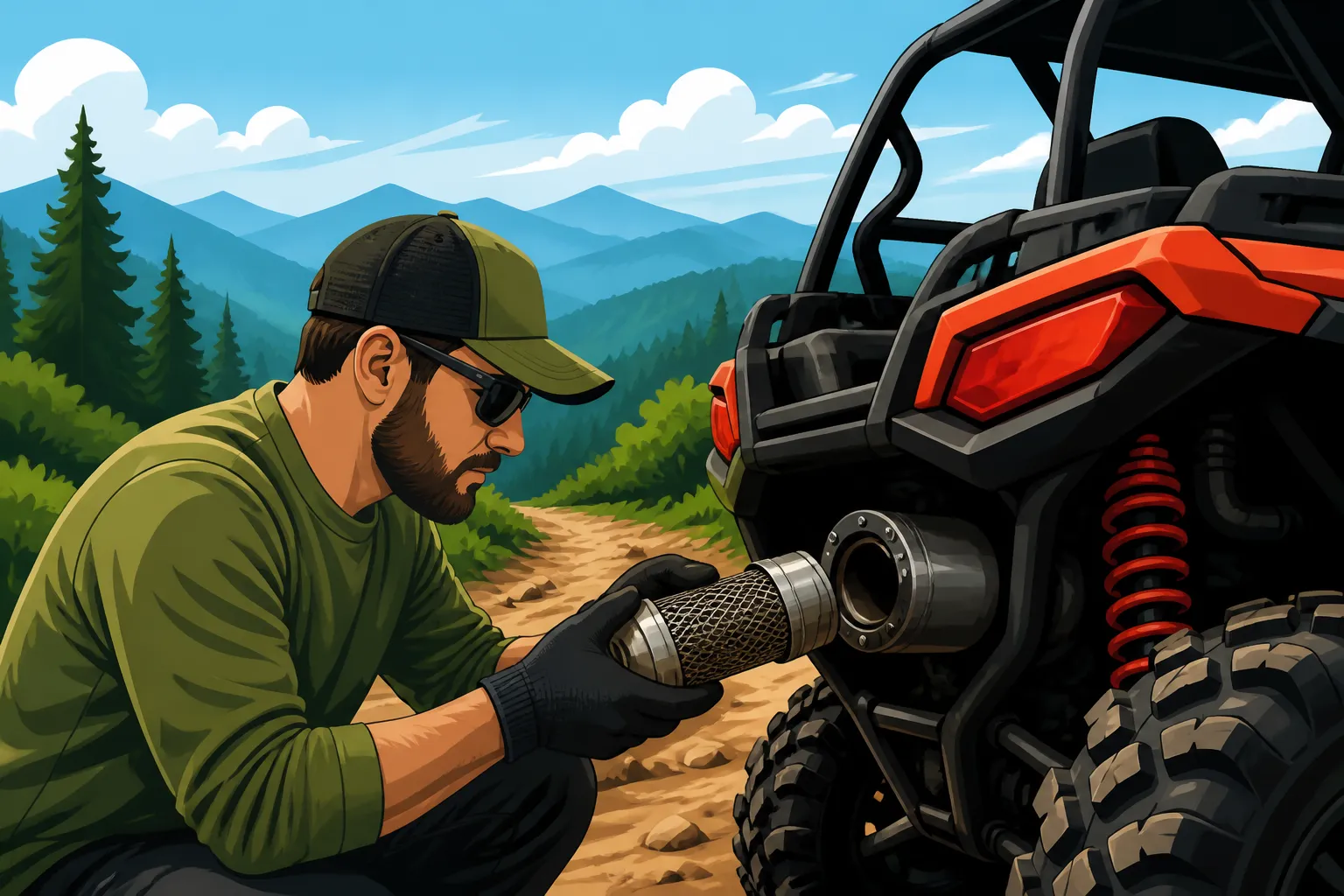
Spark Arrester Checks on a Pisgah Trail
A spark arrester is easy to overlook when you are getting an ATV or UTV ready for a ride near Pisgah, but a missing or nonworking device can put your trip out of compliance. Here’s what the Forest Service requires, how to check your machine before you leave, and what to confirm about your route and pass.
What the spark arrester rule means
The Forest Service says an OHV operator cannot operate an internal or external combustion engine without a spark-arresting device in working order. That requirement applies to the machine you bring onto a designated OHV trail; having a muffler or a quiet exhaust does not, by itself, establish that the spark arrester is present and working.
A spark arrester is part of the exhaust system. Its job is to help stop hot particles from leaving the exhaust and potentially starting a fire. The rule is about having a working device, not merely having an exhaust component that looks similar from the outside. If you are unsure whether your exhaust has a spark arrester, check the machine’s manual or ask a qualified mechanic to identify it.
“Spark arrester check” can mean a rider’s pre-ride inspection, or it can refer to a compliance check by an official. The available Forest Service requirements establish that the device must be in working order, but do not specify a particular inspection method or say that every rider will be checked at a trailhead. Treat the requirement as something to meet before riding, rather than waiting to find out whether anyone inspects your machine.
A quick look at the exhaust outlet may catch an obvious problem, such as a missing component or damage. It may not confirm that an internal part is present, intact, or appropriate for your machine. If the exhaust has been modified, replaced, or repaired, ask the installer or manufacturer whether the spark-arresting device is included and functional. Don’t assume a generic screen or insert will satisfy the requirement without checking that it is designed for the exhaust system.
For a broader overview of what forest riders need to prepare for, see North Carolina Spark Arrester Rules on Forest Land. The key takeaway is straightforward: the machine must have a working spark-arresting device while it is being operated on the applicable OHV trail.
How to check your machine before riding
A useful pre-ride check is careful and modest. You are looking for signs that the required device is installed and in usable condition, not trying to take apart a hot exhaust system at the trailhead.
- Start with the owner’s manual. Look for the exhaust-system description and any instructions about a spark arrester. If the manual is unavailable or unclear, contact the manufacturer or a qualified repair shop.
- Inspect the exhaust when it is cool. Check for obvious damage, missing parts, loose fittings, or signs that the exhaust has been altered. Never reach into or remove parts from a hot exhaust.
- Check recent modifications. If you or a previous owner changed the muffler, exhaust pipe, or other components, confirm that the spark-arresting device remains installed and in working order. A replacement exhaust may not include the same components as the original.
- Deal with uncertainty before loading. If you cannot confirm the device is present and functional, get professional help before riding. A trailhead is a poor place to discover that a part is missing or that the exhaust needs repair.
Keep the inspection practical. Don’t rely on a seller’s description, a product photo, or a part that merely fits the exhaust opening as proof. If you need a replacement, identify the machine and exhaust model first. Amazon may have replacement components, but check compatibility and product documentation carefully; a listing’s wording alone is not a reliable way to confirm that a device meets the Forest Service requirement.
The spark arrester is only one part of preparing a machine. Check the tires, brakes, controls, lights, and fuel before setting out, and carry the tools and recovery gear appropriate for your route. If your machine develops an exhaust problem on the trail, stop riding it. Continuing to operate an engine with a missing or damaged device does not become acceptable because the ride is nearly over.
| Before you ride | What to confirm |
|---|---|
| Exhaust system | A spark-arresting device is installed and in working order |
| Recent repairs or modifications | The device was not removed or left out during the work |
| Route | The trail is designated and open to your type of machine |
| Pass | You have the valid pass required for that riding area |
| Documents | You can show your pass and state driver’s license if asked |
Confirm the route and permit, not just the exhaust
A compliant machine does not make every road or trail open to OHV use. The Forest Service says riders must stay on designated trails, and OHVs must be trailered to the trailhead. It also says ATVs cannot be registered and are therefore not allowed on Forest Service roads. Plan your route around the designated OHV area and don’t ride an ATV or UTV on a forest road just because it reaches a trailhead.
This matters when you are planning a ride near Pisgah. Don’t assume that a trail, forest road, or route shown on a general recreation map is open to motorized use. Check the current map and closure information for the specific riding area before you leave. North Carolina Forest Trail Maps can help with map planning, while North Carolina Trail Closures to Check is useful for checking whether a route is closed. If you are comparing places to ride, remember that the Forest Service lists only four designated OHV areas within the National Forests of North Carolina; confirm the specific area rather than relying on the broad name of a forest.
The Forest Service requires a valid permit or pass for the specific area where you are recreating. Passes for OHV riding in the National Forests in North Carolina are sold through Recreation.gov, and a pass must be carried while you are on the trail. The Forest Service says passes remain valid until midnight on the date written on them. Before departure, confirm that the pass matches the area you intend to ride and that you have it with you.
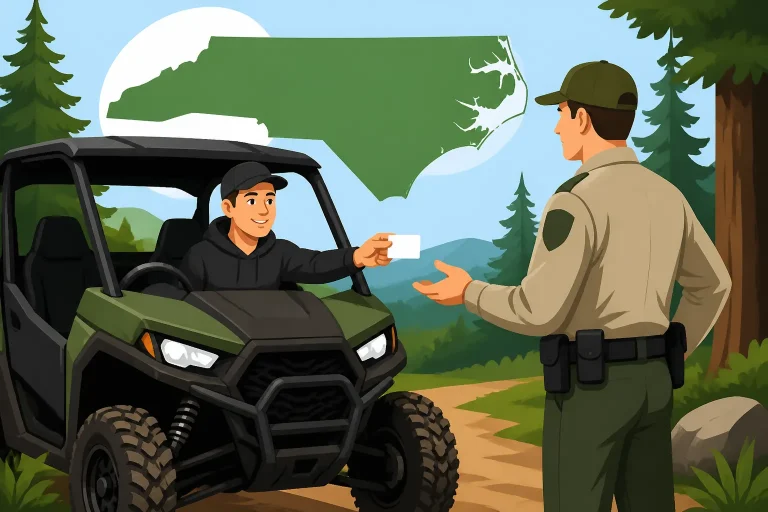
A state driver’s license must also be available to show during a law-enforcement compliance check, according to the Forest Service. Keep it accessible along with the pass, rather than packed somewhere you cannot reach while stopped. For more on permits and what to have with you, see North Carolina Forest OHV Permits and Carrying a Safety Card on a North Carolina Ride.
The device requirement is not replaced by a pass, and a pass does not authorize riding outside the marked system. Think of these as separate checks: the machine must meet equipment rules, and the rider must follow the area’s access, trail, and permit requirements.
If a problem comes up at the trailhead
If you find that the spark arrester is missing, damaged, or uncertain, postpone the ride until the issue is resolved. Don’t try to improvise a repair with an unverified screen or substitute, and don’t assume that a machine is acceptable because it passed an earlier inspection or ran without trouble on another trip. The requirement is that the device be in working order when the engine is operated.
If an official asks about your exhaust during a compliance check, stay calm and follow the instructions given. The Forest Service states the equipment requirement but does not describe a universal field test in the information summarized here. If you have documentation for an exhaust component or repair, it may help explain what is installed, but it does not change the requirement that the device work.
For a planned ride, a few calls or checks before loading can prevent a wasted drive. Confirm that the trail is designated for your vehicle, check for closures, make sure the pass is valid for that area, and verify the exhaust before the machine goes on the trailer. If you are unsure what device is fitted, ask the dealer, manufacturer, or a qualified mechanic rather than guessing.
The safest practical rule is to treat a spark arrester as required equipment, not an optional accessory. Check it when the machine is cool, keep it in working order, and make sure your chosen trail is actually open to motorized use. That approach helps you avoid both an equipment problem and a trip planned around a route you cannot legally ride.
Sources
- Forest Service — National Forests in North Carolina | Off-Highway Vehicles (OHV) | Forest Service (checked November 3, 2026)
- Forest Service — National Forests in North Carolina | Black Swamp OHV Trailhead | Forest Service (checked November 3, 2026)
- Forest Service — National Forests in North Carolina | Off-Highway Vehicles (OHV) | Forest Service (checked November 3, 2026)
- Forest Service — National Forests in North Carolina | Off-Highway Vehicles (OHV) | Forest Service (checked November 3, 2026)
- USDA Forest Service — National Forests in North Carolina | Off-Highway Vehicles (OHV) | Forest Service (checked November 3, 2026)
Disclaimer
This article is for general informational purposes only and does not constitute professional advice. Laws, prices and regulations vary by location and change over time. Consult a qualified professional for guidance on your specific situation.