The 58-Inch Width Requirement
For anyone who loves hitting the trails or even just traversing their own property in North Carolina, understanding the specific rules for your ATV or UTV can feel like navigating a maze. One of the most perplexing aspects often revolves around vehicle dimensions, particularly the 58-inch width requirement. This guide is here to untangle that confusion, helping you understand exactly when and why your machine's width truly matters in the Tar Heel State.
Understanding North Carolina's Width Rules for Off-Road Machines
It's a common scenario across North Carolina: you're eyeing a new side-by-side or a beefier ATV, perhaps for hauling gear around your farm in Statesville or for tackling the more rugged trails near Badin Lake. You hear whispers about "width limits" and immediately, a little alarm bell goes off. What does that even mean for your passion? The truth is, North Carolina’s rules around ATV and UTV width are often misunderstood because they aren't universally applied to all riding scenarios. Most of the time, when you're on private land or a designated off-highway vehicle (OHV) trail, your machine's width isn't a direct legal issue in the same way, say, a missing helmet might be. However, there are specific situations, primarily when you try to venture onto public roads, where that measurement becomes absolutely critical. It’s this nuanced distinction that often trips up even seasoned riders.
Why Width Matters: Safety and Road Use
The primary reason vehicle width comes under scrutiny in North Carolina, especially for ATVs and UTVs, boils down to safety and how these machines interact with public roadways. Traditional vehicles on the road – cars, trucks, motorcycles – are designed and regulated with specific dimensions in mind to ensure they fit safely within lanes, navigate turns, and don't pose undue hazards to other traffic. When an ATV or UTV exceeds certain widths, it can become less stable on paved surfaces, struggle to stay within lane markers, and simply isn't engineered for the same road dynamics as a conventional car. This is why you'll find that restrictions around width almost always accompany discussions about making these machines "street legal" or allowing them on public rights-of-way. The state is trying to balance the desire for recreational and utility use with the paramount need for public safety, and width is a key factor in that equation. It's not about stifling fun, but ensuring everyone gets home safely at the end of the day, whether they're on a four-wheeler or in a pickup truck.
Many riders, especially those in rural areas of places like Wilkes County, might wonder why their trusty side-by-side, which handles farm chores perfectly, suddenly becomes a legal puzzle on the asphalt. The answer lies in the fundamental design differences. An off-road machine is built for traction, ground clearance, and navigating uneven terrain, often at slower speeds. Its wider stance provides stability on trails, but on a smooth, crowned road, it can feel squirrelly or simply take up too much space. Imagine a wide UTV trying to navigate a narrow mountain road with oncoming traffic; the potential for conflict is clear. This focus on road-worthiness is central to understanding why North Carolina draws a line in the sand with certain dimensions.
The issue of width directly impacts road infrastructure as well. Road lanes are designed for vehicles of a certain size, and anything significantly outside that norm can create logistical problems. Wider machines can make passing difficult, particularly on two-lane roads, and can even pose challenges for parking in designated areas. So, while it might seem like a minor detail, the 58-inch width rule for road-going machines is a deliberate legislative choice aimed at maintaining order and safety on North Carolina's vast network of public thoroughfares. It's a standard applied to minimize risk for everyone, whether they're driving a compact car or a heavy-duty truck.
The General Rule: No Width Limit Off-Road, Usually
Here’s a piece of good news that often gets lost in the chatter: for the vast majority of your off-road adventures on private property or within designated OHV trail systems in North Carolina, there isn't a specific statewide legal width limit imposed on your ATV or UTV. If you're tearing up your own land in Duplin County, riding through a friend's timber lot, or tackling the trails at Brown Mountain, you generally won't find a North Carolina statute dictating how wide your machine can be. [Where to Ride an ATV in North Carolina] details many of these fantastic spots where off-road machines are welcome. This freedom allows manufacturers to design machines that excel in various off-road conditions, from narrow quads built for agility to wide-stance UTVs offering ultimate stability and passenger comfort.
However, a crucial caveat here is "designated OHV trail systems." While there might not be a statewide legal limit, individual trail systems, particularly those in national forests like the Uwharrie, can and do implement their own width restrictions for practical reasons. These restrictions are usually about trail design and maintenance, not state law enforcement. Trails are often cut to a certain width to prevent erosion, protect vegetation, and ensure that vehicles can safely pass or navigate tight turns without getting stuck or damaging the trail's integrity. For instance, some trails might have bollards or narrow gates that physically prevent wider machines from entering. Always, always check the specific rules and regulations of any OHV park or trail system before you load up and head out. A quick call to the ranger station or a check of their website can save you a lot of frustration. Also, for why there isn't a general statewide 'sticker' for trails, see [Why There Is No North Carolina Trail Sticker].
So, while the state itself generally doesn't care if your ATV is 48 inches or 64 inches wide when you’re on the dirt, the landowners or forest managers do. It's about respecting the land and ensuring the longevity of these precious riding areas. This is particularly true for older, more established trails that were initially designed for narrower machines. Ignoring these local width limitations can lead to fines, damage to your machine, or even the closure of trails for all riders, something no one wants. This cooperative spirit is essential for keeping our beloved North Carolina trails open and enjoyable for everyone for years to come.
The Exception: When Width Does Become a Factor
Now for the part where width becomes a very real and often frustrating hurdle: when you want to take your ATV or UTV onto public roads or highways in North Carolina. This is where the state's vehicle laws, primarily those governing "street legal" vehicles, come into sharp focus. Unlike some other states that might offer various pathways for ATV or UTV road registration, North Carolina is quite restrictive. The primary, and almost exclusive, route for getting an off-road machine legally onto public roads (beyond very limited exceptions like farm use or beach access) is through its classification as a [North Carolina's Modified Utility Vehicle Route], or MUV. And guess what? This MUV classification comes with a very specific set of dimension requirements, including that all-important 58-inch width limit.
It's a common source of disappointment for riders who invest in a spacious, powerful side-by-side, only to discover it simply cannot meet the MUV criteria for street use. Many modern UTVs are designed for comfort and stability, naturally making them wider than 58 inches. This often means that if your dream machine is wider than this threshold, it’s effectively barred from being registered as an MUV, thereby closing off the street-legal path. It’s a stark reality for many who hope to use their UTV for quick trips to the general store in West Jefferson or to connect trails without trailering. Understanding this exception upfront can save you significant time, money, and heartache down the road, preventing you from purchasing a machine with the expectation of road use that it simply cannot fulfill.
This exception is not designed to be punitive but rather to ensure a level of compatibility and safety on public roads. The legal framework attempts to prevent off-road vehicles, which are not built to typical automotive standards, from posing risks to other motorists or pedestrians. While it might feel overly strict to a UTV owner, the legislative intent is to protect the broader public. Thus, the 58-inch rule is not just a suggestion; it is a fundamental pillar of the MUV definition, and failing to meet it means your machine will remain an off-road-only vehicle, at least for general public road use in North Carolina.
The Modified Utility Vehicle (MUV) and the 58-Inch Requirement
The concept of the Modified Utility Vehicle (MUV) is North Carolina's answer, albeit a very specific one, to allowing certain utility-focused off-road machines onto public roads. But it's not a free-for-all. Far from it. The state has outlined a rigorous set of criteria that a machine must meet to be considered an MUV, and each of these requirements is non-negotiable. Missing even one of them means your machine simply won't qualify. This system is designed to differentiate between purely recreational ATVs and UTVs, and those machines that more closely resemble small, street-legal utility vehicles, offering a safer and more predictable presence on shared roadways. It’s a distinct classification, and it’s where the 58-inch width rule truly bites.
What Exactly is a Modified Utility Vehicle (MUV)?
So, what exactly is an MUV in the eyes of North Carolina law? It's not just any UTV that someone has slapped a horn and some turn signals onto. An MUV is a motor vehicle that has been modified from an original manufactured utility vehicle to meet a very particular set of specifications that make it more akin to a low-speed vehicle or golf cart, but with more capability. Beyond the physical modifications, it must also pass an inspection and carry proper insurance, much like a traditional car. Think of it as a specialized niche for utility-oriented machines that bridge the gap between pure off-roaders and street-legal automobiles. [What Makes a Machine an MUV in North Carolina] delves into all the nitty-gritty details, but some of the core requirements include specific engine displacement, weight, and, yes, those critical dimensions.
The intent behind the MUV classification is to create a pathway for machines that serve a genuine utility purpose and can operate safely on lower-speed public roads. It's not for tearing up the main drag in Charlotte, but perhaps for getting around smaller towns or agricultural communities where speeds are lower and traffic is less dense. These machines are often used by farmers, vineyard operators in the Yadkin Valley, or even some small businesses for local transport and tasks. The modifications required aren't just cosmetic; they often involve adding safety equipment like headlights, taillights, turn signals, mirrors, a speedometer, and seat belts, all designed to make the vehicle visible and controllable in a road environment. Without meeting all these points, your machine remains strictly off-road. You'll also need to consider the [North Carolina MUV Registration Requirements] and ensure you have adequate [North Carolina MUV Insurance Requirements].
The MUV category represents North Carolina's highly specific attempt to categorize a vehicle that fits somewhere between an off-road recreational machine and a fully street-legal vehicle. It acknowledges the utility and convenience these machines can offer in certain settings, but it places significant emphasis on making them as safe and predictable as possible when sharing space with traditional traffic. This includes everything from brake functionality to tire type, all contributing to the overarching goal of road safety.
How the 58-Inch Rule Applies to MUVs
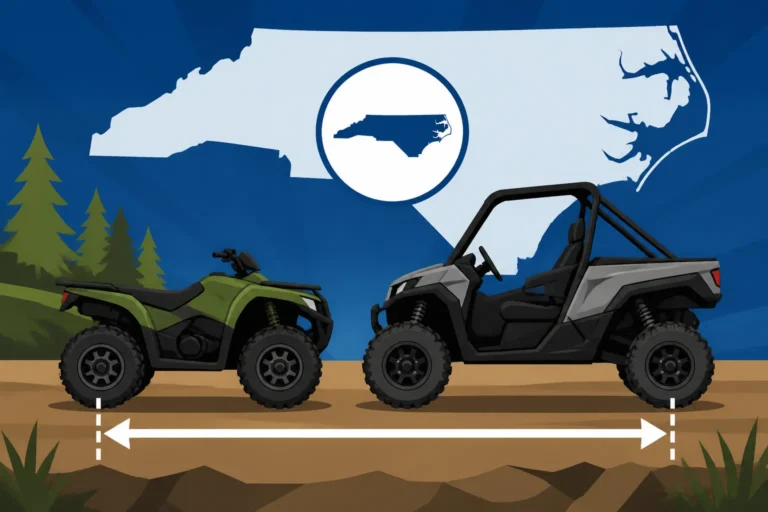
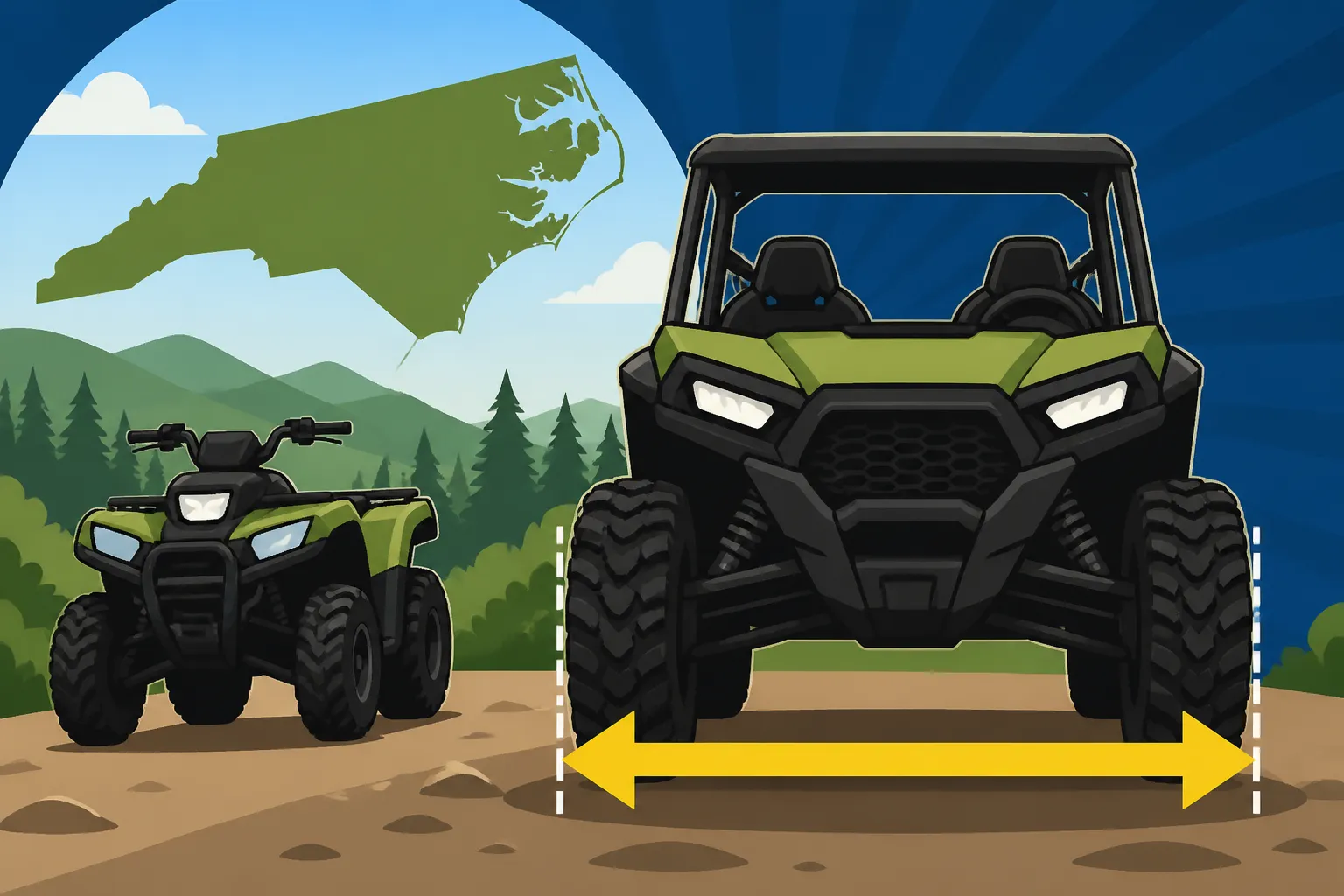
Here's the critical juncture: for your machine to be classified and registered as an MUV in North Carolina, its total width cannot exceed 58 inches. This is a hard limit, measured from the widest points of the vehicle, typically including the tires or any permanently affixed parts. If your UTV rolls in at 60, 62, or even 59 inches wide, it simply does not qualify for MUV status. Period. This is a deal-breaker for many popular side-by-side models on the market today, as manufacturers have increasingly trended towards wider stances for improved stability, suspension travel, and interior room. [North Carolina MUV Dimension Requirements] makes this perfectly clear, alongside other crucial measurements like length and height.
This 58-inch rule is perhaps the most significant hurdle for riders hoping to gain street-legal status for their UTVs. It’s not uncommon for someone to purchase a new side-by-side, thinking they can add the required lights and turn signals later, only to discover too late that their machine is inherently too wide. This can lead to significant frustration, as the investment in the machine might have been made with the assumption of road legality. It’s why checking the exact specifications, down to the inch, before purchase is absolutely vital if MUV registration is your goal. It also means that modifying a wider machine to shrink its width is usually impractical, if not impossible, given the structural design of the vehicle.
The measurement of 58 inches isn't arbitrary; it reflects a compromise between the typical dimensions of smaller utility vehicles and the need for safe integration into existing road traffic. It ensures that MUVs don't unduly impede traffic flow or create hazardous situations due to their size. For many prospective MUV owners, this single measurement often dictates whether their desired vehicle can ever legally touch North Carolina's paved roads outside of specific, limited exemptions. It forces a careful consideration of vehicle choice versus intended use.
Why Most Side-by-Sides Don't Qualify as MUVs
Given the 58-inch width restriction, it's easy to see [Why Most Side-by-Sides Miss the Mark] for MUV qualification. The vast majority of modern UTVs, especially those marketed for recreational trail riding or sporting purposes, easily exceed this measurement. While there are some older or more specialized "narrow-track" utility models that might fit, they are becoming increasingly rare in the new market. Performance-oriented machines from manufacturers like Polaris, Can-Am, or Honda often start at widths well over 60 inches, with some sport models pushing 70 inches or more. This wider stance is intentionally designed to enhance stability at speed, improve suspension articulation, and provide a more comfortable ride, particularly on challenging terrains.
This creates a significant disconnect for consumers. They see "UTV" and "utility" and assume there's a straightforward path to road use, especially in rural North Carolina where these machines are so prevalent. However, the engineering choices that make a UTV excellent off-road are often precisely what disqualify it from MUV status. It’s a classic case of form meeting function in conflicting ways. The state’s definition of an MUV is quite specific and doesn't bend to accommodate the evolving designs of the off-road vehicle industry. So, while your shiny new side-by-side might be a beast on the trails of the Nantahala National Forest, its width will likely keep it from legally cruising down a two-lane county road outside of specific exemptions.
The trend in UTV design towards larger, more comfortable, and more capable machines has inadvertently created a barrier for MUV qualification. As manufacturers strive to meet consumer demand for robust off-road performance and passenger amenities, the physical dimensions naturally expand. This means that if road legality is a primary concern, potential buyers must actively seek out specific, often less common, models that were designed with narrower dimensions, rather than assuming their chosen UTV will automatically fit the MUV criteria.
Practical Implications for Riders and Buyers
Understanding North Carolina's width requirements isn't just about obscure legal definitions; it has very real, tangible impacts on what kind of machine you buy, where you can ride it, and how you can use it. For a rider in the Tar Heel State, this information directly affects your budget, your riding plans, and potentially your safety. It’s about making informed decisions that align with your intended use, rather than learning the hard way after a significant investment.
Choosing a Machine: Checking Width Before You Buy
For anyone in North Carolina considering the purchase of an ATV or UTV, especially if you have any aspirations of street use, checking the machine's width should be right at the top of your due diligence list. Don’t rely on assumptions or general descriptions; get the exact manufacturer specifications. Whether you’re at a dealership in Greensboro or looking at a used machine advertised online, make that measurement a priority. If MUV registration is your goal, and the machine is over 58 inches wide, you’re already out of the running before you even sign the paperwork. This simple step can prevent immense frustration and financial regret.
It’s also important to consider if any accessories you plan to add might affect the width. While most common accessories like winches, bumpers, or roofs typically don't extend beyond the main chassis or tire width, it’s worth a double-check if you're pushing the limits. For private sales, if you are looking to draft a [North Carolina ATV Bill of Sale Requirements], ensure all details, including dimensions, are accurately recorded. Tools like LawDepot can assist you in creating legally sound documents for such transactions, protecting both buyer and seller. Having clear documentation of the machine's original specifications can be helpful if you ever need to prove its dimensions for MUV inspection or resale.
This proactive approach to checking specifications applies to both new and used machines. When buying used, you might encounter modifications that affect width, so a physical measurement is highly advisable, regardless of what the original manufacturer specs state. A seller's word or a faded brochure might not hold up during a DMV inspection, so always verify the current state of the vehicle yourself. This attention to detail before purchase can save you from a major headache later on.
Trail Access and Width Restrictions
While the state doesn't generally impose width limits for off-road riding, the entities that manage those trails absolutely do. As mentioned, national forests, private OHV parks, and even local riding areas often have their own specific rules regarding vehicle dimensions. This is crucial for planning your rides. A wider side-by-side might be fantastic for stability on open terrain, but it could mean being turned away from certain trails at Wayehutta OHV or finding yourself unable to navigate tight sections at Brown Mountain. Always check ahead!
These restrictions are not arbitrary; they are usually in place to protect the trails, prevent environmental damage, and ensure rider safety. Overly wide machines can chew up trail edges, flatten vegetation, and cause erosion, especially on narrow, winding paths designed for smaller vehicles. Before you load your rig onto the trailer and head to a specific riding spot in the Appalachian Mountains, a quick visit to the trail system's website or a phone call to the land manager can confirm any width limitations. It’s always better to know before you go than to arrive and find your machine is too wide to enjoy the trails you had planned.
Imagine driving hours to a popular riding area, only to find a physical barrier or a ranger enforcing a width limit that your machine exceeds. It's a frustrating, costly, and completely avoidable situation. Planning your trips with your machine's dimensions in mind ensures that your passion for riding remains enjoyable and complication-free. This forethought is a small effort that yields significant peace of mind for every off-road adventure.
Modifying Your Machine: What You Need to Know About Width
Some riders inevitably consider modifying their machines to meet specific criteria, whether for performance or, in rare cases, to try and meet MUV dimensions. For width, however, modifications are usually a non-starter if your goal is MUV qualification. Widening a machine is common for stability and tire clearance, but narrowing a machine is a far more complex and often impractical endeavor. It typically involves significant structural changes to suspension components, axles, and frame, which can compromise the vehicle's safety, handling, and structural integrity.
Attempting such extensive modifications solely to meet the 58-inch MUV width requirement would likely be prohibitively expensive, technically challenging, and could invalidate manufacturer warranties. Furthermore, even if you could mechanically narrow a machine, it's highly unlikely it would then pass the rigorous MUV inspection, as inspectors are looking for factory-designed compliance or professionally installed, certified modifications. It's generally a far more sensible approach to purchase a machine that already meets the MUV dimensions if street legality is a priority, rather than trying to engineer a workaround. For any modifications, whether related to width or other aspects, always consider safety, legality, and the potential impact on your machine's performance and longevity.
Beyond the MUV context, any significant modification to your machine's width, even for off-road use, should be carefully considered for its impact on handling and stability. While a wider stance can improve stability in some situations, it can also make the machine more cumbersome on narrow trails or impact its turning radius. Always prioritize safety and consult with reputable aftermarket parts suppliers or mechanics before undertaking major structural changes.
Navigating North Carolina Roads with Wider Machines
The dream of cruising down a public road on your ATV or UTV is understandable, especially in a state with such diverse terrain. However, North Carolina's approach to street legality for these machines is, as we've discussed, quite particular. For wider machines, those exceeding 58 inches, the path to legal road use narrows considerably, often to the point of being non-existent for most recreational riders. This section will help clarify the very limited options and stark realities.
The Reality of Street Legal ATVs/UTVs in NC
Let’s be blunt: for most ATVs and UTVs, being truly "street legal" in North Carolina is an uphill battle, if not an impossible dream. The MUV classification is the main avenue, but its strict dimension requirements, including the 58-inch width limit, rule out a huge percentage of the market. This means that if your machine is wider than 58 inches, it cannot be registered as an MUV, and therefore, it cannot be legally driven on most public roads. There's no "loophole" or alternative registration category for wider off-road machines to achieve street legality. So, if you're rolling in a modern, wide-track side-by-side, understand that its primary domain in North Carolina will be private land and designated OHV trails.
It's a frustrating reality for many, particularly those who see neighboring states with more lenient laws. However, North Carolina’s stance prioritizes safety and regulatory consistency. [North Carolina Rules for Riding a Public Street] makes it clear that unless a vehicle falls into a specific category like an MUV, or meets one of the very narrow exemptions, it’s not meant for the paved roads. This means that for the majority of UTV owners, getting from one trail system to another, or running a quick errand in town, will still require a truck and a trailer.
The temptation to disregard these rules is strong, especially in rural areas where law enforcement presence might feel less frequent. However, the consequences of illegal road operation can range from hefty fines to vehicle impoundment, and even more severely, can involve significant liability if an accident occurs. It's simply not worth the risk. Understanding this firm reality is the first step toward responsible and legal ATV/UTV ownership in North Carolina.
Farm Use Exemptions and Width
There is one significant exemption that often causes confusion regarding width and road use: the farm use exemption. North Carolina law allows certain vehicles, including ATVs and UTVs, to be operated on public roads for agricultural purposes, even if they aren't registered as MUVs. This is a crucial lifeline for many farmers across the state, from the tobacco fields of eastern North Carolina to the apple orchards in Hendersonville. The key here is "agricultural purposes" – you must be actively engaged in farm business, not just taking a joyride.
Crucially, while the farm use exemption allows for road travel, it does not magically remove all restrictions, nor does it make an overly wide machine safe for high-speed highway travel. These operations are typically limited to short distances, often crossing a road or traveling along a rural road between fields. The exemption doesn't nullify general safety expectations, and an extremely wide machine could still draw attention from law enforcement if it's perceived as a hazard. So, while your wide UTV might qualify for farm use road travel, it's essential to exercise extreme caution and ensure visibility. Familiarize yourself with the specifics of the farm exemption to ensure you're compliant, as misuse can lead to tickets and fines.
Even under the farm use exemption, common sense and courtesy dictate how you operate your machine. While the specific 58-inch width rule might not apply here, remember that other vehicles on the road expect predictable behavior. Always use appropriate signaling, maintain a safe speed, and be aware of your surroundings. This exemption is a privilege designed to support the agricultural community, and responsible use is key to its continued availability.
Understanding Local Ordinances and Their Impact
While North Carolina has statewide laws regarding MUVs and farm use, it's also important to remember that local municipalities and counties can sometimes have their own ordinances, particularly concerning very specific low-speed vehicle use within town limits. However, these local ordinances almost never override or expand upon the state's MUV width requirements for general street legality. What they might do is regulate things like golf cart use in certain resort areas or specify rules for very localized, low-speed zones.
It's highly unlikely you'll find a local ordinance that suddenly allows your 64-inch wide side-by-side onto public roads if it doesn't meet the state's 58-inch MUV width rule. These local rules are typically supplementary and designed to manage traffic flow or designated routes for existing legal vehicle types. Therefore, always default to the stricter state-level regulations first. If you have any doubts about riding in a particular town or county, especially concerning width, it's best to contact their local law enforcement or municipal office directly. Don't assume that just because you see some UTVs on a local road, yours is automatically legal. Always confirm the specific rules that apply to your machine's dimensions.
The principle here is that state law usually sets the minimum standard, and local governments can add further restrictions but generally cannot make something legal that is illegal at the state level. This hierarchy means that if your machine's width doesn't qualify it as an MUV under state law, a local ordinance isn't going to grant you street-legal status. Always err on the side of caution and adhere to the most restrictive applicable law to avoid any unwelcome surprises.
Documentation, Enforcement, and Common Misconceptions
Navigating the rules for ATVs and UTVs in North Carolina can be confusing, and the 58-inch width requirement adds another layer of complexity. It's not just about knowing the rules, but also understanding how they're enforced and dispelling common myths that circulate among riders. Proper documentation of your machine's characteristics can save you a lot of headaches, especially when interacting with authorities or attempting to prove compliance.
Proving Your Machine's Dimensions
When it comes to the MUV classification, proving your machine’s dimensions, including its width, is essential. This often comes into play during the inspection process at the North Carolina Department of Motor Vehicles (DMV) or when you're simply trying to understand if your vehicle qualifies. The best way to prove your machine's dimensions is through official manufacturer specifications. These can usually be found in your owner's manual or on the manufacturer's website. Keep a copy of these specifications with your vehicle's paperwork. For an MUV, the DMV will conduct a physical inspection to verify that all requirements, including width, are met. If your machine is borderline or you have any custom components, having clear documentation is paramount. Even for machines not intended for road use, having your manufacturer's specs on hand can be useful for trail system checks or insurance purposes. For any private sale, ensuring these details are clear on your bill of sale, perhaps drafted with the help of a service like LawDepot, can protect both parties. It creates a clear record of the machine's condition and specifications at the time of transfer. Beyond sales, having any formal documents related to your machine's unique characteristics, whether for modifications or specific use cases, can be vital, and resources like LawDepot can help you generate them.
Beyond the raw numbers, remember that consistency in documentation is key. If your paperwork shows one set of dimensions and your vehicle presents another, it can raise red flags. This is particularly true if your machine has had any aftermarket parts or modifications that might alter its original factory width. Having a clear and legible [A VIN Assigned by the North Carolina DMV] on your machine and all corresponding documents is also fundamental for identification and proving ownership, which ties into any inspection process.
What a North Carolina Trooper Checks Roadside
If you're operating an ATV or UTV on a public road in North Carolina, and a law enforcement officer pulls you over, they'll be checking for a few key things. First and foremost, they'll want to confirm if your vehicle is legally allowed on that road. This means checking for MUV registration if it's operating under that premise, or verifying your adherence to the farm use exemption if that's your claim. Part of the MUV check will absolutely involve a visual assessment, and potentially a measurement, of your vehicle's width. [What a North Carolina Trooper Checks Roadside] covers more broad checks, but dimensions are paramount for MUVs.
Beyond width, they’ll also look for other MUV-required equipment, such as proper lighting, turn signals, mirrors, and a speedometer. They'll confirm you have a valid driver's license and insurance. If your machine is clearly over the 58-inch width limit and operating without a valid MUV registration or a legitimate farm use purpose, you can expect a citation. Ignorance of the law is generally not a valid defense, so understanding these parameters before you ever venture onto a public road is critical for avoiding fines and other legal issues.
A trooper's assessment often starts with a visual inspection. If your side-by-side appears significantly wider than a typical compact car, it's likely to draw attention. While they might not carry a tape measure in their patrol car for every stop, a clearly oversized vehicle will stand out. This reinforces the importance of knowing your machine's dimensions and adhering strictly to the MUV requirements if road use is your intention.
Dispelling Myths About Width and Registration
There are several persistent myths circulating among North Carolina riders regarding ATV/UTV width and registration, and it’s important to set the record straight.
-
"My neighbor rides his 65-inch side-by-side on the road all the time, so I can too." This is a dangerous assumption. Just because someone else is doing it doesn't make it legal. They might be operating under a specific, narrow exemption (like farm use) or simply breaking the law and haven't been caught yet. The 58-inch width rule for MUVs is state law. It's a risk your neighbor is taking, and it's not one you should emulate without verifying your own compliance.
-
"If I add turn signals and a horn, it's street legal, regardless of width." Absolutely false. Adding accessories does not magically convert an off-road vehicle into a street-legal MUV. It must meet all MUV criteria, and width is one of the most inflexible. This is a common and costly misconception that leads many to purchase unqualifying machines and then face disappointment.
-
"Local laws override state width rules." Generally, no. While local ordinances can add specific regulations, they cannot typically supersede state statutes regarding vehicle classifications like MUVs. If a machine is too wide for MUV status at the state level, a local rule isn't going to change that. Always defer to the state law first, as it's the overriding authority.
-
"The width rule only applies to ATVs, not UTVs." This is incorrect. The 58-inch width requirement specifically applies to Modified Utility Vehicles, which are almost exclusively UTVs or side-by-sides. Standard ATVs (quads) are typically narrower and usually don't even approach the MUV classification due to other structural differences. The rule exists precisely because UTVs can be wider.
-
"They don't really measure, it's just a guideline." When it comes to MUV inspections, they do measure. And if a trooper suspects a violation, they certainly can and will verify dimensions. This isn't a suggestion; it's a hard and fast legal requirement. Don't risk a costly citation and potential impoundment based on a rumor.
Understanding these realities and relying on accurate information is key to responsible and legal ATV/UTV ownership in North Carolina. Always refer to official sources like the North Carolina DMV or consult with professionals when in doubt.
| Criteria | Standard ATV (Quad) | Most Modern UTVs (Side-by-Side) | North Carolina MUV Requirement |
|---|---|---|---|
| Typical Width | 45-50 inches | 60-70+ inches | Not to exceed 58 inches |
| Engine CC | Varies | Varies | >2400cc (Specific for MUV) |
| Primary Use Case | Recreation, Utility | Recreation, Utility, Sport | Utility, Low-speed Road Travel |
| Street Legal Path in NC | Very limited/None | Only via MUV classification | Yes, if all criteria met |
| Commonly Meets 58" Width for MUV? | Yes (usually) | No (usually) | Yes (must) |
| Requires NC Inspection for Road Use? | No | Yes (if MUV) | Yes |
Disclaimer
This article is for general informational purposes only and does not constitute professional advice. Laws, prices and regulations vary by location and change over time. Consult a qualified professional for guidance on your specific situation.