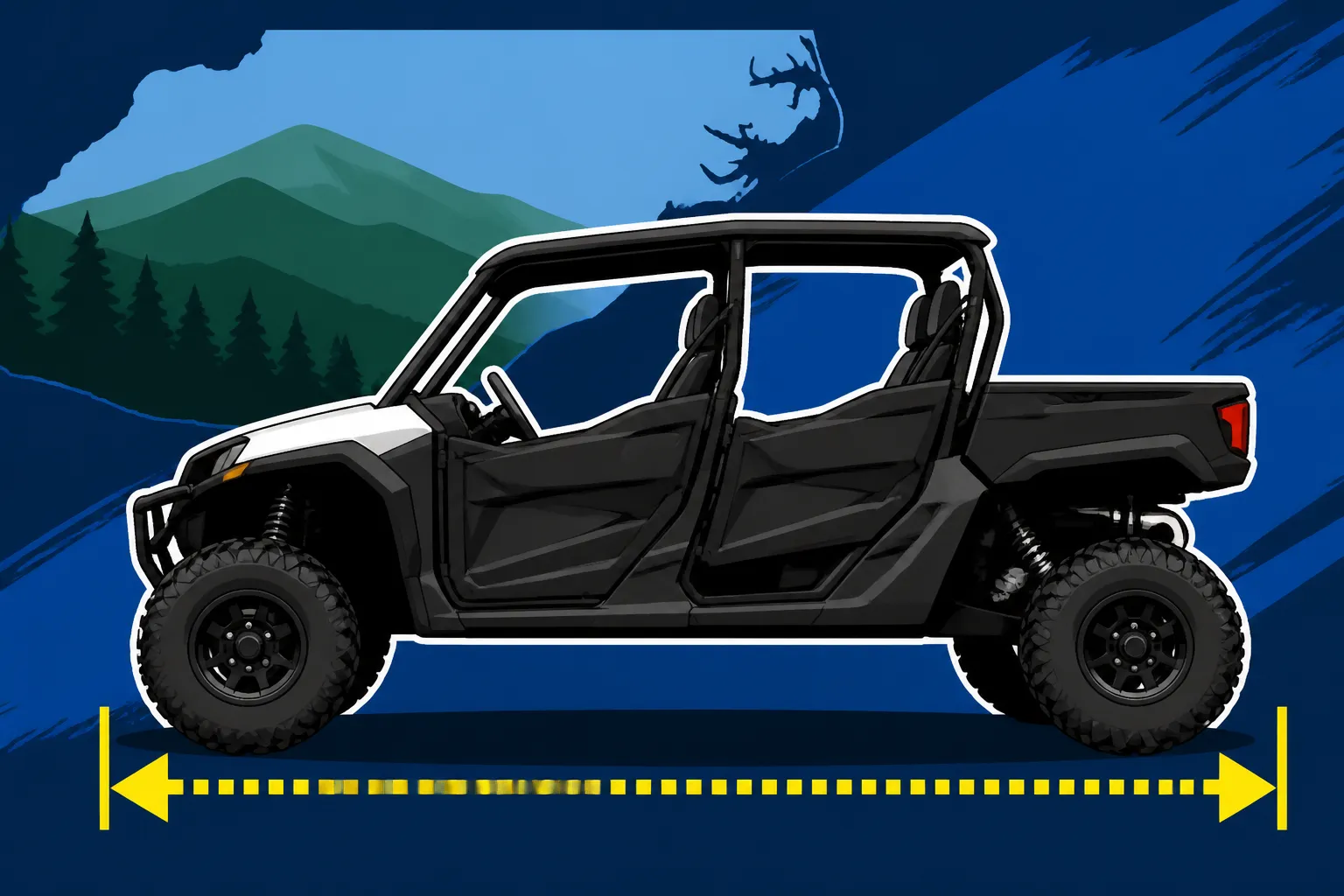
Measuring 142 Inches End to End for an MUV
Navigating the specific requirements for a Modified Utility Vehicle (MUV) in North Carolina can feel like trying to solve a puzzle, especially when you encounter precise measurements like the 142-inch length limit. Many riders get frustrated when their seemingly street-legal side-by-side doesn't quite fit the state's very particular definition, leading to confusion and roadblocks. This guide will meticulously break down the 142-inch end-to-end length requirement for MUVs, helping you understand exactly what it means for your machine and how to accurately measure it for compliance.
Understanding the Modified Utility Vehicle Definition
In North Carolina, the term "Modified Utility Vehicle" isn't just a fancy way to say "side-by-side." It's a very specific legal classification designed to allow certain off-road machines to be registered for limited street use. This isn't a blanket allowance; it’s a carefully crafted category with stringent requirements that most standard ATVs and UTVs simply don't meet straight off the dealership floor. The state created this path because they recognized that some larger, more robust utility-focused machines could, with proper modifications and adherence to strict rules, operate safely on public roads under specific conditions. Without meeting every single one of these requirements, your machine won't qualify for MUV status, no matter how close it gets.
Why MUVs Have Specific Dimensions
The North Carolina DMV isn't just throwing out random numbers when it comes to MUV dimensions. These measurements are rooted in a desire for public safety and to differentiate MUVs from traditional passenger vehicles, as well as from recreational off-road vehicles not intended for public road use. The thinking is that a machine that meets these dimensions, along as well as other criteria like engine size and top speed, behaves somewhat predictably on the road and can safely coexist with other traffic, at least on certain types of roads. For instance, the length requirement, specifically 142 inches, helps ensure the vehicle isn't excessively long for typical road maneuvers, parking, or crossing intersections. It's all about ensuring a minimum standard of roadworthiness, even for a "modified" utility machine.
The Bigger Picture: MUV Requirements
While we're diving deep into the 142-inch length, it's crucial to remember that this is just one piece of a much larger puzzle. To qualify as an MUV in North Carolina, your machine must meet several other criteria, including a minimum engine displacement of [Why an MUV Needs More Than 2,400cc], a top speed of at least [40 mph to Qualify as an MUV], and specific limits for both [The 58-Inch Width Requirement] and [The 70-Inch Height Requirement]. Additionally, MUVs must have a Vehicle Identification Number (VIN) assigned by the North Carolina DMV if they don't have one that the DMV accepts, and they must carry insurance, among other things. Missing even one of these details means your machine won't pass muster for [North Carolina MUV Registration Requirements], which can be a real bummer after you've put in the effort.
The 142-Inch Length Requirement Explained
Now, let's zero in on the 142-inch length. This is a critical measurement that often trips up side-by-side owners hoping to gain street-legal status. It's not an arbitrary number; it’s designed to ensure the MUV has a certain footprint on the road, balancing utility with maneuverability. Many popular side-by-sides, especially those designed primarily for recreational trail riding, simply don't measure up to this specific length.
How to Accurately Measure Your Machine
Measuring your machine for the 142-inch MUV requirement needs to be done meticulously. We're talking end-to-end, meaning from the absolute furthest point forward to the absolute furthest point backward. This typically includes bumpers, hitches, winches, or any other factory-installed or permanently affixed accessories that extend beyond the main body of the vehicle.
Here’s a practical approach:
- Find a Level Surface: Park your machine on a perfectly flat, level surface, like a concrete garage floor or driveway. Even a slight incline can throw off your measurements.
- Use a Long Tape Measure or String: A standard short tape measure won't cut it. You'll need a long, retractable tape measure (like those used for construction or landscaping) or even a long piece of string that you can mark and then measure with a shorter tape.
- Identify Extremities: Locate the absolute most forward point of your machine. This might be the tip of a bumper, a fairlead for a winch, or even the front tire if nothing else protrudes further. Do the same for the absolute most rearward point. This could be a rear bumper, a hitch receiver, or the back of a cargo bed. Remember, if you have a removable hitch ball, it typically wouldn't count unless it's a permanent part of the receiver. However, the hitch receiver itself often extends beyond the main frame.
- Measure in a Straight Line: Run your tape measure or string directly from the most forward point to the most rearward point. If using string, stretch it taut and mark where the front and rear extremities touch. Then, measure the string.
- Double-Check: Always measure at least twice, and even better, have a second person confirm your measurements. A small error can make a big difference in compliance.
Hypothetical Scenario: Sarah just bought a new utility side-by-side, hoping to get it street-legal as an MUV so she can use it for quick trips to the hardware store on local roads. She measures it carefully, from the front of its heavy-duty brush guard to the very tip of its rear hitch receiver. She gets 138 inches. She’s four inches short! This is a common pitfall. Even if the machine looks big, it still might not hit that precise 142-inch mark. She realizes she'll need to explore other options or consider specific modifications that might legally extend the vehicle without compromising safety or legality, such as a sturdy, permanently mounted rear cargo rack that extends the machine's overall length.
What Counts and What Doesn't
When measuring, think about anything permanently attached. A snowplow mount, if it's a fixed part of the vehicle and not easily removed, would likely be included. A flag whip, however, typically would not count as it's not a structural or integral part of the vehicle's footprint on the road. The key is "end-to-end" and "permanently affixed." If it can be easily detached for everyday operation, it's generally not part of the official length. If you're unsure, it's always best to err on the side of caution and measure with it included, or consult directly with the DMV or a qualified mechanic specializing in MUV modifications.
Practicalities of Measuring Your Machine
Getting this measurement right is crucial. It’s not just for your peace of mind; it’s what the DMV agent will be looking for if you ever bring your machine in for MUV titling. A discrepancy here can mean the difference between getting your MUV status and being turned away.
Tips for Accurate Measurement and Documentation
Beyond the physical act of measuring, there are a few other tips to keep in mind:
- Photography: Take photos of your measurement process, especially if your machine is just over or under the 142-inch mark. Show the tape measure clearly laid out, indicating the front and rear points. This visual evidence can be helpful if there's any ambiguity when you submit your paperwork.
- Manufacturer Specs vs. Reality: Don't just rely on manufacturer specifications. While they provide a good baseline, they often don't account for all the accessories you might have added or even slight variations in specific models or trims. Always perform your own physical measurement.
- Consider Future Modifications: If you're close to the 142-inch mark but slightly short, think about whether any future permanent modifications could get you there. Adding a robust rear bumper with an integrated cargo rack, for example, might add those crucial inches. Just make sure any additions are safe, legal, and truly permanent.
- Documentation: When preparing your paperwork, like those you might find on LawDepot for other legal needs, ensure all measurements you report are precise. While LawDepot itself doesn't offer DMV forms, understanding how to accurately represent factual information in legal contexts is a good skill to apply here.
| MUV Dimension | Requirement | Common Challenges |
|---|---|---|
| Length | At least 142 inches (end-to-end) | Many recreational side-by-sides are shorter. |
| Width | No more than 58 inches | Many utility side-by-sides are wider. |
| Height | No more than 70 inches | Lift kits or large roll cages can exceed this. |
| Engine Size | More than 2,400cc | Most ATVs and many UTVs are under this displacement. |
| Top Speed | At least 40 mph | Some heavily modified or older machines might struggle. |
What if Your Machine is Just Shy of 142 Inches?
This is a common scenario. You’ve got a fantastic side-by-side, it’s powerful, it’s safe, but it’s 139 inches long. What then?
- Re-measure, meticulously: Go back over your measurements with fresh eyes. Is there anything you missed that genuinely extends the length?
- Evaluate Permanent Additions: Can you add a permanent accessory that extends the length? A heavy-duty, permanently bolted-on rear bumper with an integrated towing package might do the trick. A substantial front winch assembly or brush guard, if it extends further than your current front, could also help. Remember, it must be permanently affixed and robust. Don’t just strap something on.
- Consult a Professional: If you're on the fence, consider getting an independent mechanic who understands MUV requirements to measure your machine. They might spot something you missed or offer advice on compliant modifications.
- Accept the Reality: Sometimes, despite your best efforts, a machine simply doesn't fit the MUV criteria. In such cases, you might need to reconsider your options for using it on public roads. North Carolina offers limited exceptions for [North Carolina's Farming Operations Exception] or [North Carolina's Ocean Beach Rule], but these are very specific and don't grant general street-legal status.
For owners of machines that are just a few inches short, the temptation might be to find a loophole. However, the DMV is quite strict on these measurements for good reason. Trying to circumvent the rules could lead to fines, your MUV status being revoked, or even having your vehicle towed. It's always best to be completely honest and compliant. You might even want to look at general legal forms from a provider like LawDepot to familiarize yourself with legal accuracy and detail, even though they don't provide DMV-specific forms.
Beyond Length: Other Critical MUV Requirements
While length is our focus today, it’s vital to see the whole picture. Your MUV needs to meet a full suite of requirements to get that coveted street-legal status. Understanding all these factors together will prevent future headaches down the road.
Why All Dimensions Matter Equally
North Carolina's MUV law is a package deal. It’s not enough to just meet the length requirement. Your machine must also adhere to the [The 58-Inch Width Requirement] and [The 70-Inch Height Requirement]. If your side-by-side is too wide, perhaps due to wider A-arms or aftermarket wheels and tires that push the limits, it won’t qualify. Similarly, if you’ve installed a tall lift kit or a custom roll cage that significantly increases the overall height, you might exceed the 70-inch limit. These dimensions are all about ensuring that the vehicle maintains a certain footprint and profile that's deemed acceptable for sharing public roads with other vehicles.
Think about a standard parking space or the width of a typical road lane. Vehicles that significantly exceed these common dimensions can pose challenges for traffic flow and safety. The MUV rules aim to keep these utility vehicles within a reasonable range.
Engine and Speed Requirements
Beyond physical dimensions, the MUV classification also specifies performance characteristics. Your machine must have an engine size of [More Than Twenty-Four Hundred Cubic Centimeters] (2,400cc) and be capable of reaching speeds of [Why an MUV Has to Top 40 mph]. This means that smaller, less powerful utility vehicles, even if they meet the length, width, and height, would not qualify. The larger engine size ensures enough power for sustained road speeds, while the minimum speed capability means the MUV won't be a hazard by impeding traffic too much on appropriate roads. [North Carolina's Modified Utility Vehicle Route] is specifically for these robust machines, not just any off-road vehicle.
Many standard ATVs, for instance, have engine sizes well below 2,400cc. Even many popular recreational side-by-sides fall short of this engine displacement. It really narrows down the field to truly heavy-duty utility models.
Finalizing Your MUV Paperwork
Once you've diligently measured your machine and confirmed it meets all the physical and performance criteria, you'll need to gather the appropriate documentation for the DMV. This will include the [North Carolina Title Application on Form MVR-1] and potentially the [North Carolina Damage Disclosure on Form MVR-1A] if buying a used machine. You’ll also need proof of ownership, like a bill of sale, and proof of insurance. It can be a detailed process, and having all your ducks in a row makes it much smoother. For help with generic legal documents or understanding terms, resources like LawDepot offer templates and information, though for DMV specifics, you'll work directly with the state forms. Remember, the DMV agents are thorough, and having all your accurate information ready, including your meticulously taken measurements, will expedite the process.
Ultimately, getting your machine classified as an MUV in North Carolina is an exercise in precision and attention to detail. The 142-inch length requirement is just one hurdle, but an important one, that needs to be cleared with accurate measurements and a full understanding of the state's very specific rules.
Disclaimer
This article is for general informational purposes only and does not constitute professional advice. Laws, prices and regulations vary by location and change over time. Consult a qualified professional for guidance on your specific situation.