North Carolina’s 58 Inch Width Limit
It can be incredibly frustrating to navigate the complex rules and regulations surrounding off-road vehicles in North Carolina, especially when you're trying to understand what you can and can't ride on certain roads or trails. One specific area that often causes confusion for riders, particularly those with side-by-sides, is the state's 58-inch width limit. This guide aims to demystify this rule, explaining where it applies, why it exists, and what it means for your riding adventures across the Tar Heel State.
Understanding North Carolina's 58-Inch Width Limit for Off-Road Machines
North Carolina has specific rules about vehicle dimensions, and the 58-inch width limit is one that often catches ATV and UTV owners off guard. It's not a universal ban on wider machines, but rather a key measurement that determines whether certain vehicles can be considered street-legal under particular classifications. Understanding this limit begins with knowing its primary purpose: enabling the "Modified Utility Vehicle" (MUV) designation.
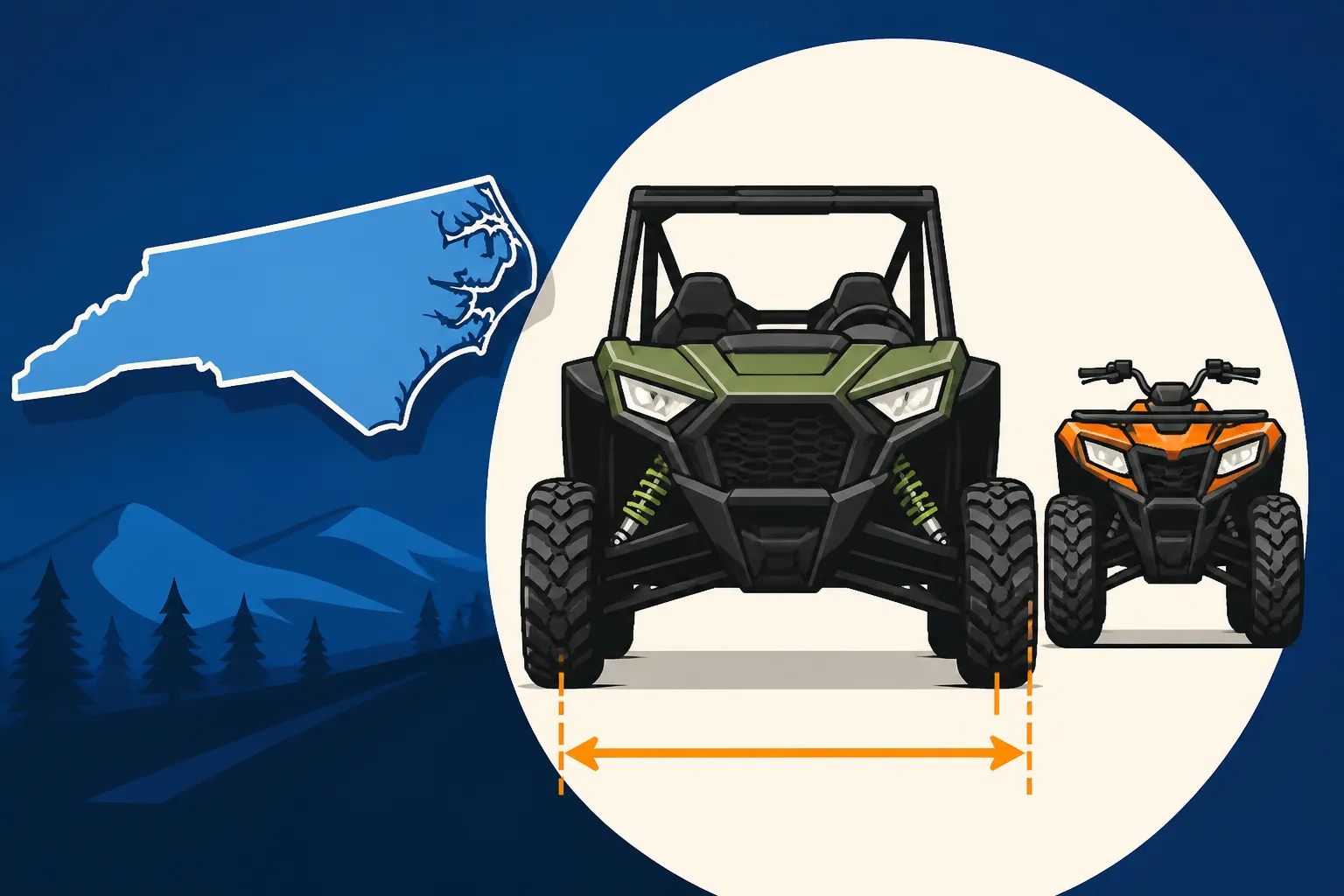
First, let's clarify what "width" means in this context. Generally, when the state refers to a vehicle's width, it means the widest point of the vehicle, typically measured from the outside of one tire to the outside of the opposite tire. This measurement includes the tires themselves, not just the body of the machine. If you've got wider aftermarket tires or wheel spacers, those absolutely factor into your overall width. Accessories like fender flares might be considered if they extend beyond the tire's widest point, so it's always best to measure your machine thoroughly from its absolute widest points.
The 58-inch measurement matters most when you're dreaming of taking your off-road machine onto public roads, even for short distances. North Carolina does not generally allow ATVs or UTVs on public roads, but there's a specific pathway for some larger machines through the [North Carolina's Modified Utility Vehicle Route]. An MUV is a specific classification designed to allow certain utility-focused machines, often what we commonly call side-by-sides, to operate on designated public roads. This isn't about transforming every UTV into a road-legal car; it's a very specific set of criteria that aims to ensure these larger machines meet minimum safety and dimensional standards for sharing certain roadways. Without meeting all the MUV requirements, your machine simply won't be granted street-legal status, and that 58-inch width is a big one.
The Road to Street Legality: How Width Impacts MUV Status
For many side-by-side owners, the idea of driving their machine on public roads, even just to connect trails or access a store, is incredibly appealing. However, North Carolina's MUV route presents a significant hurdle for many modern machines, and the 58-inch width limit is often the culprit. If your UTV or side-by-side measures wider than 58 inches from its outermost tire edge, it simply won't qualify as an MUV. Period. This can be a real letdown, especially since many popular side-by-side models on the market today exceed this measurement straight from the factory. A standard two-seat side-by-side can easily be 60-64 inches wide, and some of the more performance-oriented or multi-passenger machines can be 72 inches or even wider.
This presents a considerable challenge. You might have a machine that otherwise perfectly fits the spirit of a utility vehicle, but if it's too wide, the MUV door is closed. This limit, alongside other requirements, is put in place for safety and to differentiate these machines from standard cars or trucks. It's about maintaining a certain profile on the road, particularly on narrower rural routes where MUVs might operate.
Beyond the 58-inch width, becoming an MUV also requires meeting several other crucial criteria. Your machine needs to have an engine displacement of [Why an MUV Needs More Than 2,400cc]—yes, you read that right, more than 2,400 cubic centimeters—which again excludes many common UTVs. It also has to meet specific length, height, and speed requirements, such as [The 142-Inch Length Requirement], [70 Inches From the Ground], and being capable of at least [40 mph to Qualify as an MUV]. Furthermore, an MUV must be equipped with full road-legal safety features, including turn signals, headlights, taillights, brake lights, a speedometer, rearview mirrors, and seat belts. These are all part of the comprehensive [North Carolina MUV Dimension Requirements] that aim to make MUVs as safe as possible when sharing the road with other vehicles. If your machine doesn't tick every single box, including that 58-inch width, it simply won't be able to get the necessary street-legal registration. This means no riding on most public streets, except for very limited agricultural exceptions or short road crossings.
Trail Riding and the Width Factor in North Carolina
While the 58-inch width limit is primarily a concern for street-legal MUV status, it can also play a role, albeit a less direct one, in your trail riding experiences in North Carolina. Unlike the strict MUV requirements for road use, dedicated off-road trails, particularly those managed by the U.S. Forest Service within North Carolina's National Forests, often have their own specific width guidelines.
Many older trails or those in sensitive environmental areas were originally designed for traditional ATVs, which typically measure around 48 to 50 inches wide. As side-by-sides have grown in popularity and size, trail systems have had to adapt. Some trails, or even entire trail sections, might still have physical barriers, gates, or very tight turns that simply prevent wider machines from passing. This isn't always tied directly to the 58-inch MUV rule, but rather to the physical constraints and design of the trail itself. Imagine a narrow path winding through dense trees or a metal gate designed to keep larger vehicles out—if your machine is too wide, you simply won't fit.
It's absolutely critical to check the specific rules and regulations for any trail system you plan to visit before you load up your machine. Websites for the Uwharrie, Pisgah, and Nantahala National Forests, for example, will often have detailed information about permissible vehicle types and sizes. Private off-road parks may have more lenient or entirely different rules, but it's always best to call ahead. You don't want to drive for hours to [Brown Mountain OHV Trail System] or [Badin Lake OHV Trail Complex] only to find your wider machine isn't permitted on the trails you planned to ride. Many trails are now explicitly designed to accommodate wider side-by-sides, but others might have specific loops or sections designated only for narrower machines. Always look for information regarding [North Carolina Trails for a Wide Machine] to ensure a hassle-free trip.
Practical Advice for Riders Facing Width Restrictions
Navigating North Carolina's rules around ATV and UTV width requires a proactive approach. Here's some practical advice to help you avoid headaches and make the most of your riding opportunities:
First and foremost, measure your machine accurately. Don't rely solely on manufacturer specs, as aftermarket additions or even tire variations can change the actual width. Use a tape measure and check from the outermost edge of your tires at their widest point. This is crucial for both MUV consideration and trail access.
If you're considering buying a new or used machine, especially if street legality is a dream of yours, thoroughly investigate its dimensions before you commit. This is particularly important when [Buying an Out-of-State Machine for North Carolina], as other states may have different rules. A machine perfectly legal on roads elsewhere might fall short of North Carolina's MUV requirements, including that 58-inch width.
For those with machines wider than 58 inches who still want some limited road access, explore the [North Carolina's Farming Operations Exception]. This exception allows ATVs and UTVs (regardless of width, in this specific context) to operate on certain public roads for agricultural purposes. It's not a free pass for joyriding, but it can be a lifesaver for farmers needing to move equipment between fields.
Regarding modifications, be cautious. While some riders might consider narrower tires or specialized wheels to reduce width, understand the implications for performance, stability, and safety. Any modification made to meet a specific dimension must also maintain the machine's safe operating characteristics. Always prioritize safety over trying to squeeze into a technical limit.
It's a good practice to keep accurate records of your machine's specifications, including its actual measured width, along with other critical information like the VIN and engine size. If you're buying or selling a machine, using a robust document like a bill of sale can formalize these details. Services like LawDepot offer templates for various legal documents, which can be useful for creating a comprehensive bill of sale that includes all relevant specifications and disclaimers about the machine's status in North Carolina, especially regarding its width for MUV purposes. This can help clarify expectations between buyer and seller and provide you with a solid record of your machine's initial dimensions.
Finally, always double-check the rules. The North Carolina DMV website is your go-to for MUV regulations. For trail specific rules, consult the individual National Forest websites (Uwharrie, Pisgah, Nantahala) or the websites of private off-road parks. Things can change, so a quick check before each trip can save you a lot of trouble.
Here's a quick comparison of typical widths for different machine types versus the MUV requirement:
| Feature | Standard ATV | Common Side-by-Side (UTV) | MUV Requirement (NC) |
|---|---|---|---|
| Typical Width | 46-50 inches | 55-72+ inches | Max 58 inches |
| Engine Size | 250-1000cc | 500-1200cc+ | > 2400cc |
| Seating | Single or two-up | Two to six passengers | No specific limit |
| Road Use Intent | Off-road only | Off-road / Utility | Limited road use |
| Street Legal? | Generally No | Generally No | Only if all MUV criteria are met |
This table clearly highlights why many popular side-by-sides fall outside the MUV criteria, with width being a primary factor. Be diligent, know your machine, and always ride responsibly!
Disclaimer
This article is for general informational purposes only and does not constitute professional advice. Laws, prices and regulations vary by location and change over time. Consult a qualified professional for guidance on your specific situation.