70 Inches From the Ground
Navigating the rules for riding your ATV or UTV on public roads in North Carolina can feel like trying to solve a puzzle with half the pieces missing. Many folks dream of taking their side-by-side from their property straight to the corner store, or cruising down a quiet back road, only to be met with a frustrating wall of regulations. This guide is here to shed light on one of those crucial, often misunderstood pieces of the puzzle: the specific dimension requirements, particularly the "less than 70 inches from the ground" rule, that dictate whether your machine can legally become a Modified Utility Vehicle (MUV) and hit the pavement in the Tar Heel State.
The Specifics of North Carolina's Modified Utility Vehicle (MUV) Definition
Let's be real, the idea of just hopping on your favorite UTV and driving it down a North Carolina street is appealing. The reality, however, is a bit more complex, and often, quite disappointing for those who haven't done their homework. North Carolina law is pretty clear: your standard, off-the-assembly-line ATV or UTV is not designed or legally permitted for public road use. This isn't just a suggestion; it's a hard-and-fast rule designed to keep everyone safe.
The Narrow Road to Street Legality
For most multi-passenger utility vehicles, the only legal pathway to public road access in North Carolina is through a special classification: the Modified Utility Vehicle, or MUV. This isn't just a fancy name; it's a specific designation that your machine has to earn by meeting a very precise set of criteria and undergoing a rigorous titling process. Without converting your UTV into an MUV, you're generally limited to private land, designated [Where to Ride an ATV in North Carolina] trails, or roads opened up by specific exceptions like those for farming operations. It's a significant distinction that many riders overlook, leading to tickets and frustration. [North Carolina's Modified Utility Vehicle Route] is truly the only consistent game in town for street use.
Unpacking the MUV Criteria: Beyond Just Height
While the "less than 70 inches from the ground" rule is a key focus, it's just one piece of a larger puzzle that defines an MUV. North Carolina has laid out a comprehensive set of requirements that your machine must satisfy to qualify. We're talking about everything from engine size to overall dimensions and even specific safety equipment. You can't just meet one or two; you have to tick every single box. It’s like trying to get into an exclusive club – there's a strict dress code and a list of specific accomplishments you need to have. Understanding all these factors together is crucial, because failing on even one point means your machine simply won't make the cut for street-legal status.
Why the State Cares So Much About Dimensions
You might wonder why North Carolina is so hung up on exact measurements like height, width, and length for these vehicles. It's not just to make your life difficult, I promise. These rules are primarily about safety and ensuring that MUVs can operate predictably and safely alongside other vehicles on public roads. Standard UTVs are designed for off-road conditions, often with higher centers of gravity, wider stances, and different handling characteristics than traditional cars or trucks.
The dimension limits help ensure that MUVs are not excessively wide or long, which could impede traffic flow or make them difficult to maneuver in regular lanes. The height restriction, in particular, aims to keep the vehicle's profile relatively low, reducing the risk of rollovers and improving overall stability, especially at higher speeds. It also helps prevent issues with overhead clearances, like low bridges or parking garage entrances. Essentially, these dimensions are an attempt to bridge the gap between an off-road beast and a road-worthy vehicle, integrating it safely into the existing infrastructure. These rules, along with requirements like [North Carolina MUV Insurance Requirements], aim to create a safer environment for everyone sharing the road.
Decoding the "Less Than 70 Inches From the Ground" Rule for MUVs
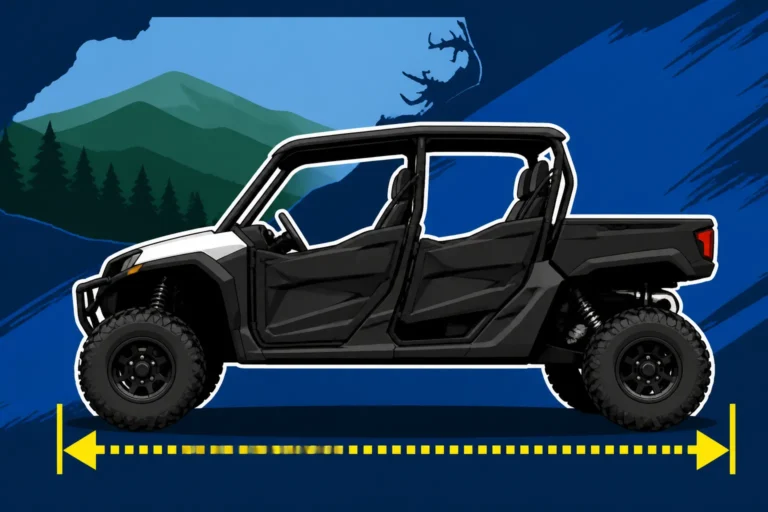
Okay, let's zero in on the specific measurement that often trips people up: the height. For your utility vehicle to qualify as an MUV in North Carolina, its total height must be less than 70 inches from the ground. This isn't a suggestion; it's a clear cut-off point. If your machine measures 70 inches or more, it does not meet the MUV height criteria.
How to Accurately Measure Your Machine's Height
Getting an accurate measurement is absolutely vital. You can't just eyeball it or rely on manufacturer specs, as modifications or even tire pressure can change things. Here's how to do it correctly:
- Park on Level Ground: Find a flat, even surface. This is critical for an accurate reading.
- Ensure Proper Tire Inflation: Inflate your tires to their recommended pressure. Under-inflated tires will give you a lower reading, which is misleading.
- Measure to the Highest Fixed Point: Use a tape measure to measure from the ground to the absolute highest fixed point of your vehicle. This includes the top of the roll cage, any integrated roof, or even a permanently mounted light bar if it's the highest point. Do not include flexible antennas, temporary flags, or detachable items that aren't a permanent part of the vehicle's structure.
- Consider Accessories: If you have an aftermarket roof, a light bar, or even a cargo rack, these are usually considered part of the vehicle's overall height if they are permanently installed. Make sure they are included in your measurement.
Taking your time and possibly having a friend help hold the tape measure can ensure you get the most precise reading. Remember, this isn't just for curiosity; it's a legal requirement that will be checked when you attempt to register your MUV.
The Implications of Exceeding (or Not Meeting) the 70-Inch Mark
If your machine measures 70 inches or taller, it simply won't qualify as an MUV. Period. This can be a tough pill to swallow, especially if you've invested heavily in a particular model or modifications. The immediate implication is that your UTV will remain an off-road-only machine, restricted from public roads, save for very specific exceptions like [North Carolina's Farming Operations Exception] on certain agricultural routes.
For UTVs that are significantly shorter than 70 inches, this is generally less of an issue, as the rule is an upper limit. Most modern side-by-sides are well within or just slightly over this threshold, so being too short isn't usually the problem. The concern almost always lies with machines that are too tall. A machine that is too tall risks higher instability, especially if it's also narrow, which is why [North Carolina MUV Dimension Requirements] are all interconnected. Getting caught riding an unqualified machine on a public road can lead to fines, citations, and even having your vehicle impounded, adding a whole new layer of headaches.
Modifications and Considerations for Meeting the Height Rule
Sometimes, you might find your beloved UTV is just a hair over the 70-inch limit. In these cases, it's natural to wonder if you can make some adjustments. Modifications are a common part of the MUV conversion process, but they need to be done strategically and legally.
- Tires: Taller tires will, naturally, increase your overall height. If you're close to the limit, swapping to slightly shorter-profile tires could potentially bring you under. However, this might affect ground clearance and ride quality, so it's a trade-off.
- Lift Kits: Conversely, lift kits are designed to raise your machine. While popular for off-road performance, a lift kit will almost certainly push a UTV over the 70-inch maximum, making MUV conversion impossible without removing it. If street-legal MUV status is your goal, a lift kit is generally counterproductive for meeting the height rule.
- Roofs and Roll Cages: Many UTVs come with factory roofs or roll cages that might put them right at or slightly over the limit. Aftermarket roofs can also add significant height. Carefully review the specifications before purchasing and installing. In some extreme cases, some enthusiasts might even modify the roll cage itself (a complex and potentially dangerous undertaking) to reduce height, but this should only be done by certified professionals to ensure structural integrity and safety.
- Accessories: Even seemingly minor accessories like roof-mounted light bars, cargo racks, or custom overhead consoles can be the difference between making the cut and not. Always measure with all fixed accessories installed.
The key here is meticulous planning. If you're set on making your UTV an MUV, you need to consider the 70-inch height rule (along with all other MUV requirements) before you start making significant modifications or even before purchasing a new machine. It’s far easier to buy a machine that fits the dimensions or only needs minor adjustments than to try to undo major modifications later.
Beyond Height: The Full Gauntlet of MUV Requirements
While the 70-inch height rule is critical, it's by no means the only hurdle your machine must clear to become a legal MUV in North Carolina. The state has a whole list of specifications and safety features that need to be present and accounted for. Ignoring any one of these can stop your MUV registration dead in its tracks.
The Engine, Length, and Width Requirements
Beyond height, North Carolina imposes strict limits on the engine size, overall length, and width of an MUV. These aren't just arbitrary numbers; they further define the type of vehicle that can safely share public roads.
- Engine Size: An MUV must have an engine displacement of [More Than Twenty-Four Hundred Cubic Centimeters] (2,400cc) or more. This is a significant requirement, as many smaller UTVs, and almost all ATVs, won't meet this. The idea is to ensure the MUV has enough power to keep up with traffic and not become a hazard due to slow speeds on roads.
- Length: The machine's overall length must be [Measuring 142 Inches End to End for an MUV] or less. This keeps MUVs relatively compact, allowing them to maneuver and park appropriately in standard road environments.
- Width: The width is equally important, requiring the MUV to be [North Carolina's 58 Inch Width Limit] or less. This is often a tough one for many modern side-by-sides, which frequently exceed this measurement, especially with wider tire and wheel setups. Again, this is about ensuring the vehicle fits comfortably in a traffic lane and doesn't pose an undue hazard.
These three dimensions, coupled with the height, create a very specific envelope for what can and cannot be an MUV. Many popular sport-oriented UTVs, designed for aggressive off-road performance, will struggle to meet these narrow dimension requirements.
Mandatory Safety Equipment for Road Use
Once your machine's physical dimensions are in line, you're still not done. An MUV must also be equipped with a comprehensive suite of safety features to be considered road-worthy. These are the same types of features you'd expect on any passenger vehicle and are non-negotiable for registration.
- Headlights and Taillights: These must be fully functional for visibility, especially during dawn, dusk, or adverse weather.
- Brake Lights: Essential for signaling stops and slowing down to traffic behind you.
- Turn Signals: Required for clearly indicating turns and lane changes.
- Mirrors: You'll need at least one rear-view mirror, and often side mirrors, to ensure adequate visibility of surrounding traffic. [North Carolina MUV Mirror Requirement] is very specific about this.
- Speedometer: A working speedometer is crucial for maintaining legal speeds. [North Carolina MUV Speedometer Requirement] ensures you can accurately gauge your speed on public roads.
- Parking Brake: A fully functional parking brake is a safety must-have.
- Seat Belts: All occupants must have access to and use appropriate seat belts.
- Windshield: A sturdy windshield to protect occupants from road debris.
Adding all this equipment can be a significant undertaking, often requiring electrical work and careful installation to ensure compliance. It's not uncommon for an otherwise dimension-compliant UTV to fail MUV qualification due to missing or inadequate safety equipment.
The Critical Paperwork for MUV Certification
After all the physical modifications and safety equipment checks, you then face the administrative hurdle: paperwork. This process involves navigating the North Carolina Division of Motor Vehicles (DMV) to formally classify and register your machine as an MUV.
First, your machine will need a proper Vehicle Identification Number (VIN) that the DMV can recognize and process. In some cases, if your machine doesn't have a standard manufacturer VIN that satisfies the state's requirements, you might need to apply for [A VIN Assigned by the North Carolina DMV] after an inspection. This typically happens for custom builds or machines with non-standard identification.
Once your machine has a verifiable VIN and meets all the physical and safety criteria, you'll need to submit the necessary forms for MUV registration. This will include applying for a title, providing proof of ownership (like a bill of sale or previous title), and demonstrating that the machine meets all the MUV criteria through an inspection process. You’ll need to understand all the [North Carolina MUV Registration Requirements] to ensure you submit everything correctly. If you're buying a used machine privately, a robust bill of sale is crucial proof of ownership. Resources like LawDepot can be incredibly helpful for creating legally sound [North Carolina ATV Bill of Sale Requirements] documents, ensuring you have all the necessary details covered for your purchase and subsequent titling. Don't underestimate the power of clear, concise documentation when dealing with the DMV; it can smooth out a potentially bumpy process. This is part of the larger [North Carolina ATV Title Paperwork] process.
What to Do If Your Machine Doesn't Quite Fit the MUV Mold
So, what happens if, after all your measuring and checking, your beloved UTV simply doesn't meet the MUV criteria? It's a common scenario, and while it might be disappointing, it doesn't mean your riding days are over. It simply means you need to adjust your expectations and riding plans accordingly.
Riding Off-Road: Trails and Private Lands
The most straightforward answer is to embrace the off-road life. Your ATV or UTV was designed for dirt, mud, and trails, and North Carolina has some fantastic places to enjoy them.
- Designated OHV Trails: Places like the [Badin Lake OHV Trail Complex] in the Uwharrie National Forest or the [Brown Mountain OHV Trail System] in the Pisgah National Forest offer miles of challenging and enjoyable terrain. These areas are specifically managed for off-highway vehicles, and you'll find plenty of like-minded riders. Just remember to check for specific [North Carolina Forest OHV Permits] and [North Carolina ATV Safety Certificate Requirements] that might apply to these areas.
- Private Land: If you own land or have permission from a landowner, you can ride to your heart's content on private property. This is where many off-road enthusiasts get their fix without having to worry about street-legal conversions. Always ensure you have explicit [North Carolina Landowner Permission Requirements] if riding on someone else's property to avoid trespassing issues.
- Farm Use: North Carolina does offer some specific exceptions for ATVs and UTVs used exclusively for agricultural purposes on public roads, but these are very narrow and don't grant general street legality. [North Carolina's Farming Operations Exception] needs to be strictly followed.
These avenues provide legitimate and exciting opportunities to ride your machine without the headaches of MUV conversion.
Selling, Trading, or Adapting Your Machine
If you're dead set on having a street-legal machine and your current UTV can't be converted, you have a few options:
- Sell and Buy Compliant: You could sell your current machine and purchase a new or used UTV that more closely meets the MUV dimensions and engine size. Many manufacturers are starting to produce models with MUV-like specifications in mind, even if they're not explicitly marketed as such.
- Trade-in: Some dealerships might offer trade-in options if you're looking to upgrade to a different model that has a better chance of MUV conversion.
- Keep it Off-Road: You might decide that the hassle and expense of MUV conversion aren't worth it, and simply continue to enjoy your UTV as an off-road-only vehicle. This is a perfectly valid choice and often the most cost-effective one.
Essential Ownership Documents, Regardless of Road Legality
Even if your machine never touches a public road, proper documentation is still crucial. A clear record of ownership is vital for a variety of reasons.
| Document Type | Purpose | Why It Matters |
|---|---|---|
| Bill of Sale | Proves legal transfer of ownership from seller to buyer. | Essential for future sales, proving purchase date/price, and resolving disputes. |
| Manufacturer's Title | The original document from the manufacturer, proving the first owner. | Crucial for initial titling applications (if applicable) and proving origin. |
| Existing State Title | If previously titled in NC or another state, proves current legal ownership. | Required for transferring ownership, demonstrating lien status, and proving origin. |
| Loan/Lien Agreement | Details any outstanding financial interest on the machine. | Important for knowing who truly owns the machine and clearing it for sale. |
| Insurance Policy | Proof of liability or comprehensive coverage. | Protects you financially in case of accidents, theft, or damage (even off-road). |
Whether you're buying or selling, having a professionally crafted bill of sale or other legal forms can protect you. Resources like LawDepot can assist you in creating these kinds of documents, ensuring that every detail is covered and your ownership is clear, whether you're dealing with a private sale or just want to keep your records straight. Having proper paperwork protects you if your machine is ever stolen, if you need to make an insurance claim, or if you decide to sell it down the line. It's peace of mind that every owner, MUV or not, should have. [How a Title Proves You Own the Quad] is a key concept here, even if not strictly required for off-road use, it solidifies your ownership.
Disclaimer
This article is for general informational purposes only and does not constitute professional advice. Laws, prices and regulations vary by location and change over time. Consult a qualified professional for guidance on your specific situation.