North Carolina Rules for an Electric Machine on a Road
It's a common thought, especially with the rise of eco-friendly vehicles: can my electric ATV or UTV hit the pavement in North Carolina? Many of us dream of a quiet, emissions-free ride from our property to the local store or even just down a country road. But the reality for electric off-road machines in North Carolina, when it comes to public roads, is a lot more complex and often, frankly, disappointing than we might hope. This guide will walk you through the specific regulations, helping you understand why your electric machine faces the same, if not greater, challenges as its gasoline-powered counterparts when it comes to street legality in the Tar Heel State.
The Fundamental Challenge: ATVs, UTVs, and Public Roads in North Carolina
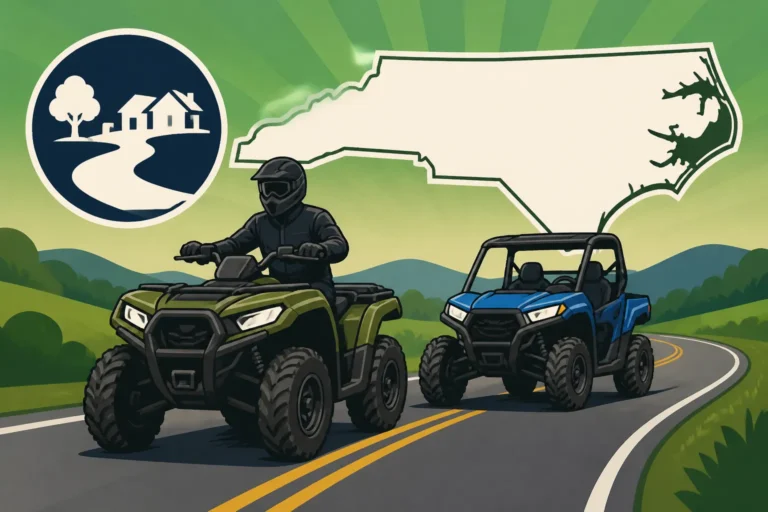
Let's get straight to the point: North Carolina law is pretty clear and consistently restrictive when it comes to operating ATVs and UTVs on public roads. Whether your machine hums along on battery power or roars with a gasoline engine, the baseline assumption is that it's designed for off-road use, and therefore, it doesn't belong on public highways, streets, or even shoulders. This isn't just about speed or noise; it's about classification and safety. The state views these machines as inherently different from traditional motor vehicles, lacking many of the safety features required for road travel.
Why Standard Machines Are Off-Limits
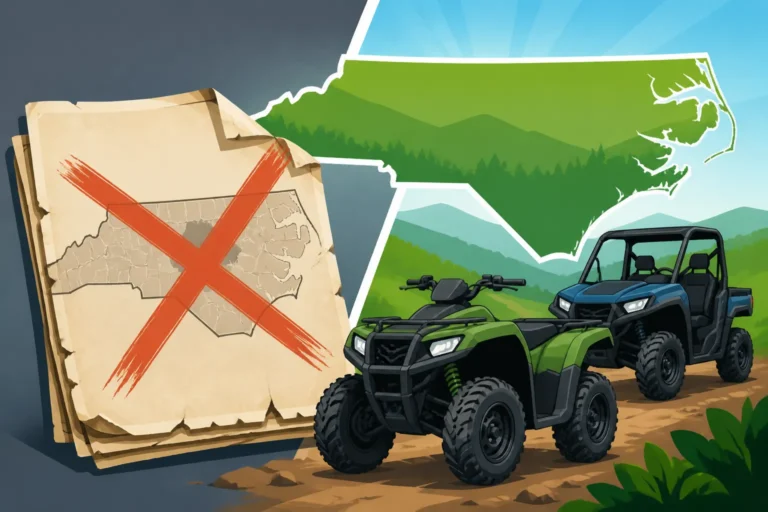
The primary reason ATVs and UTVs, electric or otherwise, are generally prohibited on North Carolina roads boils down to how they're classified. They simply don't meet the definition of a "motor vehicle" that's allowed on public roads. They aren't cars, trucks, or motorcycles. They're built for dirt, trails, and rough terrain, not for navigating traffic alongside sedans and tractor-trailers. This distinction means they typically aren't eligible for registration and titling in the way a conventional vehicle is, which is a prerequisite for road use. It's a frustrating hurdle for many owners who just want to connect properties or get to a nearby trail without trailering. For a deeper dive into why registration isn't typically an option, check out [Why North Carolina Has No ATV Registration].
Beyond the basic classification, there are safety concerns. Most ATVs and UTVs lack federally mandated safety equipment like proper headlights, taillights, turn signals, brake lights, windshields, and even basic crash-worthiness standards that road-going vehicles must meet. Imagine trying to make a quick lane change on a busy highway in a machine designed for carving through mud – it’s just not safe for you or other drivers. This is why the laws are so stringent, aiming to keep off-road vehicles where they belong: off the road.
The "Electric" Distinction Isn't a Free Pass
It's natural to think that an electric ATV or UTV might escape some of these restrictions. After all, they're quieter, don't produce emissions, and often have smooth, controllable power delivery. You might assume these attributes would make them more acceptable for limited road use. However, under current North Carolina statutes, the method of propulsion (gasoline, electric, or even hydrogen fuel cell) does not fundamentally change the classification of an ATV or UTV as an off-road vehicle.
An electric ATV is still an ATV, and an electric UTV is still a UTV in the eyes of the law. The rules against street legality are broad and cover these vehicle types regardless of their power source. So, while you might appreciate the silent operation of your electric rig, a North Carolina law enforcement officer will view it through the same lens as a roaring gas-powered quad when it comes to road use. The primary focus remains on the vehicle's design, safety features (or lack thereof), and its intended purpose.
Dissecting the Modified Utility Vehicle (MUV) Route
For those absolutely determined to get their UTV (and potentially an electric one) onto North Carolina roads, there is one narrow, highly specific pathway: the Modified Utility Vehicle, or MUV. This isn't a general "street-legal kit" loophole; it's a distinct vehicle classification with a very demanding list of requirements. Many UTV owners consider this route, but it’s crucial to understand how an electric machine fits, or rather, doesn't fit, into this framework. You can learn more about this specific path in [North Carolina's Modified Utility Vehicle Route].
The Critical Engine Displacement Hurdle for Electric Machines
Here's where the electric dream for road use often hits a major roadblock. The North Carolina General Statutes define a Modified Utility Vehicle as requiring an "internal combustion engine with a total engine displacement of at least 2,400 cubic centimeters." This is a significant detail. An internal combustion engine is one that generates power by burning fuel within cylinders – think gasoline or diesel. Electric motors, by their very nature, do not have cubic centimeters of displacement. They operate on principles of electromagnetism, measured in kilowatts or horsepower, not displacement.
What this means in plain language is that, as the law currently stands, an electric ATV or UTV cannot qualify as an MUV in North Carolina because it lacks an internal combustion engine and therefore cannot meet the 2,400cc displacement requirement. This is perhaps the most critical piece of information for electric machine owners hoping for road legality. Until the law is updated to include equivalent electric motor specifications, this path remains closed to them. It's a point of frustration for many, as it effectively excludes an entire category of utility vehicles from what is already a very restrictive road-legal option. [North Carolina MUV Engine Size Requirement] goes into more detail about this specific rule.
Other MUV Requirements: What an Electric UTV Would Still Need
Even if, by some future legislative change, electric machines were given an equivalent path to MUV status, the list of other requirements is extensive and costly. These apply to any machine attempting to become an MUV, regardless of its power source. These requirements are designed to bring the UTV up to a standard that makes it somewhat comparable to a low-speed vehicle or golf cart in terms of road safety equipment.
To qualify as an MUV, a vehicle must be modified to include:
- Headlamps
- Taillamps
- Stop lamps (brake lights)
- Turn signal lamps
- Red reflectors on the rear
- A parking brake
- A rearview mirror or mirrors
- A windshield
- A speed-governing device (limiting speed to 40 mph or less)
- Seat belts for each occupant
- A VIN assigned by the North Carolina DMV
- A speedometer
- Specific dimension requirements: not less than 58 inches and not more than 80 inches in width; not less than 142 inches in length; not more than 70 inches in height.
These are significant modifications, often requiring aftermarket parts that can add up financially. Companies like SuperATV offer a vast range of accessories, from windshields and mirrors to turn signal kits, that owners of gas-powered UTVs might consider for an MUV conversion. However, for electric UTVs, focusing on these modifications is secondary to the primary issue of the "internal combustion engine" clause. You can find more information about the physical dimensions in [North Carolina MUV Dimension Requirements].
Here's a quick look at the MUV requirements and how an electric UTV stacks up:
| Requirement | Standard UTV (Gas) | Electric UTV | Notes |
|---|---|---|---|
| Engine Type | Internal Combustion | Electric Motor | Critical MUV Disqualification for Electric (NC Law specifies internal combustion with 2,400cc+) |
| Engine Displacement | At least 2,400cc | N/A (measured in kW/HP) | Directly linked to engine type; electric cannot meet. |
| Headlamps, Taillamps, Stop Lamps | Often requires additions/upgrades | Often requires additions/upgrades | Modifiable with aftermarket kits from vendors like SuperATV. |
| Turn Signal Lamps | Requires additions | Requires additions | Common aftermarket upgrade. |
| Red Rear Reflectors | May need additions | May need additions | Simple addition. |
| Parking Brake | May need additions/verification | May need additions/verification | Standard on many UTVs, but must be functional. |
| Rearview Mirror(s) | Requires additions | Requires additions | Common aftermarket item. |
| Windshield | Requires additions | Requires additions | Essential for road use, good aftermarket availability. |
| Speed Governing Device (40 mph max) | May require modification/limitation | May require modification/limitation | Often an ECU tune or physical governor. Electric machines might need programming. |
| Seat Belts (for each occupant) | Often standard, but must be functional | Often standard, but must be functional | Essential safety feature. |
| VIN Assigned by NCDMV | Required for titling | Required for titling | A specific DMV process, not inherent to the vehicle. See [Getting a VIN Assigned by the DMV]. |
| Speedometer | Often standard, but must be functional | Often standard, but must be functional | Essential for road safety. See [North Carolina MUV Speedometer Requirement]. |
| Dimensions (Width 58-80", Length 142"+, Height 70" max) | Must meet specific measurements | Must meet specific measurements | Physical modifications or selecting a specific UTV model might be needed. |
This table clearly illustrates the most significant hurdle for electric machines, which is the engine requirement.
Limited Exceptions for Road Use (Electric or Not)
While the MUV path is essentially closed to electric machines, and general road use is prohibited, there are a few very specific and limited exceptions that might apply to any ATV or UTV, regardless of its power source. These exceptions are narrow and don't grant widespread road-legal status, but they are important to understand.
Road Crossings and Farm Operations
North Carolina law does allow for ATVs and UTVs to cross public roads at a ninety-degree angle, provided it's done safely and without impeding traffic. This is strictly for crossing, not riding on the road for any distance. So, if your property is bisected by a public road, you can cross it to access the other side, whether your machine is electric or gas-powered. This is a common scenario in rural areas. For more on this, check out [North Carolina Rules for Crossing a Road].
Another significant exception applies to machines used for bona fide "farming operations." If an electric ATV or UTV is being used exclusively for farming, logging, or ranching on private land, it may be allowed limited access to public roads for very specific purposes related to that operation. This could include transporting tools, feed, or equipment from one part of a farm to another, or moving between adjacent farm properties. However, this exception is not a blanket permission to joyride on public roads. It's tied directly to the agricultural purpose. The machine must be operated by a person actively engaged in the farming operation, and its use must be directly related to that work. This exception allows for specific, task-oriented road use, not general transportation. This rule is detailed further in [North Carolina Farming Exception for ATVs].
It's vital to remember that these exceptions are extremely narrow. You can't just slap a "farm use" sticker on your electric side-by-side and expect to cruise through town. Law enforcement officers are well aware of the limitations of these rules, and misinterpreting them can lead to citations.
Specific Beach Access Rules
North Carolina's beautiful coastline offers another unique, albeit highly restricted, scenario for vehicle use. Some specific beaches or designated coastal areas may permit ATVs or UTVs, including electric ones, to operate on the sand. These rules are almost always set by local ordinances (county or municipal) and can vary wildly from one stretch of beach to another. For example, some areas might allow vehicles during certain times of the year, for specific activities like fishing, or with special permits.
Generally, these beach rules are for designated access points and the hard-packed sand below the high-tide line. You won't be able to ride through the dunes or on primary roads leading to the beach. The rules often also include restrictions on speed, age of operator, and requiring specific equipment like flags or lights. It is absolutely essential to check with the local authorities for the specific beach you plan to visit before attempting to ride an electric machine there. Relying on anecdotal information or rules from a different beach can lead to fines and disappointment. [North Carolina's Ocean Beach Rule] provides additional context on this topic.
Practical Realities for Electric ATV/UTV Owners
So, if the MUV path is mostly closed and road exceptions are limited, what's an electric ATV or UTV owner in North Carolina to do? It largely comes down to understanding where you can ride and making smart choices about how you operate your machine. The goal is to maximize your enjoyment without running afoul of the law.
Where You Can Ride Your Electric Machine
The good news is that your electric ATV or UTV is perfectly at home on private property and designated off-road trail systems. North Carolina has a number of fantastic places where you can legally and safely enjoy your machine.
- Private Land: This is the most straightforward option. If you own the land, or have explicit permission from the landowner, you can ride your electric machine to your heart's content. This is where many utility-focused electric UTVs truly shine, quietly hauling equipment, scouting property, or simply navigating around a large estate.
- Designated OHV Trails: North Carolina boasts some incredible public and private off-highway vehicle (OHV) trail systems. Locations like the Uwharrie National Forest (with its Badin Lake OHV Trail Complex) and the Pisgah National Forest (home to Brown Mountain OHV Trail System) offer miles of challenging and enjoyable trails. Private parks, such as Carolina Adventure World (just over the border in South Carolina but a popular destination for NC riders), also provide legal riding opportunities. These trails are specifically designed and managed for off-road vehicles, and your electric machine will be welcome there, provided it meets the general park or forest regulations (e.g., spark arrestor if it were gas, sound limits, permit requirements, etc.). Always check the specific rules for each trail system before you go. [Where to Ride an ATV in North Carolina] can guide you to some great spots.
- Club and Member-Only Parks: There are often local clubs or private member-only parks that provide extensive trail networks. These can be a great way to find safe, legal, and often well-maintained places to ride your electric machine, away from the complexities of public road laws.
The Importance of Knowing Your Local Ordinances
While state law sets the overarching framework, local ordinances (from county commissioners to city councils) can sometimes add layers of rules, especially concerning noise, curfews, or specific prohibitions within certain areas. Even if an electric machine is much quieter than a gas one, some areas might have broad bans on "off-road vehicles" that don't distinguish by power source.
Always take the time to research the specific rules for any municipality or county where you plan to ride, even if it's on private land. This is particularly important if your private property borders a residential area or if you anticipate any need to travel even short distances near public access points. A quick call to the local sheriff's department or city administrative office can save you a lot of headache and potential fines.
In conclusion, while electric ATVs and UTVs offer many advantages, North Carolina's road-use laws present a significant barrier. The "internal combustion engine" requirement for MUVs is the primary reason electric machines are generally excluded from street-legal status, forcing owners to rely on private land or dedicated off-road trails for their adventures. It's a reality that underscores the need for careful planning and adherence to existing regulations for all off-road enthusiasts in the state.
Disclaimer
This article is for general informational purposes only and does not constitute professional advice. Laws, prices and regulations vary by location and change over time. Consult a qualified professional for guidance on your specific situation.