Buying a Pass at the Uwharrie District Office
If you’re driving to the Uwharrie District Office to buy an OHV pass, the last thing you want is to arrive and discover you needed a different permit, a separate pass for each machine, or a backup plan for a closed trail. This guide explains how to prepare, what to ask at the office, and how to make the pass part of a smoother Uwharrie riding day.
What to know before buying a Uwharrie pass
A Forest Service pass is for riding access, not vehicle registration
A pass for the Uwharrie National Forest’s OHV trails is separate from state paperwork for owning or operating a machine. It does not replace a title, make an ATV street legal, or serve as North Carolina registration. Likewise, having a North Carolina title does not automatically give you permission to ride a managed forest trail. These are different requirements, and treating one as a substitute for another is an easy way to start a trip with the wrong paperwork.
The simplest way to keep the distinction straight is to think of the forest pass as access permission for designated riding areas, subject to the forest’s rules and closures. North Carolina title or affidavit documents address ownership matters. If you’re sorting out the state paperwork too, [North Carolina Forest OHV Permits] gives you a useful starting point for understanding the permit side, while [Registering an ATV in North Carolina] covers a separate state-level issue.
This distinction can matter even if you have ridden elsewhere. A plate, registration document, or out-of-state permit from home should not be assumed to satisfy Uwharrie’s local requirements. Before you unload at a trailhead, check the instructions for the specific forest system and pass you plan to use.
Decide whether you need a day or season option
The right pass depends on your plans, not just on how experienced you are. If Uwharrie is a one-day stop during a longer trip, ask about the day-use option that applies to the machine and riding area you intend to visit. If you expect to return, ask whether a season option is available, when it is valid, and whether its validity period matches your future ride dates. Names, dates, and conditions are worth confirming rather than relying on something a friend bought in a previous season.
For example, a family visiting for one Saturday may need a different option from a group that rides Uwharrie several times over the season. A rider who has an annual pass for another forest should also ask whether it applies here; do not assume one forest’s pass transfers to another. [North Carolina's Forest Day Permit] and [The Forest Season Permit in North Carolina] explain the broad distinction between day and season permits, but the office or current forest information should guide your purchase for a particular trip.
Ask whether the pass applies to one machine, one person, or another defined unit. The answer affects your budget and your group’s checklist. [Why a Permit Is Per Vehicle in North Carolina] is especially useful when several ATVs or side-by-sides are traveling together, because a group purchase should not be assumed to cover every vehicle.
Confirm that the office is the right place to buy
The Uwharrie District Office is associated with the Uwharrie National Forest near Troy, but that does not mean every visit will work like a walk-up shop. Office access, pass availability, payment methods, and service arrangements can change. Before you make a special drive, confirm that the office is open to visitors and that it can sell the particular pass you need. If you are already traveling through the area, build in a backup option instead of leaving the purchase to the last minute.
It also helps to distinguish a ranger or district office from a retail location or a self-service purchase point. Different sellers may carry different permit products or operate on different schedules. The overview [Where North Carolina Forest Permits Are Sold] can help you think through possible purchase locations, and [Buying a Permit at a Ranger Station] covers the practical questions to ask when planning to buy in person.
A quick confirmation before leaving home can spare you a frustrating detour. Ask what permit is appropriate for your machine and destination, whether it is available at the office, what payment methods are accepted, and how the pass must be displayed or carried. Those few questions are more useful than assuming that last season’s directions still apply.
| Trip detail | What to confirm before you go | Why it matters |
|---|---|---|
| Pass type | Day or season option, and the dates it covers | Prevents buying a pass that does not fit your trip |
| Number of machines | Whether a separate pass is needed for each vehicle | Helps avoid an incomplete group purchase |
| Purchase location | Whether the office can sell your specific pass | Avoids an unnecessary drive or a closed counter |
| Payment | Accepted payment methods | Keeps a payment issue from delaying the ride |
| Display or carry instructions | Where the pass goes or whether paperwork must stay with you | Helps you follow the permit’s actual conditions |
| Trail access | Which riding areas are open and appropriate for your machine | A pass does not override a closure or trail restriction |
How to prepare for the office visit
Bring the details that identify your machines and your plan
You may not need every piece of vehicle paperwork just to buy a pass, but it is sensible to arrive knowing the number and type of machines in your group. Write down whether you’re bringing quads, UTVs, or a mix, and be ready to explain where you plan to ride. If you are unsure whether a particular vehicle fits the intended area or permit, ask before paying rather than trying to resolve it at the trailhead.
A simple example: if you’re towing two ATVs and a side-by-side from the Charlotte area, don’t describe the trip only as “three machines.” Tell the staff what each one is and ask whether the permit rules differ by machine or location. If one vehicle is rented, ask whether its permit is already covered or whether you need to arrange one yourself. Rental arrangements vary, so confirm the responsibility instead of assuming it is included.
Have your trip date and likely trailhead in mind as well. Uwharrie includes several access points, and the best purchase advice may depend on where you intend to unload. If you are still choosing an area, [North Carolina Forest Trail Maps] can help you organize the geography before you go. A navigation app such as onX Offroad can also be useful for reviewing routes and keeping your group oriented, but check official forest information for current closures and access rules.
Ask the questions that prevent a second trip
At the counter, be specific. Ask which pass applies to your machine, whether each vehicle needs its own pass, how long the pass is valid, and whether it covers the trail system you plan to ride. If you are buying a season pass, confirm its start and end dates rather than judging its value by the name alone. If the pass is for a single day, ask whether the date is fixed at purchase or handled another way.
Then ask how to display or carry it. A pass may come with instructions about placement, visibility, or keeping accompanying documents available. Follow the instructions provided with that permit. Don’t copy the placement you remember from a different park or forest; a permit bought elsewhere may have different terms.
It is also worth asking what happens if weather, a closure, or a mechanical problem changes your plans. Do not assume a pass can be refunded, transferred, or reused. Get the applicable terms before you purchase, especially if you’re traveling a long distance or coordinating a group. Questions like these may feel fussy at the desk, but they are far less stressful than trying to sort them out beside a locked gate.
Keep your receipt and pass instructions together
Once you have the permit, make sure it is readable and that you understand what came with it. Keep the receipt, any printed instructions, and any other required paperwork in a dry place in the tow vehicle. If the permit must be displayed on the machine, follow the provided directions and make sure it will remain visible through dust, mud, or rain. If it must be carried, assign someone in the group to keep track of it.
A photo of a receipt can serve as a personal backup, but do not assume that a photo replaces the physical pass or any required original document. If something is unclear, ask the staff before leaving. This is particularly helpful for groups where the driver who bought the passes may not be the person leading each machine on the trail.
A small envelope or waterproof pouch is an easy practical fix. Put the receipt and instructions in one place, and tell the other drivers where they are. When the group stops to unload, nobody has to rummage through glove boxes or text the person who purchased the pass to ask what it said.
Plan your ride after buying the pass
A pass does not guarantee every trail is open
A permit provides access only under its terms; it does not promise that every trail will be available on the day you arrive. Weather damage, maintenance, seasonal schedules, or other restrictions can affect access. A trail that appears on a map may be closed, and a pass does not give permission to ride around a gate or bypass a posted restriction.
Check the forest’s latest notices before you tow to Uwharrie, and check again close to departure if the forecast is unsettled. [Checking a Forest Alert Before You Drive] is a helpful reminder that trail status should be part of trip planning, not something you discover only after reaching the staging area. For a wet-weather visit, a quick check can prevent a long drive to a trail that is closed or unsuitable.
Digital maps can help you plan, but they are not a substitute for official closure information. onX Offroad may be useful for seeing routes and orienting yourself to nearby roads or riding areas. Use it as a planning aid, then compare your plan with current Forest Service notices and posted signs. If the two appear to disagree, follow official restrictions and ask the district office for clarification.
Choose a trailhead and route that fit your group
The Uwharrie area is not a single parking lot with one loop. Trailheads, roads, and riding options are spread across the forest, so think through your unloading point, route, fuel, and return time before the group sets off. A route that sounds short on a map may take longer when the terrain is rough, traffic is slow, or riders need frequent breaks.
Match the plan to the least experienced rider and the least capable machine in your group. A new rider on a stock quad may be happiest on a different route from an experienced group looking for more challenging terrain. If you’re unsure, ask staff about the current trail ratings and the best starting point for your group. Do not choose a route just because it is the one a friend rode on a previous visit; trail conditions and closures can change.
If everyone is meeting from different directions, agree on a trailhead and a check-in plan before leaving the office. Share the route with the group, decide where you will regroup if someone falls behind, and set a turnaround time. [Uwharrie Loops You Can Finish Before Dark] is a useful planning topic for keeping a ride manageable, especially when the group includes children or less experienced drivers.
Build in time for the practical parts of the day
A good Uwharrie day includes more than trail time. Allow for the office stop, travel between the office and your chosen access point, unloading, vehicle checks, breaks, and loading again at the end. If the office visit is one stop on a longer drive, avoid scheduling it so tightly that a short wait or detour pushes your trail start into the afternoon.
Before rolling, check fuel, tires, brakes, lights where applicable, and any loose cargo. Make sure helmets and other protective equipment fit properly, and that the group knows the plan for communicating if machines become separated. Carry water and basic supplies appropriate to the day. Even a familiar route can feel longer if someone has a flat tire or the group has to stop for a repair.
At the end of the ride, leave enough daylight to return to the staging area and load safely. Muddy machines, a crowded lot, and a tired group are not a great combination when everyone is rushing. Planning the finish time in advance is a simple way to protect the best part of the day: getting home without an avoidable scramble.
Compare buying at the district office with other options
In-person purchase offers a chance to clarify details
The main advantage of buying at the district office is the opportunity to ask questions before you ride. If your group has several types of machines, you are uncertain about the right pass, or you need clarification about display instructions, a face-to-face conversation can be useful. You can also ask about current access notices and get pointed toward the right information for your intended area.
The trade-off is that an office visit takes planning. You need to verify that the office is accessible and sells the permit you need, then account for the extra driving. If the office is not on your route, a different authorized seller or purchase method may be more practical. Compare the options using current forest information, not an old social media post or a memory from a prior season.
| Purchase approach | Potential advantage | What to verify |
|---|---|---|
| Uwharrie District Office | Opportunity to ask questions in person | Availability, visitor access, payment, and pass type |
| Another listed seller | May be more convenient to your route | Whether that seller has the pass you need |
| Self-service option, if offered | May fit travel outside office access times | Purchase instructions, proof of purchase, and display rules |
| Advance purchase, if available | Can reduce errands on ride day | Validity dates, transfer rules, and any machine-specific conditions |
Other sellers may suit a different itinerary
Some riders prefer to buy a pass at a location closer to their route or at a business that serves visitors to the forest. That can save time, but check that the seller offers the correct permit and that you understand what you must do after purchase. A store counter may be convenient without being the right place to resolve a complicated question about machine eligibility or a current closure.
If you plan to purchase elsewhere, [Buying a Pass at the Eldorado Outpost] and [Buying a Pass at Swift Island] offer related location-specific topics to compare with a district-office visit. Treat each seller as a separate option: confirm availability, operating arrangements, and whether the purchase process matches your trip. Do not drive out of your way based only on a listing that may not reflect current service.
For a group, convenience includes more than distance. Consider whether everyone can arrive together, whether the buyer can carry the passes to the group, and whether each driver will receive the necessary instructions. A slightly longer stop that prevents confusion may be worthwhile; a stop that leaves you with the wrong pass is not.
Be cautious about assumptions from old trip reports
Riding forums and older trip reports can be helpful for learning what a trail feels like, but they can become stale when they discuss permit details, sellers, hours, or access. A rider might describe buying a pass at a location that has since changed its process. Another might have visited under a different permit period or at a different trailhead. Use those stories for general context, not as final purchasing instructions.
The same caution applies to map apps and saved routes. A line on a map does not necessarily mean that a trail is open to your machine today. onX Offroad and similar tools can help with orientation, but official notices and signs take priority when they address access, closures, or permitted use.
A reliable routine is simple: confirm the pass with the office or official forest information, check trail status before leaving, and read posted signs when you arrive. Keep your receipt and instructions, and make sure every driver understands the route and permit conditions. That routine takes only a little preparation and can prevent the common frustration of reaching Uwharrie ready to ride but unclear about what comes next.
A straightforward Uwharrie pass checklist
Before leaving home
Start by choosing the machines and the likely riding area. Count every ATV and UTV, and confirm whether each vehicle needs its own pass. Decide whether a day or season option makes sense, but check the validity dates and conditions rather than assuming the name tells the whole story. If you are renting, ask the rental provider whether the forest pass is included or whether you are responsible for buying it.
Next, confirm that the Uwharrie District Office can sell the pass you want and that your visit fits its current public access arrangements. Ask about accepted payment methods and any display or carry requirements. Check current trail notices and identify a backup plan in case weather or maintenance affects your preferred route. Keep a map or navigation plan available, but use official information to confirm access.
Finally, share the plan with everyone in the group. Agree on the meeting point, trailhead, route difficulty, turnaround time, and what to do if a machine has trouble. This is especially important when one person buys the permits for several drivers. Each rider should know what the pass covers and where the group’s paperwork is stored.
At the office and at the trailhead
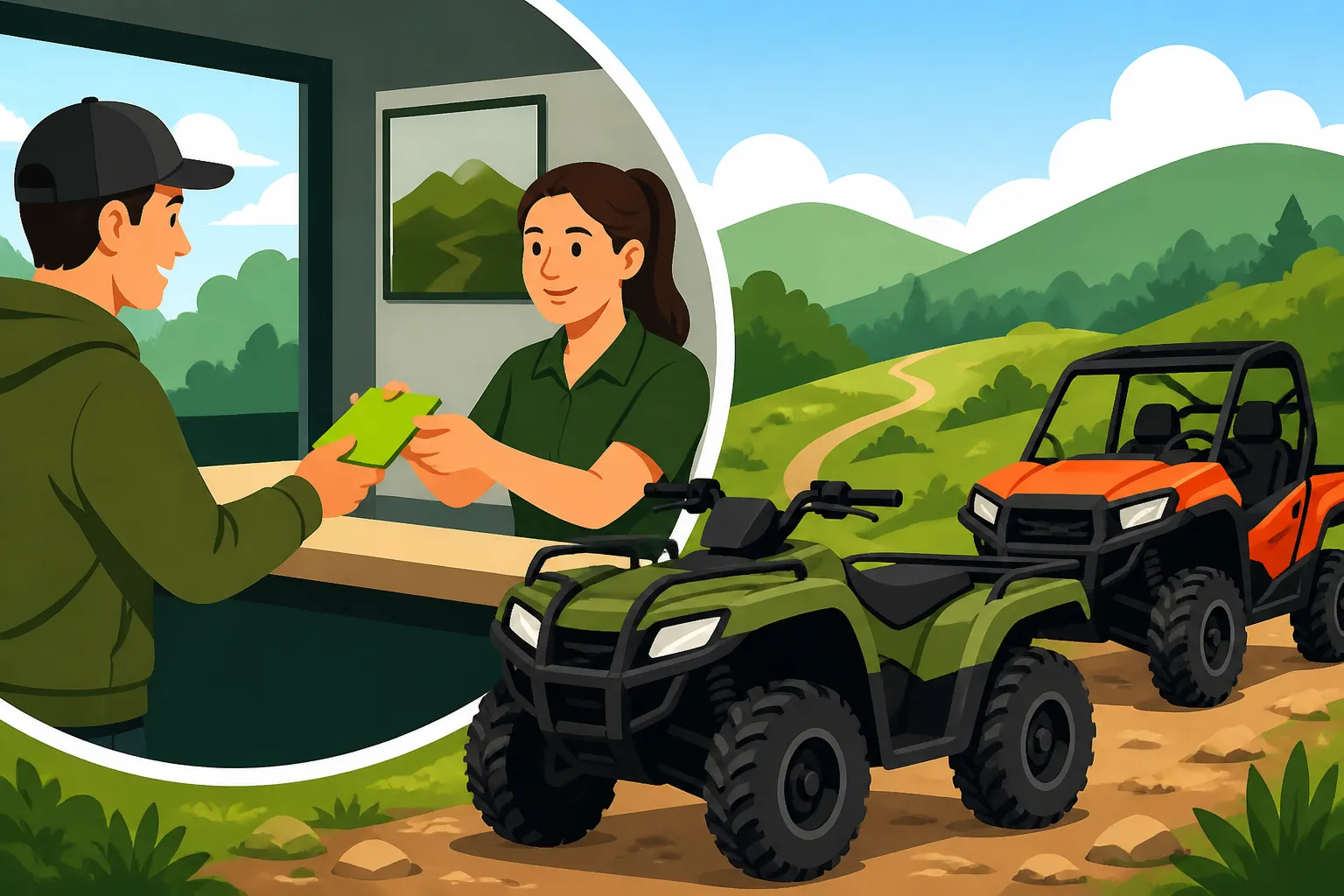
At the office, describe your machines and ask which permit applies to the riding area you intend to use. Confirm the number of passes, the validity period, and how each must be displayed or carried. Before driving away, check that you received the right quantity and keep the receipt and instructions together.
At the trailhead, read the posted information before unloading. Look for closures, route restrictions, and any instructions that affect your machine or permit. If signs conflict with a route you planned, stop and get clarification rather than riding onward and hoping the map is correct.
Once you are ready, keep the ride within the designated routes and the permit’s conditions. Leave time to return before dark, regroup if the party spreads out, and take the same care on the way back as you did when setting out. A little organization at the office can make the rest of the day feel much more relaxed.
Disclaimer
This article is for general informational purposes only and does not constitute professional advice. Laws, prices and regulations vary by location and change over time. Consult a qualified professional for guidance on your specific situation.