Where to Ride an ATV in North Carolina
North Carolina offers very different ATV and UTV experiences, from rocky Uwharrie trails to steep mountain routes and private riding parks. The hard part is knowing which places actually allow your machine, what permits you need, and whether a trail is open before you tow for hours. This guide explains the main options and how to plan a ride that fits.
Start by choosing the kind of riding you want
Match the terrain to your machine and experience
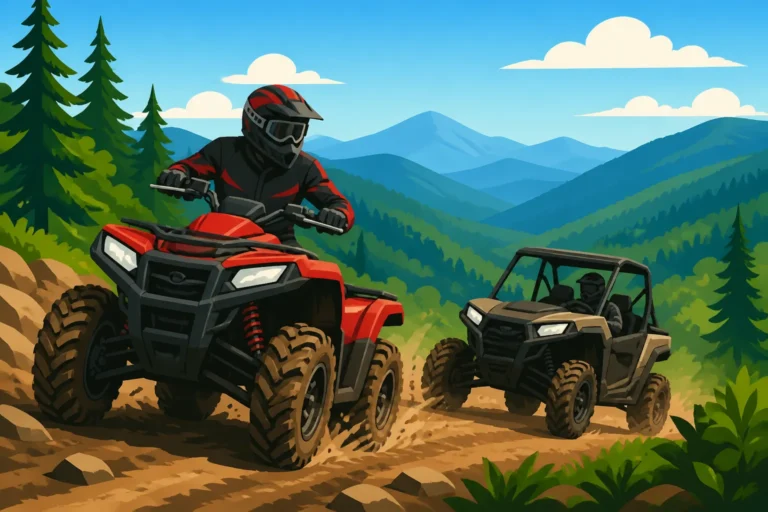
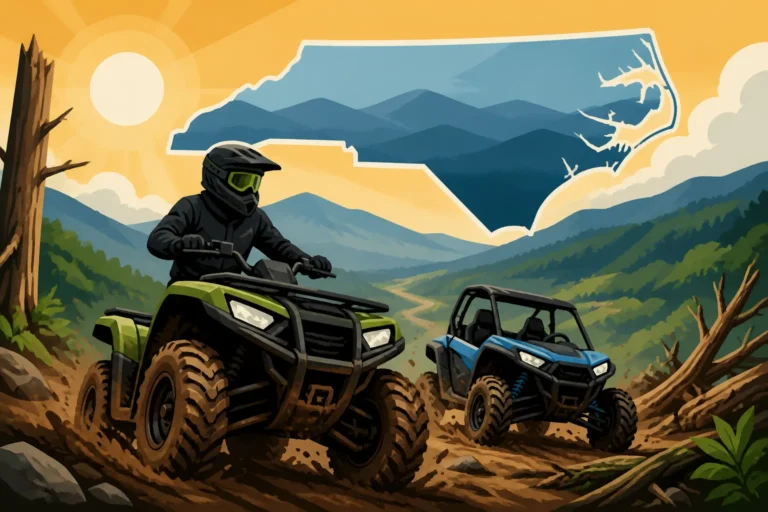
North Carolina riding can mean several very different things. In the Uwharrie region, expect Piedmont forest, roots, rocks, tight turns, and changing traction after rain. Mountain riding around Brown Mountain or Wayehutta can add steeper grades, uneven surfaces, and limited room to maneuver. A route that feels manageable in a small quad may be more demanding in a long, wide side-by-side.
Think about the least experienced person in your group, not just the strongest rider. A beginner may enjoy a short, clearly marked route with room to stop and regroup. A confident rider might want longer loops and more challenging terrain, but difficulty ratings and trail conditions can change the character of a route. A wet rock slab, washout, or fallen branch can make a familiar section feel entirely different.
Your machine matters, too. Check the width restrictions, vehicle types, and trail rules for the area before choosing a destination. A machine that is comfortable on broad private-park paths may be cumbersome on a narrow forest trail. If you are comparing machines or areas, [North Carolina Trails for a Wide Machine] is a useful related topic to explore.
Decide between a public forest trail and a private park
Public forest OHV areas appeal to riders who want marked trails in a natural setting. They often require permits, have designated operating seasons, and close trails for weather, maintenance, or resource protection. You’ll need to follow the posted route rather than treating the surrounding forest as open riding space. The permit and access process can vary by trail system, so confirm the details for your destination.
Private off-road parks can offer a different experience. Some have more varied terrain, organized riding zones, or facilities designed around day visits. Rules, vehicle limits, admission arrangements, and available services are set by each property. A private park may be a good fit if your group wants a managed setting, but it is still important to review its requirements before arriving.
Do not assume that a forest road, game land, utility corridor, or empty-looking patch of land is open to ATVs. Public ownership does not automatically mean public motorized access. For an overview of the major options and the planning questions to ask, start with [Best Places to Ride an ATV in North Carolina] and [North Carolina's Three National Forest Systems].
Explore the main public OHV areas
Brown Mountain OHV Trail System
Brown Mountain is in the Grandfather Ranger District of Pisgah National Forest, near the Lenoir and Morganton area. It is a well-known destination for riders looking for a forest setting and a network of designated OHV routes. The terrain is mountainous, so expect elevation changes and surfaces that may include rocks, roots, and loose material. The exact feel of a ride depends on the route, recent weather, and current trail conditions.
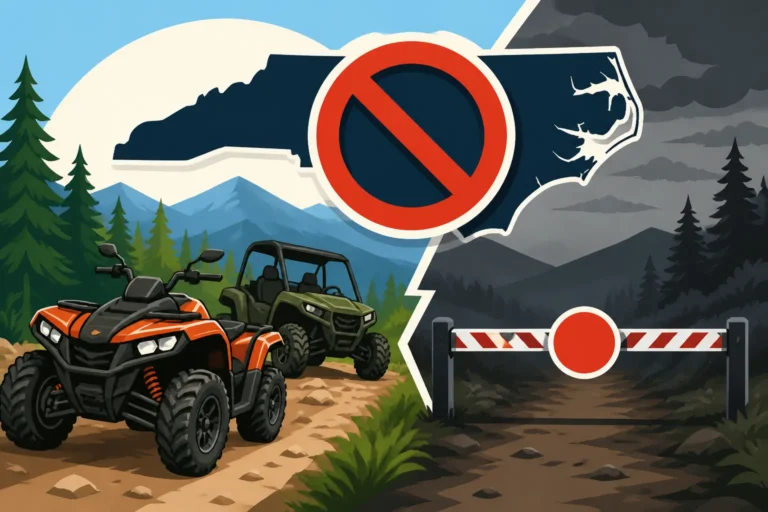
Before you go, check the trail system’s current operating information and access requirements. Forest gates and trail openings are not guaranteed to follow a schedule that works for every weekend, and storms can affect access. A map is helpful, but it does not replace checking official notices: a route shown on a map may be closed or unsuitable at the time of your visit. [Brown Mountain OHV Trail System] covers the area, while [North Carolina Trail Conditions Before You Ride] can help you build a pre-trip check into your routine.
Brown Mountain can be a poor choice for a rushed trip if you have not confirmed access, fuel, and parking arrangements. Think through the drive from your lodging or fuel stop to the staging area, and allow extra time to unload and prepare. If you are bringing children or new riders, choose a route plan that leaves room for breaks and a conservative turnaround. In unfamiliar mountain terrain, finishing comfortably before dark is more important than squeezing in one last trail.
Badin Lake OHV Trail Complex
Badin Lake sits in the Uwharrie National Forest area of the Piedmont, within reach of communities such as Troy and Albemarle. Riders come for a forest trail experience with a mix of surfaces and route options. The area can feel very different from the mountain systems: the elevation profile is generally less dramatic, but rocks, narrow sections, and muddy conditions can still make some routes demanding.
Plan your route around the ability of the least experienced rider and the capabilities of the least capable machine. A stock ATV or UTV can be enjoyable on appropriate trails, but not every route will feel easy just because it is in the Piedmont. Read the current map and difficulty information carefully. If one rider is worried about a section, agree on a regrouping point or alternate route before anyone heads out.
Badin Lake access rules, operating dates, and permit arrangements should be checked before the trip. There can be a big difference between arriving at a trailhead with a plan and arriving after a long drive only to discover a closure, full staging area, or missing permit. See [Badin Lake OHV Trail Complex] and [North Carolina's Badin Lake Trailheads] for destination-specific planning. If your group is staying nearby, include where you will park, refuel, and wash down machines after the ride.
Wayehutta OHV in Western North Carolina
Wayehutta is in Jackson County, in the Nantahala National Forest area. Its wooded mountain setting makes it a natural choice for riders looking for a Western North Carolina outing. As with any mountain system, a map distance alone does not tell you how long a loop will take. Elevation, surface conditions, stops, mechanical issues, and the group’s pace all affect the day.
Check which routes are open before you leave. Trail networks may have sections closed for maintenance or repairs, and a route description from a previous visit may not match current access. It can be tempting to trust an old post or a friend’s memory, especially when everyone is eager to ride. Confirm the relevant forest notice and use the signs at the trailhead as your final guide.
Wayehutta can be paired with a stay in the surrounding mountain communities, but think carefully about your logistics. Confirm whether your lodging allows trailers and where you can clean or secure the machines. Cell coverage can be limited in mountain terrain, so save the route information and emergency contacts before leaving town. For more detailed destination planning, see [Wayehutta OHV in Western North Carolina] and [North Carolina Trails Near Asheville].
Compare riding areas before you commit
Use a practical comparison, not just a mileage number
Trail mileage can sound impressive, but it is only one part of choosing a destination. A shorter, well-suited loop may be a better day for a family than a longer route with difficult sections. Access rules, operating seasons, surface type, staging space, distance from fuel, and the experience level of your group all matter. Compare the whole outing rather than picking the area with the biggest advertised number.
The table below is a starting point, not a substitute for current trail maps and official notices. Conditions and access can change, and routes within one system may differ significantly. Confirm the exact vehicle rules, permit requirements, and trail status for the route you intend to ride.
| Riding area | General setting | What to consider | Useful planning focus |
|---|---|---|---|
| Brown Mountain | Mountain forest near Lenoir and Morganton | Elevation, changing mountain conditions, route closures | Confirm access, trail status, and staging details |
| Badin Lake | Piedmont forest near Troy and Albemarle | Rocks, mud, route difficulty, busy periods | Check permits, operating dates, and trail map |
| Wayehutta | Mountain forest in Jackson County | Elevation, current route openings, limited cell coverage | Confirm open sections and plan fuel and lodging |
| Private off-road park | Varies by property | Park-specific vehicle rules, admission, and facilities | Contact the park and read its rules before travel |
When comparing options, ask everyone in the group what a successful day looks like. One person may want technical obstacles, while another wants a relaxed ride and a picnic break. Those are not incompatible goals if you choose the right route and agree in advance on when to stop, turn around, or split up. They become a problem when the group makes those decisions at a difficult junction with tired riders and no signal.
Check current conditions and route information
A map app can help with orientation, but don’t treat a digital track as permission to ride. Public land boundaries, motorized routes, and closures can be confusing on a small screen, particularly where trails meet roads or nonmotorized routes. Download maps or save essential information before leaving an area with reliable service. You can use a tool such as onX Offroad to organize route notes and review mapped access, while still verifying closures and rules with the land manager.
At the trailhead, read the signs and posted notices. If a route is closed, do not treat the closure as optional because the track appears on your phone. Closures may protect riders from hazards or protect sensitive ground from damage. Following the posted system also helps prevent accidental trespass onto private property or travel onto routes where motorized use is not allowed.
Weather deserves a separate check. A forecast for a nearby town may not describe conditions at a higher elevation or in a forested valley. Recent rain can leave clay, mud, and creek crossings in very different shape from what you expected. For practical trip planning, [North Carolina Trail Closures to Check First] and [North Carolina Forest Trail Maps] are useful related reads. Consider checking again shortly before departure, not only when you first book a cabin.
Understand permits, access, and trail rules
Forest permits are not the same as registration
Some North Carolina forest OHV areas require a permit for riding. That access requirement is separate from whether the machine is titled, registered elsewhere, or used on private land. Do not assume that a license plate or registration from another state automatically replaces a local forest permit. Confirm the rules for the specific trail system and each machine in your group.
Permit arrangements can differ by place and may include options tied to a day visit or a season. The rules about where to obtain a permit, how to display it, and whether it applies to one vehicle or more should be checked before you arrive. If your group is bringing multiple machines, verify whether each one needs its own permit rather than assuming a single purchase covers the trailer load.
A good routine is to save the permit details with your trip plan and keep any required proof accessible. Don’t leave the process until you reach a trailhead with poor reception or a closed office. Learn more in [Do You Need a Permit for North Carolina Forest Trails?] and [Where to Buy a North Carolina OHV Permit]. When you have a question about a particular forest, check directly with the responsible district or land manager.
Know where riding is and is not allowed
A marked motorized trail is not a general invitation to explore nearby woods. Stay on routes open to your vehicle, obey one-way signs and gates, and do not create a shortcut around mud, a fallen tree, or a difficult obstacle. Riding off-trail can damage soil and vegetation and may expose you to enforcement or create a hazard for other visitors.
The same caution applies to roads, creek beds, utility corridors, and private land. A road that looks empty may be closed to public motorized use, and a trail that crosses property lines may have specific restrictions. Ask for explicit permission before riding on private ground; a friendly wave from someone at the edge of a field is not a reliable substitute for permission from the landowner.
For a clearer understanding of access boundaries, read [North Carolina Landowner Permission Requirements] and [North Carolina Rules for Riding Off the Trail]. If a route is unclear, stop and check rather than guessing. It is much easier to reroute while everyone is calm than to sort out an access mistake after someone has ridden past a gate or onto property that the group does not have permission to use.
Plan for safety, equipment, and group needs
Prepare the machine and carry practical essentials
A pre-ride inspection is especially valuable when a machine has been trailered a long distance or stored between trips. Check tires, brakes, steering, lights, throttle response, and visible fluid leaks. On a UTV, inspect seat belts, doors or nets, and the condition of any required safety equipment. On an ATV, make sure the controls work as expected and that the machine fits the rider.
Carry the basics for a trail day: water, food, a first-aid kit, a charged phone, and the tools or repair supplies appropriate for your machine and route. The right spares depend on the vehicle, terrain, and group. A tire repair kit may be useful in one setting; extra water and a recovery plan may be more important in another. Avoid packing so much that loose gear becomes a safety hazard.
On a mountain route, think about how you will handle a breakdown or an unexpectedly slow return. Tell someone who is not riding where you plan to go and when you expect to be back. Save emergency information and route details before entering a dead zone. Apps such as onX Offroad can be useful for organizing maps and keeping route information available offline, but keep a backup plan and do not rely on a phone battery lasting all day.
Set expectations for children, beginners, and mixed groups
A group ride goes better when the pace and rules are agreed on before the engines start. Decide who leads, who rides at the back, where the group will regroup, and what happens if someone wants to stop. Keep enough distance to avoid dust and sudden stops, and make sure no rider is pressured into an obstacle they are not comfortable attempting.
For younger riders, choose routes and machines appropriate to their experience, size, and ability to control the vehicle. A child who is tired, cold, overheated, or overwhelmed may not be able to communicate clearly while wearing a helmet and goggles. Build in breaks and keep the riding plan flexible. For age and supervision rules, consult [North Carolina Supervision Rules for Young Riders] and [North Carolina Helmet Rules for ATV Riders].
Mixed groups may need separate plans for part of the day. For example, experienced riders could tackle a challenging section while beginners take an easier route to a designated meeting point, provided the trail system permits that route and everyone understands the plan. Do not split up casually in unfamiliar terrain. Agree on a clear location and a time to reconnect, and account for limited cell service.
Choose between riding your own machine and renting
When bringing your own machine makes sense
Trailering your own ATV or UTV can be the right option if you know the machine well, have the equipment to transport it, and expect to ride regularly during the trip. You can bring familiar protective gear, set up the machine the way you prefer, and avoid learning unfamiliar controls at the trailhead. The trade-off is the extra work: loading, securing, towing, parking, and cleaning the machine afterward.
Plan the trip as a complete transport job. Check that your tow vehicle and trailer are appropriate, secure the machine correctly, and confirm that your lodging or campsite can accommodate the trailer. Think about where you will park at the trailhead and how you will handle a flat tire or other problem on the road. A long tow can turn an otherwise simple day ride into a tiring outing if arrival and departure logistics are not planned.
Before choosing a forest destination, verify that your vehicle type is allowed on the routes you want to ride. A wide machine may not fit every trail, and a machine’s suitability for a private park does not guarantee it will be permitted in a public forest system. If you are deciding where to ride based on the size of your vehicle, review [North Carolina Trails for a Wide Machine] and confirm the system’s rules directly.
When renting can reduce the hassle
Renting can make sense when you are traveling without a trailer, want to try a different kind of machine, or prefer not to bring your own vehicle into the mountains. The details vary by rental provider: where the machine can be ridden, whether equipment or permits are included, what the contract says about damage, and whether you need to return the machine to the same location. Read the agreement before you pay or sign.
Ask clear questions when booking. Find out what terrain the rental is intended for, whether the machine can be taken to the public forest area you have in mind, and whether the provider supplies a map or route guidance. Check the driver requirements, passenger rules, safety equipment, fuel expectations, and what to do if the machine develops a problem. A rental that cannot be taken onto your intended trail is not a useful solution, even if it is located nearby.
Rentals can be especially helpful for visitors who want to avoid towing to a first ride, but they do not remove the need to check access rules. Confirm that the destination allows the rented machine and that your rental arrangement covers the planned route. [Renting an ATV in North Carolina] and [North Carolina Rentals That Allow Forest Trails] offer more questions to consider before booking. For a broader comparison, see [North Carolina Rentals Versus Buying a Machine].
Build a day trip or weekend itinerary
Plan the drive, arrival, and ride as one outing
Start with the travel time to the area, but don’t stop there. Include time to unload, check the machine, sort permits, review the map, and get everyone ready. A group that arrives late may feel tempted to ride faster or skip a safety check to make the most of the remaining daylight. It is better to plan a shorter ride than to turn the return trip into a race against sunset.
For a day visit, identify a fuel stop and a place to pick up essentials before entering the forest area. Do not assume that a trailhead will have fuel, food, water, or reliable phone service. For a weekend, choose lodging that can handle your machines and trailer, and check whether there is a suitable place to clean equipment. Local services vary, so call ahead rather than relying on an old listing.
A simple itinerary might include an early departure, a planned arrival window, a conservative first loop, a lunch break, and a return time that leaves room for delays. Share that plan with someone at home. If you are riding a new area, avoid scheduling a long, demanding route on the first morning; use the first ride to learn the trail markings, surface, and pace of the group.
Leave room for weather, closures, and fatigue
A good trip plan includes a backup. If rain makes a route unsafe, a gate closes, or someone in the group is tired, you need a reasonable alternative. That might mean switching to another open area, shortening the ride, spending the day exploring nearby towns, or rescheduling. The backup does not have to be elaborate; it just needs to keep the group from feeling that the only option is to ride regardless of conditions.
Watch for fatigue. Steering and balance take attention, and riders can become tired without noticing until their decisions start to get sloppy. Take breaks before people are exhausted. On a long day, check in with the group rather than assuming silence means everyone is fine. If a rider is uncomfortable, slow down or turn back instead of treating the concern as an inconvenience.
After the ride, take time to inspect the machines and account for everyone before loading. Look for obvious damage, secure loose equipment, and clean the vehicle where permitted. Leave the staging area tidy and respect other visitors who may be arriving as you depart. A considerate finish makes the next visit easier for your group and for the people sharing the area.
Frequently asked questions about ATV riding in North Carolina
Can you ride an ATV on any public land in North Carolina?
No. Public ownership does not mean that motorized riding is allowed everywhere. Use only trails and roads designated for your vehicle and open at the time of your visit. Follow signs, closures, permit requirements, and land-manager rules. If a route’s status is uncertain, verify it before riding rather than assuming that a visible track or road is available to ATVs.
Do you need a permit to ride a North Carolina forest trail?
Permit requirements depend on the riding area. Some public forest OHV systems require a permit, and the details can differ by location. Confirm whether you need a day or season option, how to obtain it, and whether each machine needs its own permit. Do not assume that a registration, title, or permit from another state substitutes for the local access requirement.
Which area is best for a beginner?
There is no one best area for every beginner. Choose based on the rider’s experience, machine, comfort with hills and obstacles, and the routes currently open. A beginner may prefer a shorter, less technical ride with clear signs and convenient places to stop. Check current maps and difficulty information, and plan to turn around if conditions or confidence change.
Can you ride a UTV on the same trails as an ATV?
Not necessarily. Vehicle width and other area-specific rules can limit where a UTV may go. Check the exact trail system’s requirements for your machine, including any posted restrictions. Do not assume that because another UTV is on a route, your vehicle is permitted there; it may be a different class or the other rider may be outside the rules.
What should you check before leaving home?
Confirm that the destination is open, identify the routes suitable for your machine, and check permits and parking. Review weather, fuel options, lodging arrangements, and the trail map. Make sure your machine is in working order and that everyone has the appropriate protective gear. Save important information for offline use, particularly if your route includes mountain areas with limited cell service.
Disclaimer
This article is for general informational purposes only and does not constitute professional advice. Laws, prices and regulations vary by location and change over time. Consult a qualified professional for guidance on your specific situation.