North Carolina Trails Open in Winter
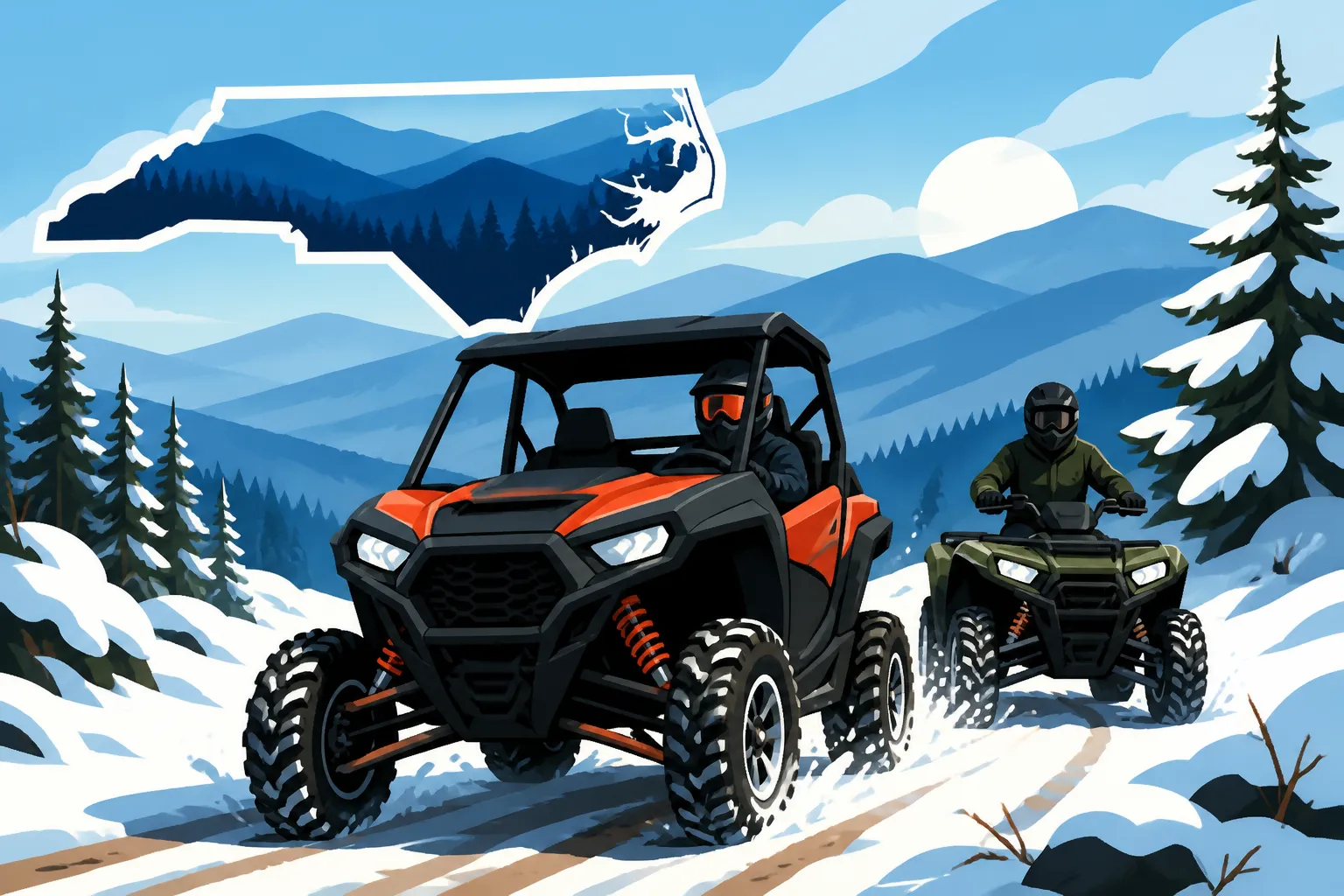
A winter ride near Uwharrie or the Blue Ridge can turn into a wasted drive if a gate is closed, a trail is muddy, or the route you planned does not allow your machine. North Carolina has places to ride in colder months, but access is seasonal and conditions change quickly. This guide explains how to find a suitable winter ride and prepare before you haul your ATV or UTV.
Where to ride an ATV or UTV in North Carolina during winter
Winter riding in North Carolina takes a little more planning than picking a nearby trail and heading out. Public off-highway vehicle areas may close for part of the season, and private parks set their own calendars. Even when a place is open, weather, trail conditions, or maintenance can affect which routes are usable.
A good starting point is to decide whether you want a designated OHV trail, a private off-road park, or a permitted forest road. These are not interchangeable: a road that is open to some vehicles may not be open to ATVs, and a forest road is not necessarily an OHV trail.
Check seasonal access before choosing a destination
North Carolina’s best-known public OHV areas have seasonal schedules that can limit winter options. Brown Mountain OHV Trail System, in the Grandfather Ranger District near Morganton, has traditionally operated on a seasonal calendar that includes a winter closure period. Badin Lake OHV Trail Complex in the Uwharrie National Forest also has a riding season that does not extend through the entire winter. Dates and closures can change, so confirm the schedule and notices for your planned visit before loading up.
For a trip to Uwharrie, check the specific access information for the Badin Lake area rather than assuming that a nearby campground, forest road, or trailhead means the OHV trails are open. The same goes for Brown Mountain: its location in the mountains does not guarantee winter access. A closed gate is not a suggestion to unload somewhere else and continue on an unmarked route.
If you are comparing destinations, use [North Carolina Trails Open in Winter] as a starting point for seasonal planning, then confirm current access with the land manager or park operator. For broader context on how the different riding areas fit together, see [North Carolina's Three National Forest Systems]. The key is to verify the exact trail system, not just the forest or county.
Consider private off-road parks and permitted roads
When a public OHV system is seasonally closed, a private off-road park may be an option. Private parks set their own operating days, reservation rules, machine restrictions, and weather policies. Call or check the park’s own notices before making the drive, especially after heavy rain or during a cold snap. Some places may offer a different riding experience from a forest trail, with more managed access or a designated staging area.
Forest roads can also be relevant, but only where machine use is expressly allowed. Do not assume that a road shown on a map is open to an ATV or UTV, or that a road open to highway vehicles is open to off-highway machines. Gates, signs, district rules, and vehicle-specific restrictions matter. The guide to [Forest Roads Open to North Carolina Machines] can help you understand what to check before treating a forest road as a riding route.
When using a digital map, including onX Offroad, look at the route details and boundaries carefully. A map can help you orient yourself and save a planned route, but it does not grant permission to ride or replace posted signs and official closure notices. Before departing, compare your planned route with the land manager’s latest information.
| Riding option | What to confirm before winter travel | Common planning concern |
|---|---|---|
| Public OHV trail system | Seasonal schedule, trail closures, permit rules, and machine requirements | A familiar system may be closed for part of winter |
| Private off-road park | Operating days, reservations, weather policy, and machine limits | Hours and access rules can vary by operator |
| Forest road | Whether off-highway machines are allowed on that specific road | A road on a map may not be a legal riding route |
| Guided ride or rental | Route access, included equipment, cancellation policy, and weather plan | The ride may depend on a partner park or open trail |
How to check winter trail conditions and closures
Finding a trail that is open is only half the job. Winter weather can change the ride itself: a dry afternoon may follow a cold night, while rain can leave clay, creek crossings, and shaded slopes slick. In the mountains, conditions can vary sharply with elevation. Check more than the forecast for the town where you are staying.
Before leaving, look for closure notices from the relevant forest district or park, review the forecast for the riding area, and make sure your route has a reasonable turnaround point. If the available information is unclear, contact the land manager or operator rather than relying on an old social media post or a map downloaded months ago.
Read notices and maps with care
A trail map is useful for understanding trail names, junctions, and possible loops. It does not necessarily show temporary closures or establish that every line is open to every vehicle. Use a current official map or notice for access decisions, and follow signs at the trailhead even if your phone displays a route as available.
Tools such as onX Offroad can help you plan around trail networks, save a route, and keep your bearings when cell service drops. That can be especially helpful in rural sections of the Uwharrie or in the mountains west of Morganton. Still, treat the app as a planning aid, not an authority on live access. Download maps ahead of time, note the trailhead and exit options, and check official notices separately.
A practical pre-trip check is to write down the destination’s official contact information, the trailhead you intend to use, and one backup plan. If you are comparing systems or trying to understand how closures affect a weekend, [North Carolina Trail Conditions Before You Ride] and [North Carolina Trail Closures to Check First] are useful companion topics.
Account for rain, ice, and changing daylight
Winter ground can be deceptive. A trail that looks firm in the morning may soften as the day warms, while a shaded section can remain icy after sunny areas have dried. Red clay can become slippery when wet, and a shallow-looking creek crossing may be harder to judge when the water is cold or moving quickly. If you encounter conditions that feel unsafe or are damaging the trail, turn around rather than trying to power through.
Shorter daylight also changes how much riding you can reasonably plan. Choose a loop that gives you time to return before dark, and build in extra time for a slow climb, a stuck machine, or a route-finding pause. On a cold day, even a minor delay can become uncomfortable if riders are wet, underdressed, or far from the trailer.
For Uwharrie-specific planning, [Uwharrie Mud After a Week of Rain] offers useful context for thinking about how wet conditions affect a ride. A forecast alone cannot tell you whether a particular trail is passable, so use local notices and on-the-ground signs as the final check.
Prepare your machine and group for cold-weather riding
Cold-weather preparation is not only about staying warm. It also affects how your ATV or UTV starts, how well you can control it, and how quickly your group can respond to a problem. A little preparation at home can prevent a frustrating repair or an early trip back to the trailer.
Before setting out, inspect tires, brakes, lights, battery condition, fluids, and any recovery equipment you plan to carry. If the machine has been sitting for a while, do not assume it is ready simply because it ran well at the end of the previous season. A quick check in the driveway is easier than troubleshooting at a remote trailhead.
Pack layers, tools, and a realistic emergency plan
Dress in layers that let you adjust as you warm up while riding. A wind-resistant outer layer, warm gloves, dry socks, and eye protection can make a major difference on a cold, exposed ride. Bring a spare layer in a dry bag; clothing that is comfortable while moving may not be warm enough once you stop.
Pack basic tools and supplies appropriate to your machine and route. That may include a tire repair kit, a small first-aid kit, water, food, a flashlight or headlamp, and a way to contact someone if the group is delayed. Do not count on cell coverage in every section of a forest. Share your destination and expected return time with someone who is not on the ride.
Plan for the least experienced rider and the least capable machine in your group. A demanding route that is manageable for one driver may be a poor choice for a mixed group, especially when cold or slick conditions leave less room for mistakes. Set a clear regrouping point and agree that anyone can call for a turnaround without being pressured to continue.
Adjust your riding style to the surface
On cold, damp ground, use smooth throttle and braking rather than sudden inputs. Give yourself more following distance, approach obstacles at a controlled pace, and avoid turning a difficult section into a competition. In a UTV, keep passengers belted and inside the protective structure, and make sure everyone knows how to communicate with the driver.
Stay on marked, open routes and respect barriers. Riding around a closure can damage the ground, put you in an area that is not authorized for your machine, and make it harder for land managers to keep trails available. If you are unsure whether a trail is open, stop and check rather than treating uncertainty as permission.
For more on preparing for winter trail days, see [North Carolina Trails Closed After Rain] and [North Carolina Rules for Riding After a Storm Closure]. If you use onX Offroad to track your route, save the plan before losing signal and keep a separate offline map or written route notes as a backup.
Plan the trip, permits, and backup options
A successful winter ride is usually decided before the truck leaves home. Confirm access, permits, parking, and the rules for each machine in your group. Then make a backup plan that does not depend on riding a closed trail or finding an unplanned route at the last minute.
Permit requirements depend on where you ride. Public forest OHV areas may require a permit for each machine, while private parks have their own admission or access rules. A North Carolina title or other ownership paperwork is not a trail permit. For an overview of public-land permits, read [North Carolina Forest OHV Permits] and confirm the requirements for the particular riding area.
Build a route that works if plans change
Choose a primary destination and a realistic alternative before traveling. If the main trail system is closed, a useful backup might be a private park that has confirmed it is open, a different permitted riding area, or a non-riding activity near your lodging. Do not count on being able to substitute a forest road unless you have verified that it is open to your machine.
For longer trips, identify fuel, food, and a place to warm up before you get deep into a rural area. In the Uwharrie region, small communities and trail access points are not always close together, and mountain routes can add time even when the distance looks short on a map. Keep enough fuel for the planned ride and any reasonable detour back to the trailer.
If you are visiting from out of state, check permit and rider requirements before arrival rather than assuming your home-state paperwork carries over. A useful related guide is [North Carolina Rules for a Visiting Rider]. If you are renting instead of bringing your own machine, confirm where the rental is allowed to go and whether the operator’s plan depends on a particular trail system being open.
Use a simple pre-departure checklist
Before leaving home, confirm the trail or park is open, review the latest closure notices, and check the weather for the riding area itself. Verify permit requirements, machine restrictions, and parking arrangements. Then tell someone where you are going and when you expect to return.
At the trailhead, read the posted information and reassess conditions. If a gate is closed, a route is signed out, or weather has made the trail unsafe, do not improvise around the restriction. A shorter ride or a change of plans is frustrating, but it is far better than getting stranded, damaging a trail, or discovering that the route was not open to your machine.
Keep your plans flexible. Winter riding in North Carolina can be rewarding, from a crisp day in the Piedmont to a clear afternoon in the foothills, but access and terrain can shift from one week to the next. Confirming the details before you go is what turns a hopeful drive into a well-planned outing.
Disclaimer
This article is for general informational purposes only and does not constitute professional advice. Laws, prices and regulations vary by location and change over time. Consult a qualified professional for guidance on your specific situation.