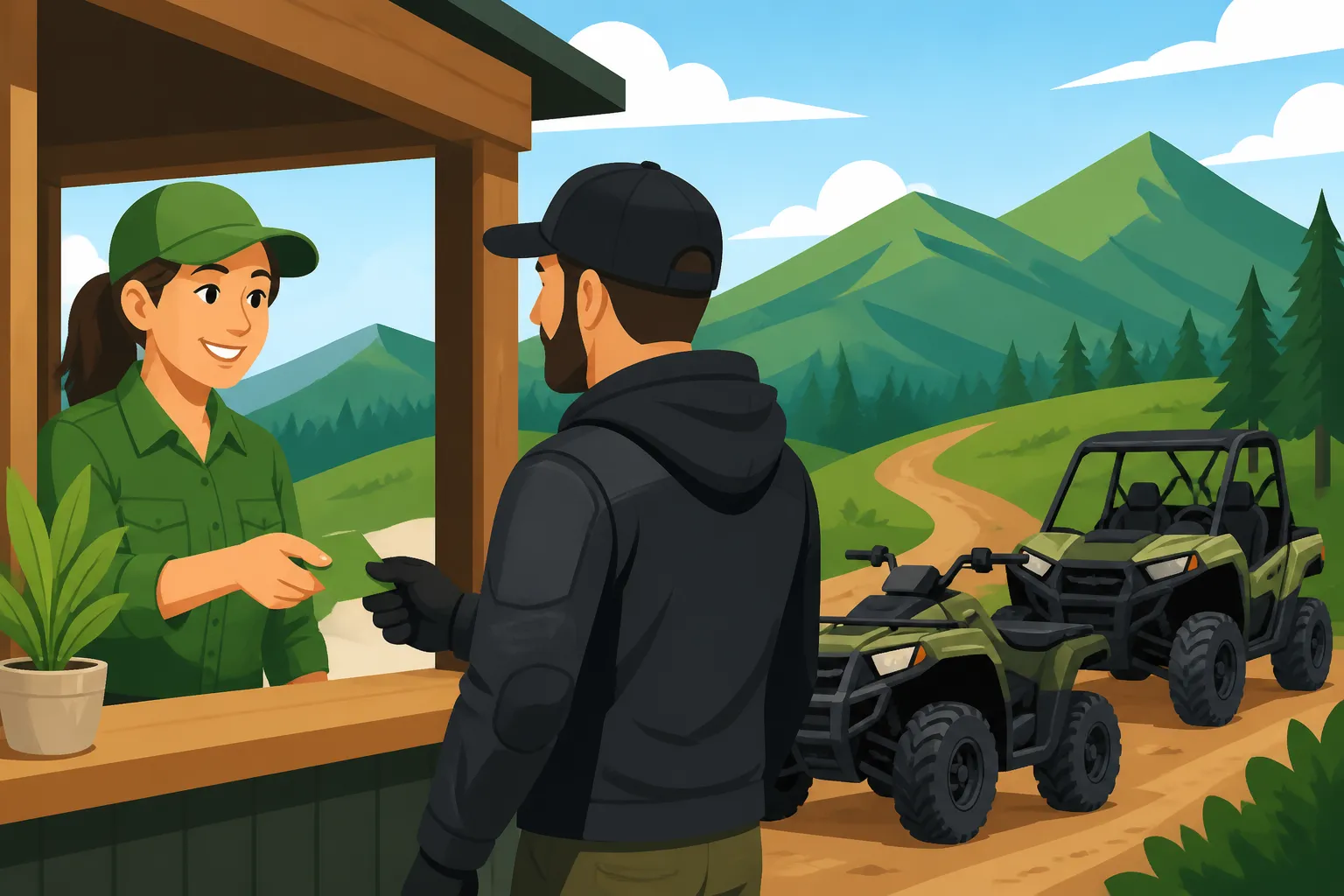
Buying a Pass at Mount Gilead
A ride to Uwharrie can be derailed by one small errand: arriving near the forest without the required OHV permit, or assuming a nearby town shop sells one. This guide explains how to plan a pass purchase around Mount Gilead, what to confirm before you leave, and how to avoid confusing a forest riding permit with vehicle registration or a trail pass for another area.
Buying a Uwharrie pass near Mount Gilead
Mount Gilead can be a practical stop when approaching the Uwharrie National Forest and Badin Lake OHV Trail Complex, particularly if you are arranging fuel, food, or other supplies before heading toward the trail system. The key is not to assume that every convenience store, outdoor shop, or fuel station in town sells the permit. Retail locations and availability can change, so confirm the seller before building your trip around a particular stop.
A permit is for riding designated OHV trails where one is required. It is not a North Carolina ATV registration sticker, and it does not give permission to ride on every forest road, private track, or public road in the area. The [North Carolina Forest OHV Permits] explain the broader permit system, while [Where to Buy a North Carolina OHV Permit] can help you compare purchase options before setting out.
Confirm the seller before driving to Mount Gilead
Before leaving home, identify the exact place where you plan to buy the pass and contact it directly. Ask whether it currently sells permits for the riding area you intend to visit, whether the permits are available in person that day, and what payment methods it accepts. Do not rely only on an old social media post, a search result snippet, or a friend’s memory of where they bought a pass on a previous trip.
This matters most when you are traveling with a group or arriving early. A shop may open later than your planned departure, run out of printed permits, or sell a pass for a different forest area. If your first-choice seller is unavailable, have a backup identified, such as another authorized retailer or the appropriate district office. Check the official forest information for the correct contact details and current purchase instructions.
If you are already in Mount Gilead, pause before riding onward and verify the purchase point rather than assuming the pass can be bought at the trailhead. Some visitors plan to pay at a trailhead box, but payment arrangements can depend on the location and the pass type. The details in [Paying at a Trailhead Box After Hours] are especially useful if your arrival time is outside normal business hours.
Check that the pass matches your riding area
The Uwharrie area is not one single, interchangeable riding zone. Badin Lake is a distinct OHV complex, and permits may be tied to a particular forest area, season, or access arrangement. When you buy in or around Mount Gilead, say exactly where you plan to ride—for example, Badin Lake—rather than asking only for “an ATV pass.” That simple clarification can prevent a wasted trip back to the counter.
Also check whether the pass is issued per machine. Forest permits are generally associated with the vehicle using the trail, not simply with the driver or the entire truckload of riders. If your family is trailering three machines, ask whether each one needs its own permit and how the permit must be displayed. The details in [Every Machine Needs Its Own Trailhead Box Permit] and [Why a Permit Is Per Vehicle in North Carolina] can help you understand why one pass should not be assumed to cover several ATVs or side-by-sides.
A forest permit does not replace compliance with other riding rules. Riders may need to carry proof of a required safety certificate based on their birth year, and machines must follow applicable equipment and trail rules. If someone in your group is visiting from another state, do not assume their state’s registration or credentials substitute for North Carolina requirements. The related guidance in [North Carolina Rules for a Visiting Rider] and [Carrying the Certificate on a North Carolina Ride] helps separate those obligations from the purchase of a forest pass.
Day passes and season passes
The right pass depends on how often you expect to ride, how long you will be in the area, and which forest riding area you plan to use. A day permit may be convenient for a single outing, while a season permit may make sense for repeated visits during the period it covers. Before purchasing, verify the dates, the location covered, and any display instructions. Do not assume one season pass has the same start and end dates as another area’s pass.
| Pass option | May suit you if | Confirm before paying |
|---|---|---|
| Day permit | You are planning one ride or an occasional visit | Which riding area it covers, whether it is valid for your ride date, and whether each machine needs a separate permit |
| Season permit | You expect to return during the covered season | The exact validity period, eligible riding area, machine-by-machine requirements, and display rules |
| Trailhead-box purchase | You are arriving when a staffed seller is not convenient | Whether the box is available at your intended location, accepted payment method, and how to display proof |
| Permit from an authorized retailer or office | You want to have the permit before reaching the trail system | Current availability, business hours, payment options, and whether the seller issues the correct area’s permit |
Decide based on actual riding plans
For a single Saturday trip, a day pass can be the straightforward choice, especially if you are still learning the Uwharrie system or visiting with a rental machine. If you return often, compare the season option with the number of trips you genuinely expect to make. A season pass is not automatically the better deal if your schedule is uncertain, the covered season is nearly over, or most of your intended rides are at a different location.
Think through the plan for every machine. A family may be riding two ATVs while towing them behind one vehicle; a group of friends may have several side-by-sides arriving together. The pass purchase needs to match the machines that will use the trail, not just the number of people in the convoy. Ask the seller to clarify the rule before you pay, and keep the answer consistent with the forest’s current posted requirements.
Season dates can be easy to overlook. A permit that works for one part of the year may not cover a ride later in the season, and separate riding areas may have different closing schedules. Check the Badin Lake-specific information rather than assuming Uwharrie-wide dates are identical. [The Badin Lake Season Permit Ends December 15] and [Badin Lake's Season Permit] are useful related reads when you are comparing options and planning a return visit.
Keep the permit accessible and follow display instructions
Once you have the permit, read any instructions that come with it before loading up. Some permits must be displayed on the machine in a particular way; others may require you to retain proof of purchase. Do not tuck a sticker, receipt, or paper permit somewhere you cannot reach and then discover the problem at the trailhead.
A practical routine is to take a clear photo of the receipt or permit for your own records, then follow the official display instructions for the original. A phone photo may be handy if paper gets damp, but do not treat it as a substitute for a required physical permit. If the permit is a sticker, attach it where directed rather than guessing at a location that could be hidden by mud, a rack, or bodywork.
Before unloading, check that each machine has its own required permit and that it is visible as instructed. This is a small detail, but it is exactly the kind of thing that causes a stressful last-minute scramble when the rest of the group is already geared up. For a step-by-step look at the process, see [Where a Uwharrie Forest Permit Goes on Your Machine].
Planning the trip from Mount Gilead to the trails
Buying the pass is only one part of a smooth ride day. Mount Gilead may be a useful place to arrange supplies, but the ride itself depends on trail access, weather, vehicle readiness, and your route to the correct staging area. Confirm your intended trailhead before leaving town, then check that the trails you plan to use are open and appropriate for your machine and experience.
Verify conditions before you load the trailer
Trail status can change after heavy rain, storm damage, maintenance, or seasonal closures. A map app may show a road or trail line without telling you whether it is open to OHV use today. Check official forest notices before you make the drive, especially after a major storm or a stretch of wet weather. [North Carolina Trail Conditions Before You Ride] and [North Carolina Trail Closures to Check First] offer useful planning reminders.
Use mapping tools as a supplement, not as your final authority. onX Offroad can help you review route context and organize a ride, but compare its information with official maps, signs, and current forest notices. A line on a digital map does not automatically mean the route is open to motorized vehicles, and an open forest road does not necessarily connect to a legal OHV trail. If you use onX Offroad, save your route information before you leave areas with reliable cell service, while keeping official maps and notices as your authority for access.
It is also worth checking whether the trails suit the least experienced rider in your group. Uwharrie routes can include uneven ground, rocks, climbs, and changing conditions. A machine that handles a moderate trail comfortably may struggle on a more challenging section, particularly if the ground is slick. Start with a route that leaves room to turn around, take breaks, and return before dark.
Build in time for the stop and the staging area
Do not plan the day so tightly that a closed shop or a slow checkout forces a rushed ride. If you need to buy a pass in Mount Gilead, include a backup purchase location and enough time to reach the right staging area afterward. Tell your group where you are meeting and what to do if one vehicle is delayed. A simple text with the chosen seller, the trailhead, and a fallback plan can prevent several trucks from driving in circles.
When you reach the staging area, park only where permitted and keep the access lane clear. Secure loose gear, check tire pressure and fuel, and make sure each rider knows the planned route and regrouping point. If cell coverage is weak, agree on a time and location to reconnect rather than assuming everyone can call or message from the trail. A saved route in onX Offroad may help with orientation, but do not rely on a phone alone in a dead zone.
Mount Gilead is also a sensible point to top up on supplies before heading toward the forest, but avoid treating the town as the last guaranteed source for every item. Bring drinking water, basic tools, a tire repair kit, and the safety gear your group needs. Trail rides often take longer than expected when riders stop to help one another, wait for a group to regroup, or carefully navigate a difficult section.
Common pass-purchase mistakes to avoid
A little preparation can spare you the frustrating version of a ride day: a trailer full of machines, eager riders, and a permit problem discovered after the shops are closed. Most avoidable issues come from confusing permits with registration, assuming every seller has stock, or overlooking restrictions tied to the riding area.
Treating the pass like registration
A forest OHV permit is not the same as a title or registration document. North Carolina’s requirements for ATV ownership paperwork are separate from access rules for specific public riding areas. Having a title does not automatically authorize riding a forest trail, and purchasing a trail permit does not make an ATV street legal.
Likewise, the permit does not provide permission to ride on private land or on roads that are closed to OHVs. Before a trip, sort out the paperwork questions separately from trail access. The [Do You Need a Permit for North Carolina Forest Trails?] guide focuses on forest access, while [Do You Need to Register an ATV in North Carolina?] covers the distinct registration question.
Assuming a pass covers the whole group
A common misunderstanding is that the person who pays for the pass has covered every machine in the group. Ask how the permit applies to each ATV or UTV, and do not leave the counter until you understand whether additional permits are needed. This is particularly important when one family member buys the passes for everyone or when a rental company has already arranged some paperwork.
If a rental is part of your trip, ask the rental provider specifically whether the forest permit is included. Do not assume that a rental price, waiver, or guided-tour booking automatically covers trail access. The practical details in [North Carolina Rentals That Include the Permit] can help you ask the right question before arriving.
Relying on an old pass or outdated directions
A permit from a previous season may no longer be valid, and a seller you used before may not be selling permits now. Likewise, a trailhead or access point that worked for an earlier visit may be affected by a closure or changed instructions. Reconfirm the details before each trip instead of treating last year’s routine as a guarantee.
If you are planning a return visit, store the permit instructions, seller contact information, and official trail-status page together in your trip notes. Check them again before you leave. This is especially helpful for fall and winter visits, when shorter daylight and changing weather can make a backup plan more important than it seemed during summer.
Mount Gilead can be a convenient part of the plan, but the best approach is to treat the pass purchase as a confirmed errand: verify the seller, buy the permit for the correct area and date, account for every machine, and check forest conditions before driving to the trailhead. Then you can spend the day focused on the ride rather than trying to solve paperwork and access questions from the parking lot.
Disclaimer
This article is for general informational purposes only and does not constitute professional advice. Laws, prices and regulations vary by location and change over time. Consult a qualified professional for guidance on your specific situation.