North Carolina Trails With Rock Crawling
North Carolina riders looking for rock crawling often find that “rocky” can mean anything from a few ledges to slow, tire-placement challenges that test a machine and its driver. This guide explains where to look, what the trails are really like, how to choose a suitable route, and what to check before loading up for a ride.
Where to Find Rock Crawling in North Carolina
Start with Badin Lake and the Uwharrie National Forest
For public off-highway riding, the Badin Lake area of the Uwharrie National Forest is one of the first places to investigate for rocky, technical terrain. Its trail system has a mix of difficulties, and some sections are known for demanding rock features. That does not mean every route is a dedicated rock-crawling course: Uwharrie trails are designated routes through a forest, and the surface, steepness, and challenge can change from one stretch to the next.
Before choosing a route, review the [Badin Lake OHV Trail Complex] and the descriptions of [Badin Lake's Eight Named Trails]. Look closely at difficulty ratings and whether a trail suits your specific machine, tires, experience, and group. A route that feels manageable to a well-equipped, experienced rider can be intimidating for someone new to rocky terrain, especially when the rocks are wet or loose.
It helps to think of Uwharrie as a place where you can encounter rock obstacles on a trail ride, rather than a place where every mile is a purpose-built crawling course. You may ride through smoother sections before reaching a steeper or rockier feature. That variety can be fun, but it also means you should plan for the full route, not just the obstacle you saw in a photo or heard about from a friend.
For a closer look at the system’s more demanding options, read [Which Badin Lake Trails Are Rated Extremely Difficult]. Treat a difficult rating as a serious signal, not a dare. If nobody in your group has experience with slow, controlled obstacle riding, choose an easier route and build confidence before attempting more challenging ground.
Consider Brown Mountain for rough, rocky riding
Brown Mountain OHV Trail System is another public riding area worth researching if you want uneven, rocky terrain. Its trails can feel rough and technical, but they are not interchangeable with a private rock-crawling park or a competition course. Check the [Brown Mountain OHV Trail System] details and current trail information before deciding whether it matches your expectations.
The most useful question is not simply, “Does this area have rocks?” It is, “Does the type of rock terrain here suit my machine and my group?” A stock ATV may be comfortable on a route that a long, wide side-by-side finds awkward. Conversely, a machine set up for crawling may still struggle if the trail is narrow, the rocks are slick, or the approach angle is poor.
If you are comparing locations, use the article on [North Carolina Trail Difficulty Ratings] as a reminder that ratings are a starting point, not a personal guarantee. Riders differ in experience, machine setup, and comfort level. A trail can also feel dramatically harder after rain, trail damage, or a change in conditions.
How to Choose a Trail for Your Machine and Skill Level
Match the route to your machine
Before riding, check that the trail is open to your vehicle type and that your machine fits the posted limitations. Width is especially important for side-by-sides. A vehicle that is physically capable of crawling over an obstacle may still be unsuitable for a narrow trail or may not be allowed on that route. Start with [North Carolina Trails for a Wide Machine] if you ride a larger vehicle.
Ground clearance, wheelbase, turning radius, tires, and underbody protection all affect how a machine behaves on rocks. A short-wheelbase ATV may be easier to place around an obstacle, while a heavier side-by-side can offer a stable seating position but may have less room to maneuver. Neither setup makes every feature easy. The machine’s size and shape can matter as much as horsepower.
| What to check | Why it matters on rocky trails | A practical question |
|---|---|---|
| Trail rating | Helps you avoid terrain beyond your group’s comfort level | Can every rider handle the hardest section? |
| Vehicle type and width | Some trails may not suit or permit wider machines | Does the route allow my exact vehicle? |
| Ground clearance | Helps reduce contact with rocks beneath the machine | Could the underbody hang up on a ledge? |
| Tires and tire condition | Traction and sidewall condition matter on uneven surfaces | Are the tires appropriate and in good shape? |
| Weather and surface | Rain can make rocks slippery and change water crossings | Has recent weather made the route harder? |
| Recovery plan | A stuck or damaged machine can be difficult to move | Can the group assist safely without risking injury? |
A machine with aggressive tires is not automatically ready for difficult crawling. Tire pressure, tread condition, suspension, driver judgment, and route choice all play a part. Make sure tires are in good condition before leaving home, and avoid assuming that a modification will compensate for limited experience.
Be realistic about experience and group ability
Rock crawling rewards patience and controlled decisions. Riders who are comfortable on open trails sometimes feel surprised by the slower pace of a technical section. Instead of rushing an obstacle, pause to look at the line, consider where the tires need to go, and decide whether there is a safe way through. If you are unsure, turning around can be the smartest choice.
Group dynamics matter, too. A confident lead rider can make an obstacle look easier than it is. The last rider may face a different line after the first machines have shifted loose stones or disturbed mud. Agree in advance that anyone can ask to stop, wait, or turn back without being pressured to continue.
For a first outing, choose a route that leaves room to learn and gives the group an easy way to shorten the ride. New riders should avoid making their first technical trail day a test of how much damage a machine can survive. A controlled, enjoyable ride is a better foundation for tackling harder terrain later.
Prepare for a Safer Rock Crawling Ride
Check conditions, closures, and navigation
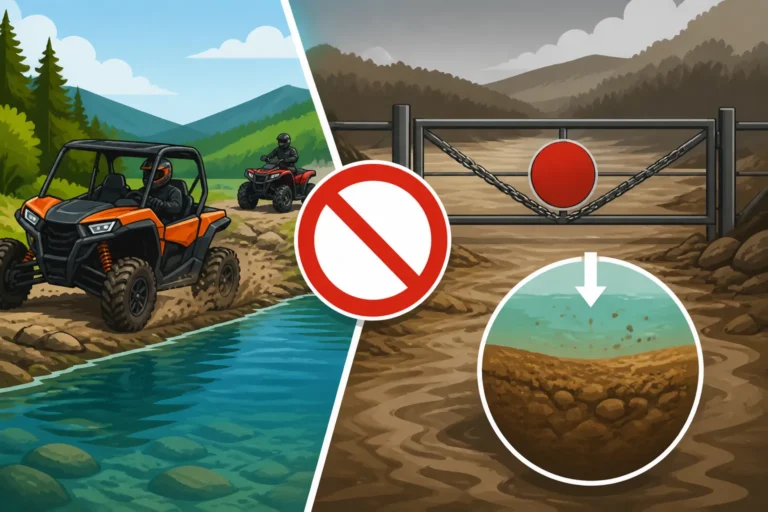
Trail conditions can change after heavy rain, storms, erosion, or maintenance work. A route that was passable on a previous visit may be muddy, rutted, or temporarily closed later. Check [North Carolina Trail Conditions Before You Ride] and relevant forest notices before driving to a trailhead. If the gate or official notice says a route is closed, stay off it even if you see tracks leading past the closure.
Carry a current map and know how to use it before you lose cell service. onX Offroad can be useful for reviewing routes and keeping track of your position, but do not treat any mapping app as a substitute for posted signs or official closure notices. Download the information you need before leaving an area with reliable service, and bring a backup navigation option if your group is traveling unfamiliar trails.
For a public forest ride, confirm permit requirements and how to obtain the right permit for the specific riding area. [North Carolina Forest OHV Permits] explains the permit system, but check the appropriate district information for the area you plan to visit. A permit for one location should not be assumed to apply everywhere.
Pack for a slow, technical day
Rocky riding often takes longer than riders expect. The group may stop to inspect an obstacle, help another rider choose a line, or deal with a puncture or mechanical issue. Bring water, food, basic repair supplies, and the tools that fit your machine. A first-aid kit and a way to contact help are sensible additions, especially when the group is riding away from busy roads.
Use protective gear that suits the ride and your vehicle. Helmets, eye protection, sturdy clothing, gloves, and appropriate footwear help protect against common trail hazards. Secure loose items before setting out. A bag or tool that shifts around during a climb can distract the driver or interfere with controls.
For rock-specific preparation, consider [Tire Choice for Uwharrie Rock]. The key is to arrive with tires in safe condition and a plan for dealing with a puncture—not to rely on tires alone to make a difficult route manageable. If your machine has a winch or recovery equipment, understand its safe use before you need it. Improvised recovery under tension can injure people or damage vehicles.
Ride Designated Trails and Know When to Turn Back
Stay on the marked route
On public riding land, do not create a new line around an obstacle by driving through vegetation, cutting across a slope, or following an unmarked path. Going around a difficult feature may cause erosion, damage habitat, and put your group somewhere that is not open to vehicles. Review [North Carolina Rules for Riding Off the Trail] and follow trail signs and closures.
If an obstacle feels beyond your group’s ability, stop in a safe place and reassess. Continuing because another rider made it through is not a sound plan. The first machine may have a different setup, the driver may have more experience, or the trail may have changed since that rider’s visit. If there is no safe, permitted way forward, turn around rather than leaving the designated trail.
This matters especially when the route is narrow or steep. A machine stuck sideways on a rock feature can block other riders and make recovery risky. Give others room, avoid crowding an obstacle, and make sure the group knows who is spotting and who is moving before anyone attempts a difficult section.
Leave room for changing conditions
Rain can make exposed rock slick and muddy approaches unpredictable. A shallow-looking crossing can also hide a soft edge or uneven rock under the water. If the surface has changed since your last visit, treat the trail as a new challenge rather than assuming your previous ride proves it is safe.
After a difficult section, take a moment to check the machine for obvious damage, such as a damaged tire, loose equipment, or a leak. Small issues are easier to address before they become a breakdown far from the staging area. Keep the group together and avoid leaving a rider behind to manage a problem alone.
A rewarding rock-crawling day is not measured by the hardest obstacle completed. It is measured by choosing a suitable route, respecting trail rules, and getting everyone and every machine back safely. Start with terrain your group can handle, check conditions before you go, and save more demanding routes for a day when your experience and equipment are ready.
Disclaimer
This article is for general informational purposes only and does not constitute professional advice. Laws, prices and regulations vary by location and change over time. Consult a qualified professional for guidance on your specific situation.