North Carolina Riding Areas in the Piedmont
If you’re looking for ATV or UTV trails in North Carolina’s Piedmont, the choices can feel surprisingly scattered: public riding is concentrated around Uwharrie, while other options are private parks with their own rules and access arrangements. This guide explains where to start, what to check before loading your machine, and how to avoid mistaking a nearby forest road for an open OHV trail.
Where to Ride in the North Carolina Piedmont
Start with Uwharrie National Forest and Badin Lake
For many Piedmont riders, the first place to investigate is the Badin Lake OHV Trail Complex in Uwharrie National Forest. It’s in the central part of the state, within reach of towns such as Troy, Mount Gilead, and Albemarle. The area’s designated routes make it a popular destination for ATVs and suitable UTVs, but the exact trails available to your machine depend on posted rules and conditions.
Don’t assume that every road or path inside the forest is an OHV trail. National forest land includes roads and recreation areas that may have different access rules, and motorized riding is generally restricted to routes specifically open to it. Before heading out, check the current forest map and notices for the relevant district. [Badin Lake OHV Trail Complex] is a useful starting point for understanding the riding area, while [North Carolina Forest Trail Maps] can help you think through route planning.
A trail day here takes a little more preparation than simply driving to a public park. You’ll need to confirm access and permit requirements, check whether your machine fits the rules for the routes you want to ride, and plan for changing conditions. A loop that looks manageable on a map may feel much slower once you’re working through rocks, ruts, hills, or a busy trailhead.
Look at private off-road parks for another kind of ride
Private parks can be a good alternative when you want a managed riding venue, a different trail style, or an option outside the public forest system. The tradeoff is that each park sets its own operating schedule, admission arrangements, machine rules, and site requirements. A park’s website or staff are the best place to confirm whether it is open and whether your particular ATV or UTV is allowed.
Before making the drive, ask practical questions: Do you need to reserve? Are there separate routes for different machine sizes or experience levels? Is camping available, and can you ride directly from the campground? Are passengers allowed in your vehicle, and what safety equipment should everyone bring? These details can matter just as much as the trail map, especially if you’re traveling with children or a group.
Use a directory or map app to discover possibilities, not to assume that a location is open for riding. For example, onX Offroad can help you explore and organize route ideas, but a mapped line is not proof that a trail is legal, open, or suitable for your vehicle. Confirm access directly with the land manager or park before you go.
| Riding option | What it may suit | What to verify before leaving |
|---|---|---|
| Badin Lake OHV Trail Complex | Riders looking for designated public forest trails | Current access, permits, open routes, machine rules, and trail conditions |
| Other Uwharrie forest routes | Riders planning a broader visit to the national forest | Whether each road or route is open to the type of vehicle you’re bringing |
| Private off-road park | Riders seeking a managed site or a specific riding experience | Operating status, reservation rules, vehicle limits, fees, and included amenities |
| Private land with permission | Riders who have a landowner’s invitation or access agreement | Written permission, boundaries, allowed routes, and any conditions set by the owner |
For more help distinguishing mapped routes from places you can actually ride, see [Where to Ride an ATV in North Carolina] and [North Carolina’s Private Off-Road Parks].
How to Plan a Piedmont Trail Day
Confirm access, permits, and seasonal status
A common frustration is arriving with a trailer full of gear only to find that the trailhead, route, or riding area is closed. Forest routes can be affected by seasonal schedules, maintenance, weather, or temporary closures. Private parks can also change their opening days or access procedures. Check the latest notices before you leave, and recheck if heavy rain or a storm has passed through since your first look.
Public forest riding may require a permit, and the rules can differ by riding area. Confirm whether a permit is needed, whether it is per machine, and where it must be displayed. If you’re riding with a group, don’t assume one person’s permit covers every vehicle. [Do You Need a Permit for North Carolina Forest Trails?] and [Where to Buy a North Carolina OHV Permit] cover the questions to sort out before the trip.
Keep a backup plan. If a route is closed, don’t work around a barrier or ride a neighboring road that isn’t designated for OHV use. Instead, consider a confirmed open route, a private park you’ve contacted in advance, or another day. It’s disappointing to change plans at the trailhead, but ignoring a closure can create safety problems and threaten access for other riders.
Match the ride to your machine and group
A map can make a route look simple, but trail character matters. Uwharrie riding may include uneven, rocky, or steep sections, and recent rain can make traction and water crossings more challenging. A newer rider may enjoy a shorter outing on familiar terrain more than a full-day loop chosen because it looked easy on a phone screen. Pick a route that matches the least experienced person in your group, not just the most confident driver.
Check the machine’s dimensions and the trail’s vehicle restrictions before setting out. A side-by-side that is comfortable on a wide private trail may be a poor fit for a narrower route. Bring the owner’s manual, know how to use any recovery equipment you carry, and avoid relying on a vehicle’s advertised capability as a substitute for route-specific rules.
Mapping apps such as onX Offroad can be helpful for saving possible routes and keeping your plan organized. Treat them as one planning tool rather than the final word on access. Compare what you see in the app with official forest information, current signs, and guidance from the park or land manager. [North Carolina Trails for a Wide Machine] is also worth reviewing if you’re trying to choose an area that better suits a larger UTV.
Safety and Access Rules to Understand
Stay on routes that are open to motorized riding
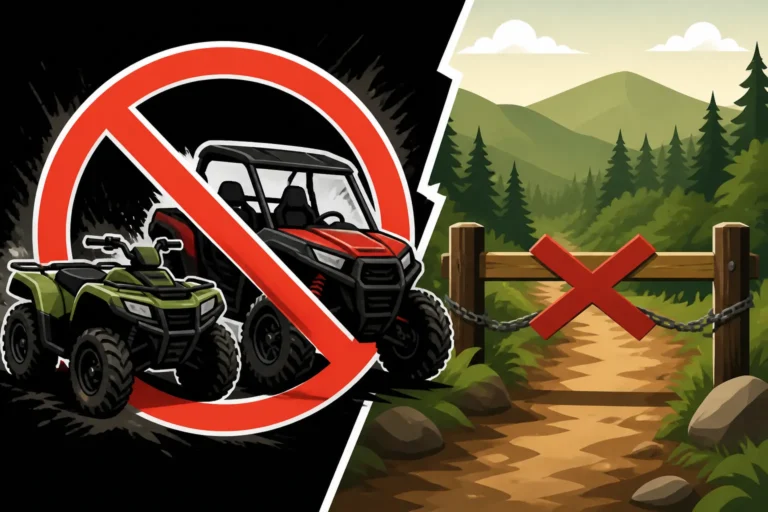
Being inside a national forest does not automatically make a road or trail available to ATVs and UTVs. Follow posted signs, use routes designated for your vehicle, and respect gates and temporary closures. A road that appears on a map might be intended for other uses or might not permit the machine you’re driving. If the map and a posted sign seem to conflict, stop and check with the land manager rather than guessing.
The same care applies on private property. An informal invitation to ride one field or trail does not necessarily include permission to cross a driveway, use another parcel, or leave the agreed route. Ask the landowner where you may ride and whether there are restrictions on passengers, speed, hours, or noise. Clear permission protects both the landowner’s boundaries and your day out. See [North Carolina Landowner Permission Requirements] for more on riding with permission.
Be especially cautious around public roads. A trail connection, forest road, or nearby pavement does not automatically make a public street legal for ATV or UTV travel. Know whether the route involves an approved crossing, a road open to your type of vehicle, or a segment where motorized riding is prohibited. [North Carolina Rules for Crossing a Road] can help clarify why a quick connection between trails still needs careful checking.
Prepare for weather, breakdowns, and limited service
Piedmont weather can change a familiar trail quickly. Rain may soften the ground, deepen ruts, and turn a manageable slope into a slippery one. Dust and heat can make a long ride tiring, while a cold or wet day can make waiting for help uncomfortable. Check the forecast, but also think about what the trail may have experienced in the hours or days before your visit.
Tell someone where you’re going and when you expect to return. Carry water, basic first-aid supplies, a charged phone, and a way to navigate if reception is poor. A map app such as onX Offroad may help you keep track of your intended route, but don’t plan as though you’ll have a strong signal everywhere. Save useful information ahead of time and bring a backup navigation method that works for your group.
Before you unload, inspect tires, controls, lights, fuel, and recovery gear. For a UTV, make sure passengers understand seat belts and safe riding behavior. For an ATV, confirm that the rider is comfortable controlling the machine on the terrain you’ve chosen. A quick check in the parking area is easier than discovering a problem after your group has spread out along a trail.
A Practical Checklist Before You Go
Use a simple planning sequence
Start by choosing the kind of experience you want: designated public forest routes, a private park, or land where you have direct permission. Then confirm that the specific site is open and that the routes allow your machine. Check the required permits or admission process, and find out whether the trail system has restrictions that affect vehicle size, passengers, or equipment.
Next, plan the day around your group rather than the most ambitious route on the map. Set a turnaround time, agree on a meeting point if riders get separated, and decide what to do if someone has a mechanical issue. If you’re traveling with children or newer riders, keep the first outing shorter and build in breaks. A modest day that ends with everyone feeling confident is usually better than pushing through an overlong ride.
Finally, pack for the conditions and leave room for a change of plan. Bring the essentials you’ll need if the ride takes longer than expected, and make sure everyone knows where the vehicle is parked and how to contact the group. If you use onX Offroad to keep track of a proposed route, pair it with official access information and the signs you encounter on site.
Piedmont ride-day checklist
- Confirm that the riding area is open on the day you plan to visit.
- Check official maps and notices for routes approved for your vehicle.
- Verify permit, reservation, and admission requirements.
- Ask about machine size, passenger, and safety-equipment rules.
- Check weather and recent trail conditions.
- Bring water, basic first aid, navigation, and recovery essentials.
- Tell someone your plan and expected return time.
- Respect closures, private boundaries, and posted instructions.
- Have an alternate plan in case your first choice is unavailable.
For a broader overview of the region’s destinations, [North Carolina Riding Areas in the Piedmont] can help you compare options. If you’re leaning toward a public-forest outing, [North Carolina Trail Conditions Before You Ride] is a useful reminder to check conditions close to departure rather than relying on an old trip report.
The Piedmont’s public ATV and UTV opportunities are more concentrated than many first-time visitors expect, so planning makes a real difference. Start with Badin Lake and Uwharrie if designated public trails are your goal, and look at private parks or permission-based land for other kinds of riding. Confirm access directly, match routes to your machine and group, and treat maps as planning aids—not permission to ride.
Disclaimer
This article is for general informational purposes only and does not constitute professional advice. Laws, prices and regulations vary by location and change over time. Consult a qualified professional for guidance on your specific situation.