Copperheads on a Warm Ledge in Pisgah
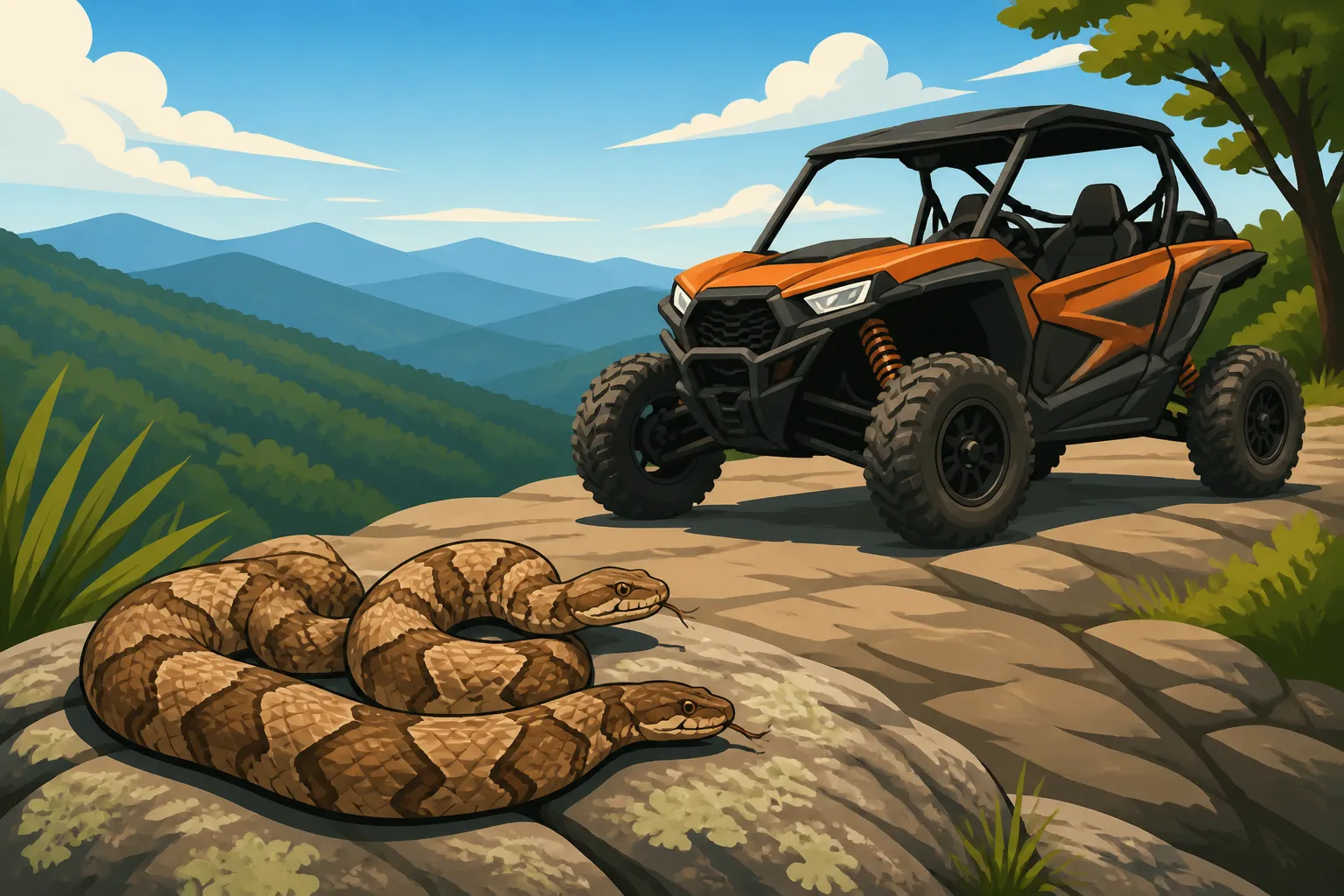
A warm rock ledge can look like the perfect place to pause on a Pisgah ride, but it can also be where a copperhead blends into leaves, bark, and stone. That possibility can make a scenic stop feel tense. This guide explains where to watch, how to respond if you spot a snake, and what to do if someone is bitten.
Why copperheads may be near warm ledges in Pisgah
The rocks, leaves, and weather create useful hiding places
Copperheads are well camouflaged. Their brown, copper, and tan markings can disappear against leaf litter, weathered wood, and mottled rock—especially when the light is broken by trees. A rider may see a snake only after stopping, stepping down, or approaching a ledge to take a photo.
Warm surfaces can attract snakes looking for places to regulate their body temperature. In wooded parts of Pisgah, a sunny rock shelf beside shade, fallen leaves, or a log can offer a mix of warmth and cover. That does not mean every sunny ledge is occupied, or that copperheads are waiting to attack. It does mean a quick visual check before walking into brush or placing a hand on a rock is sensible.
Copperheads are generally defensive animals. A bite can happen when someone accidentally gets too close, steps on one, or tries to move or handle it. Their camouflage makes accidental encounters a bigger practical concern than deliberately seeking out people. Keep your distance and give the snake a clear path to move away.
Where to be especially observant during a ride
Pause carefully around rocky edges, shaded pull-offs, leaf-covered trail margins, and logs that cross or border a route. Watch where you put your hands when steadying yourself on uneven ground, and look before stepping off the machine. Avoid reaching into gaps between rocks or into piles of leaves where you cannot see what is underneath.
A quick scan should not turn into walking off the marked route. Pisgah terrain can be steep and uneven, and leaving a designated path can create other hazards, including loose footing and damage to sensitive ground. Stay on the open route and use a safe, visible place to stop. For route planning and area orientation, [North Carolina Forest Trail Maps] can help you understand where trails and access points are; a map cannot show whether a snake is present at a particular ledge.
If you are using onX Offroad to plan a route, treat it as a navigation aid, not a wildlife warning system. Download or otherwise prepare the information you need before entering areas with poor service, and do not assume your phone will provide a reliable connection in a remote spot. A map helps you plan where you can ride and return; your eyes and your distance from wildlife remain the essential precautions.
A practical risk guide for common trail situations
| Situation | Safer response |
|---|---|
| Stopping beside a sunny rock ledge | Look over the ground before stepping down, and keep hands away from unseen gaps |
| Seeing a snake on or near the trail | Stop at a safe distance, give it room, and wait for it to move away |
| Wanting a closer photo | Stay back; use zoom rather than approaching |
| Finding a snake where riders need to pass | Do not prod, pick up, or try to relocate it; wait or turn back if the route is not safely passable |
| A rider is bitten | Call 911, keep the person still and calm, and follow emergency dispatch instructions |
What to do when you see a copperhead
Stop, create space, and let the animal move
If you spot a snake from your ATV or UTV, stop without riding toward it. Keep other riders behind you and avoid crowding the animal from multiple directions. If it is on the trail, give it time and space to leave. Do not use a stick, boot, tool, or vehicle to push it aside.
A snake may remain still because it is relying on camouflage. That can make it tempting to move closer for a better look, but closing the distance increases the chance of an accidental contact. If you cannot confidently pass without approaching it, wait in a safe location or choose another permitted route. The ride is not worth forcing a close encounter.
For a group, one person can quietly alert the others while everyone stays back. Keep children and pets close, and do not let anyone circle around the snake for a photograph. A picture is never worth getting within striking distance.
Keep the stop within the riding rules
When a wildlife encounter interrupts your trip, the safest response is still to use designated routes and legal stopping areas. Do not pull off into vegetation or cross a closed section just to avoid waiting. Review [North Carolina Rules for Riding Off the Trail] before a trip if you are unsure what counts as leaving an authorized route.
Trail conditions can also change after storms, maintenance, or seasonal closures. Before heading out, check [North Carolina Trail Closures to Check] and [North Carolina Trail Conditions Before You Ride]. These checks do not predict wildlife activity, but they can keep you from being forced into an unfamiliar detour or an unsafe stopping place.
If you use onX Offroad to review a route with your group, agree on a meeting point and a turnaround plan before the ride. A navigation app can help riders orient themselves when the group pauses, but it should not encourage anyone to approach wildlife or continue onto a route that is closed. Forest roads and trails can have limited service, so decide how you will communicate if riders become separated.
Make the whole group’s stop safer
A roadside or trail stop can become chaotic if several machines pull up at once. Ask riders to stop well back from the snake and avoid blocking the route if there is room to position safely. Keep engines quiet when practical, and do not surround the animal with machines. If the trail is narrow, do not create a traffic hazard while waiting.
Before riding, make sure everyone knows a simple plan: the lead rider signals a stop, following riders keep distance, and no one approaches the snake. This matters on narrow routes, where a rider at the back may not see why the group has stopped. For general riding courtesy and safe passing, [North Carolina Trail Etiquette on Narrow Trails] is useful background.
Season and weather influence when you are more likely to encounter wildlife, but a warm day is not a guarantee that a copperhead will be present—or absent. Staying alert is more useful than trying to predict a precise time or location. [North Carolina Riding in Summer] offers broader warm-weather planning considerations for riders.
If someone is bitten by a copperhead
Treat a suspected bite as an emergency
Move away from the snake first, without trying to catch or kill it. Call 911 and tell the dispatcher that a snake bite is suspected, where you are, and how the person is doing. A bite can be difficult to identify with certainty, so do not delay emergency care while trying to decide whether the snake was venomous.
Keep the person as calm and still as possible. If you can do so without delaying help, remove rings, watches, or tight items near the bite before swelling develops. Keep the affected limb supported and still, ideally at a comfortable position, and follow the dispatcher’s instructions. Do not let the person ride out, walk a long distance, or drive themselves if emergency responders can reach the location.
Do not cut the wound, try to suck out venom, apply ice, use electric shock, or apply a tight tourniquet. Do not attempt to capture the snake for identification. If a photograph can be taken from a safe distance without approaching or delaying care, it may help responders, but it is not necessary.
Get responders to the right place
In a remote riding area, a clear location description can matter as much as the first call. Give the dispatcher the trail or access point name if known, your nearest landmark, and the direction you were traveling. If you have a map or GPS position, share it with emergency services when possible. Do not assume that a location pin will be accurate without checking it against recognizable access points.
If the group has no phone service, follow the plan made before the ride. Send a designated rider to seek help only if doing so is safe and necessary, and make sure someone stays with the injured person. Avoid splitting the group without communicating who is going where. A prepared map, a charged phone, and a clear return plan can reduce confusion, even though they cannot replace emergency response.
onX Offroad or another navigation tool may help you describe a location or retrace a route, but do not rely on a single app as your only emergency plan. Save relevant maps for offline use where available, carry basic first-aid supplies, and tell someone outside the group where you intend to ride. In the forest, connectivity and travel time can be unpredictable.
Planning a Pisgah ride with wildlife in mind
Build awareness into your pre-ride routine
Before loading the machines, confirm that your intended route is open and appropriate for your vehicle. A trail shown on a map is not automatically open to every ATV or UTV, and riding access can vary by location. Use [Where to Ride an ATV in North Carolina] as a starting point for understanding designated riding areas, then verify the specific route and current access rules before leaving.
Pack for the ride rather than assuming the day will go exactly to plan. Bring water, a charged phone, a first-aid kit, and any navigation tools you rely on. Tell the group what to do if someone sees wildlife or if a rider becomes separated. If you are heading into a remote area, share your route and expected return time with someone who is not on the ride.
A useful group briefing can be short: stay on the authorized route, watch the ground when stopping, do not touch wildlife, and regroup if the lead rider signals an unexpected stop. That simple agreement can prevent the common problem of one person stepping down while another is still maneuvering nearby.
Keep wildlife precautions realistic
Seeing a copperhead is not a reason to panic or abandon every ride. It is a reason to slow down around likely hiding places, look before stepping, and resist the urge to handle or corner wildlife. Most of the risk can be reduced by giving snakes room and keeping hands and feet out of places you cannot see.
The same approach applies to other trail hazards. Riders should pay attention to footing, weather, route conditions, and other trail users rather than focusing on one risk alone. If a route feels unsafe because of terrain, congestion, or an animal blocking the way, turn around when it is safe and legal to do so.
For navigation, onX Offroad can be one part of a broader preparation routine: review the route, understand how to return, and make sure every rider knows the plan. It cannot confirm that a trail is currently open unless the relevant information is available and current, and it cannot identify wildlife ahead. Use it alongside official trail information, sound judgment, and basic backcountry preparedness.
A calm response is better than a close encounter
A copperhead on a warm Pisgah ledge is a reason to pause—not to crowd the snake or rush through the area. Stop at a distance, keep the group together, and give the animal a chance to move away. If a bite occurs, call 911, keep the person still, and follow emergency instructions rather than trying home remedies.
Before the next trip, check route access, brief your group, and carry a workable plan for navigation and emergencies. The [North Carolina Trail Conditions Before You Ride] and [North Carolina Forest Trail Maps] resources can support that preparation, while good trail habits help you respond sensibly when the unexpected appears.
Disclaimer
This article is for general informational purposes only and does not constitute professional advice. Laws, prices and regulations vary by location and change over time. Consult a qualified professional for guidance on your specific situation.