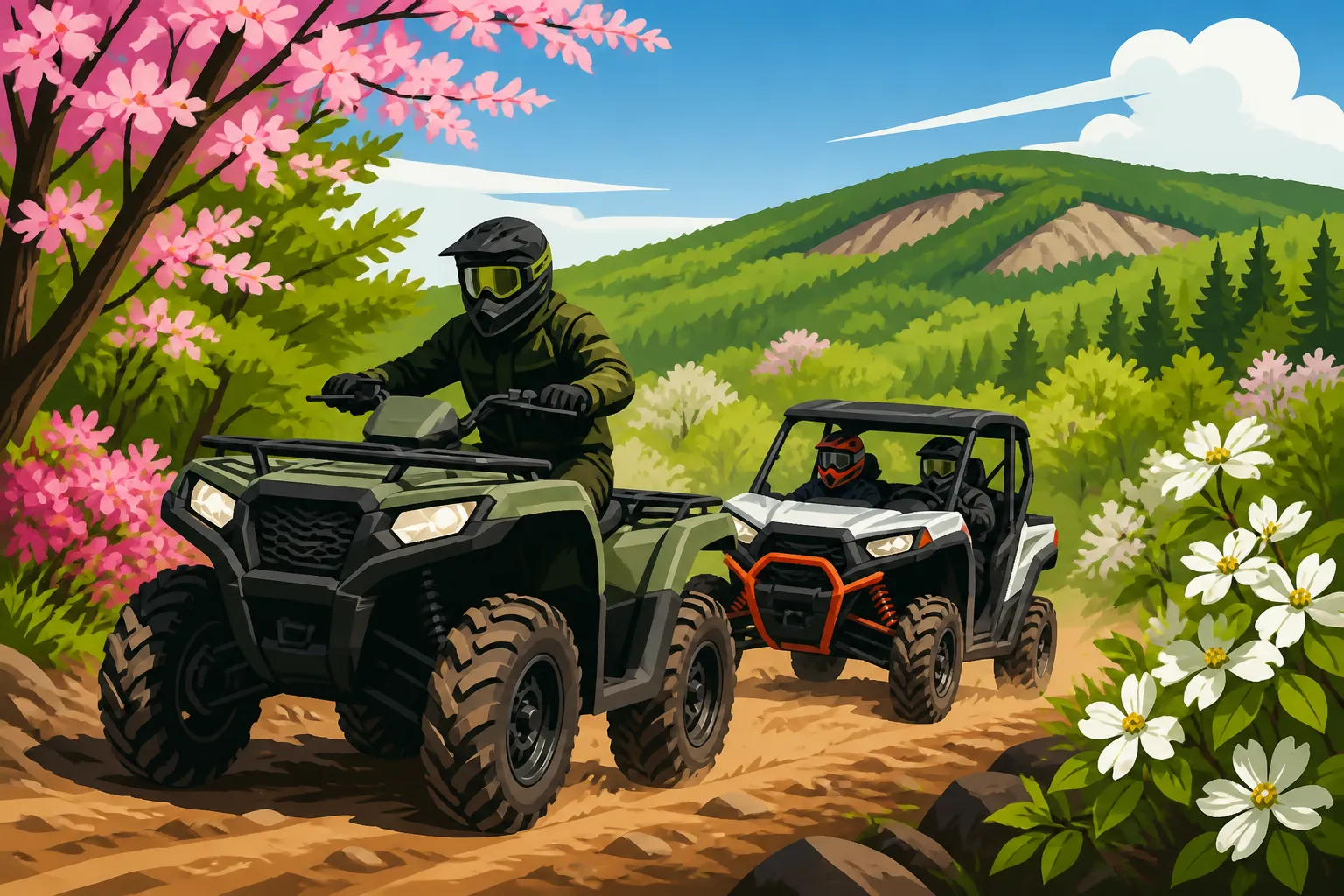
Riding the Uwharries in Spring
Spring is a rewarding time to ride the Uwharries, but rain can turn familiar routes into slick, rutted trails, and a forest gate may not be open just because the weather looks inviting. This guide explains how to plan a spring ATV or UTV trip near Badin Lake, check conditions, choose a sensible ride, and prepare for changing trail and weather conditions.
Plan around spring conditions in the Uwharries
Check access and trail status before you drive
The Uwharrie National Forest’s OHV riding area is in Montgomery County, near Badin Lake and the town of Troy. Spring can bring comfortable riding weather, but it can also bring heavy rain, muddy ground, storm damage, and temporary closures. A route that was open on your last visit may be affected by maintenance or weather the next time you head out.
Before loading your machine, check current notices from the U.S. Forest Service and confirm which roads and OHV trails are open. Pay attention to gate information and trailhead postings when you arrive, too. A map or older social-media post can be useful for general orientation, but it should not override an official closure sign or current forest notice. For a broader overview of local riding options, see The Uwharrie National Forest in North Carolina.
Spring access can also depend on the forest’s seasonal schedule. Don’t assume that a trail is open simply because it is dry at home, or because you have already driven to the area. If an official update is unclear, contact the appropriate ranger district before making a long trip. It is frustrating to unload at a trailhead only to discover that the route you planned is closed, but checking ahead is far easier than trying to improvise from the staging area.
Understand how recent rain changes the ride
Rain affects more than the amount of mud on your tires. Wet clay and leaf litter can make climbs and descents slippery, while standing water can hide holes, rocks, and damaged trail edges. A shallow-looking crossing may be deeper or softer than it appears, and a rutted section can pull a machine away from the line you intended to take.
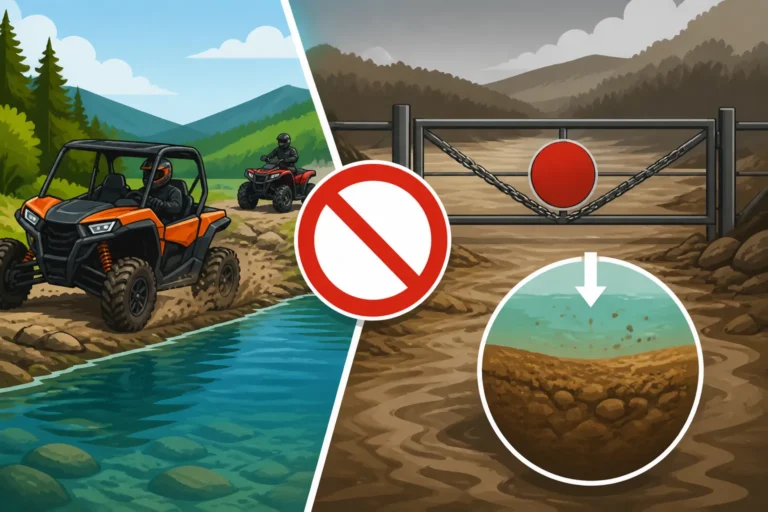
Give the ground time to recover after substantial rainfall. If the forest has closed a trail or posted a warning, respect it; riding around a barrier can cause damage and put other visitors at risk. Even without a closure, consider shortening your route after a wet spell. Muddy conditions can slow a group considerably, and the extra effort of recovering a stuck machine can turn a relaxed spring outing into a tiring day.
For a practical look at how a wet week can affect local routes, read Uwharrie Mud After a Week of Rain. The main takeaway is simple: trail conditions can change quickly, and a route that felt manageable in dry weather may require a much more cautious approach after rain.
Sort out permits and machine requirements in advance
Don’t treat access paperwork as a detail to handle at the trailhead. Confirm the permit rules for the area and the type of machine you plan to ride, and check where permits are sold and how they must be displayed. Requirements and sales arrangements can vary by riding area, so verify the instructions for your specific destination rather than relying on an old permit or a friend’s experience.
Each machine may have its own permit requirement. If your group is bringing multiple ATVs or UTVs, check the rules for every vehicle, even if one person is organizing the trip. A visitor arriving from Virginia, South Carolina, or another nearby state should also confirm North Carolina’s requirements rather than assuming an out-of-state credential covers everything. North Carolina Forest OHV Permits and Why North Carolina Reciprocates Nothing offer more context about permits and visitor expectations.
Make a short pre-trip checklist: confirm the trail area is open, determine what permit applies, identify where you can obtain it, and check whether a birth-year safety certificate requirement applies to any rider in your group. Carry required documents with you rather than leaving them in a tow vehicle parked far from the trail.
Choose a ride that fits your group and machine
Match the route to the least experienced rider
A group’s pace is set by its least experienced rider, not by its most confident one. That matters especially in spring, when slick surfaces and changing trail conditions can make familiar terrain feel more demanding. A new rider who is comfortable on a level, dry route may feel overwhelmed by steep sections, loose rocks, or mud that reduces traction.
Talk through the day before anyone starts the engine. Ask who has ridden off-road before, what kind of terrain they are comfortable with, and whether anyone is worried about a particular feature. Then choose a route with room to pause or turn back. It is better to finish with energy left than to push a beginner into a climb or obstacle they are not ready to handle.
If you have children riding along, plan around their attention span, ability, and safety needs—not just the distance an adult hopes to cover. A shorter day with regular stops can be much more enjoyable than trying to complete a long loop before everyone is ready. Riding With Children at a North Carolina Park is a helpful companion read when you are planning a family outing.
Use trail names as a starting point, not a guarantee
Uwharrie’s OHV routes include named trails and connections around the Badin Lake area. Riders may encounter names such as Daniel and Dickey Bell when researching the riding area, but a trail name alone does not tell you whether the route is suitable for your machine, skill level, or current conditions. The same section can feel very different after rain or when traffic has churned up the surface.
Study an up-to-date forest map before you leave home and orient yourself again at the trailhead. A digital tool such as onX Offroad can help you review trail lines and keep track of your location, especially when you are trying to understand how trails connect. Use it as a planning aid, not as permission to enter a closed route or travel beyond signed access.
For a map-reading refresher, see North Carolina Forest Trail Maps and Reading a North Carolina Forest Trail Map. Build your route around clear landmarks and known connections, and make sure everyone in the group understands the plan. If a junction is confusing, stop in a safe place and check the map instead of following another group without knowing where it is headed.
| Spring riding factor | What to consider | A sensible response |
|---|---|---|
| Recent rainfall | Slick clay, hidden ruts, soft shoulders, and muddy climbs | Check notices, reduce speed, and be ready to shorten the ride |
| Rider experience | Spring conditions can make familiar terrain more demanding | Choose a route the newest rider can handle comfortably |
| Machine size and capability | Width, ground clearance, tires, and turning space affect route choices | Confirm the route suits every machine in the group |
| Daylight | Mud, stops, and recovery can stretch a planned ride | Start with enough time to return before dark |
| Trail status | Closures and maintenance can change access | Follow current forest updates and posted signs |
Keep the day manageable rather than chasing mileage
A route that looks short on a screen can take longer than expected when the group is stopping at junctions, waiting for slower riders, or carefully working through muddy sections. Plan a conservative loop and agree on a turnaround point. If conditions are better than expected, you can always decide whether to add another section after checking your time and energy.
It also helps to split the group thoughtfully. If riders have different experience levels or machines, agree on regrouping points before setting off. Keep the faster riders close enough that no one feels pressured to catch up, and make sure the group knows what to do if someone stops or takes a wrong turn. Good communication is more useful than trying to maintain a constant pace.
For ideas on planning within daylight, Uwharrie Loops You Can Finish Before Dark can help you think through the shape of a ride. Leave extra room in your schedule for muddy conditions, minor repairs, and breaks. In spring, finishing early is a better outcome than racing the sunset back to the staging area.
Prepare your ATV or UTV for a wet, changeable day
Inspect the machine before leaving home
A quick inspection in the driveway can prevent a frustrating failure on the trail. Check tire condition and pressure according to the machine manufacturer’s guidance, look for loose parts, and confirm that the brakes, throttle, steering, and lights work as intended. On a UTV, check seat belts and make sure passengers know how to use them. On an ATV, inspect the controls and ensure the machine is appropriate for the rider.
Bring the equipment needed for the type of day you have planned, but avoid carrying loose items that could shift or interfere with controls. A basic tool kit, tire-repair supplies suited to your machine, and a way to communicate with your group can be useful. If your machine has a winch, check its operation before the ride rather than discovering a problem when you need it.
Spring mud can make post-ride cleanup more important, too. Mud packed around moving parts or cooling areas can create trouble if it is left to dry in place. After the trip, inspect the machine and clean it according to the manufacturer’s guidance. If you trailer, keep a few towels and suitable tie-downs on hand so cleanup and loading are less of a scramble.
Pack for weather shifts and limited cell service
Spring weather in the Piedmont can change during the day. Start with layers you can adjust, waterproof outerwear, gloves, eye protection, and footwear that works for walking on uneven ground. A sunny forecast does not mean the trail will stay warm and dry, especially if you are stopped for a long time or riding in shaded areas.
Do not assume you will have reliable cell service everywhere in the forest. Download maps for offline use before leaving home, share your route and expected return time with someone who is not riding, and carry a basic first-aid kit. onX Offroad can be useful for reviewing mapped routes and checking your position, but it should not be your only navigation plan. Save a map for offline access where that feature is available, and bring a backup method of orientation.
Bring drinking water and food even if you expect a short ride. A slow group, a mechanical issue, or a route change can stretch an outing. Keep supplies accessible without putting anything where it could shift, fall, or create a hazard. If you are riding with children, pack extra water and warm or dry layers; a damp, chilly rider can lose enthusiasm quickly.
Ride with space, patience, and a recovery plan
Leave enough room between machines to react to sudden stops, loose rocks, or a rider losing traction. Dust may be less of a concern after rain, but mud and spray can still affect visibility. On narrow sections, communicate clearly before passing or entering a tight spot, and avoid stopping where another rider could come around a blind corner and meet you unexpectedly.
Before tackling a muddy hill, look at the line and decide whether it is appropriate for your machine and skill level. If you are uncertain, stop somewhere safe and talk it through. Don’t let group pressure turn a questionable obstacle into a risky attempt. Keep the route within the boundaries of marked trails, and never go around a closure to avoid turning back.
If a machine gets stuck, pause before everyone crowds around it. Decide who is directing the recovery and keep bystanders clear of the winch line or other recovery equipment. If the situation is beyond the group’s ability, do not make it worse by rushing into a dangerous pull. A calm recovery plan is part of spring preparation, not a sign that you expect the day to go wrong.
Make the trip smoother from staging area to ride home
Arrive ready to stage and leave cleanly
Before setting off, organize helmets, eye protection, water, permits, maps, and tools so no one is searching through a vehicle while others wait. Check that trailers and tow vehicles are parked where permitted, and keep access routes open for other visitors. The busy part of the day can feel hectic, particularly when several groups are unloading at once, so a little preparation makes the start less stressful.
At the trailhead, read posted signs and confirm that your intended route is open. Make sure everyone knows the planned loop, the expected return time, and the agreed regrouping points. If the group is large, identify a lead rider and a sweep rider so nobody is left behind. For guidance on respectful riding and shared trail use, see North Carolina Trail Etiquette on Narrow Trails.
When the ride is over, check the machine and gear before loading. Remove mud where needed, secure loose equipment, and leave the staging area in good condition. A tidy departure matters to other riders and helps prevent mud, straps, or tools from becoming a safety problem on the drive home.
Have a backup plan if the weather or trail changes
A spring trip should have a version that works if the forecast worsens or a section is closed. That might mean riding a shorter route, spending time at a different open area, or postponing the outing. Decide as a group what conditions would make you turn around before you are tired, wet, or already committed deep into a route.
If the Uwharrie area is not suitable that day, do not treat a nearby road, game land, or unmarked route as an automatic alternative. Public access rules differ by place, and a trail shown on a general map may not be open to motorized use. Verify access for any substitute destination. North Carolina Trail Conditions Before You Ride and North Carolina Trail Closures to Check First can help you build the habit of checking conditions before departure.
The most enjoyable spring ride is not necessarily the longest one. It is the trip where the group finds open trails, chooses terrain that suits its riders, and gets home without having to make hurried decisions in worsening weather. If you plan with room for changing conditions, the Uwharries can be a satisfying place to ease into the riding season.
Disclaimer
This article is for general informational purposes only and does not constitute professional advice. Laws, prices and regulations vary by location and change over time. Consult a qualified professional for guidance on your specific situation.