The Forest Season Permit in North Carolina
A season permit can make repeated ATV or UTV rides in a North Carolina national forest simpler, but it is not a statewide pass. Riders often discover too late that permits are tied to particular trail systems, machines, and operating seasons. This guide explains how forest season permits work, how they differ from day permits, and what to check before loading up.
What a North Carolina forest season permit covers
A season permit is for a particular riding area
A forest season permit is generally intended for repeated use of a designated off-highway vehicle trail system during the permit’s stated validity period. It can be convenient if you expect to ride the same area more than once, but do not treat it as a general North Carolina ATV permit. A pass for one forest or trail complex does not automatically authorize riding somewhere else.
North Carolina’s well-known national forest OHV areas include Brown Mountain in the Grandfather Ranger District of Pisgah National Forest, Badin Lake in Uwharrie National Forest, and Wayehutta in Nantahala National Forest. They have different access arrangements, operating seasons, and permit details. Before setting out, identify the precise trail system you plan to ride and read the conditions for that area rather than relying on the word “season” alone.
This matters when a trip includes more than one destination. A rider might buy a pass for Badin Lake, then decide to stop at Brown Mountain on the way home. The original pass should not be assumed to cover that second area. Confirm whether a separate permit is required before unloading at another trailhead.
If you are still sorting out the basic rules, start with Do You Need a Permit for North Carolina Forest Trails? and North Carolina Forest OHV Permits. Those topics help distinguish trail access permits from other paperwork and requirements that can apply to a machine or rider.
A permit does not replace other requirements
A forest permit is only one part of preparing for a legal ride. It does not serve as an ATV title, a road registration, proof of ownership, or permission to ride on private property. It also does not turn a public road or an unmarked forest road into an OHV trail. The permit applies within its stated scope, not everywhere a machine can physically travel.
Riders also need to follow the rules that apply to the machine and the person operating it. Depending on the ride, that can include age-related requirements, helmet and eye-protection rules, equipment rules, and a safety certificate requirement tied to the rider’s birth year. A permit does not waive those obligations. Review North Carolina’s Birth-Year Safety Certificate and Carrying the Certificate on a North Carolina Ride if a rider in your group may need to carry proof of course completion.
The same distinction applies to trail access. A trail can be closed even if you have a valid season permit. Forest managers may restrict access because of maintenance, weather, fire concerns, or other conditions. A pass is not permission to ride through a gate that is closed or beyond a marked boundary.
It helps to think of the permit as one piece of a ride plan: it addresses access to a designated OHV area, while the trail’s current status and the rider’s other obligations still matter. If you are planning a particular route, check the district’s trail information close to your departure date and again before you unload.
Season permits versus day permits
When a season permit may make sense
A season permit can be practical for someone who expects to ride the same system several times during its permit period. For example, a local rider who returns to Badin Lake on multiple weekends may prefer to handle access paperwork once rather than arrange a day permit each visit. The same logic can apply to a family or riding group that plans several trips to one area, provided each machine and rider meets the applicable rules.
The convenience is mostly about repeated use and planning. You can sort out the permit before a trip, keep its instructions with your ride paperwork, and avoid treating every outing as a brand-new permit purchase. It may also make budgeting easier when you compare the provider’s current day and season options. The permit itself is not a guarantee that the trails will be open on the dates you choose.
A season pass is less useful when you expect only one visit, are uncertain which system you will ride, or plan to visit several areas with different permit arrangements. In those cases, a day permit or a separately purchased permit for each system may fit better. Check the rules for each destination rather than assuming there is a universal pass.
The most useful question is not simply “Is a season pass cheaper?” It is “Will I ride this particular area often enough, during the dates it accepts the pass, to justify buying one?” Check the current terms and permit options through the responsible forest district or an authorized seller before deciding.
When a day permit may be the simpler choice
A day permit can suit a one-time visit, a weekend trip, or a rider who wants to try a trail system before committing to multiple outings. It may also be easier for visitors who are coming from outside North Carolina and do not know whether they will return during the same permit period. A short visit does not automatically mean a day permit is available at every area, so confirm the options first.
Day permits and season permits can differ in how and where they are sold, how they must be displayed, and which dates they cover. Do not rely on a photo of a friend’s pass or an old receipt to determine what you need. Read the instructions attached to the permit or provided by the authorized seller, and keep any proof of purchase that the instructions tell you to retain.
A day permit can also be a sensible fallback when your plans are unsettled. Suppose your group is considering either Brown Mountain or Badin Lake, depending on weather and trail conditions. Rather than purchasing a season pass for one system before the plan is firm, confirm which area is open and buy the correct permit for the final destination.
For a closer look at the day-use option, see North Carolina’s Forest Day Permit. The comparison below is a planning guide, not a substitute for the permit terms for a particular trail system.
| Permit option | Often suits | What to confirm before buying |
|---|---|---|
| Day permit | A single outing or occasional visit | Which area it covers, the valid date, and how it must be displayed |
| Season permit | Repeat visits to one designated system | The covered area, validity period, machine-specific rules, and whether it transfers |
| Permit for another forest area | A trip to a different OHV system | Whether that system requires its own permit and where it is sold |
| Rental or outfitter access | A ride using a rented machine | Whether the rental includes the required forest permit and which trails are allowed |
Permit areas, validity periods, and seasonal differences
North Carolina does not have one shared forest season
One common planning mistake is to treat “North Carolina forest season permit” as a single statewide pass. In practice, permit conditions are associated with particular areas, and different trail systems can have different validity periods. A pass purchased for one location should not be assumed to work at another, even if both areas are in national forests within the state.
That difference can affect a trip that crosses regions. A rider based near Charlotte might visit Uwharrie’s Badin Lake trails, while someone traveling near Lenoir might be interested in Brown Mountain. A permit intended for one of those locations should not be treated as an all-forest credential. Read the permit description carefully and confirm the exact trail system it names.
Permit validity and trail opening dates are also separate questions. A pass can be valid during a period when a particular trail is temporarily closed, or a trail can be open while a certain permit option is no longer available for purchase. Always check both the permit terms and the trail status. Neither one answers the other.
For the reasons behind those differences, see Why North Carolina Season Permits End on Different Dates. The important takeaway is simple: identify the forest, the trail complex, and the permit period separately instead of assuming those details are identical throughout the state.
Brown Mountain, Badin Lake, and Wayehutta have distinct arrangements
Brown Mountain, Badin Lake, and Wayehutta are useful examples of why riders need to check the local rules. The areas are in different national forests and ranger districts, and their permit arrangements are not interchangeable. Their trail seasons, access points, and permit sales information may also differ. Confirm each detail with the district responsible for the area you plan to visit.
Brown Mountain’s season permit has a validity period associated with January 1, while Badin Lake’s season permit ends December 15. Those differences are a practical reason not to assume a season pass runs through the same date at every forest. Check the actual permit terms before planning a late-season outing, particularly if you expect to ride close to a closing date.
Wayehutta also has its own permit information and access details. If you are planning a trip in western North Carolina, do not apply Brown Mountain or Badin Lake assumptions to Wayehutta. Review Wayehutta’s Day Permit and verify the current access arrangements for the area before you set off.
The system-specific details are covered further in Brown Mountain’s Season Permit and Badin Lake’s Season Permit. These are useful starting points, but always compare what you read with the permit instructions and trail notices for your intended ride. If a group is choosing between areas, make the permit question part of the destination decision rather than a last-minute stop at the trailhead.
Buying and using a forest season permit
Find the authorized seller for the specific area
Permit sales are connected to the trail system, so the right place to buy a pass depends on where you plan to ride. Some permits may be available through a ranger district or an authorized local seller. Availability and sales arrangements can differ by area, so do not assume a familiar store or office sells passes for every forest.
Before driving to a seller, check that it handles permits for your destination and that the permit option you want is available. This is especially helpful for visitors traveling a long distance. A rider driving toward Uwharrie from Raleigh or Durham, for example, should confirm the permit arrangements for Badin Lake rather than count on finding the right pass at an unrelated stop along the route.
If the permit is available through a district office, confirm the office’s process and operating arrangements before you go. If a local business sells permits, make sure it is an authorized seller for that specific area. Where North Carolina Forest Permits Are Sold is a useful companion topic for sorting out the sales question.
Buying the pass ahead of time does not eliminate the need to check trail status. A closed trail remains closed, and a permit purchase does not guarantee that a forest road or OHV route will be accessible on your chosen day. Make the purchase and the conditions check separate steps in your trip plan.
Follow the display and proof instructions
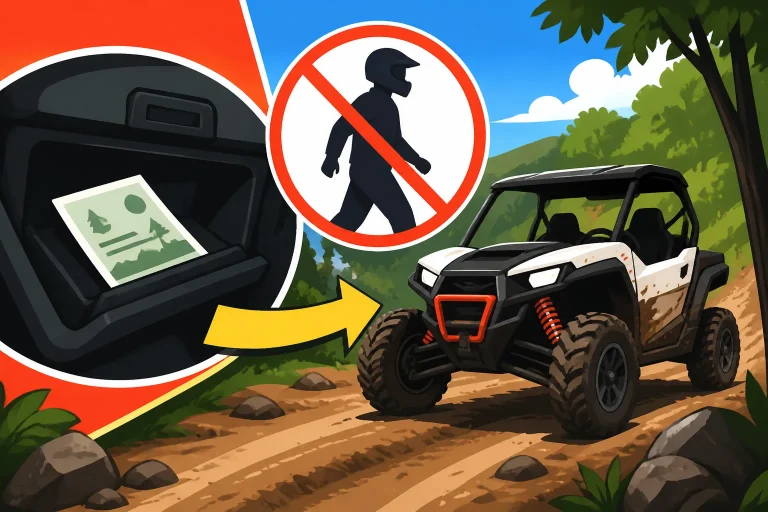
After you buy a permit, follow the directions supplied with it. The instructions may explain whether the permit must be displayed on the machine, where it should go, or what proof the rider should keep. Do not guess based on another rider’s setup. A permit tucked into a truck, stored in a phone photo, or left in a gear bag may not meet the stated display requirements.
Take a few minutes at home to read the full permit information. If the pass is a physical tag, make sure you know how it should be attached and that it will remain visible and secure during the ride. If the instructions require proof of purchase or other documents to be carried, put those items somewhere protected but accessible.
This preparation is easy to overlook when the group is unloading in a busy staging area. One person may be airing down tires, another may be fitting helmets, and someone else may be trying to locate the trail map. Sorting out permit placement before leaving home avoids a frustrating scramble at the trailhead.
A small waterproof document pouch can help keep a paper receipt, permit instructions, or a trail map from getting soaked or covered in dust. If you already shop on Amazon, it can be one place to look for a basic pouch or map sleeve; compare the dimensions and closure style with what you need. The key is still to follow the permit’s own display rules, not to assume a pouch makes an incorrectly displayed permit acceptable.
Machine-specific rules and transfer questions
Plan for one permit per machine when required
A season permit should not automatically be treated as a group pass. Forest OHV permit rules may require a permit for each vehicle, meaning that a family arriving with two ATVs cannot assume one tag covers both. Confirm the per-machine rule for the area before buying, especially if several vehicles are traveling together.
This matters even when the machines belong to the same household. A parent and teenager may ride separate quads, or a couple may bring a side-by-side alongside an ATV. The fact that the riders share a trailer or a purchase receipt does not establish that one permit is enough. Check what the permit covers and how it must be associated with each machine.
The per-machine detail is explained in Why a Permit Is Per Vehicle in North Carolina. Build the number of permits into your trip checklist before departure. It is much easier to correct a shortfall while planning than after a group has reached the trailhead and unloaded.
Machine-specific permit requirements are also different from ownership paperwork. A permit is not a title, and a title is not a forest access pass. If you are uncertain about documents for a machine as well as trail access, keep those questions separate: resolve ownership or title matters through the relevant motor vehicle process, then check the forest’s permit rules for riding.
Do not assume a season permit transfers
A season permit is not necessarily transferable to a different machine, a new owner, or another rider. The pass may be linked to a vehicle, and its conditions may specify whether it can be moved or reused. Selling an ATV, borrowing a friend’s machine, or swapping vehicles in the middle of a trip can therefore create a permit question.
Imagine that a rider sells a quad in the middle of the season and buys another one. The old permit may not simply move to the replacement machine. Or a group may share a trailer and trade machines during the day. Unless the permit instructions expressly allow that use, do not assume the pass follows the rider rather than the vehicle.
Before buying a season pass, ask what happens if the machine changes, the pass is damaged, or ownership changes. Keep a copy of the stated terms, and avoid peeling off or reattaching a tag unless the instructions permit it. A damaged or altered pass can create confusion when a ranger or other official checks the machine.
See Does a North Carolina Season Permit Transfer With the Machine? for more on this issue. If the terms do not answer your specific situation, contact the responsible district or seller before relying on the permit. A quick question before purchase is better than discovering at the trail entrance that the pass does not cover the machine you brought.
Permits, trail conditions, and responsible trip planning
Check closures and operating conditions before leaving
Forest trail conditions can change after a permit is purchased. Heavy rain, storm damage, maintenance work, fire danger, or another management decision can close routes or affect access. A valid pass does not override a closure notice, so check conditions close to the ride date rather than relying only on a saved map or an old social media post.
This is especially important for riders traveling to the mountains. A long drive from Charlotte, Winston-Salem, or the coast is disappointing enough when weather changes; it is worse to arrive and discover that the intended trail system is closed. Check notices from the responsible ranger district, and pay attention to signs and gate boards when you reach the area.
The same care applies during the ride. Stay on routes open to your machine, respect barriers, and do not use a season permit as justification to ride around a closure. A trail that looks passable may be closed for a safety, environmental, or maintenance reason that is not obvious from the staging area.
Use North Carolina Trail Closures to Check as part of your planning. If a closure changes your destination, confirm the replacement area’s permit requirements rather than assuming the first permit will work there. A change in route can mean a change in both access rules and permit needs.
Pack for the ride, not just the permit check
A permit is a small part of a safe and enjoyable forest ride. Before leaving, confirm that each machine is suitable for the route and in sound working condition. Bring a map or another reliable way to understand the trail system, especially where cell coverage is limited. A group should agree on a meeting point and a plan for what to do if someone becomes separated.
Protect your paperwork from mud, water, and damage. A zippered pouch, compact document wallet, or protected compartment can keep instructions and proof of purchase together. Amazon may be a convenient place to compare simple storage options, but choose something that fits your permit and does not interfere with any required display. Keep the trail map accessible rather than buried under tools and spare clothing.
Carry the safety equipment required for the riders and conditions. Helmets, eye protection, appropriate clothing, water, basic tools, and a charged phone or communication device can make a real difference if the ride takes longer than expected. Riders should also know the route difficulty and avoid pushing an inexperienced rider onto a trail that is beyond their comfort or skill.
For groups, make one person responsible for checking permits and another for confirming trail conditions and equipment. That division keeps the paperwork from becoming an afterthought while everyone is focused on loading. If a permit is required for every machine, count the machines and verify the pass on each one before leaving the staging area.
Common season permit mistakes to avoid
Confusing a forest pass with statewide permission
The most consequential misunderstanding is believing that a forest season permit gives broad permission to ride across North Carolina. It does not automatically allow riding on public streets, private land, game lands, state parks, or another forest’s OHV trails. Each type of land has its own access rules, and some places do not allow recreational ATV use at all.
A rider might purchase a pass for a trail complex near Troy, then see a nearby logging road and assume the pass covers it. That assumption can lead to trespass or riding outside the designated system. Stay within signed and mapped routes that are open to your machine, and get permission before riding private property.
It is also easy to confuse an access permit with vehicle registration or a title. These serve different purposes. Forest permits address access to designated riding areas; ownership documents establish or record ownership; road-related documents apply to eligible vehicles and lawful road use. One document does not substitute for another.
If you are deciding whether a trail permit is required for an upcoming outing, review Do You Need a Permit for North Carolina Forest Trails? and check the rules for the specific area. Keep separate notes for title, road-use, and trail-access paperwork so one does not create a false sense that everything is covered.
Leaving permit details until the last minute
Another common mistake is waiting until arrival to work out which pass to buy, where it is sold, and whether each machine needs one. That approach can turn a relaxed ride into a frustrating search for an open seller or a scramble to correct a paperwork issue while the rest of the group waits.
A simple pre-trip checklist helps. Confirm the destination, check the trail status, identify the correct permit, verify the validity period, count the machines, and read the display instructions. If the group includes a rental machine, ask the outfitter whether the forest permit is included and which trails the rental is permitted to use. Do not assume that paying for a rental automatically covers every access fee.
Make a backup plan for closures. If your first-choice area is unavailable, check whether the alternative has its own permit, season dates, or operating restrictions. This is particularly useful for a multi-day trip where changing weather can affect the original plan.
Finally, save the permit instructions and relevant contact information before leaving home. You may not have reliable service at a staging area. A little preparation can prevent the all-too-familiar situation of standing beside an unloaded machine, trying to resolve a basic permit question with a weak phone signal.
Disclaimer
This article is for general informational purposes only and does not constitute professional advice. Laws, prices and regulations vary by location and change over time. Consult a qualified professional for guidance on your specific situation.