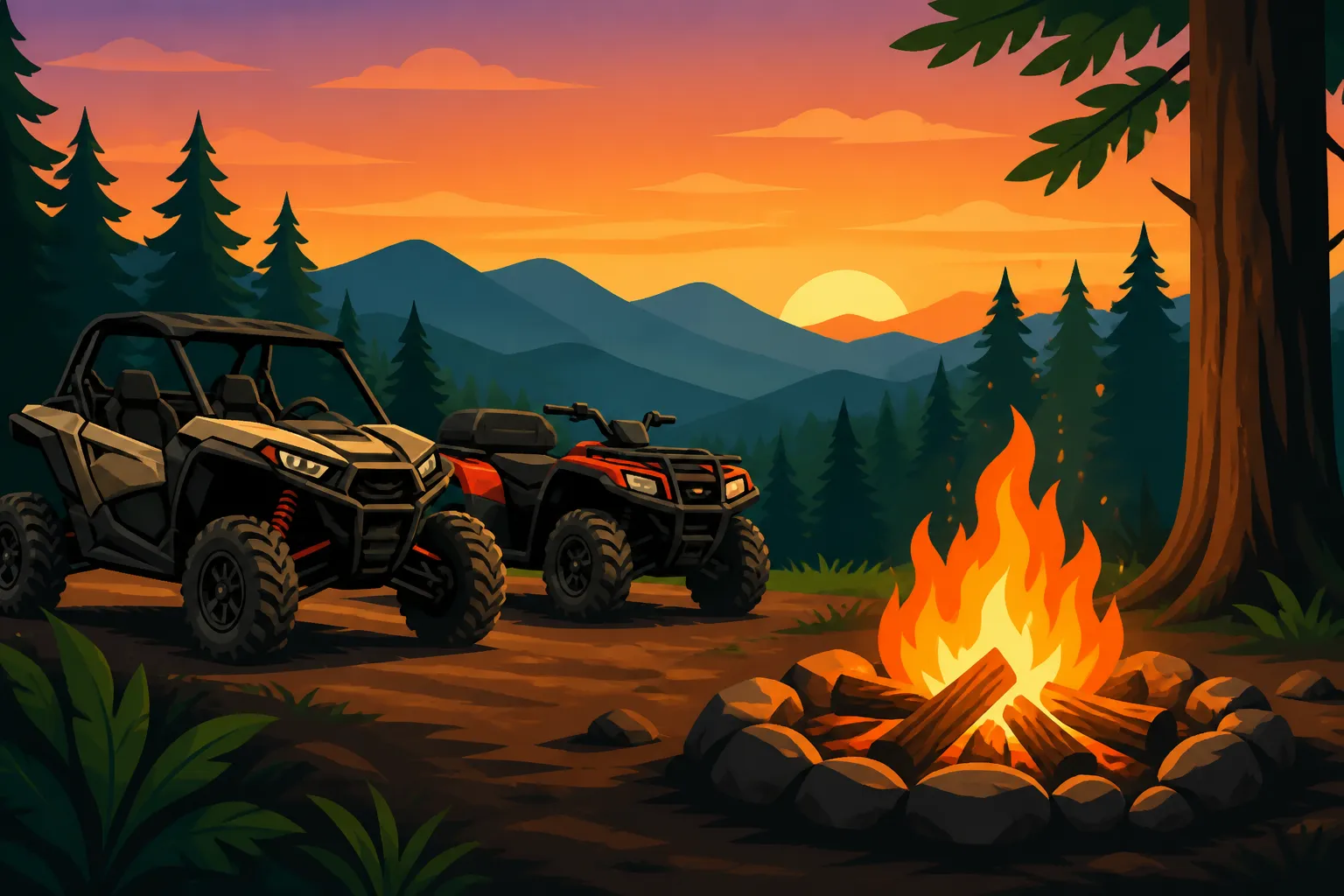
Campfires on North Carolina Forest Land
A campfire can be a welcome end to a day on the trail, but permission to ride does not automatically mean permission to build a fire. Rules can differ by forest, campsite and current fire conditions. Before packing firewood or striking a match, confirm that fires are allowed where you plan to camp and learn how to put one out completely.
Where Campfires May Be Allowed
North Carolina’s national forests include the Nantahala, Pisgah, Uwharrie and Croatan. They offer different recreation settings, and fire rules may vary by location and conditions. A fire that is permitted at a developed campground may not be allowed at a trailhead, along a trail or at a dispersed campsite. Never assume that a place is suitable just because someone has built a fire there before.
Start by identifying the land you will use. “Forest land” can refer to national forest, state game land, state park land, private timberland or another kind of property. Each has its own rules. The guidance for a Forest Service campground, for example, may not apply to a nearby game land or private riding area. North Carolina’s Three National Forest Systems gives an overview of the forest systems where riders may be planning a trip.
Even within one national forest, a fire may be limited to an established fire ring or another designated location. Some developed campgrounds provide fire rings, while dispersed camping may have different requirements—or may be affected by a temporary restriction. A bare patch of ground, old fire scar or homemade ring is not proof that a new fire is allowed there.
An off-highway vehicle permit is separate from permission to camp or make a fire. A permit may be required to ride a particular forest trail system, but it does not grant access to every campsite or authorize a campfire. Check the rules for both your riding area and your overnight location. North Carolina Forest OHV Permits explains the riding-permit side of the trip; camping and fire rules need their own confirmation.
| Location or situation | What to verify before lighting a fire |
|---|---|
| Developed campground | Whether fires are allowed at your site, and whether you must use the provided ring or grill |
| Dispersed campsite | Whether camping and campfires are allowed at that specific location under current forest rules |
| Trailhead or staging area | Whether fires are permitted there; do not assume a riding area is also a campsite |
| Private riding property | The landowner’s rules, including any limits on fires and overnight stays |
| State game land or park | The agency’s rules for that property; national forest rules may not apply |
| Any public land during dry or windy conditions | Current fire restrictions, closures and applicable local burn rules |
If you are not sure whether a site is approved for overnight camping, settle that question before planning a fire. Use official land-management information or contact the responsible office. A map can help identify land boundaries and designated facilities, but it may not show temporary fire restrictions. North Carolina Forest Trail Maps can help with trail planning, while Camping Near North Carolina OHV Trails can help you think through where to stay.
Check Restrictions Before You Pack
Fire rules can change with weather, vegetation conditions and wildfire risk. A site that normally permits a fire may be subject to a temporary restriction. Restrictions can prohibit all open fires, limit fires to designated facilities or impose other conditions. The scope and duration depend on the applicable order, so check the current notice for the exact area and activity.
Make the check close to your trip, then check again before you leave if conditions are changing. A general campground page or an old social media post may not reflect a new closure. Look for notices from the land manager responsible for your destination, including alerts for the specific forest, district, campground or trail area. North Carolina Trail Closures to Check and [Checking a Forest Notice Before You Load] can help riders build that check into their departure routine.
Also consider restrictions that may come from outside the forest manager. Local burn rules can apply in the area, and an active fire ban may affect what you can do even if a campground has a fire ring. If different notices appear to conflict, do not rely on the less restrictive one. Ask the responsible office which rule applies at your exact campsite.
Before departing, confirm:
- Who manages the land. A national forest, game land, park and private property can have different rules.
- Whether overnight camping is allowed at your intended spot. Riding access does not equal camping access.
- Whether campfires are currently allowed. Check for fire restrictions or closures that cover the location.
- Where a fire may be built. Use only a permitted site and required fire facility.
- What fuel is permitted. Rules may limit gathering or burning wood and other materials.
- What to do if conditions worsen. Wind, dry vegetation or a new restriction can make a previously planned fire unsafe or prohibited.
If you cannot confirm that a fire is allowed, plan to cook and stay warm without one, using equipment that is permitted at the site. A portable stove is not automatically exempt from restrictions, so check its use separately rather than assuming it is allowed during a fire ban.
Riders planning to stay near Uwharrie should not treat a forest campground as interchangeable with a trailhead or staging lot. Confirm the overnight site and the applicable fire rules directly. Fire Rings at a Uwharrie Forest Camp offers more specific context for that setting. For other destinations, use the same approach: identify the exact property and verify the current rule with its manager.
Build a Small, Controlled Fire and Put It Out Completely
If fires are permitted, the safest choice is usually the provided fire ring or designated fireplace. Do not move rocks to create a new ring or light a fire on bare ground simply because the area looks clear. A fire can escape through dry leaves, roots or debris beyond the visible flame. Keep it small enough to manage with the water and tools you have on hand.
Before lighting it, look around the site. Avoid a fire when gusty wind could carry sparks, when dry vegetation is close by or when conditions make it hard to control the flame. Clear loose combustible material from the immediate area only where that is allowed and appropriate; do not disturb the site or remove vegetation in ways the land manager prohibits. Keep tents, vehicles, fuel containers and other flammable gear well away.
Use only fuel that is allowed. Do not burn household trash, cans, plastic, treated or painted wood, or materials that could produce harmful smoke or leave debris. If you plan to gather wood, check the rules first. Permission to camp does not necessarily allow cutting, breaking or collecting wood, and dead or downed branches may still be protected or unavailable for gathering at that site. Bringing firewood from elsewhere can also be subject to restrictions intended to prevent the spread of pests, so follow local guidance on what wood may be brought in.
Keep these basics in mind:
- Have water ready before the fire is lit, not after you decide to leave.
- Keep a shovel or another suitable tool close by if one is available.
- Assign an adult to watch the fire continuously.
- Keep children and pets at a safe distance.
- Do not leave a fire unattended, even briefly.
- Do not add fuel just before going to sleep or leaving the site.
- Stop adding wood well before you need to pack up.
Extinguishing a fire takes more than letting the flames disappear. Pour water over the coals and embers, stir the material, and apply more water until everything is cold to the touch. Check beneath ash and around the edges of the fire area, where heat can remain hidden. If you do not have enough water to put it out thoroughly, do not light the fire in the first place.
Do not bury hot embers. They can stay hot under soil and later ignite nearby roots or dry material. Do not leave a fire to burn down while you sleep or drive away. A campsite is not safe to leave until the fire is completely out and cool.
Conditions can change after a fire has been started. If wind picks up, smoke blows toward dry brush, or a new restriction is announced, stop adding fuel and put the fire out promptly if it is safe to do so. If the fire spreads beyond your control, move away and contact emergency services. Do not risk injury trying to fight a spreading wildfire with campsite tools.
Common Trip Planning Mistakes to Avoid
A frequent mistake is treating an OHV permit as a general recreation pass. Riding access, overnight camping and campfire permission are separate questions. Verify each one for the specific destination. A trail permit also does not authorize riding beyond marked routes or using a closed area as a campsite. North Carolina Rules for Riding a Game Land is useful when a trip includes land that is not part of a national forest.
Another mistake is relying on a visible fire ring without checking whether it is available for use. The ring could be at a site where fires are temporarily prohibited, or it could be intended for a different permitted activity. Follow posted notices and current restrictions over assumptions based on what is physically at the campsite.
Do not assume that a campfire is allowed because another group has one. Other campers may be at a different type of site, may have permission that does not apply to you, or may simply be breaking the rules. If the posted instructions are unclear, ask the land manager. Until the answer is clear, use a no-fire plan.
It is also easy to overlook fire rules when a trip is organized around riding. Build the checks into the same planning process as trail conditions, permits, fuel and overnight parking. North Carolina Trail Conditions Before You Ride and North Carolina Trail Closures to Check First can help with the riding portion, but neither replaces checking campsite and fire notices.
A practical pre-trip checklist looks like this:
- Identify the owner or manager of the camping area.
- Confirm that overnight stays are allowed at the chosen site.
- Check whether fires are allowed there under current conditions.
- Find out whether a designated ring or fireplace is required.
- Confirm rules for gathering or bringing firewood.
- Pack water and a way to extinguish the fire fully.
- Have a stove or cold-meal backup if fire use is prohibited.
- Check the site notice again when you arrive.
The lowest-risk option is to use a permitted developed site with a designated fire facility and clear instructions. If your plans involve dispersed camping, a remote staging area or a property with unclear boundaries, get direct confirmation before lighting anything. That small step can prevent a good trail weekend from turning into a safety problem or a violation.
Disclaimer
This article is for general informational purposes only and does not constitute professional advice. Laws, prices and regulations vary by location and change over time. Consult a qualified professional for guidance on your specific situation.