North Carolina MUV Dimension Requirements
It can be incredibly frustrating when you’re trying to understand the nitty-gritty details of making your side-by-side or UTV street legal here in North Carolina, only to be met with confusing terms and specific measurements that feel like a secret code. Many riders just want to take their machine on a short hop down a paved road to get to the next trail or to run a quick errand, but the path to street legality is paved with very particular rules. This guide is here to demystify one of the biggest hurdles: the specific dimension requirements your machine must meet to be classified as a Modified Utility Vehicle (MUV) in our state.
Understanding the Modified Utility Vehicle (MUV) Classification
First things first, let's clear up what an MUV actually is, because it's not just any old UTV or side-by-side. In North Carolina, the term "MUV" refers to a very specific class of vehicles that have been modified (or, more often, built) to meet a set of strict criteria that allows them to be registered for limited street use. It's the state's way of distinguishing these machines from regular off-road vehicles that are absolutely forbidden on most public roads.
You see, our beautiful state, while a haven for off-road enthusiasts, has a pretty firm stance against ATVs and UTVs cruising down main streets. The MUV designation is the only avenue for a UTV or side-by-side to gain any semblance of street legality beyond specific, limited exceptions like farming operations or certain beach areas. If your machine doesn't jump through all the MUV hoops, it simply can't get a license plate to drive on most North Carolina roads. It’s a distinct classification laid out by the North Carolina Department of Motor Vehicles (NCDMV), and it comes with its own set of paperwork, like the [North Carolina Form MVR-59 Explained], which is your first step in showing the state what you're trying to do. Without meeting these requirements, you're essentially riding an unregistered vehicle on the street, which is a big no-no and can lead to hefty fines and trouble with the law.
Why North Carolina Has MUVs
You might wonder why North Carolina even bothers with this MUV classification when other states have more relaxed rules for street-legal UTVs. The truth is, it's all about safety and fitting these machines into existing vehicle categories. UTVs, even side-by-sides with roll cages, handle very differently from cars, especially at road speeds. They have a higher center of gravity, different braking characteristics, and often lack essential safety equipment found on traditional vehicles.
The MUV category was created to carve out a very narrow exception for certain utility-focused machines that can be adequately equipped for road use, without opening the floodgates for every off-road vehicle to hit the asphalt. It's a compromise designed to allow some flexibility for users who genuinely need to operate these machines on roads for short distances, while still protecting public safety. It’s a unique path, and one that many standard side-by-sides actually struggle to meet straight out of the box, which is why we often hear riders scratching their heads over things like [Why Most Side-by-Sides Miss the Mark]. Understanding the why behind these rules often makes the what a little less daunting, even if the process itself remains particular.
The Core MUV Dimension Requirements
Now, let's dive into the specifics that often trip people up. When the NCDMV looks at your machine for MUV status, they're not just glancing at it; they're looking for exact measurements. These dimensions are crucial because they dictate whether your vehicle is considered compatible with existing road infrastructure and safety standards. Missing even one of these by an inch or two can mean the difference between getting a plate and being told no.
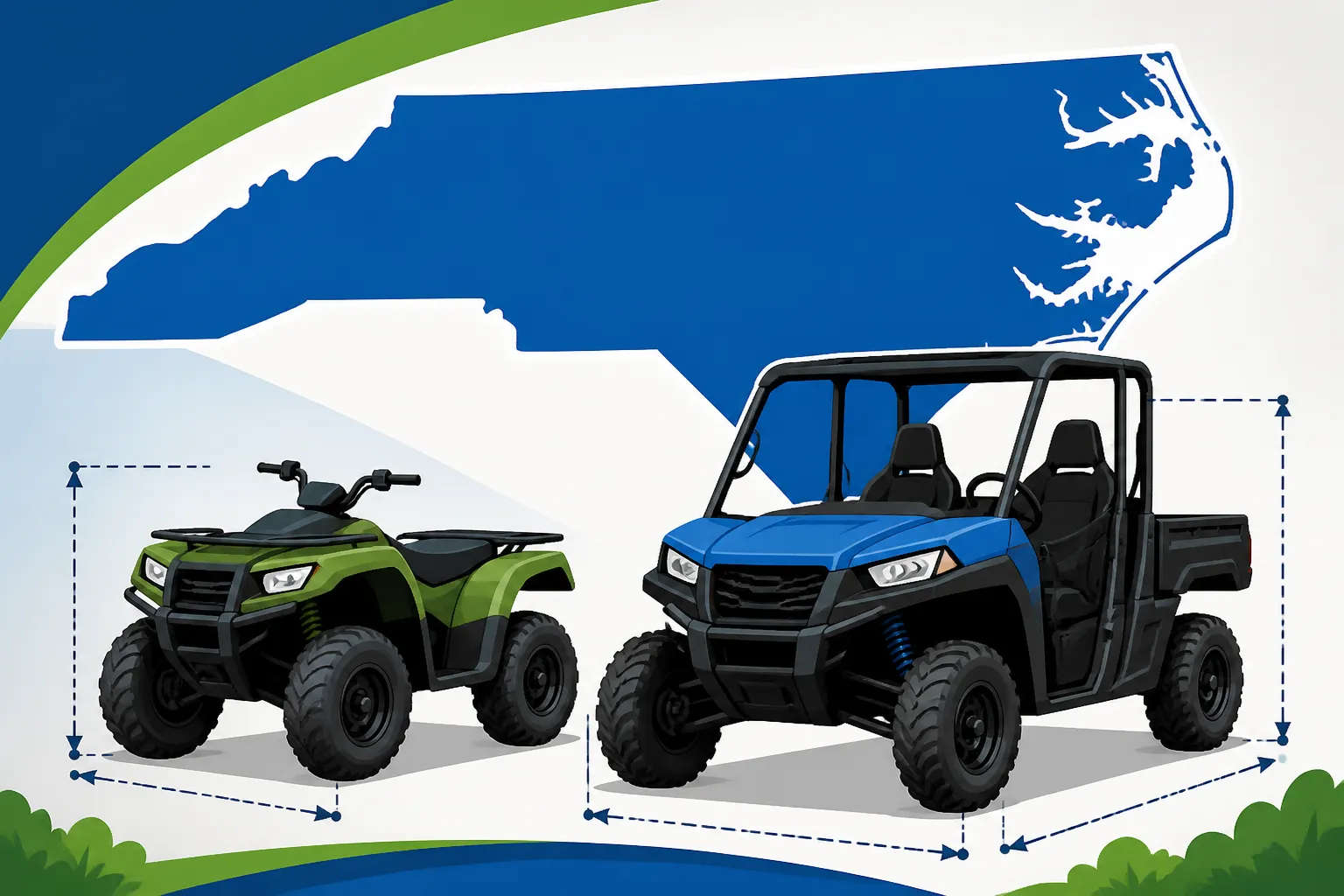
It’s not just about what makes sense to you; it’s about what the law defines. For a machine to qualify as an MUV, it must meet three primary dimension requirements: maximum length, maximum width, and maximum height. These aren't suggestions; they are hard limits your machine needs to stay within.
The 142-Inch Length Requirement
The first critical dimension for an MUV in North Carolina is its overall length. Your machine cannot exceed 142 inches from its foremost point to its rearmost point. This measurement includes bumpers, winches, or anything else permanently attached to the machine, but generally excludes removable accessories like tow hitches that are designed to be taken off when not in use.
To put 142 inches into perspective, that's just under 11 feet, 10 inches. Many standard two-seat side-by-sides hover around 110-125 inches. So, even a two-seater typically has a bit of wiggle room here, while a four-seater might push closer to the limit. The state implemented [The 142-Inch Length Requirement] to ensure that MUVs are still relatively compact and don't take up excessive road space, especially on narrower rural roads or in parking situations. It’s a balance, allowing for machines with some utility bed capacity or a second row of seating, without becoming cumbersome like a small truck. When you’re measuring, grab a good tape measure, ideally a long one, and measure from the absolute tip of the front bumper or winch fairlead to the absolute rear of the machine, including any fixed rear bumper or cargo rack. Be meticulous, because the NCDMV clerk or inspector will be.
The 58-Inch Width Requirement
This one is often the biggest hurdle for many popular side-by-sides. Your MUV must not exceed 58 inches in width. This measurement is taken from the widest part of the vehicle, typically across the tires or wheel wells, but it generally excludes side mirrors, which often extend beyond the body.
Fifty-eight inches is precisely 4 feet, 10 inches. If you've been looking at new side-by-sides, you'll know that many sport and even utility models now come standard with widths of 60 inches, 64 inches, or even 72 inches. This requirement, officially known as [The 58-Inch Width Requirement], is a major reason why [Registering a Side-by-Side in North Carolina] as an MUV is so challenging for most. It’s designed to keep these machines narrow enough to comfortably share lanes with other vehicles, reduce the risk of collisions on narrow roads, and allow for easier maneuverability. If you’ve added aftermarket wheels and tires that push your width out, you might unfortunately exceed this limit. Before you even think about the NCDMV, you need to measure your machine carefully, from the outside edge of one tire to the outside edge of the other, at the widest point, or across fender flares if they are wider. Even a slight overhang can disqualify you.
The 70-Inch Height Requirement
The final dimension you need to be mindful of is height. An MUV cannot be taller than 70 inches. This measurement is taken from the ground to the highest point of the vehicle, excluding any flexible antennas, flagpoles, or light whips that can be easily removed or bent. The roof, roll cage, or any fixed light bars would be included in this measurement.
Seventy inches translates to 5 feet, 10 inches. This [The 70-Inch Height Requirement] is crucial for several reasons, including overhead clearances for bridges, parking garages (though you likely won't be parking an MUV in one!), and ensuring the vehicle doesn't have an excessively high center of gravity that could make it unstable on public roads. Many utility-oriented side-by-sides and even some sport models can easily exceed this with their factory roll cages, especially if you have a lift kit or larger tires. Measuring height accurately can be tricky; it's best to do it on flat, level ground, with the machine at its normal operating suspension height. Don't measure with the tires deflated or suspension compressed. Again, every inch counts here, and a rigid light bar mounted on top of your roll cage could be the reason you're just over the limit.
Why These Dimensions are So Strict
It can feel arbitrary, can't it? Like the state just pulled these numbers out of a hat. But there's usually a method to the madness, even if it feels frustrating for us riders. The strictness of these MUV dimension requirements in North Carolina stems from a few key considerations that are primarily focused on safety and the seamless integration of these unique vehicles into the existing road infrastructure.
Think about it: our roads were largely designed for cars, trucks, and motorcycles. Off-road vehicles, by their very nature, are designed for different terrains and don't always conform to the same specifications. The NCDMV needs to ensure that any vehicle given a license plate can safely operate alongside traditional traffic, without creating undue hazards or congestion.
Safety on Public Roads
The most significant factor behind these dimensions is public safety. A vehicle that is too long might struggle to navigate tight turns or intersections, potentially creating blind spots or blocking traffic. One that is too wide could easily encroach on other lanes, particularly on two-lane roads, leading to head-on collision risks or forcing other drivers off the road. And a machine that is too tall, especially if combined with a narrow stance, could have a dangerously high center of gravity, making it prone to rollovers during evasive maneuvers or even just sharp turns at road speeds.
These dimension limits, combined with other [North Carolina MUV Street Legal Requirements] like mandatory seat belts, mirrors, and headlights, are all part of a comprehensive effort to minimize risks. The state isn't trying to make it impossible; they're trying to make it safe. It’s a way to ensure that if you’re driving an MUV on the street, it behaves predictably and within certain parameters that other drivers are accustomed to.
Integration with Existing Infrastructure
Beyond immediate safety, these dimensions also consider how an MUV fits into our everyday road network. Imagine a UTV that's excessively wide trying to navigate a narrow residential street or a parking lot entrance. Or one that's too tall attempting to go under a low bridge or through a drive-thru. While these might seem like minor inconveniences for the driver, they can pose significant issues for traffic flow and even infrastructure damage.
The 58-inch width limit, in particular, is a strong indicator of this. It aims to keep MUVs roughly within the width of smaller compact cars, making them less disruptive in traffic and allowing them to share lanes more effectively. For anyone considering the MUV route, the process involves more than just physical modifications; it also involves correctly filling out all the required forms. Resources like LawDepot can be a huge help here, offering templates for documents like a bill of sale if you're buying a machine that you plan to convert, or even affidavits for homebuilt machines, ensuring you have your paperwork in order before approaching the DMV. This careful consideration of dimensions ensures that MUVs don't become an obstacle or a danger to others on North Carolina's varied roadways, from the mountain passes to the coastal highways.
What if Your Machine Doesn't Meet MUV Dimensions?
This is the moment of truth for many hopeful side-by-side owners. You’ve measured, re-measured, and perhaps even tried to convince yourself that 59 inches is really close enough to 58. But the NCDMV isn't in the business of approximations. If your machine doesn't meet the specified length, width, and height requirements (along with other criteria like [North Carolina MUV Engine Size Requirement] and the 40 mph minimum speed), it simply cannot be registered as an MUV for general street use.
It’s a tough pill to swallow, especially if you’ve already invested in a wider, taller machine. But understanding this reality upfront can save you a lot of headache and potential legal trouble down the road. This doesn't mean your off-road dreams are over; it just means your machine won't be enjoying paved roads as an MUV.
No MUV Registration, No General Street Use
The most direct consequence of not meeting the MUV dimensions is straightforward: you cannot get a North Carolina license plate for your UTV or side-by-side to drive on most public roads. Period. There's no workaround for the dimensions. You can't just pay an extra fee or get a special permit. If the measurements are off, it's a non-starter for MUV status.
This means you’ll be limited to [Riding Private Ground in North Carolina] or designated off-road trail systems. Any attempt to drive a non-MUV side-by-side on a public road where MUVs are allowed will be considered operating an unregistered off-road vehicle, which carries penalties including fines and potential impoundment. It’s crucial to understand that North Carolina does not offer an "ATV registration" in the traditional sense, so the MUV path is truly unique for street use.
Exploring Other Legal Exceptions for Road Use
While the MUV path might be closed to your machine due to its dimensions, it’s important to remember that there are a couple of very specific, limited exceptions in North Carolina where off-road vehicles can legally operate on public roads or within certain public areas, regardless of MUV status. These are not general street-legal options, but they are worth knowing:
- North Carolina's Farming Operations Exception: If you're using your ATV or UTV for bona fide farming purposes, North Carolina law provides an exemption that allows you to operate it on public roads for short distances to get between fields, or to perform farm-related tasks. This isn't a free pass for joyriding; it's strictly for farm business and usually requires the driver to be a farmer or farm employee. It’s a very practical exception for our rural communities, allowing farmers to conduct their essential work efficiently.
- North Carolina's Ocean Beach Rule: Along our beautiful coastline, some municipalities designate specific areas of the beach where ATVs and UTVs are permitted to operate. These are typically very specific zones, often with speed limits and age restrictions, and are usually confined to the beach itself, not the paved access roads leading to it. It’s a highly localized rule, so always check with the specific beach town’s regulations before you ride on the sand. You'll often find that certain times of year or even specific hours are restricted.
Neither of these exceptions makes your machine generally street-legal, but they do provide narrow windows of opportunity for road or public land use without MUV registration. For anyone navigating the intricacies of buying or selling a machine that might fall into these categories, having a clear [North Carolina Bill of Sale for an ATV] is always a good idea, and again, resources like LawDepot can assist with generating the right forms to protect both buyer and seller.
Steps to Verify Your Machine's Dimensions and What to Do Next
Alright, so you're ready to get down to business and see if your side-by-side measures up. This isn't a time for guesstimates; it's time for precise measurements and honest evaluation.
Accurate Measurement Techniques
Getting accurate measurements is paramount. Here's a quick guide to help you:
- Use a reliable tape measure: A long, retractable tape measure (like a construction tape) is best. Fabric tape measures can stretch and give inaccurate readings.
- Park on level ground: Ensure your machine is on a perfectly flat surface, like a garage floor or concrete pad. Any incline can skew your height measurement.
- Check tire pressure: Make sure your tires are inflated to their recommended pressure. Under-inflated tires can slightly reduce height and affect width.
- Measure length: From the absolute furthest point forward (e.g., front bumper, winch fairlead) to the absolute furthest point back (e.g., rear bumper, cargo rack). If you have a tow hitch, assume it needs to be removed for the measurement unless it's a fixed part of the frame.
- Measure width: From the widest point of the machine, typically the outside edge of the tires or fender flares. Do not include side mirrors in this measurement, as they are usually designed to extend beyond the vehicle's body.
- Measure height: From the ground to the highest fixed point on your machine, which is typically the top of your roll cage or roof. Exclude flexible antennas or flags. If you have a lift kit, account for that height increase.
- Take photos: It can be helpful to take photos of your measurements with the tape measure visible, especially if you anticipate any questions or want to be absolutely sure for your own records.
Modifying Your Machine to Meet Requirements (If Possible)
If your machine is just barely over one of the limits, you might be able to make some modifications.
- For width: This is the toughest one. If you're over, it's usually due to aftermarket wheels, tires, or fender flares. You might need to revert to narrower wheels and tires, or even consider stock fender flares if yours are excessively wide. Be aware that significant changes to tire width can affect handling and stability. It is extremely difficult to narrow the actual frame of a side-by-side.
- For length: If you’re over, it might be due to a particularly aggressive bumper or a very long cargo rack. Sometimes, a different bumper design or a more compact rack could bring you under the 142-inch limit.
- For height: This could involve removing a light bar mounted on top of the roll cage, or even considering a lower-profile roof. If you have a lift kit, you might have to consider removing it or reducing its height. Remember, [The 70-Inch Height Requirement] is non-negotiable.
Before making any modifications, weigh the cost and effort against the benefit. If you have a highly customized, wide-stance sport UTV, converting it to an MUV might be so extensive and costly that it strips the machine of its intended purpose.
What to Do If MUV Status Isn't an Option
If after all your measuring and consideration, MUV status just isn't in the cards for your machine, don't despair! North Carolina still has plenty of fantastic places to ride.
- Designated OHV Trails: We have incredible public trail systems like Brown Mountain, Badin Lake (Uwharrie National Forest), and Wayehutta. These are built for off-road machines, and you'll often find a thriving community of riders there. Check out [Where to Ride an ATV in North Carolina] for more ideas.
- Private Off-Road Parks: Many private parks across the state offer diverse terrain, from mud bogs to rock crawling, specifically designed for ATVs and UTVs. These are often great places to push your machine's limits safely and legally.
- Farm Use & Beach Access: As mentioned, if you fit into the specific criteria for farm operations or designated beach access, you can still use your machine in those very limited contexts. Just be absolutely sure you understand the local rules and have any necessary permits.
Ultimately, the goal is to enjoy your machine safely and legally. While the MUV dimension requirements can be a challenge, understanding them is the first step towards navigating North Carolina's unique ATV and UTV laws.
Disclaimer
This article is for general informational purposes only and does not constitute professional advice. Laws, prices and regulations vary by location and change over time. Consult a qualified professional for guidance on your specific situation.