Titling Before a Trip to Badin Lake
There's nothing quite like planning a weekend escape to the Uwharrie National Forest, especially when you're dreaming of hitting the trails at Badin Lake. You've got your gear ready, your machine tuned up, and maybe even your camping spot booked. But then a little voice in the back of your head pipes up: "Wait, do I need to title my ATV or UTV before I go?" It's a common question, and one that can feel surprisingly confusing in North Carolina, where the rules for off-road vehicles aren't always as straightforward as they are for cars. This guide is here to clear up that confusion, explaining why titling your machine, even if not strictly mandated for riding, is a smart move that can save you a lot of headaches, especially when you're gearing up for adventures like those at Badin Lake.
Understanding North Carolina's Approach to ATVs and Titles
North Carolina has a unique way of handling all-terrain vehicles and utility vehicles, which often catches riders by surprise. Unlike street-legal vehicles that require both registration and a title, off-road machines operate under a different set of guidelines. However, that doesn't mean a title is irrelevant; quite the opposite, in fact.
Why North Carolina Doesn't Register ATVs
One of the biggest sources of confusion for ATV and UTV owners in North Carolina is the lack of traditional registration. If you're coming from a state where you're used to getting a registration card and a sticker for your machine, North Carolina's system can feel a bit odd. The reality is, the state simply doesn't require ATVs or UTVs to be registered in the same way your car or truck is. This often leads people to believe that if there's no registration, there's no need for any official paperwork at all.
However, just because there's no registration doesn't mean there are no official documents. Instead of a registration, North Carolina uses an affidavit process, specifically for the purpose of collecting the Highway Use Tax when you apply for a title. This affidavit, often form MVR-60, serves as a declaration that your vehicle is indeed an off-road machine and not intended for highway use, thus distinguishing it from a street-legal vehicle that would be subject to different taxes and regulations. The affidavit confirms that your machine primarily operates off-road. You might wonder, [Why North Carolina Has No ATV Registration]? It largely comes down to the state's classification of these vehicles as recreational rather than road-going, and focusing efforts on vehicle identification and ownership proof instead of ongoing registration. It’s a distinct approach that emphasizes titling over yearly tags. For many, [Why You File an Affidavit and Not a Registration] becomes clear once they understand that it's tied directly to proving ownership and paying taxes, not to gaining road-legal privileges.
The Importance of an ATV Title in North Carolina
Given the absence of registration, you might be tempted to skip the title entirely. After all, if the state doesn't force you to get one to ride on trails, why bother? But trust me, a North Carolina ATV title is far more valuable than you might initially think, even if it's technically optional for operating the machine itself. Think of it this way: a title is the definitive proof of ownership. Without it, your machine's legal status is murky, making almost any future transaction or unfortunate event a major headache.
Consider a scenario where your beloved side-by-side is stolen from your property in Statesville. If you don't have a title, how do you definitively prove to law enforcement or your insurance company that the machine is yours? A bill of sale might help, but it's not the same ironclad proof as a state-issued title. A title establishes a clear chain of ownership, which is absolutely critical for recovery and insurance claims. This is [Why a North Carolina Title Is Worth Having]. It essentially legalizes your claim to the vehicle. Moreover, if you ever plan to sell your ATV or UTV, a title makes the process smooth and legitimate for the buyer. Most savvy buyers, especially those looking for a clean, hassle-free purchase, will insist on a title. It provides them with confidence in their investment and assurance that the machine isn't stolen or encumbered by an undisclosed lien. Companies like LawDepot can provide bill of sale templates that, while useful, don't replace the official title in proving ultimate ownership. A strong, official title ensures that [How a Title Proves You Own the Quad] beyond any doubt.
Why Titling Matters Specifically for a Badin Lake Trip
While the Uwharrie National Forest, home to the popular Badin Lake OHV Trail Complex, is a fantastic place to ride, having your machine properly titled can be a silent guardian, providing peace of mind and protection you might not even realize you need until a situation arises.
Proving Ownership at the Trailhead or in an Emergency
When you head out to Badin Lake, your main focus is probably on hitting those exciting trails, not on showing paperwork. And generally, you're right. The U.S. Forest Service doesn't typically check your ATV's title at the gate when you're buying your day permit to ride trails like those at Badin Lake. They're more concerned with your OHV safety certificate and forest permit. However, don't let this routine lull you into a false sense of security. The benefits of a title extend far beyond a gate check.
Imagine you're deep on the trails, maybe out on Rocky Mountain Loop or Falls Dam Trail, and you have an accident. Perhaps your machine breaks down, or worse, it's involved in a serious incident. If emergency services or law enforcement need to get involved, or if your machine needs to be towed out, proving immediate ownership can simplify things immensely. If your machine is lost or stolen while at or on the way to Badin Lake, a title becomes your primary piece of evidence. This is [Why a Title Matters After Your Quad Is Stolen]. Without it, you could face significant delays and complications trying to reclaim your property or get an insurance payout. Even if you only carry a copy of your title on a trip, knowing the original exists and is easily accessible back home provides crucial backup. The sheer peace of mind that comes with knowing you have undisputed ownership, even when no one is asking to see it, is invaluable for any off-road enthusiast.
The Transactional Side: Buying, Selling, and Financing
Your Badin Lake trip might be purely for recreation, but what if your interests shift, or you decide it's time for an upgrade down the line? Having a title in hand makes future transactions incredibly smooth. Let's say you fall in love with a bigger UTV while at the trails and decide to sell your current quad after your trip. Trying to [Selling an ATV in North Carolina] without a title can be a major hurdle. Many private buyers will walk away, fearing they are buying a stolen machine or one with hidden financial baggage. Even if you find a buyer willing to take it without a title, you'll likely get a significantly lower price.
Furthermore, if you ever need to finance an ATV or UTV purchase, nearly every lender will require a title. Banks and credit unions need a way to secure their loan against the asset, and a title is the legal document that allows them to do so by placing a lien on it. This is precisely [Why a Lender Insists on a Titled Machine]. Without a title, securing a loan for your off-road machine is virtually impossible. This means if you're planning to upgrade your ride, or even use your current machine as a trade-in at a dealer, a clear title is your golden ticket. You can easily find generic bill of sale forms on sites like LawDepot, which are useful for documenting a transaction, but the official title from the DMV is what truly secures the transfer of legal ownership and allows for lien placement or removal.
The Practical Steps to Title Your ATV for North Carolina Adventures
So, you're convinced that titling your ATV or UTV is the smart move, especially before your next trip to the [Badin Lake OHV Trail Complex]. Now, let's walk through the practical steps to make it happen at the North Carolina Department of Motor Vehicles (NCDMV). It's not as complex as it might seem, but it does require attention to detail.
Gathering Your Paperwork and Navigating the DMV
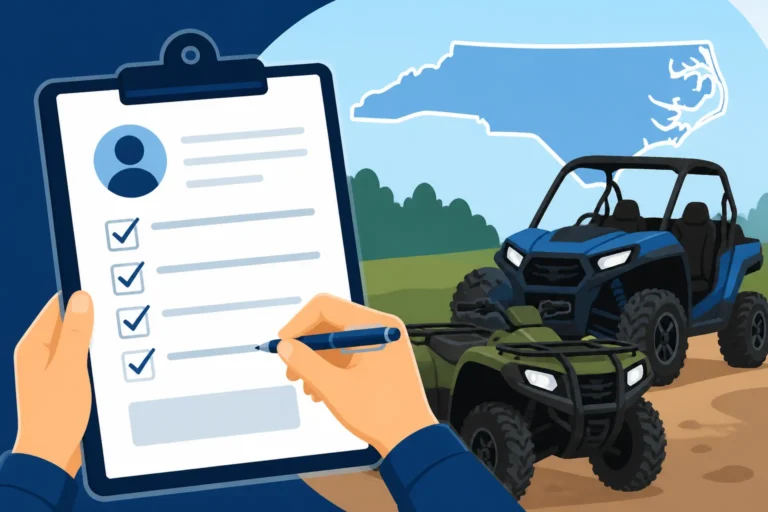
The process of titling an ATV in North Carolina involves submitting specific forms and documentation to the NCDMV. The main form you'll need is the MVR-1, which is the official North Carolina Title Application. This form requires basic information about you (the owner) and your machine, including its VIN, make, model, and year. Be sure to fill it out completely and accurately. Any omissions or errors can cause delays.
Alongside the MVR-1, you'll almost certainly need to complete and submit the North Carolina All-Terrain Vehicle Affidavit, also known as Form MVR-60. This is the document that affirms your machine is an ATV or UTV primarily used off-road, and it's crucial for avoiding certain highway-related taxes that wouldn't apply to your recreational vehicle. [North Carolina Form MVR-60 Explained] in detail covers why this form is so important. When you're working through [Filling Out the Affidavit Form], double-check all the details to ensure they match your machine's specifications. If you're buying a used machine, you'll also need the MVR-1A, the Damage Disclosure Statement. This form details any significant damage the vehicle has sustained, protecting both buyer and seller. All of this falls under the umbrella of [North Carolina ATV Title Paperwork]. While you can get these forms from the NCDMV directly, understanding what each section means is key to a smooth process. Sometimes, it's useful to look at resources from sites like LawDepot to get a general understanding of legal document structure, even though these specific forms come from the state.
Understanding Costs: Fees and the Highway Use Tax
Titling your ATV or UTV in North Carolina isn't free, but the costs are generally quite reasonable and transparent. There are two primary costs you'll encounter: the actual title fee and the North Carolina Highway Use Tax. The title fee itself is a modest administrative charge for processing your application and issuing the title document. This amount can be found on the NCDMV's website or by inquiring at a local tag office. This is part of [What a North Carolina ATV Title Costs].
The second, and often larger, component of the cost is the North Carolina Highway Use Tax. Despite its name, which often confuses people because ATVs aren't typically used on highways, this tax applies to the sale of most vehicles, including ATVs and UTVs, when a title is issued. The tax is typically 3% of the purchase price or the fair market value of the machine, whichever is greater. For example, if you bought your machine for $10,000, you'd pay $300 in Highway Use Tax. This tax is a one-time payment made at the time of titling. It's an important part of [North Carolina's 3 Percent Highway Use Tax] calculation and understanding [North Carolina ATV Highway Use Tax] ensures you're prepared for the expense. Make sure you have proof of purchase (like a bill of sale) to establish the value, or be ready for the DMV to assess it.
What if You Bought Your Machine Without Papers?
It's a common scenario, especially in the used ATV market: you find a great deal on a machine, but the seller doesn't have a title. Perhaps it was lost, never issued, or the machine has changed hands multiple times without proper documentation. While it adds a layer of complexity, it's often still possible to title such a machine in North Carolina. Don't despair, but be prepared for a bit more legwork.
If you are [Buying a Quad Advertised With No Paperwork], the first crucial step is to obtain a strong bill of sale that clearly identifies the seller, buyer, purchase price, and the machine's Vehicle Identification Number (VIN). Even if it's a simple, handwritten document, it's better than nothing. Many riders find LawDepot helpful for creating a legally sound bill of sale. Without a prior title, the NCDMV will need to verify the VIN. This often involves a law enforcement officer or an authorized DMV agent physically inspecting the machine and verifying that the VIN on the machine matches your paperwork and isn't reported as stolen. This process is essential for [Getting a VIN Assigned by the DMV] if, in rare cases, a new VIN needs to be issued, or more commonly, to validate an existing VIN. Be prepared to provide an MVR-60 affidavit stating the vehicle's off-road use, and possibly other documentation demonstrating how you came into possession of the vehicle. It might take a little longer, but with persistence, you can get that title.
Beyond the Title: Preparing for Your Badin Lake Ride
While getting your ATV or UTV titled is a critical step for ownership and peace of mind, it's just one piece of the puzzle for a fantastic and responsible off-road adventure, especially at a popular destination like Badin Lake.
Permits, Safety, and Regulations at Badin Lake
Once your machine is properly titled, your next focus for a Badin Lake trip should be on the specific requirements for riding in the Uwharrie National Forest. Unlike titling, these requirements are mandatory for accessing the trails. First and foremost, you'll need an OHV (Off-Highway Vehicle) permit from the U.S. Forest Service. These can be day permits or season permits, depending on your riding frequency. You can often purchase these at local vendors near the trailheads or at the Uwharrie District Office. Information on [Badin Lake OHV Permit Cost] is usually available from these vendors.
Beyond permits, North Carolina has specific safety regulations for riders, particularly for those born on or after January 1, 1990. If you fall into this age group, you are required to hold an approved OHV safety certificate to operate an ATV or UTV on public lands, including the Badin Lake trails. This [North Carolina ATV Safety Certificate Requirements] ensures that riders have a basic understanding of safe operation and trail etiquette. Make sure to carry your permit and safety certificate with you when you ride, as forest rangers do conduct checks. Also, remember that [Badin Lake's April to December Season] means planning your trips around the trail system's operational dates.
Essential Pre-Trip Checks and Trail Etiquette
With your title secured and permits in hand, the last but equally important step is to ensure your machine and your riding habits are ready for the trails. Before you even load up for Badin Lake, give your ATV or UTV a thorough once-over. Check tire pressure, fluid levels, brakes, and lights. Make sure your spark arrester is in good working order, as this is a federal requirement on forest lands. Carry a basic toolkit, a first-aid kit, and enough water and snacks for your ride.
Always check [North Carolina Trail Conditions Before You Ride] by visiting the U.S. Forest Service website or calling the Uwharrie District Office. Trails can close due to weather, maintenance, or other issues. Once on the trails, practice good [North Carolina Trail Etiquette on Narrow Trails]. Ride responsibly, stay on marked trails, yield to uphill traffic, and be respectful of other riders and the environment. Pack out everything you pack in, and leave no trace. Riding an ATV or UTV is an incredible way to experience North Carolina's natural beauty, and a little preparation, including securing your title, goes a long way in making every trip safe and enjoyable.
North Carolina ATV Titling vs. Public Land Riding Requirements
Here's a quick look at the distinctions between owning your ATV/UTV legally and riding it on public trails in North Carolina.
| Feature | ATV Titling (NCDMV) | Public Land Riding (e.g., Badin Lake) |
|---|---|---|
| Purpose | Proves ownership, facilitates sales/financing, legal protection | Grants access to designated OHV trails, ensures safe operation |
| Mandatory? | Optional for riding, but highly recommended for ownership | Yes, for accessing trails on public lands |
| Primary Document(s) | NC Title (Form MVR-1), All-Terrain Vehicle Affidavit (MVR-60) | OHV Permit (e.g., Uwharrie National Forest Day/Season Pass), OHV Safety Certificate (for eligible riders) |
| Cost | Title Fee + 3% Highway Use Tax | Permit Fee (varies), Safety Course Fee (if applicable) |
| Who Enforces? | NCDMV, Law Enforcement | US Forest Service, Law Enforcement |
| Key Benefit | Clear ownership, easier resale, insurance claims, financing | Legal trail access, promotes responsible riding, safety |
Disclaimer
This article is for general informational purposes only and does not constitute professional advice. Laws, prices and regulations vary by location and change over time. Consult a qualified professional for guidance on your specific situation.