Which Adult Signs a Waiver in North Carolina
If an ATV or UTV rental involves a child, it may not be obvious which adult should sign the waiver—or whether one adult can sign for the whole group. The answer depends on the rental company’s paperwork and who is riding, driving, and paying. Here’s how to sort out the roles, what to ask before signing, and why a waiver is not the same as a trail permit.
The adult who signs should match the role in the agreement
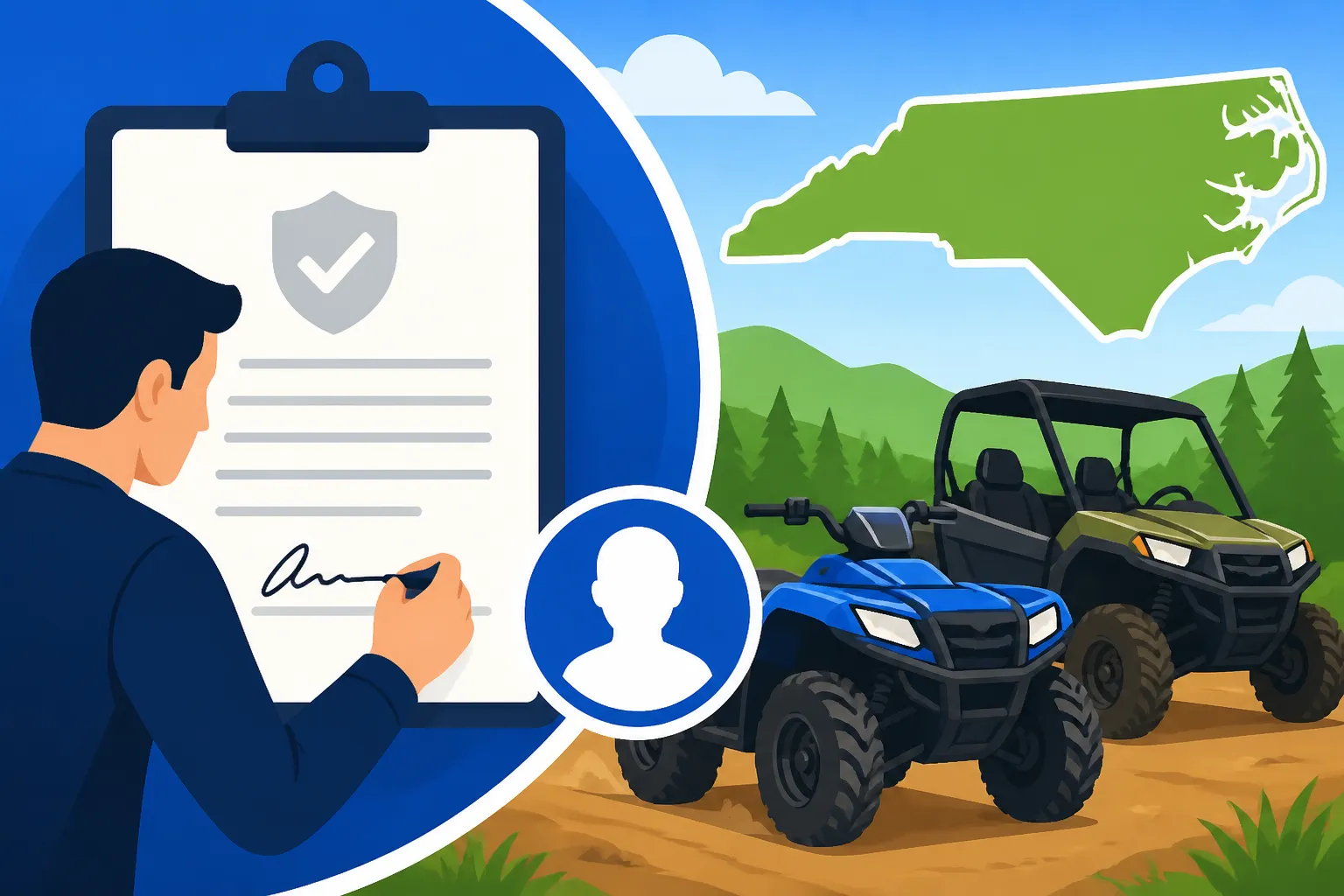
For an adult renting and riding, the simplest situation is usually that the adult renter signs their own agreement. If a minor will ride, the rental company may require a parent or legal guardian to sign paperwork for that child. But requirements vary by provider, and a signature does not automatically settle every question about responsibility or enforceability.
Start by identifying what the form asks the adult to do. The signer might be agreeing to rental terms, acknowledging risks, accepting responsibility for charges, giving permission for a minor to participate, or releasing certain claims. Those are related but different commitments. A form may combine them, so read the full document rather than relying on its title.
A parent or guardian should not assume that signing one form covers every person in a group. The agreement might require a separate signature from each adult participant, a separate consent for each minor, or paperwork completed by the person named on the reservation. Ask the company how it handles each rider and each machine.
| Person involved | Who may need to sign | What to confirm |
|---|---|---|
| Adult renter and rider | The adult named in the rental agreement | Whether the signer must be the driver, renter, or both |
| Adult passenger | The passenger, if the provider requires a separate acknowledgment | Whether passengers sign their own forms |
| Minor rider | A parent or legal guardian may be required | Whether the adult must be present and what proof is needed |
| Minor with an adult who is not a parent | Do not assume the accompanying adult can sign | Ask the provider what authorization it accepts |
| Group organizer | The organizer may sign for booking or payment, but not necessarily for everyone’s participation | Which participants must sign individually |
The most important practical rule is to ask the rental provider who it accepts as the signer before the ride date. Do not rely on a friend, relative, or group leader’s assumption that they can sign for someone else. A provider may require a parent or legal guardian for a minor, and it may decline to rent if the required adult is absent or the paperwork is incomplete.
For a minor, distinguish between accompanying adult and legal guardian. An aunt, uncle, grandparent, coach, or family friend may be supervising the child, but that does not mean the company will accept that person’s signature. If someone other than a parent or guardian is bringing the child, contact the provider in advance and ask exactly what authorization it requires. See Renting for a Child in North Carolina and North Carolina Rental Age and License Rules for related planning questions.
Signing for a child is not the same as signing for every risk or charge
A waiver can contain more than one promise. One section might acknowledge that off-road riding involves risks. Another might set out rules for the machine. A different section may make the renter responsible for damage, late return, cleaning, recovery, or other charges under the contract. Read each section as its own commitment.
If an adult signs a form that names a minor, check whether the signature is described as permission for the child to participate, acknowledgment of risks, acceptance of rental conditions, or something else. Do not infer the meaning from a brief heading. If the form is unclear, ask the provider to explain it in plain language before signing and request a copy of the completed agreement.
A signature on behalf of a child also should not be treated as permission to ignore the rental company’s age, supervision, or machine-use rules. Those rules may depend on who is driving, who is riding as a passenger, the machine’s seating, and the provider’s own operating requirements. Check the details for each participant rather than assuming that an adult’s signature makes any arrangement acceptable. North Carolina Rules for a Rented Machine and North Carolina Rules for Riders Under 16 offer further context.
If the accompanying adult is not the parent or guardian
An adult who is not the child’s parent or legal guardian should avoid signing a guardian section unless the company has confirmed that the adult is authorized to do so. Being the person who booked the ride, paid a deposit, or drove the group to the rental counter does not necessarily make someone an acceptable signer for a minor.
Before the trip, ask the rental company:
- Does a parent or legal guardian have to sign for each minor?
- Does that adult have to be physically present at pickup?
- Can the provider accept written authorization from a parent or guardian who will not attend?
- Does it require a particular form of authorization or identification?
- Must the minor sign or acknowledge any part of the agreement as well?
- Are there age or passenger restrictions that apply even if the guardian signs?
Get the answer from the provider that will supply the machine, not from another company’s policy or a general online discussion. If the provider does not accept the proposed arrangement, change the plan before traveling rather than hoping the issue can be solved at the counter.
If the group has multiple adults or machines
Each adult should check whether they are being listed as a renter, driver, passenger, payment contact, or responsible party. These roles can overlap, but they are not automatically identical. One person may reserve a machine while another is expected to drive it. The paperwork should reflect what the rental company permits.
If one adult is booking for several people, ask whether each driver must complete a separate agreement and whether passengers sign separate acknowledgments. For multiple machines, confirm whether each machine needs its own renter or authorized driver. Avoid signing a form that names only one person if the company expects all participants to be identified.
A booking contact may also be asked to accept responsibility for costs associated with the reservation. Before agreeing, determine whether that commitment applies only to that person’s machine or to more than one machine. For questions about passenger arrangements, see Does a Rental Cover a Second Rider?.
Check the waiver alongside the rental contract and the ride plan
A waiver is only one part of a rental arrangement. The company may also have a rental contract, safety briefing, equipment rules, and separate requirements for where the machine can be operated. Signing the waiver does not automatically make a road or trail open to riding, nor does it mean a rental includes a forest permit.
Before pickup, read the waiver and rental terms together. Confirm which machine is assigned to whom, who is authorized to drive, what passengers are allowed, what equipment is supplied, and what happens if the machine is damaged or the ride is interrupted. For a closer look at rental paperwork, see North Carolina Rental Insurance and Waivers and Reading a North Carolina Rental Contract Before You Sign.
Keep these distinctions clear:
- Waiver or risk acknowledgment: Describes risks and may include a release of certain claims. Its meaning depends on the actual wording and applicable law.
- Rental contract: Sets out the agreement to use the machine and may address care, return time, damage, and charges.
- Parent or guardian consent: May document permission for a minor to participate, if the provider accepts that adult’s signature.
- Trail or land-use permit: Authorizes use under the applicable land manager’s rules. A rental company’s waiver is not a substitute.
- Safety certificate or age requirement: May apply separately to riding in a particular setting. A waiver does not replace a required certificate or make a rider eligible.
If the machine is going onto a national forest trail, ask who obtains the required permit and whether the rental price includes it. Do not assume that the rental company’s agreement grants access to public land. Do You Need a Permit for North Carolina Forest Trails? explains why checking the land-specific permit rules is a separate step.
Questions to resolve before you sign
If a clause is broad, unclear, or inconsistent with what the salesperson told you, pause and ask for clarification. A useful question is: “Does this section apply to every rider, or only to the person named as renter?” You can also ask whether a parent is signing only to provide permission or is accepting additional obligations under the contract.
Check the agreement for the following details:
- The full names of the renter, driver, passenger, and any minor participant.
- Which machine the agreement covers.
- Whether each adult participant must sign separately.
- Whether an adult signing for a child must be a parent or legal guardian.
- Whether the signer is also accepting payment responsibility for damage or other charges.
- Whether the contract describes permitted routes, operating hours, or return procedures.
- How to report a mechanical problem, injury, or damage during the rental.
- Whether the company provides a copy of every signed page.
Do not sign a form with blank sections that could change who is covered or what machine is involved. Ask the provider to complete the relevant fields first. Keep a copy or clear record of the final paperwork, and make sure the adult responsible for the minor understands the rules and emergency instructions.
If you are not comfortable with a provision, ask whether the company can explain or clarify it in writing. A rental employee can explain the provider’s process, but may not be able to give legal advice about how a waiver would apply in a dispute. For advice about a particular legal concern, consult a qualified attorney.
A practical sequence for families and groups
The easiest way to avoid a pickup-counter problem is to settle the signature question while booking, especially when minors are involved. Follow this sequence:
- List every participant. Identify who will drive, who will ride as a passenger, and which participants are minors.
- Identify the renter for each machine. Ask whether the renter must also be the driver, and whether additional drivers need separate approval.
- Confirm who can sign for each minor. If the parent or guardian will not attend, ask the provider what it accepts before making the trip.
- Check age and supervision rules. Make sure the planned driver and passenger arrangements meet both the rental company’s rules and any applicable riding requirements.
- Ask what is included. Confirm equipment, permits, and any required safety documentation separately rather than assuming the waiver covers them.
- Read the completed forms. Check names, machine assignments, payment responsibility, and any clauses about damage or return conditions.
- Keep copies and follow the briefing. Make sure each participant knows the operating restrictions and how to contact the provider if something goes wrong.
This process is especially useful when a grandparent, coach, or family friend is bringing a child, or when a group organizer has made reservations for several households. The adult who handles the booking may not be the adult the rental company requires to sign for the minor. Clarifying that distinction early can prevent a child from being unable to ride after the group arrives.
Finally, do not treat a signed waiver as a substitute for the rules that apply on the route itself. North Carolina riding requirements, rental policies, and land-manager permit conditions are separate questions. Review North Carolina ATV Safety Certificate Requirements if rider certification may apply, and confirm the trail or property rules before setting out. A well-organized rental starts with accurate names and signatures, but it also depends on choosing a ride that every participant is allowed and prepared to take.
Disclaimer
This article is for general informational purposes only and does not constitute professional advice. Laws, prices and regulations vary by location and change over time. Consult a qualified professional for guidance on your specific situation.