When a Warden Asks What Year You Were Born
A warden or forest officer may ask your birth year because North Carolina ties an ATV safety-certificate requirement to the date you were born. The key cutoff is January 1, 1990—not your current age. Knowing how that rule works, what proof to carry and how it differs from a trail permit can make a roadside check much simpler.
Why an officer asks your birth year
For North Carolina’s ATV safety-certificate rule, the important question is whether you were born on or after January 1, 1990. Riders born before that date are generally outside this birth-year requirement. Riders born on that date or later must have completed an ATV safety course that qualifies under North Carolina’s rules.
That makes the question more useful than asking how old you are. Someone born in December 1989 and someone born in January 1990 may be close in age, but they fall on opposite sides of the cutoff. The rule does not move as a person gets older: if your birth date puts you within the covered group, turning 18, 30 or 60 does not change the date you were born.
The distinction is easy to miss because riders often hear that the requirement is for “young riders.” That can sound as if it ends when someone becomes an adult. Instead, the rule is based on birth date. The practical details are covered in North Carolina Safety Certificate Birth Year Rule and January 1990 and the North Carolina Line.
An officer may ask your birth year as a quick way to determine whether you fall within the group that needs a certificate. If you were born before the cutoff, you can answer that clearly. If you were born on or after it, be ready to show proof that you completed an accepted course.
The certificate requirement is only one part of a ride. It does not replace age-related supervision rules, protective equipment requirements, permission to use the land, or any permit required at a riding area. A safety card is not a general pass to ride wherever you choose.
What the January 1, 1990 cutoff means in practice
Use your full date of birth to check which side of the cutoff you fall on:
| Birth date | What the cutoff generally means |
|---|---|
| Before January 1, 1990 | The birth-year certificate requirement generally does not apply |
| January 1, 1990 | The certificate requirement applies |
| After January 1, 1990 | The certificate requirement applies |
If you were born in 1990 or later, confirm that the course you took qualifies. Completing a class, watching safety videos or receiving a certificate from an organization does not automatically prove that the course meets North Carolina’s requirements. The course must be one accepted for the state’s rule. Check Which Safety Courses North Carolina Accepts if you are unsure about a card issued elsewhere or by a particular provider.
If you have not taken an accepted course, arrange to complete one before relying on an informal class or an old training record. What an ATV Safety Institute Course Covers explains the kind of instruction a rider may encounter, but check the course provider and the relevant state requirements before enrolling. Course availability and accepted programs can change, so confirm that the specific course will provide the proof you need.
The birth-year rule concerns ATVs. Do not assume that every machine with four wheels is treated as an ATV for every law or trail requirement. A side-by-side or utility task vehicle may be classified differently from a straddle-seat quad, and its rules can depend on the machine and where it is being operated. If you ride a UTV, check the rules for that vehicle rather than assuming that the ATV certificate rule answers every question. North Carolina Rules for a Visiting Rider can help with the separate question of what applies when you come from another state.
A safety certificate also does not establish that you own the machine, that it is allowed on a particular trail, or that the rider is properly supervised. Those are separate issues. Think of the certificate as evidence of course completion, not as vehicle registration or a trail-access document.
What to carry and how to handle a check
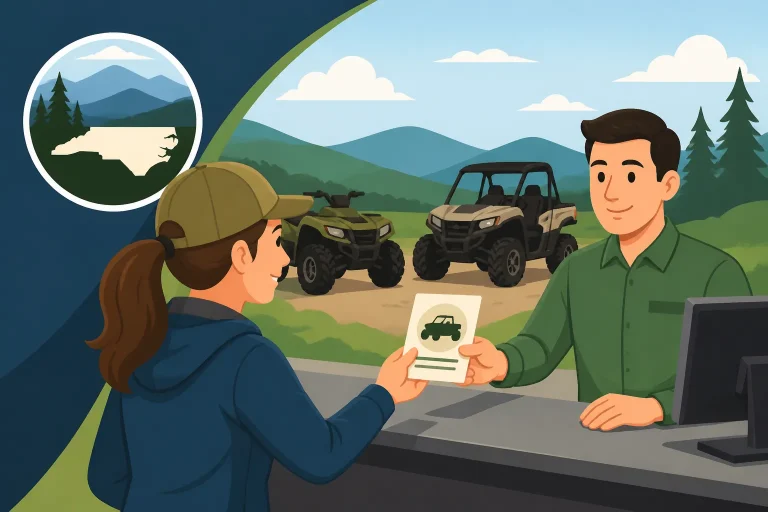
If you fall on or after the cutoff, carry your safety-certificate proof whenever you ride. A roadside check is easier when you can produce the card or other documentation promptly rather than trying to locate it later. Keep it protected from water and damage, and make sure the name and identifying details are readable.
A photo or digital copy may be convenient, but do not assume it will be accepted in place of the required proof. Confirm acceptable formats with the relevant authority or riding area before you depend on a phone. Batteries fail, screens break and service may be unavailable in remote areas. A physical card is a sensible backup if you have one. For more on keeping documentation ready, see Carrying the Certificate on a North Carolina Ride.
If an officer asks your birth year:
- Answer accurately. The cutoff is fixed, so guessing or rounding your age does not help.
- If you were born before January 1, 1990, say so plainly. The officer may still ask other questions about the ride or the machine.
- If you were born on or after January 1, 1990, show your certificate or accepted proof of completion.
- If you cannot produce it, stay calm and explain the situation. Do not claim that a different document is the certificate unless it actually proves course completion.
- If you receive a citation or are told that your proof is insufficient, keep the paperwork and ask what process applies to challenge or resolve the issue. Do not argue about the rule on the trail.
A certificate that is damaged, lost or hard to read can turn a simple check into a longer conversation. Contact the course provider about replacement proof and ask what identification or course details it needs to locate your record. If you completed a course outside North Carolina, gather the course name, completion date and issuing organization; those details can help determine whether the training is accepted.
Do not confuse the certificate with a driver’s license. The certificate shows course completion. It is not a motor vehicle license, a registration document or permission to operate on public roads. Separate age, road-use and equipment rules may apply depending on the machine and location.
The certificate is not a forest permit
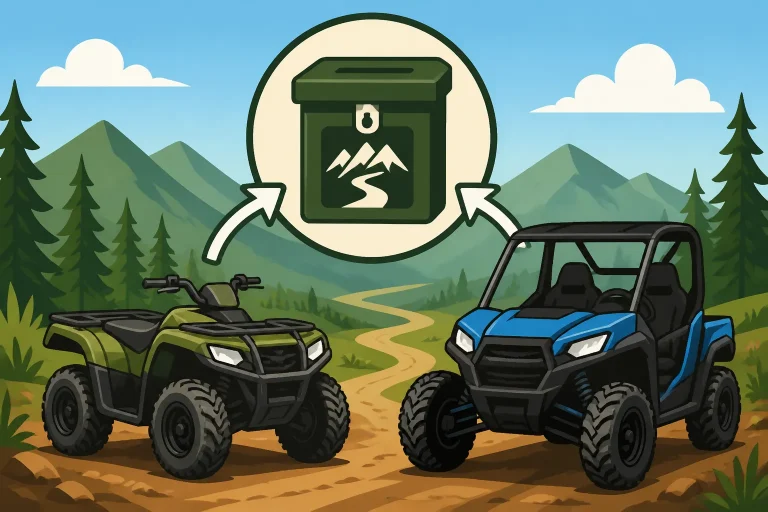
North Carolina’s forest riding requirements can involve more than one document. Some riding areas require an OHV permit for the machine, while the safety certificate rule applies to the rider covered by the birth-year cutoff. One does not replace the other.
For example, a rider could have completed an accepted safety course but still need the required permit for a particular trail system. Conversely, a permit attached to the machine does not prove that a rider born on or after January 1, 1990 completed the course. Check the permit and access rules for the specific destination before loading. Do You Need a Permit for North Carolina Forest Trails? explains why a separate permit may be part of the trip.
Permits may be required per vehicle, while a safety certificate relates to an individual rider. If several people are sharing machines or taking turns, check both sides of the requirement: whether each machine has the right permit and whether each covered rider has the required course proof. A group should not assume one person’s card covers everyone.
The same separation matters for visitors. Having an ATV registration, training card or permit from another state does not automatically settle what North Carolina requires. Check whether the particular training course is accepted and whether the destination requires a local permit. Does North Carolina Accept an Out-of-State Certificate? addresses the course question; Does North Carolina Honor Out-of-State Registration? concerns a separate document and should not be treated as an answer about safety training.
Before you leave, verify the current rules with the authority responsible for the trail or land you plan to use. Bring the certificate if your birth date puts you within the covered group, and confirm that every required machine permit is handled separately. That simple check prevents the most common misunderstanding: treating a rider’s safety card and a vehicle’s trail permit as if they were the same thing.
Disclaimer
This article is for general informational purposes only and does not constitute professional advice. Laws, prices and regulations vary by location and change over time. Consult a qualified professional for guidance on your specific situation.