Private Property Riding in North Carolina
Riding an ATV or UTV on private land in North Carolina can avoid some of the access rules that apply on public trails, but it does not mean every route or ride is automatically allowed. The key questions are who controls the land, what permission covers, and whether your route crosses a road or regulated area. Here’s how to sort those issues out before unloading.
What counts as riding on private property
Private-property riding means operating on land that is privately owned or controlled, with permission from the person who has the right to allow access. It could be your own acreage, a neighbor’s field, leased farmland, or a privately operated off-road park. Those settings may all be privately owned, but the access terms and rules can differ.
The first distinction to make is between permission to ride on the land and permission to use a road or public trail. A landowner can authorize you to ride on the land they control. That does not authorize you to ride along a public street, a public forest road, a utility corridor, or a trail that belongs to someone else.
North Carolina’s forest OHV permit system is tied to designated public riding areas, not simply to the fact that a machine is an ATV or UTV. A private field does not become a permitted public trail, and a forest permit does not give you access to neighboring private land. For the public-land side of the distinction, see North Carolina Forest OHV Permits.
A privately operated riding park is another case. The land may be privately owned, but the operator can require admission, a waiver, a machine-specific permit, safety gear, or compliance with posted routes. Those are site rules, not blanket permission to ride anywhere that looks accessible. Ask the operator what the admission or riding authorization covers, including whether it applies to every rider and every machine.
| Riding location | What you generally need to check |
|---|---|
| Your own land | Property boundaries, applicable safety and environmental rules, and any local restrictions |
| Someone else’s private land | Permission from the owner or an authorized person, plus the boundaries and conditions of that permission |
| Leased or farm land | Whether the lease or owner’s authorization allows ATV or UTV riding |
| Private off-road park | The operator’s admission, waiver, machine, route, and safety rules |
| Public forest trail | The trail’s current access rules and any required permit |
| Public road or highway | Whether the specific use is legally allowed; private-land permission does not make it legal |
Owning or borrowing a machine does not establish a right to cross land on the way to a riding area. If a private route meets a public road, stop and consider the road rules separately. Do not assume that a short connector, farm lane, or trail crossing is allowed just because the ride began on private property. North Carolina Rules for Crossing a Road explains why a road crossing is different from riding on private ground.
Get clear permission and define the route
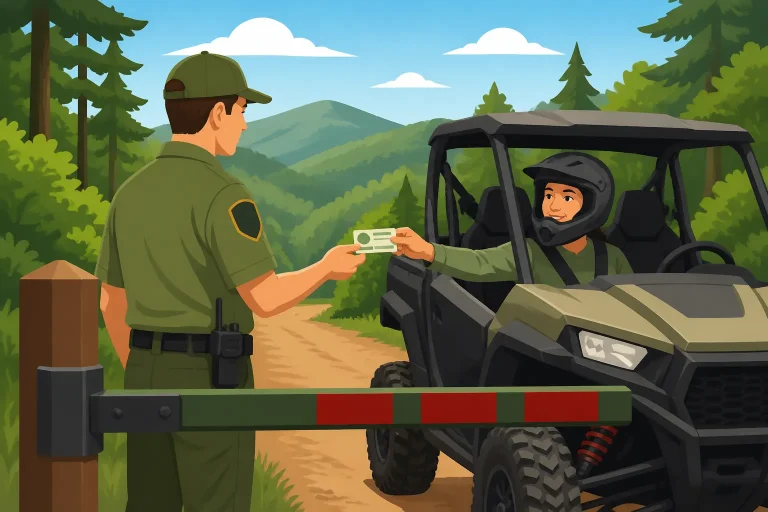
A clear conversation before the ride can prevent a trespass dispute, damage claim, or disagreement about where riders were allowed to go. Permission should come from the owner or someone with authority to grant access, such as a person managing the property. A neighbor, farm worker, or tenant may not have permission to invite riders onto land they do not control.
For a one-time ride, a text or written note is useful. It does not need to be complicated. Confirm the date, the riders and machines covered, the area you can use, and any limits the owner sets. For regular access, a more complete written agreement is sensible. See Written Landowner Permission in North Carolina and [North Carolina Landowner Permission Requirements].
Before you ride, agree on practical details such as:
- The boundaries of the area you may use, including trails, fields, and staging or parking spots.
- Whether guests, children, passengers, or additional machines are included.
- Whether the permission is for one visit or repeated use.
- Whether camping, fires, hunting, towing, or overnight parking are allowed.
- Which gates must stay closed and which areas are off-limits.
- How to report damage, a crash, or a gate left open.
- Whether the owner expects riders to avoid certain hours, crops, livestock, or wet ground.
A landowner’s permission is not necessarily transferable. If a friend invited you, do not assume you can bring a group, return another weekend, or share the access with another rider. Check with the person who granted access. The same care applies to leased land: a lease may give a tenant some use of the property without giving them authority to invite recreational riders.
Make sure everyone in the group understands the route. A marked trail can still cross onto a different parcel, and a wide field can make property boundaries hard to see. Use a map or walk the route with the owner if the boundary is unclear. Do not treat an open gate, old tire tracks, or a path leading into the woods as proof that access is allowed. North Carolina Trespass Rules for Riders covers the risk of riding beyond the area you were authorized to use.
Permission also has limits. It cannot make a closed public trail open, grant access to a neighbor’s property, or turn a public road into a private riding area. If the route reaches a road, stop and check the rules for that road rather than continuing on the strength of the owner’s invitation. Similarly, a landowner cannot authorize entry onto land controlled by a utility, government agency, or another owner unless they have the authority to do so.
Safety, property damage, and landowner responsibilities
Private land can feel less formal than a designated trail, but it can also have hazards that are not marked or maintained for recreational riding. Ditches, wire, hidden stumps, steep banks, water crossings, farm equipment, and changing ground conditions can create serious risks. Walk unfamiliar sections first where practical, set a speed appropriate to visibility, and keep riders together within the agreed boundaries.
Do not assume that a private-property setting removes every ATV safety rule. State requirements can depend on the type of machine, the rider, and where and how it is being operated. Follow the machine maker’s age and passenger guidance, use properly fitted protective gear, and check the current state rules relevant to your ride. The requirements for public roads or public riding areas may differ from those for a private parcel. For age-related requirements, see North Carolina ATV Safety Certificate Requirements.
Take particular care with passengers. A machine designed for one rider is not made safe for two simply because the ride is on private land. Use only a passenger position designed for that purpose, and make sure the rider and passenger can reach the controls and hold on as intended. Keep children away from machines that are too large or difficult for them to control, and supervise them closely.
The land itself also needs protection. Repeated riding on saturated soil can rut a field or trail, while careless turns can damage crops, fences, and vegetation. Avoid creating new routes through creek banks or wet areas. If water, drainage, wetlands, or erosion-sensitive ground is involved, do not assume private ownership removes environmental restrictions. Ask the owner before making changes, and avoid actions that could cause runoff or damage beyond the ride area.
A practical approach is to:
- Ride only on the route the owner approved.
- Avoid wet, steep, or unstable ground unless the owner has specifically identified it as suitable.
- Slow down near buildings, people, livestock, gates, and farm equipment.
- Leave gates as you found them and do not cut fences or clear vegetation without permission.
- Stop if you find a blocked route, a new hazard, or a boundary you cannot identify.
- Tell the owner promptly about damage, spills, or an incident.
Private land does not automatically mean that the owner has accepted every risk or that the rider is free from responsibility. North Carolina has a recreational-use law that can affect landowner liability when land is made available for recreation, but its application depends on the facts. It is not a blanket promise that an owner cannot be held responsible, and it does not give riders permission to ignore safety or cause damage. Riders and landowners dealing with a serious incident, regular public access, or a paid riding arrangement may want advice from a qualified legal professional.
Insurance deserves a separate check. Do not assume that a policy for a road vehicle, homeowners coverage, or a machine warranty covers off-road use, injuries to guests, or damage to someone else’s property. Ask the insurer what applies to the specific machine and activity. North Carolina ATV Insurance Requirement is useful for understanding the difference between insurance rules and the practical question of coverage.
When private-property riding rules do not settle the question
The phrase “private property” can describe several different situations, and each may bring in rules beyond the owner’s permission. A privately owned trail open to paying customers, a farm lane used by the public, and a secluded field used by invited guests are not necessarily treated alike for every purpose. Ask who controls the area and what rules apply to the activity, not just who owns the land.
Farm lanes and roads
A farm lane may look private but connect to a public road or serve more than one property. Do not assume that a lane is private, or that farm-related use gives every rider permission to use it. If you need to travel on a public road, identify the exact road and check whether the intended use is permitted. North Carolina Rules for Riding a Farm Lane addresses the difference between a private farm route and public-road use.
Public forests and neighboring parcels
Private access next to a public forest can be confusing. A trail may leave a private parcel and enter public land, or a public trail may pass close to a private boundary. The landowner’s permission ends where their authority ends. Check current maps and signs, and do not use a private access point to bypass public-area requirements or a closure. The rules for public forest riding, including permits and trail restrictions, are separate from permission to ride on a private lot.
Posted or restricted land
Signs, gates, fences, and direct instructions should be taken seriously. A route that has been used before may no longer be authorized, and a change in ownership or management can change access. If a sign conflicts with what someone previously told you, stop and confirm with the owner or authorized manager rather than relying on an old invitation. See Posted Land in the Piedmont for a related example of why visible access cues matter.
A simple pre-ride check
Before you unload, confirm these points:
- Authority: Did permission come from the owner or someone authorized to grant it?
- Scope: Are all riders, machines, dates, and routes included?
- Boundaries: Can the group identify where permission ends?
- Connections: Does the route touch a public road, public trail, or someone else’s land?
- Site rules: Are there limits on speed, passengers, noise, fires, parking, or hours?
- Safety: Are the riders equipped and capable for the machine and terrain?
- Coverage: Have you checked insurance and understood any waiver or park terms?
If any answer is unclear, pause and ask before riding. A few minutes spent confirming access is easier than resolving a trespass complaint, damaged fence, or injury after the fact. For a broader look at the private-land issue, see Riding Private Ground in North Carolina.
Disclaimer
This article is for general informational purposes only and does not constitute professional advice. Laws, prices and regulations vary by location and change over time. Consult a qualified professional for guidance on your specific situation.