State Parks and North Carolina Machines
North Carolina’s state parks can look like tempting places to ride, especially when a map shows miles of roads and trails. But an ATV or UTV permit for a national forest does not usually open state park trails to motorized riding. Here’s how to tell where your machine can go, what permits do—and do not—cover, and how to avoid arriving at the wrong trailhead.
Can You Ride an ATV or UTV in a North Carolina State Park?
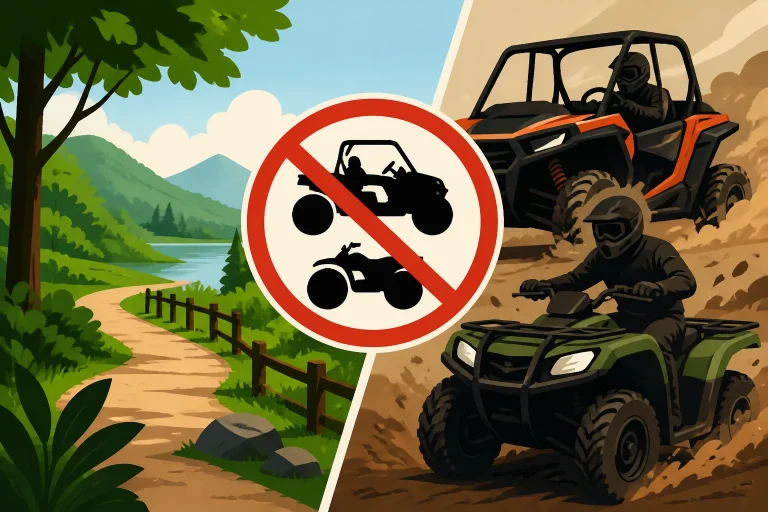
In general, North Carolina state parks are not recreational ATV or UTV riding areas. A machine may be transported into a park on a trailer, but that does not authorize riding it on hiking trails, service paths, fields, or other park grounds. Motor vehicles should stay on roads and in areas open to public vehicle traffic, and posted signs and park rules control access.
That distinction can be easy to miss. A state park may have a large trail network, a campground, and paved or gravel roads, but those features do not make it an off-highway vehicle area. Trails are designated for particular uses. A hiking trail, bicycle route, or footpath is not open to ATVs simply because it is wide enough for a machine.
Likewise, a UTV’s size or equipment does not automatically give it more access than a quad. Being able to register or insure a vehicle for road use is separate from permission to ride on park land. Even a road-capable machine must follow the park’s road restrictions and signs, and road equipment does not authorize off-road travel.
What the general rule means in practice
Treat the state park as a place to visit on foot, by bicycle, or in an authorized vehicle—not as a place to unload and ride recreationally—unless the park’s official information clearly says a particular motorized route or activity is allowed.
That means you should not assume you can:
- Ride a quad from a campsite to a trailhead.
- Use a park service road because it appears on a map.
- Follow a hiking trail on an ATV when it is empty.
- Ride between parking areas on paths or through open land.
- Use a UTV for recreation just because it has road equipment or a title.
Park staff and signs may identify limited vehicle access for specific purposes, such as authorized work or other designated use. Those exceptions are not a general invitation for visitors to ride their own machines. If a route or activity is not clearly authorized for your vehicle, ask the park before unloading.
For more background on the distinction between motorized riding areas and other public land, see Where to Ride an ATV in North Carolina and Why a State Park Turns Machines Away.
Road access is not trail access
A machine that can legally use a particular public road still does not gain permission to leave that road and ride the surrounding park property. Road eligibility, vehicle registration, park access, and trail access are separate questions.
North Carolina’s modified utility vehicle rules create a specific road-use route for qualifying machines, but that route is not a general state park riding permit. Check North Carolina MUV Street Legal Requirements if you are trying to understand whether a particular machine may use public roads. Then check the individual park’s rules to see whether that road is open to public traffic and whether the machine is allowed there.
This distinction matters even when a park has a public road running through or beside it. A route shown on a general map may be closed to visitors, restricted to park operations, or unsuitable for a particular vehicle. Follow posted restrictions rather than assuming that a mapped road is open.
State Park Rules, Forest Permits, and Reciprocity
A common source of confusion is treating all public land as if it uses one permit system. North Carolina’s state parks and national forests are different land-management systems. A permit that applies to a designated national forest riding area does not automatically authorize riding in a state park.
The same is true in reverse: a state park pass, camping reservation, or other park authorization does not grant ATV or UTV trail access in a national forest. Each permission applies to the activity and place specified by the agency that issued it.
| Where you plan to go | What to check | What a permit or pass does not automatically allow |
|---|---|---|
| North Carolina state park | Park-specific vehicle rules, posted closures, and authorized routes | Recreational ATV or UTV riding on trails or park grounds |
| Designated national forest OHV area | Forest permit requirements, trail status, and vehicle restrictions | Riding in a state park or on every road in the forest |
| Private off-road property | The owner’s permission and any site rules | Access to nearby public trails or roads |
| Public road | Whether the road is open to your vehicle and whether the machine qualifies for road use | Leaving the road to ride on adjoining land |
For applicable forest areas and permit basics, start with North Carolina Forest OHV Permits and Which North Carolina Forests Take a Day Permit. Then confirm the rules for the specific riding area you intend to visit. The Do You Need a Permit for North Carolina Forest Trails? overview can also help separate forest permit requirements from park access rules.
A forest permit is location-specific
A permit should be understood as permission for a defined area and activity, not as a statewide ATV license. Even within a forest system, the permit, allowed trail, season, and machine rules may vary by riding area. The forest office or official trail information is the place to confirm what applies before setting out.
Do not rely on a permit purchased for one trail system to cover a trip to a different public property. If your route includes more than one riding area, check each one separately. Also check closures: a permit does not make a closed trail open.
Reciprocity is another separate issue. A permit or registration from another state does not necessarily substitute for a North Carolina forest permit, and a North Carolina forest permit does not transfer riding rights to state parks or other states. For the state-to-state question, see Does a North Carolina Permit Work in Tennessee?.
A title or road document is not a land-use permit
A title can help establish who owns a machine. Registration or road equipment may address whether it can be used on certain roads. Neither document, by itself, grants the right to ride on public land.
Before a trip, keep the questions separate:
- Is the machine yours to use, and do you have the ownership documents you need?
- Is it allowed on the road or trail you plan to use?
- Does that land manager require a permit or other authorization?
- Is the route open on the day you plan to ride?
A “yes” to one question does not answer the others. This is especially important for side-by-sides: being road-equipped or meeting a category’s requirements does not turn a state park into an OHV park.
How to Check a Park Before You Bring a Machine
Park rules and access conditions can vary, and temporary closures can change a plan. Confirm the details for the specific park rather than relying on an old map, a social media post, or a general statement about North Carolina riding.
Use this process before loading:
- Identify the land manager. Confirm that your destination is a state park, not a national forest OHV area, private riding park, game land, or another type of property. Similar names and nearby trailheads can make boundaries confusing.
- Check the park’s official information. Look for vehicle rules, trail-use designations, closures, and contact details. If ATV or UTV access is not clearly listed as allowed, do not assume it is.
- Ask about the exact route and machine. If you have a genuine ambiguity, contact park staff and describe the vehicle and the road or activity you have in mind. “Can I ride an ATV here?” is more useful when paired with the specific location and purpose.
- Check signs when you arrive. Conditions and restrictions at the entrance or trailhead may differ from what you saw earlier. Do not ride past a closure or barrier because a digital map shows a route.
- Plan a legal riding destination. If your goal is off-road recreation, choose a designated riding area and confirm its permit, operating season, and trail status before traveling.
If you are changing destinations after discovering that a park is not an OHV area, use the official information for the alternative site too. Nearby does not mean connected, and a road between a park and a forest riding area may not be open to your machine. North Carolina’s Three National Forest Systems provides useful context for the state’s forest lands, while North Carolina Trail Closures to Check First is a reminder to verify conditions before making the drive.
What to ask park staff
A short, specific question is more likely to produce a useful answer than asking whether “ATVs are allowed in the park.” For example, ask whether a privately owned UTV may travel on a named road, whether that road is open to visitors, or whether machines may be unloaded at a particular parking area.
Also clarify whether your question is about riding, parking, transporting a machine on a trailer, or using an accessible route to reach a permitted destination. These are different activities. Permission to park a trailer does not necessarily mean you can unload and ride from that spot.
When answers are unclear, take the conservative approach: leave the machine on the trailer and choose a location with explicit OHV authorization. It is easier to confirm access before unloading than to resolve a rules dispute on a trail.
Planning a Ride Without Confusing Park Access
If state parks are not your riding destination, the next step is to find a place that explicitly allows the kind of machine and use you have in mind. That might be a designated forest OHV area, a private off-road park, or private land where the owner has given permission. These options have different requirements, so do not treat one as a substitute for another.
For private land, permission should come from someone with authority over the property. A visible track, open gate, or history of other riders using the land does not establish permission. Review North Carolina Rules for Riding Private Land before relying on an informal understanding.
For a designated public riding area, verify more than the existence of trails. Confirm that the area is open, that your machine fits its rules, and that you understand where the permit must be obtained or displayed. Weather, maintenance, seasonal schedules, and other closures can affect access. A permit bought in advance is not a guarantee that every trail will be open when you arrive.
Trailer and staging plans
If you are visiting a state park for hiking, camping, or another permitted activity with an ATV or UTV in tow, keep transportation separate from recreational use. Park staff can clarify where a trailer may be parked, whether the campsite or parking area can accommodate it, and whether any special restrictions apply. Do not assume that a campsite reservation includes space for a trailer or permission to operate the machine.
If you plan to ride elsewhere during the same trip, check whether the other area has a suitable staging area and whether the route between the two destinations is legal for your machine. Do not use park roads or trails as a shortcut between riding areas unless they are expressly open to that use.
A practical trip checklist includes:
- The correct address and land manager for the riding site.
- Confirmation that the site allows your type of machine.
- Any required permit and instructions for displaying or carrying it.
- Current trail openings and closures.
- Trailer parking and unloading arrangements.
- A route that does not depend on riding through a state park or other restricted property.
- A backup destination in case the planned riding area is closed.
This approach avoids a common disappointment: arriving with a valid permit, but at a place where that permit does not apply. The key is to match the machine, land manager, route, and authorization before you leave home.
Disclaimer
This article is for general informational purposes only and does not constitute professional advice. Laws, prices and regulations vary by location and change over time. Consult a qualified professional for guidance on your specific situation.