North Carolina Rules for Riding a Farm Lane
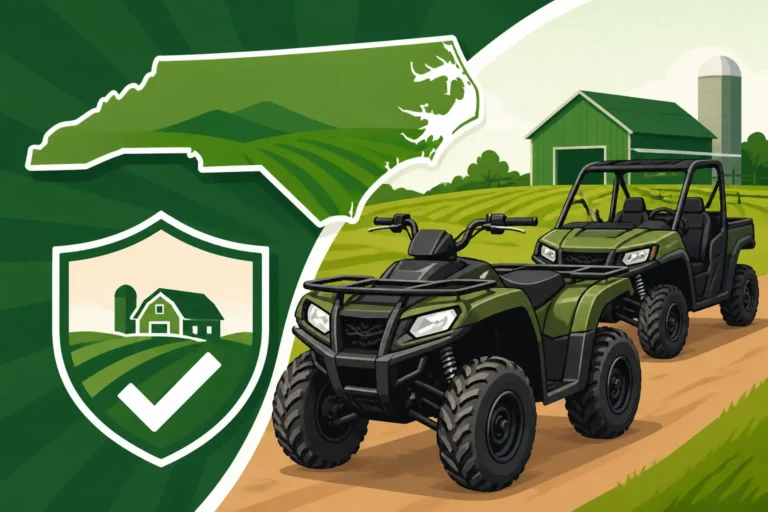
Living on a farm in North Carolina often means your ATV or UTV is less of a toy and more of a workhorse, a vital tool for getting chores done, moving supplies, and checking on livestock. But when that farm lane you rely on happens to cross or briefly share a public road, you might find yourself scratching your head about what's actually allowed. This guide is here to clear up the confusion surrounding North Carolina's rules for riding your ATV or UTV on a farm lane, especially when public roads are involved, ensuring you stay within the bounds of the law while keeping your operations running smoothly.
Understanding North Carolina's Farm Operations Exemption
North Carolina law understands that ATVs and UTVs are incredibly useful for agricultural work. Because of this, there's a specific exemption that allows these machines to operate in ways that might otherwise be restricted for recreational riders. It’s not a blanket permit to ride anywhere, but it does carve out essential flexibility for those working the land.
What Qualifies as a "Farm Operation" in North Carolina?
When the state talks about a "farm operation," they're picturing the real, day-to-day grind of agriculture. This isn't just about pulling a plow; it encompasses a broad range of activities essential to running a farm. Think about moving feed to the barns, hauling tools out to the far fields for fence repair, or even checking on a herd of cattle grazing on a distant pasture. It includes transporting crops from the field to a storage shed, or taking supplies like fertilizer and seed to where they're needed. It's about anything directly related to the cultivation of the soil, raising livestock, or producing agricultural commodities. The key is that the ATV or UTV is being used as part of the business of farming, not just for leisure. If you're using your side-by-side to spread seed for a cover crop, that's farm use. If you're just riding it around the perimeter of your field for fun, that's recreational, even if it’s on your own property.
Who Can Ride Under the Farm Exemption?
The farm exemption isn't just for the registered owner of the farm; it extends to anyone actively involved in the farm's operations. This typically includes the farmer themselves, their family members who assist with farm tasks, and any employees hired to work on the farm. The crucial link is the purpose of the ride: the individual must be operating the ATV or UTV for a legitimate farm purpose, as we just discussed. For instance, if your son is taking the quad out to check irrigation lines after a storm, that falls under the exemption. If your farmhand is moving hay bales from one barn to another using a UTV, that's also covered. The machine itself must be used for the farm operation. This means you can't lend your UTV to a friend for a joyride on your property and claim it’s part of a farm operation just because it’s on a farm. The connection must be direct and functional to the agricultural work at hand.
Public Road Access for Farm Operations
Here's where things get particularly nuanced, and where many folks often misunderstand the law. North Carolina's farm operations exemption does allow ATVs and UTVs to use public roads, but it’s a very limited allowance, specifically for crossing or briefly traversing a highway or public road to get from one part of the farm to another. Imagine your property is split by a state highway, and you need to move equipment from a field on one side to a field on the other. The law permits you to cross that public road. Similarly, if your farm lane momentarily merges with a public road before veering back onto private land, that brief transit is generally permitted.
However, and this is a big "however," this exemption is absolutely not a loophole to make your ATV or UTV "street legal" for general road use. You cannot run errands into town, take a scenic drive down a public road, or use it for commuting under the guise of "farm operations." The use of the public road must be incidental and directly necessary for the farm operation itself. The moment you deviate from that direct purpose, you're no longer covered by the exemption, and you could face citations for illegal operation on a public highway. The intent is strictly for the practical necessity of moving between farm parcels.
The Specifics of Riding on a Farm Lane
Navigating farm lanes, especially those that interact with public thoroughfares, requires a clear understanding of boundaries and proper usage. It's not just about what you're allowed to do, but where and how you do it.
Private vs. Public Farm Lanes
It’s really important to distinguish between a farm lane that is entirely contained within your private property and one that might, even briefly, become a public thoroughfare or intersect with one. A lane that stays entirely on your land, never touches a public road, and is not used by the general public, is unequivocally private. On such a lane, your primary concern is landowner permission – which, presumably, you have! – and general safety. The state’s strict rules about public road use for ATVs generally don't apply here.
However, many farm lanes, particularly in older, rural areas, might intersect, parallel, or even briefly become a public road before continuing as private access. If your farm lane connects to a county road or state highway, even if just for a few yards, that portion of the lane is often considered a public access point. This is where the farm operations exemption comes into play. For instance, if your pasture is on the other side of a paved road from your barn, you’ll need to cross that road. That brief crossing is usually permissible under the exemption, provided it’s for legitimate farm work. But you still need to exercise extreme caution, yield to traffic, and be visible. Always remember that even if a lane feels private, if it's legally designated as public or serves as an access point to public roads for multiple properties, different rules might apply to portions of it. [North Carolina Rules for Riding a Farm Lane] dives deeper into the specific allowances.
Equipment Requirements for Farm Use
For ATVs and UTVs used solely on private farm lanes, North Carolina doesn't impose specific equipment requirements beyond what typically comes standard on the machine. You won't find regulations demanding turn signals or special brake lights if you're only on your own land. However, common sense and safety are your best guides here. If you're going to be out at dawn, dusk, or after dark, having working headlights and taillights is crucial for your visibility to other farm vehicles and for your own navigation. Many farmers opt for utility enhancements, and companies like SuperATV offer robust lighting kits that can make a huge difference in low-light conditions on a sprawling farm, ensuring you can see obstacles and be seen by others.
When it comes to crossing or briefly traversing public roads, while the farm exemption doesn't magically turn your ATV into a street-legal vehicle, you are still expected to operate it safely. This implies having working brakes, and it’s highly advisable to have functional headlights and taillights, especially if light conditions are anything less than perfect. While not explicitly mandated for these brief crossings, things like a visible orange safety flag or even a slow-moving vehicle (SMV) triangle could be excellent additions to increase your visibility to oncoming traffic, potentially preventing a dangerous situation. It's about being proactive, not just meeting the bare minimum.
Age and Supervision Rules on Farm Lanes
This is another area where the lines can blur a bit, and where safety should always be the priority. North Carolina has specific age restrictions for ATV operation, particularly for riders under 16, typically requiring a safety certificate for those born on or after January 1, 1990. However, when it comes to operating an ATV or UTV on private property for farm operations, these rules can be interpreted with some flexibility, particularly for family members engaged in supervised work.
While the state might not strictly enforce the same age restrictions for a child operating an ATV to feed chickens on the family's private farm lane, a parent or guardian is still legally and morally responsible for that child's safety. Continuous visual supervision is always a good practice, especially for younger riders, regardless of whether they are on a public road or a private farm lane. For critical farm tasks, ensuring the operator (of any age) is competent and mature enough to handle the machine and the task at hand is paramount. It’s also wise to ensure that any youth operating machinery for farm work has received proper training, perhaps through a recognized safety course, even if not strictly mandated for private land. Safety gear, like helmets and eye protection, which are often recommended or required for younger riders on public lands, should be strongly encouraged on private farm lanes too. [North Carolina Rules for a Rider Under 16] provides more details on general youth rider rules.
Avoiding Misuse and Misinterpretation
It's easy to assume that because your machine is on your farm, anything goes. However, the farm exemption is quite specific and misunderstanding its limits can lead to unwelcome attention from law enforcement and potential fines.
The Difference Between Farm Use and Recreational Riding
This is probably the most critical distinction to grasp. The farm operations exemption exists solely to facilitate agricultural work. It is not a blanket pass for recreational riding, even if that riding happens on a farm. For instance, if you're using your ATV to check fences, move irrigation pipes, or bring tools to a work site, that's legitimate farm use. You might briefly cross a public road as part of that task, and the exemption would apply.
However, if you decide to take your ATV out for an afternoon of trail riding, even if those "trails" are on your own vast property, that's considered recreational riding. If your recreational ride happens to involve crossing or even briefly using a public road, you are now operating that machine illegally on a public highway. The law differentiates by purpose. If you're using your UTV to haul hunting gear to a deer stand on your property, that might fall under a different set of rules related to hunting, but if that involves public road use, it isn't covered by the farm operations exemption unless it's for farm-related wildlife management. The penalties for misrepresenting farm use can be the same as any other illegal ATV operation on a public road, including fines. The best approach is to be absolutely clear about your purpose before you put tires on any public surface. [North Carolina Farming Exception for ATVs] further clarifies this point.
When a Farm Machine Needs to be Titled or Registered
Here's another point that can cause confusion: in North Carolina, ATVs (and most UTVs, unless they qualify as a Modified Utility Vehicle or MUV) generally aren't registered like cars or trucks. There's no statewide ATV registration system. However, titling is a different story. [Titling an ATV in North Carolina Is Optional] is true for most ATVs, but it's often a smart move even for a machine used exclusively for farm work.
While not legally mandated for private farm use, having a title provides proof of ownership, which is incredibly important for several reasons. If your workhorse ATV or UTV is ever stolen from your barn, a title is invaluable for reporting it to law enforcement and proving it's yours. If you ever decide to sell the machine, a title makes the transaction much smoother and instills confidence in the buyer. Lenders also typically require a title if you financed the purchase. So, while you don't have to get one for farm use, getting your machine titled through the North Carolina DMV on [North Carolina Title Application on Form MVR-1] is a wise decision for any ATV or UTV, regardless of its primary purpose. Only if your UTV meets the very specific and stringent requirements to be a [Modified Utility Vehicle in North Carolina] would it be eligible for actual registration for highway use, which is a different beast entirely from the farm exemption.
Local Ordinances and Other Considerations
While North Carolina state law provides the overarching framework for farm operations and ATV use, it’s always a good idea to remember that local governments—counties and municipalities—can sometimes have their own ordinances. These local rules usually don't override state law regarding farm exemptions on public roads, but they might address other aspects, especially concerning noise, hours of operation, or nuisance complaints on private property that borders residential areas.
For instance, a county might not have an ordinance that prevents you from crossing a road for farm work, but they might have rules about excessive noise from machinery that could apply if you're running a particularly loud machine late at night near a residential zone. While this is less common in deeply rural areas, as communities grow and residential areas expand closer to working farms, these considerations become more relevant. Always being a good neighbor, especially when it comes to dust, noise, and operating heavy equipment, goes a long way. If you have any doubts, a quick check with your local county clerk's office or sheriff's department can provide clarity on any specific local rules that might impact your farm operations.
Practical Scenarios and Best Practices
Let's get down to the real-world situations you might encounter and some common-sense tips to keep you on the right side of the law and, more importantly, safe.
Moving Equipment Between Fields
This is perhaps the most classic scenario for using the farm operations exemption. Imagine you have a tractor attachment, like a sprayer or a small tiller, that you need to move from your main equipment shed on one side of a county road to a field located on the other side. Your ATV or UTV, perhaps outfitted with a heavy-duty hitch receiver, is the perfect machine to quickly and efficiently tow this equipment.
The key here is that your route across the public road should be as direct and brief as possible. You should approach the road cautiously, looking for oncoming traffic just as you would in any farm vehicle. Make eye contact with drivers if possible. Signal your intention to cross, even if it's just a hand signal. While not legally required for an ATV, a brightly colored flag or a slow-moving vehicle (SMV) triangle attached to the back of your UTV can significantly increase your visibility to other motorists. Remember, this is about necessity, not convenience. You're not taking the scenic route; you're simply bridging the gap between two parts of your working farm. Be extra careful if the fields are located near a blind curve or on a busy highway.
Hauling Supplies from a Main Road
Another common task involves retrieving supplies. Perhaps a delivery truck dropped off a pallet of feed or fencing supplies at the end of your gravel farm lane, right where it meets the paved state road. Instead of hooking up a full-size truck and trailer, it’s often much faster and more fuel-efficient to load up your UTV’s cargo bed and quickly ferry the supplies down your private lane.
In this instance, your ATV or UTV might briefly be on the shoulder of the public road, or even briefly cross a small section of it, purely for the act of loading and then turning onto your private property. Again, the principle of minimal, necessary use applies. You’re not cruising down the highway; you’re executing a quick, essential logistics task for your farm. Safety is paramount: ensure your machine is stable with the load, don't overload beyond its capacity, and be acutely aware of any traffic on the main road. The fewer times you have to interact with public road traffic, the safer you’ll be, so plan your movements carefully.
Upgrading Your Farm Machine for Utility
Many farmers recognize the incredible versatility of ATVs and UTVs and often invest in upgrades to make them even more capable workhorses. This is where enhancements from companies like SuperATV really shine. For instance, if you're regularly hauling heavy loads of feed, fence posts, or tools across rough farm terrain, a set of heavy-duty axles or a lifted suspension can dramatically improve your machine's durability and ground clearance.
Consider adding a strong front bumper and a powerful winch, which can be invaluable for clearing fallen trees from farm lanes after a storm, or for pulling out bogged-down equipment. For tasks like spreading seed or spraying, specialized attachments exist that mount directly to your UTV, effectively turning it into a compact, agile farm implement. Upgraded tires with an aggressive tread pattern can provide better traction in muddy fields or on slippery slopes, crucial for maintaining control while working. Enhancements like these not only make your farm tasks easier and more efficient but also contribute to safer operation by ensuring your machine is robust enough for the demands of agricultural work. Investing in such utility accessories can truly transform a standard off-road vehicle into an indispensable farm tool, letting you tackle tougher jobs with confidence.
| Feature | Farm Use Exemption (Public Road) | General Recreational Riding (Public Road) | Private Farm Lane Riding (Private Property) |
|---|---|---|---|
| Purpose | Directly related to farm operation | Leisure, sport, non-essential travel | Any purpose, with landowner permission |
| Public Road Access | Brief crossing/traversal only | Generally prohibited | Only if lane is a public road portion |
| "Street Legal" | No | No | Not applicable |
| Required Title | Optional, but recommended | Optional, but recommended | Optional, but recommended |
| Registration | Not required (unless MUV) | Not required (unless MUV) | Not required |
| Age Rules | State rules generally apply | State rules apply | Parental discretion & supervision |
| Safety Gear | Recommended, especially for visibility | Generally recommended/required for youth | Recommended |
| Law Enforcement | Subject to enforcement for misuse | Subject to enforcement | Primarily property owner's discretion |
Disclaimer
This article is for general informational purposes only and does not constitute professional advice. Laws, prices and regulations vary by location and change over time. Consult a qualified professional for guidance on your specific situation.