Headlamp and Taillamp After Dark in North Carolina
Riding your ATV or UTV in North Carolina can be an absolute blast, but when the sun starts to dip below the horizon, or you find yourself needing to cross a road, a whole new set of rules and safety considerations come into play regarding your machine's lighting. Many riders feel frustrated and confused trying to figure out if their factory lights are "good enough" or if they need to invest in upgrades just to stay legal and safe. This guide is here to shed some light on the specific headlamp and taillamp requirements in North Carolina, especially when riding after dark or when venturing onto public ways.
Understanding North Carolina's Lighting Rules for Off-Road Machines
North Carolina’s approach to ATVs and UTVs on public roads is quite distinct, and that naturally extends to lighting requirements. It's not a simple "yes or no" answer, which is often where the confusion begins for many riders. The state generally considers ATVs and UTVs as off-road vehicles, meaning they aren't designed or legally permitted for typical street use. This core principle impacts everything, including what kind of lights you need and when.
The Core Truth: Off-Road Means Off-Road
Most of the time, when you're roaring down a trail in the Uwharrie National Forest or kicking up mud at Badin Lake, your machine is operating strictly in an off-road environment. In these scenarios, while having good working lights is crucial for your safety and the safety of others, the specific legal mandates for headlights and taillights don't mirror those for street-legal vehicles. The manufacturer-installed lights are typically designed with these off-road conditions in mind, providing illumination for the rider and making the machine visible to others on the trail. However, "off-road" in North Carolina truly means off the paved public highways, roads, and shoulders. You can't just slap a license plate on your quad and expect to cruise down Main Street, regardless of how many light bars you have. The state has very strict definitions about what constitutes a public road and when an ATV or UTV can legally be on one.
This distinction is super important because it dictates the type of equipment your machine needs. For example, a powerful aftermarket LED light bar from a company like SuperATV might be amazing for lighting up a dark trail, but it won't magically make your machine street-legal in most contexts. The focus for standard off-road riding is on visibility and rider awareness, not compliance with intricate highway vehicle codes. Riders often get confused because they see other vehicles with bright lights on the road and assume their ATV's equivalent must also be legal. But the legal framework for a passenger car or even a motorcycle is vastly different from that for an ATV or UTV. For more on this, you might find [Are ATVs Street Legal in North Carolina?] helpful.
When Lights Become a Legal Must-Have
While off-road, the primary concern is safety and visibility, but there are specific, limited circumstances in North Carolina where your ATV or UTV must meet certain lighting standards similar to those for on-road vehicles. The most significant of these is if your machine qualifies and is registered as a [Modified Utility Vehicle in North Carolina]. MUVs are specifically designed to bridge the gap between off-road utility and limited on-road capability, and they come with a laundry list of equipment requirements, including specific lighting. Another limited exception is for farming operations, where ATVs might need to briefly cross or use public roads. [North Carolina's Farming Operations Exception] allows for this, but even then, common sense dictates appropriate lighting for safety, especially if it's dark or visibility is poor.
Furthermore, some areas, like specific ocean beaches, might have their own rules regarding riding after dark and require working headlamps and taillamps. [North Carolina Rules for Riding a Beach] often include stipulations about operating only during daylight hours, but if night riding is permitted, proper lighting is non-negotiable. So, while you generally don't register an ATV in North Carolina, the moment your machine touches a public road under one of these specific exceptions, its lighting immediately becomes subject to much stricter scrutiny. Understanding these narrow exceptions is key to staying out of trouble and, more importantly, staying safe.
Decoding Headlamp Requirements for North Carolina MUVs
If your UTV, or in some very specific cases, a heavily modified ATV, manages to jump through all the hoops to become a Modified Utility Vehicle (MUV) in North Carolina, then your headlamps are no longer just for lighting up the next mud puddle. They become a critical component of its street-legal status, subject to specific regulations that ensure safety for everyone on the road.
Essential Features of Street-Legal Headlamps
For an MUV to be considered street-legal in North Carolina, it must be equipped with working headlamps that meet certain standards. We're talking about more than just a couple of bright lights here. The law generally expects headlamps to be permanently mounted, providing both a high and low beam capability, just like a standard car or motorcycle. These aren't temporary clip-on lights; they need to be integrated into the vehicle's design. The purpose of having both high and low beams is crucial for road safety: low beams prevent dazzling oncoming traffic, while high beams provide maximum illumination on unlit roads when no other vehicles are present. Many factory UTVs have basic headlamps, but some might only offer a single beam or not be designed with the specific throw and cutoff patterns required for on-road use. If you're considering the MUV route, definitely check your machine's current lighting setup against these criteria.
Beyond just the beams, the placement and functionality of these headlamps are also important. They need to be positioned at a specific height from the ground to ensure proper illumination of the road ahead without being too low to be effective or too high to blind other drivers. While the exact numerical specifications can vary and are best confirmed with the DMV, the general principle is that they must mimic the performance of lights on other street-legal vehicles. This means they need to be reliably powered, free from flickering, and have a clear lens that isn't cracked or excessively dirty, which could impede light output. Upgrading to DOT-compliant LED headlamps, perhaps from a brand like SuperATV, might be necessary if your factory lights don't quite cut it for the road. For more details on what an MUV needs, check out [North Carolina MUV Lighting Requirements].
Aiming and Brightness: More Than Just "On"
It's not enough for your MUV's headlamps to simply turn on; they also need to be properly aimed and provide adequate brightness. Improperly aimed headlights are a safety hazard, either failing to illuminate the road sufficiently or, worse, blinding other drivers. This is why official inspections, which MUVs are subject to, will often check headlamp alignment. The beam pattern needs to project forward, illuminating the road surface and any obstacles, without scattering light indiscriminately into the eyes of drivers approaching from the opposite direction. There are specific procedures for aiming headlights, usually involving measurements against a wall, to ensure they meet legal standards.
Brightness, while important, isn't just about having the most lumens possible. The light output needs to be consistent and appropriate for road use. Excessively bright, non-DOT-compliant aftermarket lights, even if they illuminate the trail like daylight, can be illegal and dangerous on public roads because they can create glare. The goal is clear visibility for the MUV driver and no impairment for others. For nighttime driving, you need to see far enough ahead to react to hazards, but also ensure you're not an unexpected source of blinding light for other motorists. This balance is key for any vehicle sharing the road, and MUVs are no exception. Riders often overlook this aspect, focusing only on "more light is better," but on the pavement, quality and compliance trump sheer power. [North Carolina Rules for Riding After Dark] really drive home the need for proper lighting when you're no longer just on private land.
Taillamps and Beyond: What North Carolina Demands for the Rear
Just as important as seeing where you're going is being seen by those behind you. When your ATV or UTV transitions from purely off-road to one of North Carolina's limited on-road scenarios, the taillamp system, along with brake lights and turn signals, becomes crucial for communicating your presence and intentions to other drivers.
Brake Lights and Rear Visibility: Safety First
For any vehicle on a public road, functional taillamps and brake lights are non-negotiable. An MUV, for instance, is absolutely required to have red taillamps visible from a specified distance to the rear, which automatically illuminate when the headlamps are on. These lights serve the fundamental purpose of indicating your presence, especially during low-light conditions, fog, or rain. Without them, you're a significant hazard on the road. Even for brief road crossings under the farming exception, having working taillamps is simply good common sense and a critical safety measure.
Beyond just being "on," the brake lights must be distinctively brighter when the brakes are applied. This immediate, unmistakable signal alerts drivers behind you that you are slowing down or stopping, giving them precious seconds to react and avoid a collision. Many factory ATVs and UTVs come with basic taillights and brake lights, but it's vital to confirm they are bright enough and clearly visible under all conditions, especially if you've added any accessories that might obstruct their view. Companies like SuperATV offer replacement LED taillight assemblies that can significantly improve brightness and visibility, ensuring you meet or exceed safety standards. Remember, if someone can't see you slow down, they can't prevent hitting you. Ensuring your brake lights are working perfectly is a small effort for a huge safety gain.
The Role of Turn Signals and Reflectors
Beyond the basic taillamps and brake lights, MUVs in North Carolina are also mandated to have functional turn signals. This is a critical piece of communication equipment, allowing you to clearly indicate your intentions to turn or change lanes. Just like on a car, these need to be amber or red, flashing distinctly, and visible from the front and rear of the vehicle. [North Carolina MUV Turn Signal Requirement] is not something you can skip if you want to legally operate an MUV on public roads. Without them, you'd be relying on hand signals, which are far less effective, especially at night or on busy roads where other drivers might not be paying close attention to an off-road machine.
In addition to active lighting, passive reflectors also play a role in rear visibility. While not always explicitly detailed for MUVs as separate items if proper lighting is installed, many vehicles are equipped with red rear reflectors that enhance visibility even if the power system fails or the lights are off. These small, often overlooked components bounce light back to the source, making your machine more visible in situations where its active lights might not be fully effective. Always check that your reflectors are clean and intact. Combined, a robust system of taillamps, brake lights, turn signals, and reflectors provides a comprehensive rear visibility package, essential for any time your off-road machine ventures onto a public way in North Carolina.
Practical Considerations for Night Riding, On and Off-Road
Whether you're exploring the depths of the Uwharrie trails after sundown or navigating a brief stretch of road as an MUV, practical lighting considerations go beyond just legal compliance. Ensuring you have adequate, reliable lighting is paramount for both safety and enjoyment.
Upgrading Your Lighting for Enhanced Safety
Many stock ATV and UTV lighting systems are adequate for basic daytime or dusk riding, but when you really want to ride confidently after dark, especially on challenging trails, an upgrade can make a world of difference. The factory headlamps often provide a limited beam pattern and intensity. Aftermarket LED light bars, pod lights, and replacement headlamp assemblies can drastically improve your visibility and ability to spot obstacles, wildlife, or other riders on the trail. When you're bombing down a dark trail, seeing that fallen log or hidden rut a few seconds earlier can prevent a serious accident. For serious off-road enthusiasts, these upgrades are almost a necessity.
Consider auxiliary lighting from reputable brands. SuperATV, for instance, offers a wide range of LED light bars, cube lights, and rock lights that are designed to withstand the harsh conditions of off-road riding while providing incredible illumination. When choosing upgrades, think about the type of riding you do:
- Spot beams are great for distance, helping you see far down a straight trail.
- Flood beams spread light wide, illuminating the sides of the trail and helping with peripheral vision.
- Combo beams offer a mix of both.
Installing rock lights can also be a game-changer for technical terrain, illuminating the ground directly under your wheels when crawling over rocks. While these powerful lights are fantastic for the trail, remember that they are generally not legal for use on public roads, even for MUVs, as their intensity and lack of a focused beam pattern can blind other drivers. Always check local regulations, but typically, auxiliary lights should be covered or turned off when transitioning to public roads.
Maintenance Tips for Reliable Night Vision
Even the best lighting system is useless if it's not properly maintained. Regular checks of your headlamps and taillamps are essential, especially before a night ride. Start by simply turning on all your lights – headlamps (high and low beam), taillamps, brake lights, and turn signals – and walking around your machine to ensure everything is functioning. Pay close attention to any dimness, flickering, or burned-out bulbs.
Here are a few quick tips for keeping your lights in top shape:
- Clean lenses regularly: Mud, dust, and grime can drastically reduce light output. Use a gentle cleaner and a soft cloth to avoid scratching.
- Check wiring and connections: Off-road vibrations can loosen connections or fray wires. Inspect visible wiring for damage and ensure all connections are secure.
- Inspect for water intrusion: If your lights are fogging up or have water inside the lens, the seal might be compromised. This can lead to corrosion and electrical issues.
- Verify battery and charging system: Dim lights can be a symptom of a weak battery or a charging system that isn't keeping up. Ensure your battery is fully charged and your stator/alternator is functioning correctly, especially if you've added many accessories.
- Carry spare bulbs/fuses: For traditional bulb systems, having spares on hand can save a ride. For LED systems, while more durable, a spare fuse is always a good idea.
Neglecting these simple maintenance steps can lead to being stranded in the dark, or worse, an accident. Reliable lighting is a cornerstone of safe riding after dark, whether you're deep in the forest or making a quick dash across a rural road.
Common Misconceptions and Crucial Safety Advice
The world of ATV and UTV lighting in North Carolina is often shrouded in misconceptions, leading to potential legal troubles or, more seriously, dangerous situations. It's vital to separate fact from fiction and always prioritize safety.
The Difference Between Trail Lights and Street Lights
One of the biggest misunderstandings riders face is equating the bright, powerful lights used for off-road trails with legal street-use lights. They are, in fact, designed for entirely different purposes and governed by different regulations. Trail lights, like those massive LED light bars you see from manufacturers such as SuperATV, are built to throw light as far and wide as possible, illuminating every inch of an unpaved, unpopulated path. Their beam patterns are often uncontrolled, casting light indiscriminately. This is fantastic for spotting obstacles in the wilderness but absolutely blinding and illegal on public roads. Imagine driving towards a car with its high beams on, but ten times worse – that's what a trail light bar can feel like to an oncoming driver.
Street-legal headlamps, on the other hand, are engineered with precise beam patterns, distinct high and low beams, and specific light cutoffs. Their design is about illuminating the road ahead without creating hazardous glare for other motorists. They are subject to Department of Transportation (DOT) standards, which ensure they perform safely in traffic. This is why a standard ATV or UTV, even with powerful factory lights, generally doesn't meet the requirements for [North Carolina Equipment Rules for ATVs] on public roads, unless it's gone through the MUV conversion process. Never assume that because your lights are "bright," they are "legal" for the street. Always distinguish between lights for pure off-road use and those required for limited on-road situations, such as with a registered MUV or under the strict farm-use exception. This distinction is crucial for understanding [What Is Illegal on an ATV in North Carolina] when it comes to road use.
Staying Legal and Safe After Sundown
Operating any vehicle after dark carries inherent risks, and ATVs and UTVs are no exception. The limited visibility, combined with the often challenging terrain of off-road trails or the unexpected hazards of public roads, demands heightened awareness and proper preparation. If you find yourself riding after dark, whether on a trail or making a legal road crossing, always ensure your lighting system is in perfect working order.
For off-road riding at night:
- Ride within your limits: Don't push your speed just because your lights are bright. Slow down and be extra cautious.
- Buddy up: Ride with at least one other machine. If one person has a lighting issue or breaks down, the other can provide assistance.
- Be aware of wildlife: Animals are more active at dawn, dusk, and night. Your lights might startle them, or they might dart out unexpectedly.
- Carry backup illumination: A powerful headlamp or flashlight can be a lifesaver if your machine's lights fail, or if you need to work on the machine in the dark.
For MUVs or farm machines operating on public roads after dark:
- Ensure full compliance: Double-check that all your required lighting – headlamps, taillamps, brake lights, and turn signals – are functioning perfectly and meet legal standards. Remember that [North Carolina MUV Inspection Requirements] will specifically look at these.
- Drive defensively: Even with proper lighting, ATVs and UTVs have a smaller profile than cars and might be less anticipated by other drivers. Assume other drivers don't see you.
- Maintain visibility: Keep your lights, mirrors, and windshield clean. Wear reflective clothing if you're getting on and off the machine.
- Avoid high-traffic roads: Even if legal, using an MUV on a busy highway after dark increases risk. Stick to roads with lower speed limits and less traffic whenever possible.
Ultimately, staying legal and safe after sundown in North Carolina comes down to understanding the specific rules for your machine's intended use and exercising abundant caution. Don't take chances with your visibility or your ability to see what's ahead.
North Carolina's Rules for Riding After Dark
Riding after dark adds a layer of excitement, mystery, and undeniably, risk, to any ATV or UTV adventure. North Carolina law takes this seriously, especially when it comes to operating on any public thoroughfare. While off-road parks and private lands might have their own rules or lack thereof regarding night riding, the moment you consider public access, lighting becomes a non-negotiable legal requirement.
Legal Lighting for Public Road Use
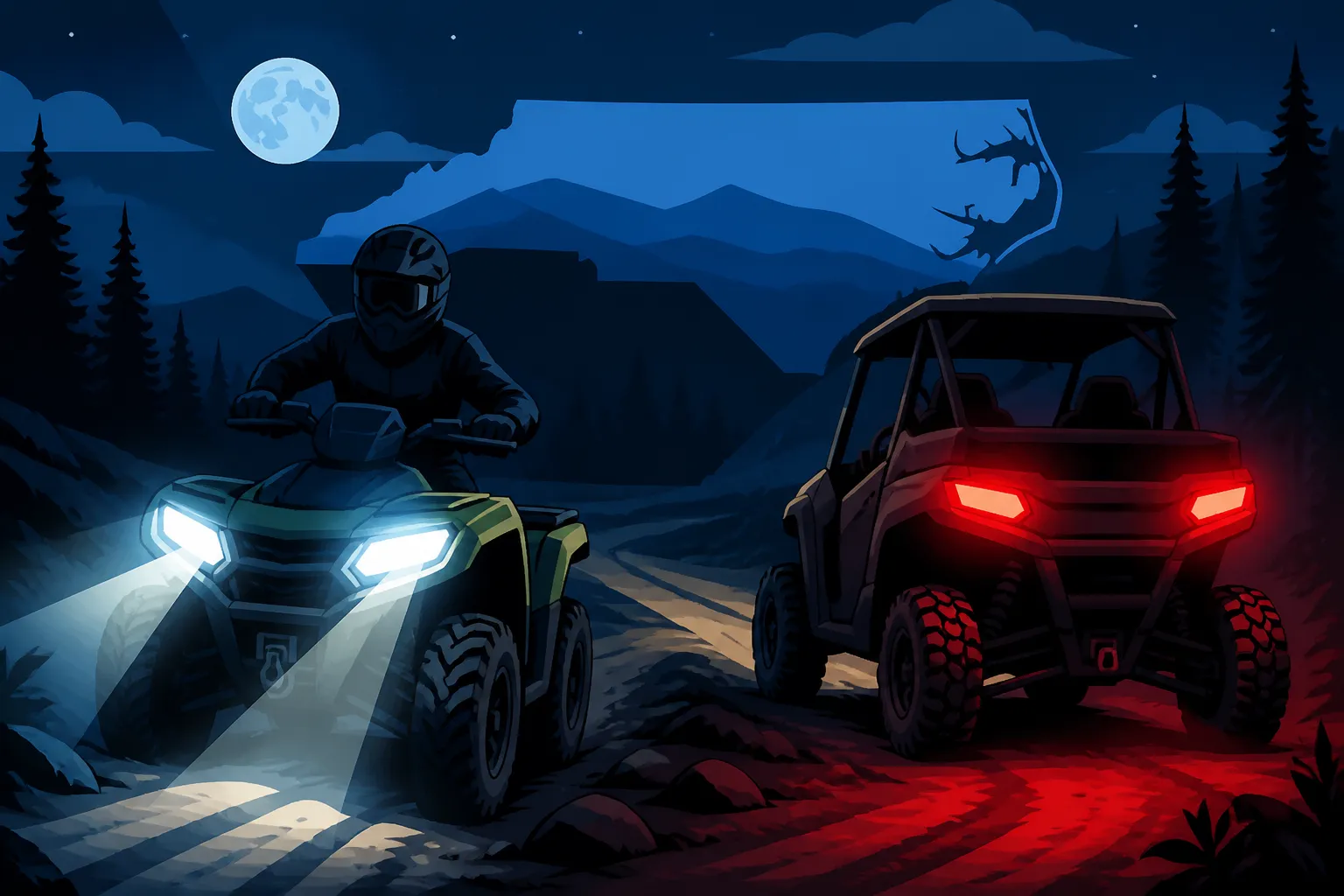
For the vast majority of ATVs and UTVs in North Carolina, public road use is largely prohibited, but for those limited exceptions like Modified Utility Vehicles (MUVs) or specific farm operations, proper lighting is absolutely mandatory after dark. The statute is clear: if you are operating on a public road, shoulder, or right-of-way between sunset and sunrise, your machine must be equipped with and use functioning headlamps and taillamps. This isn't just a suggestion; it's a legal obligation designed to prevent accidents and ensure your vehicle is visible to all other road users.
Specifically, an MUV must adhere to the same basic lighting principles as any other registered vehicle. This means having at least one headlamp, but typically two, that emit a white light visible from a specified distance to the front. These headlamps must have both a high and low beam capability. Equally important are the red taillamps at the rear, visible from a similar distance. And don't forget the brake lights that illuminate upon application of the brakes, and proper [North Carolina MUV Turn Signal Requirement] to indicate turns. It's a comprehensive system, not just a single light. If you're using an MUV, these lights must also be in good working order for any required safety inspections. Failing to have or use these lights after dark on a public road can lead to citations and is a serious safety hazard.
The Farm Use Exception and Visibility
North Carolina does provide a specific "farming operations" exception that allows ATVs and UTVs to use public roads under very limited circumstances. This exception is primarily for crossing a public highway or for traversing roads to move between parts of a farm. Even when operating under this exception, especially after dark, the spirit of the law and common sense demand adequate lighting. While an ATV used solely for farm work might not be subject to the full MUV registration and inspection requirements, if it's on a public road after sunset, visibility becomes paramount.
Imagine you're moving equipment on your UTV from one field to another, and it gets dark. Even if it's a short distance on a quiet rural road, you absolutely need to make sure your machine is seen. This means having working headlamps to illuminate your path and taillamps to make you visible from the rear. While specific MUV-level turn signal requirements might not apply to a purely farm-use ATV, using hand signals and exercising extreme caution is always advised. Many farmers, understanding the risks, choose to enhance their farm machines with additional lights, even if not strictly mandated by law for "farm use," simply to ensure their own safety and the safety of others sharing the road. This proactive approach goes a long way in preventing incidents on those dimly lit country roads.
| Lighting Component | Purpose | MUV Requirement (NC) | Farm Use (NC) | Off-Road Trail (NC) |
|---|---|---|---|---|
| Headlamps | Illuminate path, visibility to front | Required (High/Low Beam) | Recommended (Safety) | Recommended (Safety) |
| Taillamps | Visibility to rear | Required (Red, Constant) | Recommended (Safety) | Recommended (Safety) |
| Brake Lights | Indicate deceleration/stop | Required (Brighter Red) | Recommended (Safety) | Recommended (Safety) |
| Turn Signals | Indicate direction | Required (Front/Rear) | Not Mandated | Not Mandated |
| Reflectors | Passive rear visibility | Generally part of vehicle | Recommended | Recommended |
| Auxiliary Lights | Enhanced off-road illumination | Prohibited on public road | Use with caution on public road | Highly Recommended |
Why Headlamps and Taillamps Matter Beyond the Law
While legal compliance is a significant driver for ensuring your ATV or UTV has proper lighting, the real importance of headlamps and taillamps extends far beyond avoiding a ticket. They are fundamental tools for safety, both for you as the rider and for anyone else who might encounter your machine.
Your Eyes on the Trail and Road Ahead
Think about what happens when the sun dips: shadows deepen, familiar terrain transforms, and obstacles become harder to discern. Your headlamps are your primary tool for cutting through that darkness, literally extending your vision. On a rough trail, well-aimed and powerful headlamps allow you to see that unexpected rut, that hidden rock, or that fallen branch before it becomes an emergency. Without adequate illumination, you're constantly reacting to what's directly in front of your wheels, rather than being able to plan your line of travel. This dramatically increases your risk of a rollover, a collision, or becoming stuck in a challenging spot.
On a public road, even for those brief, legal crossings or MUV journeys, your headlamps not only show you the way but also announce your presence to oncoming traffic. While you might know the road like the back of your hand, other drivers might not expect an ATV or UTV. Your lights provide that crucial early warning signal. The ability to switch between high and low beams, as required for MUVs, further refines this, allowing you to maximize your own vision when the road is clear, and courteously dim your lights to avoid blinding others when passing. It’s about creating a safe envelope of visibility for yourself and others, ensuring you can anticipate and react to the ever-changing environment.
Making Yourself Seen: Protecting Against the Unseen
Just as crucial as seeing is being seen. Your taillamps and brake lights are your vehicle's voice to the world behind you. They communicate your presence, your location, and your intentions. On a trail, this means other riders can spot you, especially if you're part of a group or navigating a dusty section. It helps prevent rear-end collisions with other machines, particularly if you stop unexpectedly. For many off-road situations, aftermarket whip lights or additional rear-facing LED lights are popular upgrades that further enhance visibility, turning your machine into a glowing beacon that's hard to miss.
On public roads, the importance of taillamps and brake lights is magnified. Drivers approaching from behind need to know you are there, and they need to know when you are slowing down. An MUV's required turn signals further clarify your movements, preventing confusion and giving other drivers time to adjust their speed and position. Without these, your machine is a phantom on the road, an unexpected obstacle that other drivers might not perceive until it's too late. The small profile of an ATV or UTV compared to a car makes this even more critical; you simply don't take up as much visual space. Investing in bright, reliable taillamps and making sure they're always clean and working isn't just about adhering to [North Carolina Equipment Rules for ATVs]; it's about making sure every single time you are on the trail or a permitted road, you're doing everything possible to protect yourself and those around you from the unseen dangers of low light.
Disclaimer
This article is for general informational purposes only and does not constitute professional advice. Laws, prices and regulations vary by location and change over time. Consult a qualified professional for guidance on your specific situation.