North Carolina’s Farming Operations Exception
For those of us who live and work in North Carolina's rural communities, the question of using an ATV or UTV on public roads isn't just about recreation; it's often about practicality and efficiency. Hauling tools, checking fences, or moving feed across a short stretch of road can be a huge time-saver, but the laws can feel incredibly confusing and restrictive. This comprehensive guide will demystify North Carolina's "farming operations exception," explaining exactly when and how your off-road machine can legally touch public asphalt without landing you in hot water.
Understanding the "Street Legal" Challenge in North Carolina for ATVs and UTVs
It's a common scene: you're out on the farm, needing to get from one field to another, and there's a small section of public road in between. Or perhaps the barn is just across the state highway from the pasture. The temptation to just hop on your ATV or UTV and make that quick jaunt is incredibly strong, especially when it feels like the most logical and efficient solution. But the reality in North Carolina is that, for the most part, these machines are designed and designated for off-road use only, and the state's laws reflect that.
The General Rule: No ATVs on Public Roads
Let's be blunt: North Carolina isn't one of those states where you can just slap a license plate on your quad or side-by-side and cruise down Main Street for fun. The default position of the law is quite clear: all-terrain vehicles and utility terrain vehicles are generally prohibited from operating on public streets, roads, and highways. This isn't just about interstates or busy four-lane thoroughfares; it extends to almost any road maintained by the state or a local municipality. This rule can be a real headache for anyone who uses these machines as practical workhorses rather than just recreational toys.
The reason behind this blanket prohibition is rooted in safety and vehicle classification. ATVs and UTVs lack many of the safety features required for on-road vehicles, like turn signals, rearview mirrors, specific headlight requirements, and crash-worthiness standards. They also handle differently than cars or trucks, making them potentially hazardous in traffic. While you might feel perfectly capable navigating a quiet country road on your side-by-side, the law views these machines as distinct from typical automobiles, and thus, restricts their access to public thoroughfares. If you're wondering [Are ATVs Street Legal in North Carolina?], the short answer for general use is almost always no, with very specific exceptions.
Why the Frustration? The Desire for Road Access
The frustration for many landowners and agricultural workers is palpable. You've invested in a powerful, versatile machine like a Polaris Ranger or a Honda Pioneer, specifically for its ability to tackle tough terrain and carry heavy loads around your property. It’s perfect for checking irrigation lines, hauling feed to livestock, or repairing fences on remote parts of your land. Then you hit that small stretch of county road separating your parcels, and suddenly your efficient workhorse becomes a legal liability. The alternative — loading it onto a trailer, driving your truck a quarter-mile, unloading, and then repeating the process — is not only time-consuming but also utterly inefficient.
This isn't about wanting to commute to town on your quad or take your UTV for a leisurely Sunday drive on the highway. For many, it's about the practical necessities of running a farm or managing large acreage. The desire to seamlessly transition from off-road tasks to short road crossings is a genuine need, not a recreational whim. This is precisely why the state, recognizing these specific challenges faced by its agricultural community, enacted the "farming operations exception" – a narrow but crucial pathway for necessary road use.
What Exactly is North Carolina's Farming Operations Exception?
Given the general prohibition on ATVs and UTVs on public roads, the farming operations exception stands out as a critical lifeline for those in agriculture. It's not a free pass to ride anywhere, anytime; rather, it’s a carefully crafted legal allowance designed to facilitate legitimate farming activities. Understanding its specifics is paramount to staying compliant and avoiding costly penalties. It acknowledges that sometimes, for the sake of efficiency and necessity, a farm machine needs to briefly use a public road.
The Legal Language Behind the Exception
North Carolina General Statute 20-4.01(23a) specifically addresses the definition of a "motor vehicle" and, importantly, its exemptions. Within this statute, an ATV is generally defined, but then the law carves out exceptions for operation under specific conditions. For farming, the key is usually found in sections related to "implements of husbandry" or vehicles used exclusively for "farming operations." The language typically permits the operation of these machines on public roads for the purpose of conducting farming operations. This means the travel must be directly related to agricultural work, not personal errands or recreational rides.
This legal framework exists because lawmakers understood the unique operational needs of farms. Imagine a large agricultural enterprise that might have fields separated by several roads. Without this exception, moving equipment, personnel, or supplies between these fields would be an endless cycle of loading and unloading, making farming impractical. The law attempts to strike a balance: keeping off-road vehicles off general public roads for safety, while allowing necessary movements for the state's vital agricultural sector. It’s important to note that this exception doesn't make your ATV or UTV a fully "street legal" vehicle; it simply grants a conditional privilege for specific, defined activities.
Who Qualifies for the Farming Exception?
The "who" in this equation is as crucial as the "what." The exception is explicitly tied to individuals or entities engaged in bona fide "farming operations." This typically includes farmers, farm owners, farm employees, and sometimes even contractors performing agricultural services directly for a farm. It's not for hobby farmers with a single tomato plant, nor is it for someone who just happens to live in a rural area and wants to take their ATV to the corner store. The intent is clear: to support legitimate agricultural businesses.
If you're using your ATV or UTV to manage a commercial farm, raise livestock, cultivate crops for sale, or maintain extensive agricultural property, you likely fall under the umbrella of "farming operations." This means that the person operating the machine on the road must be actively involved in these operations at that specific time. A neighbor borrowing your UTV for a quick ride to their deer stand, even if they're also a farmer, would likely not be covered by your farm's exception if the activity isn't directly related to their farming business. It's about the purpose of the trip and the nature of the activity, not just who owns the machine. For more details on who can operate these machines, you might look into [North Carolina Rules for Riding a Farm Lane].
The Purpose: From Field to Field, Not Joyriding
This is perhaps the most critical aspect to grasp: the farming operations exception is strictly about purposeful, necessary movement related to agricultural work. It is not a loophole for recreational riding on public roads. Think of it this way: your ATV or UTV is being used as a piece of farm equipment, similar to a tractor or combine, for the brief moments it's on a public road. Its sole purpose is to facilitate the farm's daily tasks.
So, if you're transporting tools, inspecting fence lines that straddle a road, moving equipment from one pasture to another, or even delivering produce to a roadside stand directly from your fields, these activities would generally fall under "farming operations." However, taking your side-by-side to visit a friend down the road, driving to the gas station for personal use, or heading to a nearby restaurant, even if you own a farm, would not be covered. Any activity that doesn't directly serve the operational needs of the farm is a clear violation. This distinction is vital, as a state trooper or local sheriff's deputy will be looking for a clear, demonstrable connection between your road use and your farming duties.
Vehicles That Qualify Under the Farming Exception
Not every off-road vehicle automatically falls under the farming operations exception. While the distinction between an ATV and a UTV is pretty clear in common parlance, the legal definitions can sometimes overlap or be specifically detailed for this purpose. It's important to understand what North Carolina considers an eligible "farm machine" for this exception.
Defining an ATV and UTV for Farm Use
In North Carolina, an "all-terrain vehicle" (ATV) is generally defined as a motorized vehicle, 50 inches or less in width, having three or more tires, designed for off-road use, and not for operation on public streets. A "utility terrain vehicle" (UTV), while not always explicitly defined as a separate category in every piece of legislation, is typically included under the broader umbrella of off-highway vehicles (OHVs) or as an "off-road utility vehicle." For the farming exception, the key is that the machine is designed for and primarily used in off-road settings for work purposes.
This means your typical sport quad or side-by-side that you use for trail riding is likely eligible, provided its use on the road is strictly for farming operations. The specific make and model (e.g., a Kawasaki Mule, a John Deere Gator, or even a modified Honda Foreman) isn't as important as its primary function and how it's being operated on that particular trip. Machines enhanced with utility features like cargo beds, winches, or plows – think accessories from SuperATV that maximize utility – clearly lean into the spirit of a farm work vehicle. The essence is that the vehicle must be capable of and intended for agricultural tasks.
What About Specialized Farm Equipment?
Beyond what we typically consider ATVs and UTVs, the farming operations exception also covers a broader category of "implements of husbandry." This term refers to vehicles designed and adapted exclusively for agricultural, horticultural, or livestock-raising operations. This category is distinct because these machines, like tractors, combines, and various tillage equipment, are inherently designed for farm work and often have unique provisions for road travel when necessary.
While an ATV or UTV might function like an implement of husbandry in its farm role, it's generally still classified as an OHV. However, the spirit of the law for brief road use is similar. Tractors, for example, have different road-use rules, often requiring slow-moving vehicle (SMV) signs, and sometimes flags or lights, but they are generally allowed on roads for farm purposes. The ATV/UTV exception is a recognition that these smaller, more nimble machines have become indispensable tools on modern farms, filling a gap between traditional implements and highway-legal trucks. So, while your UTV isn't a tractor, its use during a farming operation can align with the same principles that allow a tractor on the road.
Permitted Roads and Travel Conditions
Even with the farming operations exception, there are strict rules about where you can ride and how you must operate your ATV or UTV on public roads. This isn't a blanket permission for any road, and it certainly doesn't mean you can disregard traffic laws or safety precautions. Adherence to these conditions is crucial to prevent accidents and avoid citations.
Which Public Roads Are Accessible?
The farming operations exception generally permits ATVs and UTVs to operate on public roads and highways other than interstate highways when necessary for farming purposes. This means local county roads, state highways (NC routes), and township roads are typically fair game for these specific movements. However, interstate highways are almost universally off-limits, even for farm-related travel, due to high speeds and specific federal regulations.
It's important to distinguish between public roads that are open to general traffic and those that might be private or designated for specific uses. The exception applies to the former. You're allowed to cross or travel short distances on these public roads to connect fields, access barns, or move equipment. For example, if your farm has land on both sides of a state-maintained route like NC-211, you could use your UTV to go from one parcel to the other. But this permission does not extend to city streets if your farm operations are outside incorporated limits and the purpose isn't strictly agricultural. Always check local ordinances, as some municipalities might have additional restrictions, though state law typically supersedes for agricultural purposes.
Time of Day and Distance Restrictions
While the statute doesn't always specify exact mileage limits, the prevailing interpretation of the farming operations exception is that road use should be for the "shortest practical distance" necessary to achieve the farming task. This isn't about taking the scenic route; it's about getting from point A to point B efficiently and directly for farm work. This means a quick dash across a two-lane road is fine, but a five-mile journey on a busy highway would likely draw unwanted attention and scrutiny.
Similarly, while there isn't a hard and fast rule about time of day, common sense and safety dictate that daytime operation is preferable. If operating after dark, your machine must be equipped with appropriate lighting, which we'll cover next. Heavy fog, torrential rain, or other low-visibility conditions would also make road operation inherently more dangerous and potentially less justifiable under the "necessary" clause of the exception. The underlying principle is always necessity and safety.
Speed Limits and Safe Operation
When you're on a public road, even under the farming exception, you are still subject to the rules of the road. This means obeying posted speed limits, yielding to other traffic, using appropriate hand signals if your machine lacks turn signals, and generally operating in a safe and predictable manner. ATVs and UTVs are not designed for highway speeds, and attempting to keep up with traffic on a 55 mph road is extremely dangerous, even if permitted for a short distance.
The expectation is that you will operate your farm machine at a speed that is reasonable and prudent for the conditions, and that will not impede the flow of traffic unnecessarily. If you're causing a significant backup, you could still be cited for impeding traffic, even if your underlying use of the road is legal. Remember, the goal is to conduct farming operations, not to blend in with highway traffic. Being highly visible, driving cautiously, and being prepared to pull over to allow vehicles to pass are all essential aspects of safe operation under this exception.
Essential Equipment and Safety Considerations for Farm Use
Operating an ATV or UTV on a public road, even briefly and for a legitimate farming purpose, comes with increased responsibility. These machines aren't cars, and they require specific safety measures and equipment to mitigate risks when sharing space with other vehicles. Ignoring these can lead to serious accidents or legal trouble, undermining the very intent of the farming exception.
Lighting, Brakes, and Reflectors
For any road use, your ATV or UTV must be equipped with functional headlamps, taillamps, and stop lamps. This is non-negotiable, especially if you anticipate operating at dusk, dawn, or in low-light conditions. While many off-road machines come with basic lighting, consider if it's adequate for road visibility. Many stock ATV headlights are designed more for illuminating trails than for making you visible to oncoming traffic. Upgrading to brighter LED lights, perhaps from a brand like SuperATV, can significantly improve your visibility.
Beyond lighting, effective brakes are paramount. Ensure your machine's braking system is in top working order. Additionally, consider adding reflective tape or a slow-moving vehicle (SMV) emblem to the rear of your machine. While an SMV triangle might be primarily associated with tractors, its purpose of warning approaching traffic about a slow-moving vehicle is entirely relevant to an ATV or UTV on a public road. This simple addition can drastically reduce the risk of a rear-end collision, especially on rural roads where drivers might not expect an ATV. For more on equipment, see [North Carolina Equipment Rules for ATVs].
Personal Protective Equipment (PPE) for Farm Riders
Even for a short hop down the road, personal protective equipment (PPE) is critical. North Carolina's laws regarding ATV helmets are pretty clear, especially for younger riders, but it's a good practice for everyone. Riders under 18 must wear a DOT-approved safety helmet while operating an ATV. While the law might not explicitly mandate helmets for adults on farm roads, the risk of injury in a collision is just as real. A helmet can be the difference between a minor bump and a life-altering injury.
Beyond helmets, consider eye protection (goggles or a face shield) to shield against dust, debris, and glare, which can impair vision. Sturdy footwear, long pants, and long-sleeved shirts can also provide crucial protection in the event of an unexpected dismount or minor incident. Remember, even a low-speed collision with a car can have severe consequences for an unprotected ATV rider. Safety should always be your top priority, even when convenience is driving your road use. You can find more specific details by checking out [North Carolina Helmet Law for ATV Riders].
The Importance of Visible Markings
Making your presence known to other drivers is key. As mentioned, an SMV triangle is highly recommended for any slow-moving vehicle on a public road. Additionally, bright colors for your machine or reflective gear for the rider can increase visibility, particularly on winding rural roads where sightlines are limited. Consider equipping your machine with a safety flag, especially if you're crossing areas with tall crops or blind spots.
While the farming exception doesn't typically require a formal registration or license plate for the ATV/UTV itself (unlike a Modified Utility Vehicle or MUV), having your farm's name or property clearly marked on the machine, if applicable, can serve as a visual cue to law enforcement that you are indeed engaged in legitimate farming operations. This isn't a legal requirement, but it can quickly convey intent and avoid unnecessary stops or questions, allowing you to get on with your work efficiently.
Navigating the Nuances: What the Exception Doesn't Cover
It's easy to get excited about the freedom the farming operations exception seems to offer, but it's absolutely vital to understand its limitations. Misinterpreting this law can lead to fines, impoundment of your machine, and even more serious legal trouble. This exception is a very specific carve-out, not a broad permission slip for all-terrain vehicle road use.
No Street Legal Status for Non-Farm Use
Let's be unequivocally clear: the farming operations exception does not magically make your ATV or UTV "street legal" in North Carolina for general purposes. It is a conditional allowance for specific, agricultural activities. The moment you deviate from that farming purpose – whether you're going to the grocery store, meeting friends for a casual ride, or just taking it for a spin around the block for fun – you are in violation of the law. Your machine reverts to its default status as an off-road vehicle prohibited from public roads.
This distinction is often where riders get into trouble. They assume that because they can operate their machine on the road for farm work, they can do so for any reason. This is a dangerous misconception. A law enforcement officer observing you operating your UTV on a public road will be looking for clear evidence that you are engaged in an active farming operation. If you're just cruising with no tools, no obvious farm-related cargo, or simply enjoying a joyride, the exception will not apply, and you could face citations. This is why North Carolina's Farming Operations Exception is so particular.
Passengers, Age Restrictions, and Other Prohibitions
Even when operating legitimately under the farming exception, other general ATV/UTV laws still apply. For instance, North Carolina has specific rules regarding passengers and the age of operators. Generally, an ATV designed for a single rider should not carry a passenger. While many UTVs are designed for multiple occupants, ensure that all passengers are seated properly and using any available safety restraints. Overloading your machine, even with farm equipment or supplies, can also be a safety hazard and potentially violate traffic laws.
Furthermore, North Carolina maintains age restrictions for ATV operators. Riders under 16 generally have specific requirements, including completing a safety course and being supervised by an adult. For specific details on youth riders, consult [North Carolina Rules for Riders Under 16]. These rules don't disappear just because you're using the machine for farm work. Always prioritize safety and adhere to these regulations, regardless of the purpose of your trip. The farming exception is about where and why you can operate on a road, not a waiver of fundamental safety or operational laws.
The Difference Between Farm Use and an MUV
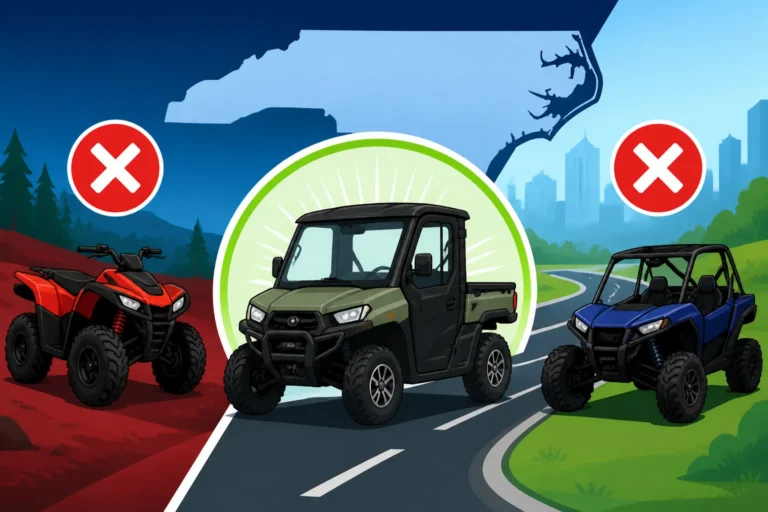
It's crucial not to confuse the farming operations exception with North Carolina's "Modified Utility Vehicle" (MUV) designation. An MUV is a specific category of vehicle that, through significant modification and registration with the DMV, can become street legal for general road use on certain public roads (typically those with a speed limit of 55 mph or less). This involves meeting stringent requirements for engine size, dimensions, safety features (like turn signals, seat belts, speedometer, and mirrors), and passing inspection. You can learn more about this by checking [North Carolina's Modified Utility Vehicle Route].
The key difference is intent and permanence. The farming exception is a temporary, conditional allowance for unmodified ATVs and UTVs to briefly use roads for farm work. An MUV, on the other hand, is a permanently altered and registered vehicle intended for general road use within its specific limitations. You don't "register" your farm ATV under the farming exception; you simply operate it within the bounds of the statute. Attempting to make a "street legal" UTV for general use requires far more than just being a farmer; it requires meeting the full MUV criteria, which most standard ATVs and UTVs don't meet without extensive and costly modifications.
| Feature | Farming Operations Exception | Modified Utility Vehicle (MUV) | Standard ATV/UTV (General Use) |
|---|---|---|---|
| Road Access | Short distances on public roads (not interstates) for farm work. | On public roads 55 mph or less (not interstates) for general use. | Prohibited on all public roads. |
| Purpose | Strictly agricultural operations. | General transportation, recreation within limits. | Off-road recreation or private property work. |
| Registration | No special DMV registration required for farm use. | Required with NC DMV, including titling. | No registration for road use. |
| Modifications | Generally stock machine, but must have basic safety gear (lights). | Extensive modifications (engine size, dimensions, safety features like turn signals, mirrors, speedometer, parking brake). | None for road use. |
| License Plate | No. | Yes, issued by DMV. | No. |
| Inspection | No. | Yes, annual safety inspection required. | No. |
| Insurance | Not explicitly mandated for the machine itself, but recommended. | Required (liability). | Not required for the machine itself, but often for rider/property. |
| Example Use | Crossing road between fields with tools, checking fences. | Driving to a local store, commuting short distances on rural roads. | Trail riding, off-road work on private land. |
Real-World Scenarios and Practical Advice
Understanding the legal text is one thing, but knowing how to apply it in your daily farming life is another. Let's walk through some common situations and practical advice to ensure you're using the farming operations exception responsibly and legally.
Transporting Tools and Livestock Feed
Imagine you need to move a chainsaw, fencing tools, or a small bale of hay from your main barn to a pasture that's across a two-lane county road. This is a classic example of a legitimate use under the farming exception. Your UTV, with its cargo bed, is the perfect vehicle for this task. Before you venture onto the road:
- Secure your load: Ensure tools are tied down and the hay bale won't shift. A loose load is a safety hazard and a legal liability. Cargo nets or tie-downs, perhaps from SuperATV's extensive utility offerings, are invaluable here.
- Check your lights: Make sure headlights, taillights, and brake lights are working.
- Be visible: Consider an SMV triangle on the back of your UTV. Wear brightly colored clothing.
- Drive defensively: Assume other drivers don't see you. Signal your turns clearly, and move over to let faster traffic pass if possible. This short trip, while legal, still demands vigilance.
Similarly, if you're checking cattle in a far pasture and need to bring a salt block or a bucket of feed, using your ATV for a short road crossing to access that pasture falls squarely within the exception. The key here is the direct agricultural purpose.
Crossing Roads Between Fields and Barns
Many farms are split by public roads. It's not uncommon to have crop fields on one side and a barn or additional pastures on the other. The farming exception is a lifesaver for these situations. You can use your ATV or UTV to cross these roads directly.
- Stop, look, and listen: Treat any road crossing with the same caution you would a railroad crossing. Come to a complete stop, look both ways multiple times, and listen for approaching vehicles.
- Cross directly: Don't linger on the road. Cross at a 90-degree angle if safe, to minimize time spent in traffic lanes.
- Shortest route: If there's an intersection or a specific point that offers the best visibility and shortest crossing, use that. Don't drive down the road a quarter-mile just to cross at a more convenient spot if a direct crossing is safer and shorter. Remember, the intent is minimal road exposure. [North Carolina Rules for Crossing a Road] offers more guidance on this.
If you have to ride along the road for a short distance before crossing or accessing an entrance, try to stay as far to the right as safely possible. Be acutely aware of driveways and blind spots where vehicles might merge onto the road unexpectedly.
Avoiding Common Pitfalls and Misinterpretations
The biggest pitfall is expanding the definition of "farming operations" beyond its legal intent. Here are some common traps to avoid:
- The "quick errand": You're on the farm, realize you need a specific part or a gallon of milk, and the store is just a mile down the road. This is not covered. Personal errands, even if you are a farmer, are not "farming operations."
- Recreational detours: You're moving machines between fields, but decide to take a short detour to show a buddy a cool new trail. Once you deviate from the direct path for farming, the exception ceases to apply.
- The "neighborly visit": Using your farm ATV to visit a neighbor, even if they're also a farmer, is typically not a "farming operation" for your vehicle, unless you are actively performing a service for their farm that falls under your agricultural business.
- Operating after hours without proper lighting: While farm work can run late, operating on a public road after dark without fully functional and visible head/taillights is a recipe for disaster and a definite citation. Refer to [North Carolina Rules for Riding After Dark].
- Assuming you're "street legal": Never think that because you're allowed on the road for farm use, your machine is now considered street legal for all purposes. This distinction is paramount. You are driving a farm machine on the road, not a road-legal vehicle.
- Ignoring other traffic laws: Speeding, running stop signs, or reckless operation will still result in citations, regardless of your farming purpose. The exception allows access, not immunity.
By staying mindful of these details, North Carolina's farming operations exception can be a truly valuable tool for managing your land and your livelihood efficiently and safely.
Disclaimer
This article is for general informational purposes only and does not constitute professional advice. Laws, prices and regulations vary by location and change over time. Consult a qualified professional for guidance on your specific situation.