Why an MUV Is the Only Street-Legal Path
It's incredibly frustrating when you invest in an ATV or UTV, dreaming of hitting both trails and paved roads, only to discover that the rules about street legality in North Carolina are about as clear as a mud puddle after a heavy rain. Many riders assume a few simple modifications will do the trick, or that certain exemptions apply more broadly than they actually do. This guide will walk you through why the Modified Utility Vehicle (MUV) is, in nearly all practical scenarios, your one and only path to legally driving your off-road machine on North Carolina's public streets and highways.
The Frustration of Street-Legal ATVs and UTVs in North Carolina
So many of us buy an ATV or UTV with grand visions of hitting the trails, sure, but also being able to zip down a quiet country road to a friend's house, or even just crossing a short stretch of pavement to get from one section of private land to another. The reality in North Carolina, however, often slams the brakes on those dreams. It’s not just a little confusing; it can feel like the state is actively trying to keep these machines off the roads, and for good reason, from their perspective. They're built for off-road, not for interacting safely with cars, trucks, and school buses. The challenge lies in reconciling the desire for convenience with the strict definitions of highway safety.
The Common Misconceptions
One of the biggest sources of confusion stems from how people interpret various exceptions. You hear whispers about "farm use" or "beach access" and think, "Aha! That's my loophole!" But these exceptions are far more narrow and specific than most riders realize. For example, the farm use exemption often applies only to a very specific set of circumstances, usually tied directly to ongoing farming operations, and only on roads adjacent to or connecting parts of a farm. It doesn't mean you can just slap a "farm use" sticker on your rig and drive to the hardware store. Similarly, while some beaches do allow ATV or UTV riding, those are typically highly regulated areas with their own specific rules, age limits, and permits, and they are definitely not considered "street legal" paths for general road use.
Another widespread misconception is about merely "crossing a road." While North Carolina law does provide for crossing a highway or public vehicular area, it's generally meant for a quick, perpendicular traverse when moving from one off-road section to another. It's not a green light to drive on the road for any distance. Thinking you can just drive a block or two on a public street because it's "just a crossing" is a risky gamble that can lead to fines and headaches. These limited allowances are often misinterpreted as a general license for short-distance road travel, leading to unfortunate encounters with law enforcement.
Why Standard ATVs and UTVs Don't Qualify
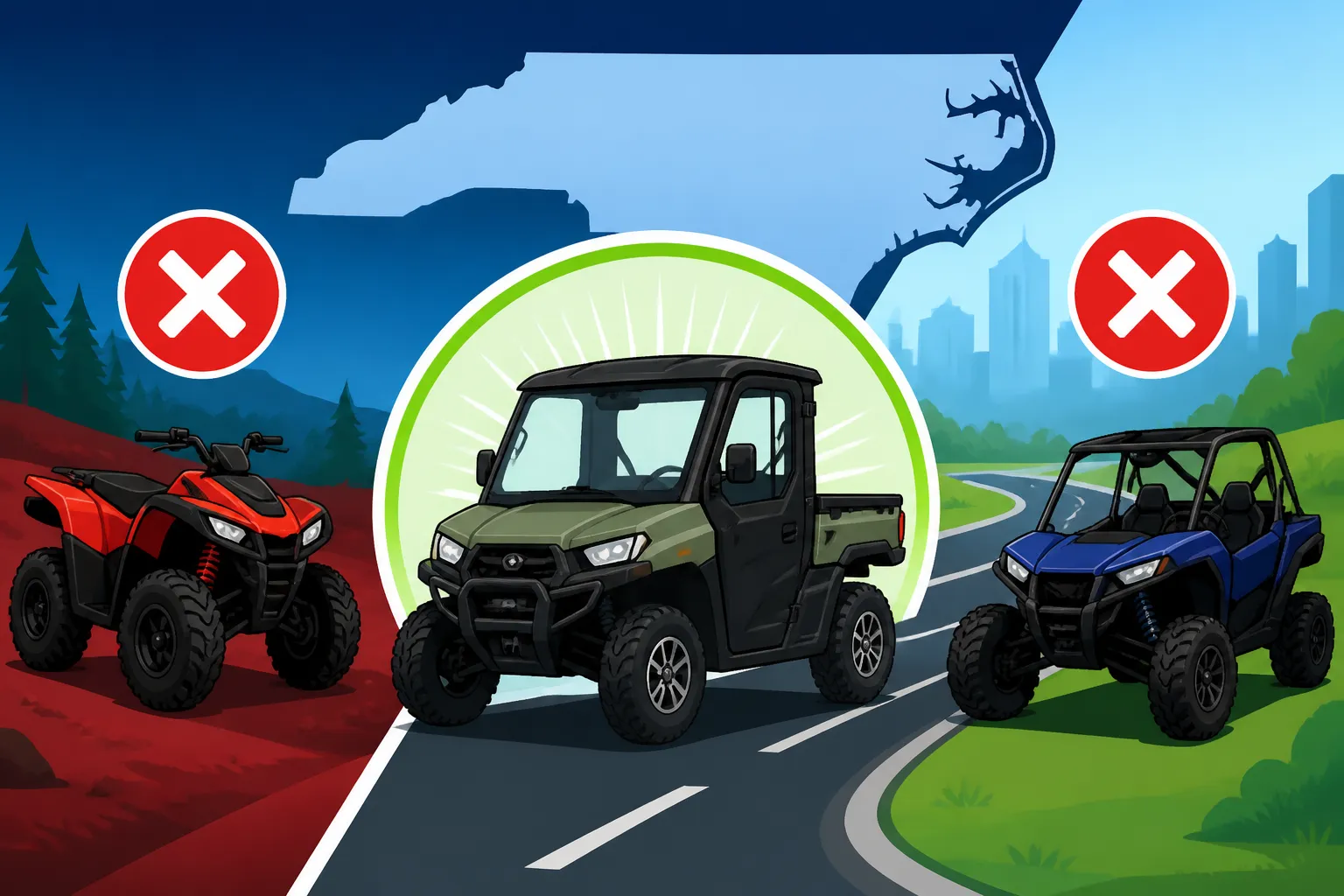
At their core, most ATVs and UTVs simply aren't designed or equipped for safe road travel alongside conventional vehicles. Think about it: they lack many of the safety features we take for granted in cars. We're talking about things like proper turn signals, side mirrors, windshields, specific lighting requirements, and even basic elements like a speedometer or an emergency brake that meets road-vehicle standards. Their dimensions, too, are often problematic. Many side-by-sides, for instance, are designed to be wider for stability off-road, which can make them too wide for certain road classifications or simply incompatible with regular traffic lanes.
Beyond the physical attributes, there's the fundamental issue of how the state classifies them. A typical ATV or UTV is categorized as an "off-highway vehicle" (OHV). This designation means, by definition, that it's intended for off-road use. The North Carolina Department of Motor Vehicles (DMV) doesn't just look at what you call your machine; they look at its manufacturer's specifications, its original intent, and whether it meets the stringent safety and equipment standards for a road-going vehicle. Without specific modifications and a reclassification through the MUV process, your standard quad or side-by-side will never pass muster as a street-legal vehicle in the eyes of North Carolina law.
Understanding the North Carolina Modified Utility Vehicle (MUV)
When the regular routes are blocked, sometimes a special path opens up, and that's precisely what the Modified Utility Vehicle (MUV) designation is in North Carolina. It's not a generic term; it's a very specific classification designed to bridge the gap between off-road capability and street legality, but it comes with a significant list of stipulations. For those of us who really want to use our machines on pavement, understanding the MUV is absolutely critical.
What Exactly is an MUV?
An MUV, or Modified Utility Vehicle, is essentially an off-road utility vehicle that has been extensively modified and equipped to meet specific North Carolina safety and design standards, allowing it to be legally operated on certain public roads. The state recognized that while standard ATVs and UTVs are not suitable for road use, there was a growing demand from owners of utility-style machines – often side-by-sides – who wanted to use them for practical purposes that sometimes involved public roads, particularly in rural or recreational areas.
The purpose of the MUV designation is not to open up every UTV to highway travel, but rather to provide a legal framework for a particular class of modified machines that can demonstrate they are as safe as possible when sharing the road with other vehicles. It’s a recognition that some utility vehicles, with the right modifications, can be made to fit into the broader ecosystem of street-legal vehicles. This is why the requirements are so stringent; they are meant to ensure a reasonable level of safety and visibility when these machines leave the dirt and hit the asphalt.
The MUV's Distinctive Legal Status
The MUV's legal status is what truly sets it apart from any other ATV or UTV in North Carolina. While your typical quad remains an off-highway vehicle, limited to private land or designated trails, an MUV, once properly titled and registered, becomes a legitimate road-going vehicle within defined parameters. This isn't just a slight adjustment; it's a complete reclassification in the eyes of the DMV. You're not just getting a sticker; you're transforming your machine's legal identity.
This distinctive status is crucial because it means an MUV is eligible for things like state titling, registration plates, and proper insurance coverage typically associated with automobiles. It allows you to legally drive on public roads where other ATVs and UTVs simply cannot. The state has created a specific [North Carolina's Modified Utility Vehicle Route] precisely because the standard laws for off-road vehicles are so restrictive regarding public road use. Without going through the MUV process, any attempt to operate a non-exempt ATV or UTV on public roads will put you in violation of the law, plain and simple.
Key Requirements to Become an MUV in North Carolina
So, you're convinced the MUV path is for you? Great! But be warned, it's not a walk in the park. Converting your utility vehicle into a street-legal MUV in North Carolina involves meeting a very specific, detailed list of requirements. These aren't suggestions; they are mandates that the North Carolina DMV enforces to ensure these modified machines can safely share public roads. Missing even one item can mean your application gets denied, sending you back to the drawing board. It truly outlines [What Makes a Machine an MUV in North Carolina].
Engine Size and Speed Capabilities
One of the first and most critical hurdles for any aspiring MUV is its engine and speed. North Carolina law specifically states that an MUV must have an engine displacement of [More Than Twenty-Four Hundred Cubic Centimeters]. That's a whopping 2,400cc! This immediately disqualifies a vast number of ATVs and UTVs right off the bat, as many, even powerful side-by-sides, come with engines smaller than this threshold. The reasoning behind this is likely tied to the need for these vehicles to keep up with the flow of traffic on certain roads, ensuring they aren't creating a hazard by being too slow.
Beyond just the engine size, the machine also needs to be capable of a certain speed. It must be able to achieve at least [40 mph to Qualify as an MUV]. This goes hand-in-hand with the engine size requirement. A powerful engine is great, but if the gearing or overall design prevents it from reaching a safe operating speed on public roads, it still won't qualify. This combination of substantial engine power and minimum speed capability is a fundamental safety measure, aiming to integrate MUVs more seamlessly into traffic.
Dimension Requirements
The physical size and shape of your utility vehicle also come under intense scrutiny when applying for MUV status. The state has very precise measurements that must be met, and these can be tricky for many factory-built machines. First, the MUV must have a length of no more than [The 142-Inch Length Requirement]. This is measured from the farthest point forward to the farthest point backward, including bumpers, hitches, or any other permanent fixtures. Then, there's a strict width limit: your machine cannot exceed [The 58-Inch Width Requirement]. This is often where many popular side-by-sides run into trouble, as they are frequently wider than 58 inches for off-road stability. If your machine is wider, you'll need to explore options like narrow offset wheels, which can sometimes compromise stability off-road. Finally, the height of the MUV, measured from the ground to the highest point, must not be more than [The 70-Inch Height Requirement]. These dimension rules are in place to ensure the MUV fits comfortably in a standard lane of traffic and doesn't pose an overhead clearance issue.
Essential Safety and Roadway Equipment
This is where the "Modified" part of MUV really comes into play, as most off-road machines don't come factory-equipped with the full suite of road-legal safety features. To be deemed an MUV, your machine must have:
- Speedometer: Essential for maintaining legal speeds.
- Turn Signals: Both front and rear, clearly visible, allowing you to signal intentions to other drivers. Many aftermarket kits, such as those from SuperATV, offer comprehensive turn signal setups for UTVs that can help meet this requirement.
- Mirrors: A rearview mirror and at least one exterior rearview mirror on the driver's side are typically required, just like a car.
- Seatbelts: For all designated seating positions. These must be properly installed and functional.
- Parking Brake: A fully functional parking or emergency brake system.
- Lights: This includes headlamps, tail lamps, brake lamps, and often a license plate lamp, all meeting DOT (Department of Transportation) standards for brightness and visibility.
It's not just about having these components; it's about having them installed correctly and functioning reliably. You might find yourself adding an entire wiring harness, new switchgear, and multiple lights to get everything up to snuff. This often requires careful planning and sourcing of aftermarket parts.
The Process of Getting Your MUV Street-Legal
So, you've got your machine modified to meet all the physical and dimensional requirements. That's a huge step! But the journey to street-legality isn't over yet. The next phase involves navigating the administrative labyrinth of the North Carolina DMV to officially register and title your MUV. This is where your machine truly transitions from an off-road toy to a recognized road-going vehicle. It demands meticulous attention to paperwork and adherence to specific procedures.
The DMV Application and VIN Assignment
The first critical step in this process is typically getting a Vehicle Identification Number (VIN) assigned by the North Carolina DMV, especially if your machine doesn't have a VIN that the state recognizes as a road-legal identifier. For machines that started life strictly off-road, the manufacturer's VIN might not be sufficient for a street-legal title. The DMV needs to inspect your machine to verify that it meets all the MUV criteria. This inspection is crucial, and they'll be checking everything from your engine size and dimensions to the functionality of all the added safety equipment. Once it passes, the DMV will assign it [A VIN Assigned by the North Carolina DMV] specifically for road-use classification, if necessary.
After the inspection and VIN assignment (if required), you'll proceed with the title application. This involves filling out the appropriate DMV forms, presenting proof of ownership for the original machine, and providing documentation that all modifications meet the MUV standards. This can feel a lot like [Titling a Homebuilt Machine in North Carolina], even if yours was factory-built but extensively modified. Be prepared for a detailed review of your paperwork; the state wants to be absolutely sure that every requirement has been met before they put a license plate on your utility vehicle.
Insurance and Inspection Considerations
Just like any other vehicle on North Carolina roads, an MUV must be insured. This isn't optional; it's a legal requirement before you can register it. You'll need to obtain liability insurance that meets the state's minimum coverage requirements for motor vehicles. It's wise to shop around and be upfront with insurance providers about your vehicle's MUV status, as it's not a standard car or truck. You'll need to show proof of this insurance when you register your MUV. Don't skip this step, as driving uninsured in North Carolina can lead to severe penalties. Knowing the [North Carolina MUV Insurance Requirements] ahead of time will save you headaches.
Beyond insurance, your MUV will also be subject to regular safety and emissions inspections, just like a conventional car or truck. These inspections ensure that your MUV continues to meet safety standards and, where applicable, environmental regulations. For safety, they'll check things like brakes, lights, tires, and steering. Emissions requirements can vary by county, so it's important to know if your county has them and if your MUV, with its potentially modified engine or exhaust, will pass. Understanding the [North Carolina MUV Inspection Requirements] is key to staying compliant year after year.
Where You Can Legally Ride an MUV in North Carolina
Now for the payoff! After all that hard work modifying your machine and navigating the DMV, you finally have a legitimate, street-legal MUV. But before you hit the open road with wild abandon, it's crucial to understand where you can actually ride it. While an MUV opens up possibilities that regular ATVs and UTVs don't have, it's not a carte blanche to drive anywhere and everywhere. There are still restrictions and limitations designed to ensure safety and smooth traffic flow.
Navigating Public Roads
The primary benefit of an MUV is the ability to operate it on many of North Carolina's public roads. Specifically, an MUV is generally allowed on roads with a posted speed limit of 55 mph or less. This is a crucial distinction. You won't be taking your MUV on interstates or major highways where speeds typically exceed 55 mph. The whole point of the MUV designation, including the 40 mph minimum speed and the 2,400cc engine, is to ensure it can keep pace with traffic on secondary roads, residential streets, and rural routes.
Think of it this way: your MUV is perfect for cruising through your local town, driving to the nearby trail, or accessing different parts of your property that are separated by a public road. This is outlined clearly in the [North Carolina MUV Street Legal Requirements]. For example, if you live in a rural area and need to get to the nearest convenience store or a friend's house just a few miles away, and the route consists of roads posted at 35 mph or 45 mph, your MUV is your ticket. Just remember that all traffic laws apply – speed limits, stop signs, signals, and yielding right-of-way.
Limitations and Restrictions
Despite its street-legal status, an MUV still comes with limitations. As mentioned, roads with speed limits above 55 mph are typically off-limits. This means no interstates, no four-lane divided highways where traffic moves at 65 mph or 70 mph. The state's intention is not to make these vehicles compete with fast-moving highway traffic, but rather to serve as practical utility vehicles on slower, local thoroughfares.
Furthermore, while an MUV can navigate [Roads Posted Fifty-Five or Less], local ordinances can still impose additional restrictions. Some municipalities might have specific rules or outright bans on MUVs on certain streets within their jurisdiction, even if the state allows it. It's always a good idea to check with local county and city authorities if you plan on extended use within specific urban or suburban areas. This ensures you're not caught off guard by a local rule that might override the general state allowance. For instance, even though an MUV is street-legal, it's still fundamentally different from a car, and you might find that some law enforcement officers, especially if unfamiliar with the specific MUV classification, might initially be skeptical or require additional clarification. The distinction between simply [Crossing a Road on an ATV in North Carolina] and driving an MUV on the road is vast and critical to understand.
The Practical Realities and Alternatives
Embarking on the MUV journey is a significant undertaking, one that requires a substantial investment of both time and money. While it’s the most comprehensive path to street-legality for your utility vehicle in North Carolina, it's not for everyone. It's essential to weigh the practical realities of what it takes versus what other options, limited though they may be, might exist for your specific needs. The goal is always to find the safest and most legally sound way to enjoy your machine.
The Investment and Effort Required
Let’s be honest: transforming your off-road machine into a street-legal MUV is not a cheap or easy endeavor. First, you might need to purchase a specific utility vehicle that already meets, or can easily be modified to meet, the stringent engine and dimension requirements. Many standard side-by-sides, as we discussed, particularly struggle with the [Why Most Side-by-Sides Miss the Mark] on the width and engine size rules. Even if your base machine is suitable, the cost of adding all the required safety equipment – the turn signals, mirrors, windshield, DOT-approved lights, parking brake, and potentially even specialized wheels or tires to meet width requirements – can add up quickly. High-quality aftermarket parts, like those offered by SuperATV for UTV customization, can be a great option, but they still represent a considerable expense.
Beyond the financial outlay for parts and potentially professional installation, there's the time commitment. You'll spend hours researching, sourcing parts, installing them, and then, of course, dealing with the DMV. The inspection process itself requires your machine to be in perfect compliance. This isn't a weekend project; it's a dedicated effort to navigate a very specific legal avenue. You need to be prepared for the possibility of multiple trips to the DMV or inspection station if something isn't quite right the first time.
Other Limited Exceptions and Their Scope
While the MUV route is the most robust way to achieve street legality, it's worth briefly touching on other very limited exceptions that sometimes cause confusion but do not equate to general street-legal status.
One such exception is for [North Carolina's Farming Operations Exception]. This allows ATVs and UTVs to be operated on public roads only for the purpose of carrying out agricultural operations, and usually for short distances between fields or farm properties. It's very narrowly defined and not intended for personal recreational use or general transportation. You can't use this exception to drive to town for groceries or to meet friends at a restaurant. It's strictly about farm business.
Another exception that sometimes comes up is [North Carolina's Ocean Beach Rule]. While certain designated stretches of North Carolina beaches do permit ATV or UTV use, these are specific, regulated areas. This permission is typically granted by local municipalities for beach access and recreation within those boundaries, and often comes with its own set of rules regarding age, time of day, and permits. It does not grant you the right to drive your machine on public roads to get to the beach, or to use public roads as a general mode of transportation. It’s beach-specific, not street-specific.
These limited exceptions serve very particular purposes and should never be conflated with the comprehensive street-legal status offered by the MUV designation. For broad access to North Carolina's public roads, the MUV remains the definitive, albeit challenging, path forward.
Disclaimer
This article is for general informational purposes only and does not constitute professional advice. Laws, prices and regulations vary by location and change over time. Consult a qualified professional for guidance on your specific situation.