Riding a North Carolina Street on Farm Business
It's a common dilemma for our North Carolina farm families: you've got acres to cover, equipment to move, and livestock to tend, but sometimes the quickest or only way from one part of your property to another involves a public road. You know you can't just cruise your ATV or UTV down the highway like a regular car, but you've heard whispers about a "farm exception." This guide is here to untangle the complexities of North Carolina's specific rules, helping you understand when and how you can legally use your off-road machine on public roads for legitimate farm business, and when you absolutely need to keep it off the pavement.
The Foundation: North Carolina's Farming Operations Exception
North Carolina law recognizes that farming isn't confined to a single field. There are often multiple tracts of land, barns, and supply houses that require equipment and personnel to move between them, sometimes necessitating a brief venture onto a public road. This understanding forms the basis for the "farming operations" exception, which is distinct from trying to make your ATV or UTV fully street legal. It’s a very specific allowance, not a blanket permission slip for joyriding on the asphalt.
What Actually Counts as "Farm Business" in North Carolina
When we talk about "farm business" in the eyes of North Carolina law, we're not talking about taking your ATV to pick up groceries in town. We're talking about tasks that are directly and exclusively related to the operation and maintenance of a farm. This could involve hauling feed from one barn to a distant pasture, moving specialized equipment like a sprayer or a small tiller from one field to another, or even checking on livestock across multiple parcels of land. The key here is the purpose: the machine must be used as part of a legitimate agricultural, horticultural, or silvicultural operation.
Think about a small family farm near Statesville that has a few plots of tobacco and a couple of acres of sweet potatoes. The farmer might need to transport small bags of fertilizer or seed from the main barn to a field a mile down a secondary road. Or perhaps a cattle rancher in the foothills needs to mend a fence line that runs alongside a quiet county road, and their UTV is the most efficient way to carry tools and fencing materials to the repair site. These are the kinds of activities that typically fall within the spirit of the farm business exception. It's about necessity for the farm, not convenience for the operator.
Which Roads Are Open Under the Farm Exception
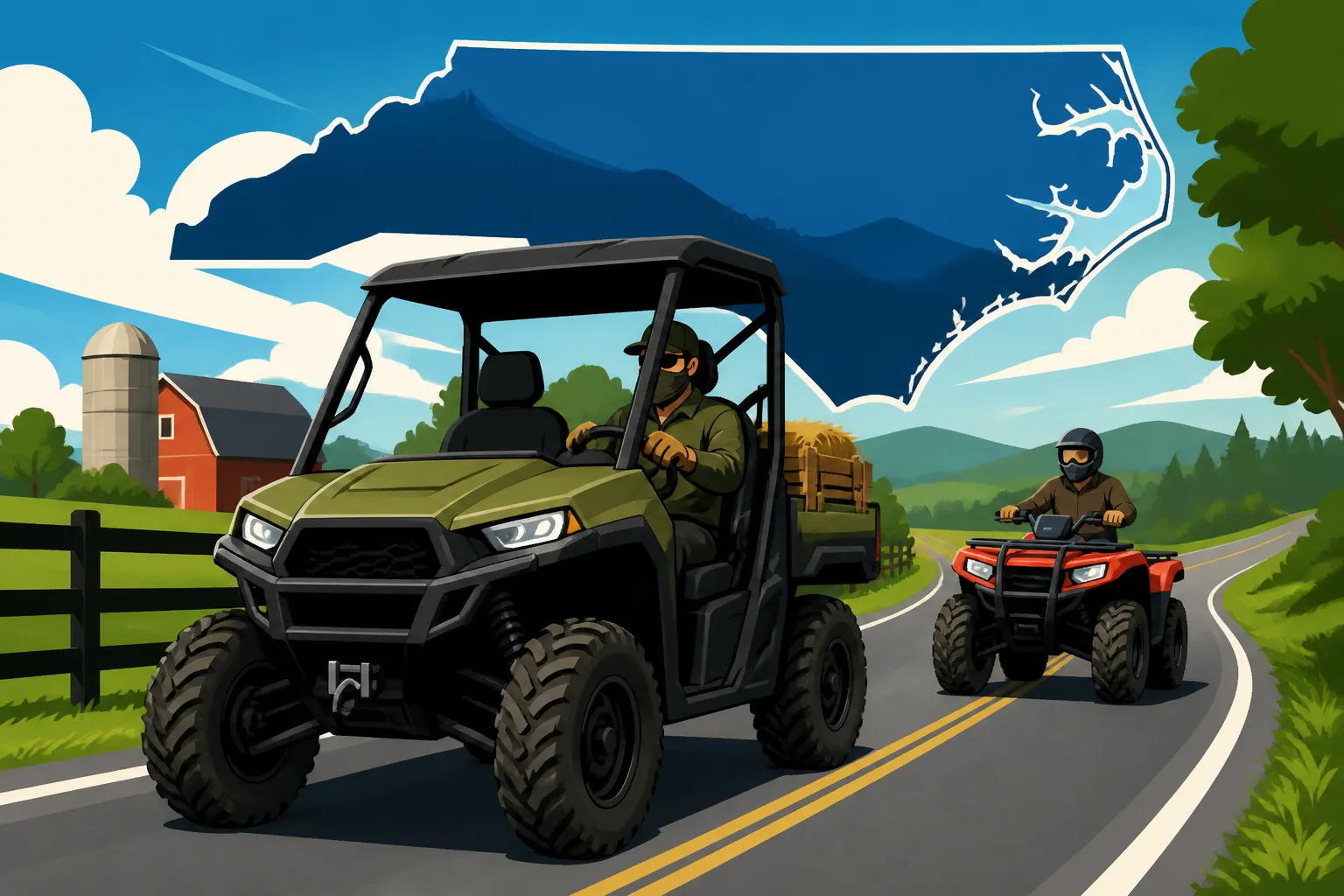
The farm exception primarily applies to situations where you need to cross a public road or travel a short distance along one to connect different parts of your farming operation. We're generally talking about secondary roads, local county roads, or even unimproved gravel roads that might bisect your property or provide access between fields. You absolutely cannot take your ATV or UTV onto interstates or multi-lane highways under this exception. Even on smaller roads, the intent is usually for transit between farm parcels, not for sustained travel or daily commuting.
For example, if your farm in Nash County has fields on both sides of a state-maintained rural road, you might be allowed to cross it directly or travel a very brief stretch to get from one field to the next. However, riding that same road for five miles into Rocky Mount to grab a part for your tractor would likely fall outside the scope of this exception. The goal of the law is to facilitate farm work, not to bypass vehicle registration and safety requirements for general road use. It's a fine line, and understanding [North Carolina Rules for Crossing a Road] is crucial, as this exception is typically for minimal and incidental road use.
Who Can Operate a Machine Under This Exception
The "who" is just as important as the "what" and "where" when it comes to the farm exception. Generally, the operator of the ATV or UTV must be directly involved in the farming operation. This includes the farm owner, immediate family members who actively participate in the farm work, or bona fide farm employees. The law is designed to aid the farm, not to provide a loophole for anyone to ride their machine on public roads.
While the exception itself doesn't typically require a driver's license for the operator of farm equipment on farm property, when you venture onto public roads, even under this specific exception, the rules can become a bit grayer. For general road use, standard licensing requirements apply. It's always safest to ensure that anyone operating an ATV or UTV on a public road, even for a short distance under the farm exception, is of appropriate age and possesses a valid driver's license. Furthermore, remember the general [North Carolina Rules for Riders Under 16] still apply when operating off-road, and while the farm exception might allow road crossings, it doesn't necessarily override fundamental safety requirements.
Understanding the Specific Legal Requirements and Limitations
It's easy to misunderstand the farm exception as a "free pass" to use your ATV or UTV on any road, but that's simply not the case. North Carolina's law is quite precise, carving out a very narrow allowance that comes with its own set of implicit expectations, if not explicit regulations. This isn't about transforming your off-road machine into a street-legal vehicle; it's about facilitating necessary farm work with minimal road exposure.
The Definition of a "Farming Operations" Machine
North Carolina law, specifically in sections related to motor vehicles, often distinguishes between general-purpose vehicles and those used exclusively for "farming operations." An ATV or UTV, when used solely for farm business, falls into this latter category for the purpose of the exception. This means it’s considered an implement of husbandry or a piece of farm equipment. This designation is critical because it's what separates it from standard recreational use or the more stringent requirements of a [North Carolina's Modified Utility Vehicle Route].
For instance, a UTV outfitted with a spray rig, a feed spreader, or even just carrying tools like shovels and fence posts, clearly demonstrates its role in farming operations. The intent and primary use of the machine define its status under this exception. If your Polaris Ranger is primarily used to haul equipment and supplies between fields and barns, then you're on solid ground. If, however, it's typically used for trail riding on weekends and only occasionally crosses a road to get to a friend's house, it likely doesn't fit the "farming operations" definition for road use. The emphasis is on the machine's utility for the farm, not its recreational potential.
Equipment Requirements for Farm Business Road Use
Here's where things get a little tricky, as the law doesn't explicitly list all the equipment required for an ATV or UTV operating under the farm exception. Unlike a Modified Utility Vehicle (MUV) which has a specific checklist for mirrors, turn signals, and a speedometer, the farm exception is less prescriptive. However, common sense and general safety principles for operating any vehicle on a public road still apply. While you might not need the full suite of street-legal modifications, you should absolutely ensure your machine is safe and visible.
At a minimum, your ATV or UTV should have working headlights and taillights, especially if there's any chance you'll be on a road during dawn, dusk, or night. Functional brakes are a given, as is a spark arrester if you're operating on forest lands that are also part of your farm. Consider adding a slow-moving vehicle (SMV) triangle to the rear of your machine, even if not explicitly mandated for ATVs/UTVs under this specific exception, as it greatly enhances visibility for other drivers. This is a practice often seen with tractors and other farm implements on public roads. Products from companies like SuperATV offer excellent lighting kits and safety accessories that can significantly improve your machine's visibility, making those short road transits much safer for everyone involved. While the official [North Carolina Equipment Rules for ATVs] mostly cover off-road specific requirements, applying relevant aspects for road safety is just good practice.
Operational Rules and Best Practices on Public Roads
Even with the farm exception, operating an ATV or UTV on a public road demands respect for traffic laws and road etiquette. This isn't a free-for-all. You should drive defensively, maintaining awareness of other vehicles, and always yield to oncoming traffic. Speed limits, while often too high for an ATV or UTV, still apply, and you should drive at a speed that is safe for your machine and the road conditions. If you're impeding traffic, it's wise to pull over when safe to let vehicles pass.
Imagine you're moving a small utility trailer loaded with fencing supplies across a short stretch of rural highway in Wilkes County. You'll need to use hand signals if you don't have turn signals, stay as far to the right as safely possible, and be extra cautious at intersections. It's a good idea to have a clear line of sight, be aware of blind spots for other drivers, and avoid using busy roads during peak traffic times if at all possible. This mindful approach minimizes risk and helps prevent misunderstandings with law enforcement or other drivers. Remember, the privilege of the farm exception comes with the responsibility of safe and courteous road use.
Common Scenarios and Misconceptions Around Farm Use
The farm exception for ATVs and UTVs in North Carolina is often a source of confusion. People hear "can be ridden on the road" and immediately jump to conclusions that aren't quite accurate. It's crucial to distinguish between legitimate farm business use and activities that, while perhaps convenient, simply don't fall under the legal umbrella of the exception. Getting this wrong can lead to costly tickets and potential legal trouble.
Distinguishing Farm Use from General Recreational Riding
This is perhaps the biggest point of confusion. The farm exception is not a loophole for recreational riding on public roads. If your primary purpose for being on the road is anything other than a direct and necessary task for your farming operations, you are likely in violation of the law. This means no quick trips to the gas station for snacks, no joyrides to visit neighbors, and certainly no taking the "scenic route" to another trail system.
Consider a farmer near Dunn who needs to move a small portable irrigation pump from one field to another, requiring a quarter-mile drive on a paved county road. This is legitimate farm business. Now, imagine that same farmer, after finishing the work, decides to take their UTV into town to grab lunch at the local diner. That's recreational or personal use, not farm business, and they would be subject to penalties for operating an unregistered, non-street-legal vehicle on the road. The intent is paramount. If you're stopped by law enforcement, you should be able to clearly articulate and demonstrate how your current activity directly supports your farming operation.
Carrying Passengers and Hauling Loads
When using your ATV or UTV for farm business on public roads, you might naturally need to carry a passenger or haul a load. The question is, what are the limits? Generally, if the passenger or the load is directly related to the farming operation, it's more likely to be permitted. For example, if your farmhand needs to ride with you to help mend a fence, that's usually acceptable. If your child is riding with you purely for fun, it's not.
Hauling loads is often a core function of UTVs on a farm. Whether it's tools, feed, harvested crops, or small equipment, your machine's cargo capacity is vital. Ensure that any load is securely fastened, does not exceed the manufacturer's weight limits for the machine or its hitch, and does not obstruct your vision or the machine's lights. Overloading can compromise steering and braking, turning a simple road crossing into a dangerous situation. Always use common sense and err on the side of caution. If you’re towing a trailer, ensure it’s properly hitched and that the combined length doesn't create an unsafe condition for public road travel.
Crossing a Road vs. Riding Along a Road
There's a critical legal distinction in North Carolina between crossing a public road and riding along a public road, and this distinction is particularly relevant to the farm exception. Generally, the farm exception most readily applies to crossing a road to access another part of your property. Sustained travel along a road, even if technically connecting farm parcels, can sometimes be viewed differently, particularly by law enforcement.
Think of it this way: a quick, direct traverse from one side of Highway 210 in Sampson County to the other to get to your soy field is typically the clearest example of allowed use. Spending several miles traveling down Highway 210, even if you eventually turn off onto another farm lane, can start to push the boundaries of the exception. The shorter the distance and the more direct the route between farm points, the stronger your case for legitimate farm business use. While some [North Carolina Rules for Riding a Public Street] might apply to an MUV, they don't generally open up all public roads to an ATV or UTV under the farm exception for extended travel. The farm exception is truly designed for the shortest, most practical connection needed for your agricultural duties.
Practical Considerations and Avoiding Trouble
Operating an ATV or UTV on public roads, even under the farm exception, puts you in a different legal landscape than riding solely on private land. It's crucial to be prepared, prioritize safety, and understand how to interact with law enforcement to avoid unnecessary complications. A little foresight can save you a lot of headaches.
Documentation and Proof of Farming Operations
Should you be stopped by law enforcement while using your ATV or UTV on a public road under the farm exception, the officer will likely want to verify that you are, in fact, engaged in legitimate farming operations. Having some basic documentation readily available can make this process much smoother. This could include:
- Proof of Farm Ownership/Operation: A business card for your farm, property tax records showing agricultural land, or a simple letter on farm letterhead stating your role.
- Proof of Current Task: While you might not carry a work order, being able to articulate exactly what farm task you are performing and why it requires road use (e.g., "I'm hauling seed to the lower field, which is across this road") can be very helpful.
- Identification: Always carry your driver's license, even if the primary purpose is farm-related.
This documentation isn't about proving your machine is "street legal" in the traditional sense, but about substantiating your claim to the farm exception. It helps an officer understand the context of your road use quickly and efficiently.
Safety Gear and Visibility When on the Road
While North Carolina's farm exception doesn't typically mandate helmets or specific safety gear for adult ATV/UTV operators on public roads (unless they are under 18, in which case [North Carolina Helmet Law for ATV Riders] applies universally), it's highly advisable to prioritize your safety. Other drivers are not expecting to see an ATV or UTV on the road, especially on higher-speed rural routes.
Wear bright, visible clothing, such as a high-visibility vest, particularly during dawn, dusk, or in inclement weather. As mentioned earlier, a slow-moving vehicle (SMV) triangle is an excellent addition. Ensure all your lights are functioning – headlights, taillights, and brake lights. Consider aftermarket light bars or auxiliary lights from reputable brands like SuperATV to enhance your visibility, especially when operating near dawn or dusk. These small investments in safety can make a huge difference in preventing an accident with a larger, faster-moving vehicle. Remember, being legally allowed to be on the road doesn't make you invincible, and personal safety should always be a top priority.
Understanding Local Ordinances and Law Enforcement Discretion
While North Carolina state law provides for the farming operations exception, local jurisdictions sometimes have their own ordinances or interpretations. What might be tolerated in a very rural county with vast agricultural lands could be viewed more strictly in a county experiencing suburban growth. Law enforcement officers also have a degree of discretion, and your conduct and preparedness can influence their approach.
Building a good relationship with your local sheriff's department or county police can be beneficial. If you're a farmer who frequently needs to cross a particular road, a brief, proactive conversation with local law enforcement to explain your operations and understand their expectations can go a long way. This isn't about getting special permission, but about fostering mutual understanding. Ultimately, it's important to remember that [Who Writes an ATV Ticket in North Carolina] can include local police as well as state troopers, and they will enforce what they understand the law to be. Always operate respectfully and cautiously to avoid any unnecessary encounters.
Comparing Farm Exception to MUV and Other Road-Legal Options
It's vital to recognize that North Carolina offers a very specific "street legal" path for off-road machines, and that's through the Modified Utility Vehicle (MUV) designation. The farm exception is a distinctly different animal. Confusing the two can lead to significant legal trouble. Understanding the differences will help you decide if the farm exception suits your needs, or if you require the full MUV registration process.
The Key Differences: Farm Use vs. Modified Utility Vehicle (MUV)
The farm use exception is about the purpose of the travel – it's incidental road use for agricultural tasks. A Modified Utility Vehicle (MUV), on the other hand, is about the machine itself meeting certain criteria to be legally registered and operated on public roads for general transportation.
Here's a breakdown of the core distinctions:
- Purpose: Farm use is strictly for farming operations, often involving minimal road travel. MUVs are for general public road use, much like a car, though with limitations.
- Equipment: Farm use has implied safety requirements (lights, brakes, visibility) but no explicit list of street-legal modifications. MUVs have very specific requirements for equipment like turn signals, mirrors, windshields, a speedometer, and seatbelts.
- Registration/Titling: An ATV or UTV used solely for farm operations typically does not require a title or registration with the DMV for road use under the exception. MUVs absolutely require [North Carolina MUV Registration Requirements] and a title.
- Road Access: Farm use is generally restricted to crossing or short distances on specific types of roads (secondary, rural). MUVs can use roads with speed limits of 55 mph or less, giving them much broader access, as described in [North Carolina's Modified Utility Vehicle Route].
| Feature | Farm Operations Exception | Modified Utility Vehicle (MUV) Route |
|---|---|---|
| Purpose of Road Use | Incidental travel for legitimate farm business only | General purpose public road travel (with speed/road limitations) |
| Required Equipment | Basic safety (lights, brakes, visibility recommended) | Headlights, taillights, brake lights, turn signals, horn, mirrors, windshield, speedometer, parking brake, seatbelts |
| Registration/Titling | Not typically required for farm use on public roads | Mandatory title and registration with NCDMV |
| Road Access | Crossing, short distances on secondary/rural roads | Roads with speed limit 55 mph or less (excluding interstates) |
| Insurance | Liability recommended, not explicitly required by state law for farm use | Mandatory liability insurance (like a car) |
| Operator Age/License | Driver's license recommended for public road use | Valid driver's license required |
| Highway Use Tax | Typically no Highway Use Tax (if not titled) | Subject to North Carolina ATV Highway Use Tax upon titling |
This table clearly illustrates that while both allow some form of road presence, they are fundamentally different pathways with distinct requirements and limitations.
Why the Farm Exception Doesn't Equal "Street Legal"
The biggest trap many ATV and UTV owners fall into is conflating the farm exception with being "street legal." They are not the same. "Street legal" means your vehicle is equipped, registered, and titled in a way that allows it to operate on public roads with the same general rights and responsibilities as a car (within its vehicle class). The farm exception is a very specific, limited exemption from certain rules, granted only when the machine is performing a very particular type of work.
If you don't meet the definition of "farming operations" and you haven't gone through the MUV titling and registration process, your ATV or UTV is, by definition, an off-road vehicle. Attempting to use it on public roads for anything other than the narrow farm exception will likely result in fines, and potentially having your machine impounded. It's an important distinction that could save you a lot of grief. [Street Legal ATVs in North Carolina: The Short Answer] clearly states that the MUV route is the only true path for general road legality.
When a Modified Utility Vehicle Might Be a Better Fit
If your needs extend beyond purely incidental farm crossings and you foresee regularly using your side-by-side or ATV on public roads for varied purposes – perhaps to visit neighbors, run errands in a small town, or access different hunting parcels that aren't technically part of your farm business – then pursuing the Modified Utility Vehicle (MUV) route is probably your best bet.
Registering your UTV as an MUV gives you significantly more freedom to travel on public roads (those with a speed limit of 55 mph or less) without constantly needing to justify your purpose to law enforcement. Yes, it involves a more rigorous process of outfitting your machine with specific safety equipment, getting a title, registration, and carrying [North Carolina MUV Insurance Requirements], but it provides a clear, defined legal status for road use. For many multi-purpose UTV owners, especially those who split their time between farm work and recreational or general property management across roads, the MUV pathway offers a practical, compliant solution for broader road access.
Disclaimer
This article is for general informational purposes only and does not constitute professional advice. Laws, prices and regulations vary by location and change over time. Consult a qualified professional for guidance on your specific situation.