Why an MUV Has to Top 40 mph
It can feel incredibly frustrating to navigate the maze of rules surrounding off-road vehicles and street legality here in North Carolina. You've got your side-by-side or ATV, it's powerful, it goes fast, and you just want to take it down the road for a bit without breaking the law. But then you hear about "MUVs" and a seemingly arbitrary speed requirement. This guide is going to clear up precisely why your Modified Utility Vehicle (MUV) needs to be able to hit over 40 mph to even be considered for street legality in our beloved Tar Heel State.
The Core Purpose of the 40 mph Requirement
When North Carolina decided to create a path for certain off-road machines to be driven on public roads, it wasn't a free-for-all. The state had to balance the desires of riders with public safety, and a major component of that balance revolved around how these machines would interact with existing traffic. The 40 mph requirement is a cornerstone of this delicate compromise.
Distinguishing MUVs from Other Off-Road Vehicles
Think about your typical ATV or UTV. Most are designed primarily for trail riding, farming, or hunting. While many can reach speeds well over 40 mph on private land or a dedicated trail, their primary purpose isn't highway travel. North Carolina lawmakers needed a clear way to differentiate between these pure off-roaders and a machine that could realistically operate alongside cars, trucks, and SUVs on public roads. The MUV category was created as a bridge, acknowledging that some utility vehicles could, with specific modifications and capabilities, serve a dual purpose.
This distinction is crucial because without it, any fast ATV could potentially claim street legality, leading to chaos and safety concerns. The speed threshold, along with other physical requirements, acts as a filter, ensuring that only machines genuinely suited for road integration are even considered. It's about defining the vehicle's intended and safe operational environment, rather than just its maximum theoretical speed on a straightaway.
Safety and Integration with Road Traffic
Imagine trying to drive a vehicle that maxes out at 25 or 30 mph on a road where the speed limit is 45 or 55 mph. It creates a significant speed differential, and that, my friends, is a recipe for disaster. North Carolina's roads, particularly our secondary highways and rural routes, often have speed limits ranging from 35 to 55 mph. A slow-moving vehicle forces following traffic to slow down drastically or make dangerous passing maneuvers.
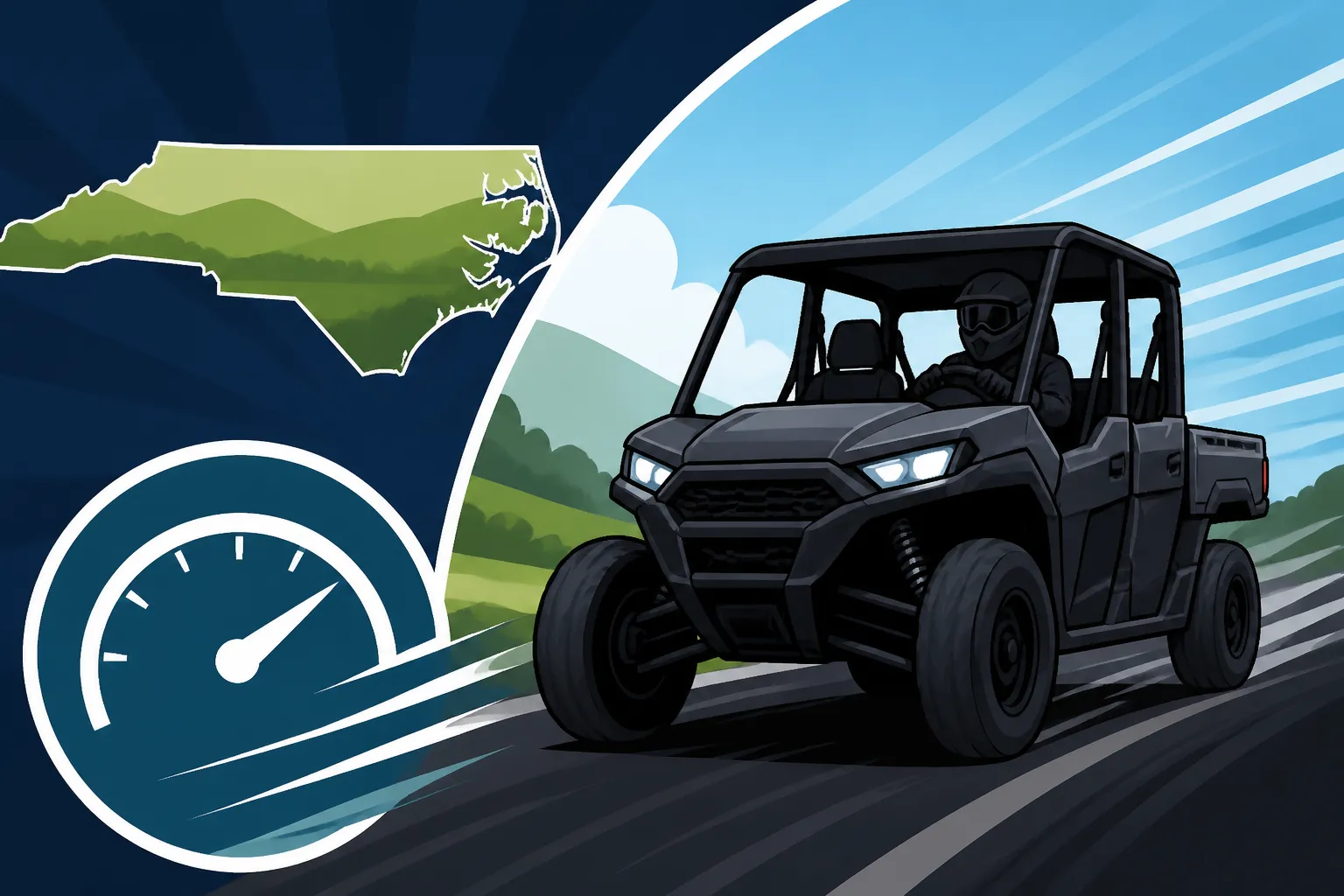
The 40 mph minimum ensures that an MUV can, at the very least, keep pace with traffic on most roads posted 55 mph or less. It helps prevent those frustrating and dangerous bottlenecks caused by vehicles that simply can't maintain the flow. This isn't just about convenience; it's a fundamental safety consideration to minimize the risk of rear-end collisions and other accidents. The state wants to ensure that if you're going to share the road, you're doing so in a way that doesn't put yourself or others unduly at risk. For a deeper dive into road rules, check out [North Carolina Rules for Crossing a Road].
The Legislative Intent Behind the Speed Limit
The speed requirement isn't just an arbitrary number pulled out of thin air; it's part of a broader legislative framework designed to define what constitutes a Modified Utility Vehicle. When North Carolina enacted these rules, they looked at what characteristics made a vehicle truly "utility" while also capable of street use. This included not just speed, but also [Why an MUV Needs More Than 2,400cc], specific dimensions, and certain safety equipment. The speed element serves to ensure the MUV isn't acting as a major impedance to traffic flow.
The general idea was to allow some utility vehicles to be registered and titled for road use, provided they met a rigorous set of standards that essentially made them more like a small car or truck in terms of roadworthiness. Without the speed requirement, the MUV definition would lose a critical component of its road-readiness. It's about setting a standard that says, "If you want to operate this kind of machine on our public roads, it needs to perform at a baseline level that aligns with other road-going vehicles." This is a key part of [North Carolina's Modified Utility Vehicle Route].
What the 40 mph Means for MUV Owners in North Carolina
So, you're looking at your machine and wondering if it makes the cut. The 40 mph rule has some very real, practical implications for you as an MUV owner in North Carolina. It's not just a number; it's a gateway to legal road access, provided you meet all the other criteria too.
Proving Your MUV Meets the Speed Requirement
This is where it can get a little tricky. It's not enough for your machine to feel like it can go over 40 mph. You need official documentation. Typically, the North Carolina DMV will look for manufacturer specifications. This usually comes in the form of a Manufacturer's Certificate of Origin (MCO) or a clear spec sheet from the manufacturer that explicitly states the top speed of the vehicle. If your MCO says the top speed is 35 mph, even if you've had it doing 50 mph on a gravel road, the state isn't going to accept it.
If your machine has been heavily modified or is a homebuilt project, proving this can be a significant hurdle. The DMV isn't set up to do speed tests, nor would they want to. They rely on established, verifiable data. This means that if you're considering buying a machine with the intent of making it an MUV, you absolutely need to verify its official top speed before you sign any paperwork. Always get that information in writing, preferably directly from the manufacturer's published specifications.
Practical Implications for Riding Public Roads
Once your MUV is officially registered and titled, and it meets all the MUV criteria including the 40 mph speed, you gain the privilege of driving it on public roads in North Carolina with a posted speed limit of 55 mph or less. This opens up a lot of possibilities for getting to trailheads, riding between private properties, or just cruising down a scenic backroad. However, it's critical to remember that this does not include interstates, controlled-access highways, or roads with higher posted speed limits.
You still need to operate it safely, follow all traffic laws, and be mindful of other vehicles. The 40 mph minimum is about capability, not an excuse to drive recklessly. For specific guidelines on road usage, you might want to review [North Carolina Rules for Riding a Public Street]. You'll also need to have proper documentation on hand, including your title and proof of insurance, similar to any other registered vehicle.
The Relationship to Other MUV Requirements
The 40 mph speed is just one piece of a much larger puzzle when it comes to MUV designation. It works hand-in-hand with other critical requirements. For instance, your MUV must also have a minimum engine displacement of over 2,400 cubic centimeters (cc). This isn't just about power; it's another indicator of a machine's substantial nature and ability to perform reliably on roads.
Similarly, there are strict dimension requirements: [North Carolina's 58 Inch Width Limit], [70 Inches From the Ground], and [The 142-Inch Length Requirement]. These dimensions ensure the vehicle isn't so small it's easily overlooked, or so large it can't safely navigate lanes. And, of course, the vehicle must be equipped with essential safety features like headlights, taillights, brake lights, turn signals, seatbelts, a speedometer, and mirrors. All these elements combined create a truly street-legal MUV, with the speed acting as a key performance metric for road integration. The state essentially defines an MUV as a specific type of utility vehicle that has been built or modified to meet passenger vehicle standards for limited public road use.
Common Misconceptions and Challenges
The MUV rules can be confusing, and it's easy to fall into traps of assumption. Many riders find themselves scratching their heads, wondering why their seemingly capable machine doesn't qualify. Let's tackle some of those common points of confusion head-on.
"My Side-by-Side Goes Faster Than 40 mph, So It's an MUV!"
This is perhaps the most common misconception out there, and one that trips up a lot of hopeful riders. Yes, many side-by-sides today are incredibly powerful and can easily hit speeds of 60 mph, 70 mph, or even higher. But speed alone does not make an MUV. Just because your machine can outrun a golf cart doesn't mean it's ready for the highway.
North Carolina's MUV definition is a checklist, and every single item on that list must be met. For example, many popular side-by-sides, while fast, often exceed [North Carolina's 58 Inch Width Limit] or fall short of the 2,400cc engine requirement. They might also lack factory-installed turn signals, a proper windshield, or a parking brake. So, while your machine's top speed might be more than sufficient, if it fails even one other MUV criterion, it simply won't qualify. This is the primary reason [Why Most Side-by-Sides Miss the Mark] for MUV status. It's a package deal, not just a speed contest.
Customizations and Aftermarket Modifications
You might be thinking, "Well, I can just upgrade my engine or add a turbo to make it faster!" Or, "I'll install all the necessary safety equipment myself." While aftermarket modifications can certainly enhance performance or add features, they often don't help with MUV qualification regarding the speed requirement. The North Carolina DMV typically relies on the original manufacturer's specifications to determine if a vehicle meets the 40 mph threshold.
If your machine's MCO or spec sheet lists a top speed of, say, 38 mph, even if you've done an engine swap that pushes it to 50 mph, you'll have an extremely difficult time proving that to the DMV's satisfaction for titling purposes. They're not going to accept your word for it or a dyno test you had done. The state wants to see that the vehicle, as manufactured, was designed to meet these minimum performance standards. This is where you might find yourself stuck, even if you've poured a lot of money into making your machine faster and safer.
The Importance of Documentation and Verification
The whole MUV process hinges on verifiable documentation. It's not just about what your machine can do, but what you can prove it can do with official paperwork. This goes for the 40 mph speed, the engine size, and all the dimensions. When you go to the DMV to title your MUV, you'll need forms like [North Carolina Title Application on Form MVR-1] and potentially others to attest to the vehicle's characteristics.
If you bought a used machine and the previous owner doesn't have the original MCO or a detailed spec sheet, you might face a significant challenge in proving its MUV qualifications. Without that crucial documentation, the DMV clerk has no official basis to accept your claim that it meets the speed requirement. It's a frustrating situation many riders encounter. Always insist on proper documentation when buying, especially if street legality is your goal. Resources like LawDepot can provide templates for general bills of sale, but for official DMV forms and specific vehicle documentation, you'll need the manufacturer's papers. You can also explore [Titling a Machine With No Papers] for more insights on this particular hurdle.
Beyond Speed: Full MUV Requirements for North Carolina Road Use
While the 40 mph speed requirement is a significant gatekeeper for MUV status in North Carolina, it's absolutely crucial to understand that it's part of a much larger regulatory package. To truly get your Modified Utility Vehicle legally on the asphalt, you need to tick every single box. Overlooking even one detail can send you back to square one at the DMV.
Engine Displacement and Physical Dimensions
Let's talk about the raw specs for a moment. Beyond the speed, your MUV needs to have an engine that's more than 2,400 cubic centimeters. This is a big one, as many standard side-by-sides, while capable and powerful, simply don't have engines that large. This requirement ensures a certain level of substantiality and power output for road integration. It's a clear differentiator from smaller, more recreational machines. For clarity, you can revisit [Why an MUV Needs More Than 2,400cc].
Then there are the dimensions, which are surprisingly strict. Your MUV must be:
- No more than 58 inches wide: This is narrower than many popular side-by-sides, which can often be 60 inches or more. You'll want to take a precise measurement from the widest point of your tires. For more detail, see [North Carolina's 58 Inch Width Limit].
- No more than 142 inches long: This covers the overall length of the vehicle, from front bumper to rear.
- No more than 70 inches high: This measurement is taken from the ground to the highest point of the vehicle.
These dimensional limits ensure the MUV fits within typical lane widths and can navigate public roads without posing clearance issues or being overly bulky. It really goes to show that the state had a very specific type of vehicle in mind when crafting this category.
Essential Safety Equipment and Features
Making an MUV road-legal also means equipping it with a suite of safety features typically found on conventional automobiles. This isn't optional; it's mandatory for registration and titling. You'll need:
- Headlamps and Taillamps: For visibility, especially during dusk, dawn, or bad weather.
- Brake Lights: To signal when you're slowing down or stopping.
- Turn Signals: Essential for communicating your intentions to other drivers.
- Windshield: To protect occupants from road debris.
- Seatbelts: For all designated seating positions. This is a critical safety feature, as highlighted in [North Carolina MUV Seat Belt Requirements].
- A Parking Brake: To secure the vehicle when parked.
- Exterior Mirrors: Typically, at least two (driver and passenger side) to give the operator a clear view of traffic behind them.
- A Speedometer: You need to know your speed to comply with posted limits.
- A Horn: For signaling and warning.
All these components must be fully functional and meet state standards. It's about ensuring the MUV is just as capable of safe communication and protection on the road as any other vehicle.
Titling, Insurance, and Inspection
Finally, once your MUV meets all these physical and performance requirements, you enter the administrative phase. You must title and register your MUV with the North Carolina DMV. This process will require specific forms and documentation, and fees like [North Carolina ATV Highway Use Tax] will apply, which is often 3 percent of the vehicle's retail value. For guidance on this, you can look up [How to Title an ATV in North Carolina].
Along with titling, your MUV will be required to carry liability insurance, just like any other motor vehicle operating on public roads. This provides financial protection in case of an accident. Furthermore, MUVs in North Carolina are typically subject to annual safety inspections to ensure all the required equipment remains in good working order. This is a crucial step to maintain its road-legal status. For detailed requirements, check out [North Carolina MUV Inspection Requirements]. This whole process is designed to make sure that once your MUV hits the road, it's not only capable but also compliant and safe.
Here's a quick reference table summarizing the key requirements for an MUV in North Carolina:
| Requirement | Specification | Purpose |
|---|---|---|
| Top Speed | Must exceed 40 mph | Ensure ability to keep pace with road traffic (up to 55 mph roads) |
| Engine Size | More than 2,400cc | Indicate substantial power and durability for road use |
| Width | No more than 58 inches | Fit safely within typical lane widths |
| Length | No more than 142 inches | Ensure reasonable vehicle footprint on roads |
| Height | No more than 70 inches | Prevent clearance issues and ensure stable profile |
| Headlights | Required | Visibility for night/low-light conditions |
| Taillights/Brake L | Required | Rear visibility and signaling stops |
| Turn Signals | Required | Communicate turns and lane changes |
| Windshield | Required | Protection from debris |
| Seatbelts | Required for all seating positions | Occupant safety |
| Parking Brake | Required | Secure vehicle when stationary |
| Mirrors | Required (typically two exterior) | Operator visibility to the rear |
| Speedometer | Required | Monitor speed to comply with limits |
| Horn | Required | Audible warning signal |
| Title/Registration | Mandatory with DMV | Legal ownership and road authorization |
| Insurance | Liability insurance required | Financial protection in case of accident |
| Inspection | Annual safety inspection typically required | Ensure ongoing compliance with safety standards |
This article is for general informational purposes only and does not constitute professional advice. Laws, prices and regulations vary by location and change over time. Consult a qualified professional for guidance on your specific situation.