North Carolina Golf Cart Street Rules
It's a common sight in so many North Carolina communities – golf carts cruising along neighborhood streets, carrying folks to the clubhouse, the community pool, or just for a quick jaunt around the block. You see them everywhere from quiet lakefront towns to bustling beach communities, and it’s natural to wonder, "Can my golf cart do that?" The truth is, while you might see golf carts on public roads, North Carolina's rules about their street legality aren't as straightforward as many people assume. This guide will cut through the confusion, explaining exactly when and where your golf cart can legally share the road in our beautiful state, and what it takes to make that happen.
The Basics: Why Golf Carts Aren't Really Street Legal Everywhere in NC
It's a common misconception that if you see golf carts zipping around on public roads in one town, the same rules apply everywhere. Unfortunately, that's just not how it works with North Carolina law, which can be a real headache for folks who just want to enjoy their property and get around easily. The state has a very specific stance on golf carts, and any deviation from that usually comes down to local control, not a statewide blanket permission.
What North Carolina Law Says About a Golf Cart
From the state's perspective, a golf cart is primarily designed for use on a golf course. Its definition centers around it being a motor vehicle "designed and manufactured for operation on a golf course for sporting or recreational purposes." This might seem simple enough, but it carries a huge implication: if it's designed for a golf course, it's generally not designed, or allowed, for public roadways. The frustrations here are real. You bought your golf cart for leisure, maybe for your lake house or beach cottage, and you quickly realize that the convenience you imagined — a quick trip to the corner store or a neighbor's house — is often technically illegal on public streets unless very specific conditions are met. State law explicitly states that golf carts, as defined, are not allowed on public streets or highways. This means that if your town doesn't have a specific local ordinance in place, or if your cart doesn't meet specific conversion requirements, you could face a ticket from law enforcement for simply using your cart on a two-lane road in front of your house. It’s a bitter pill to swallow when you’re just trying to enjoy your weekend.
The Difference Between a Golf Cart and an LSV
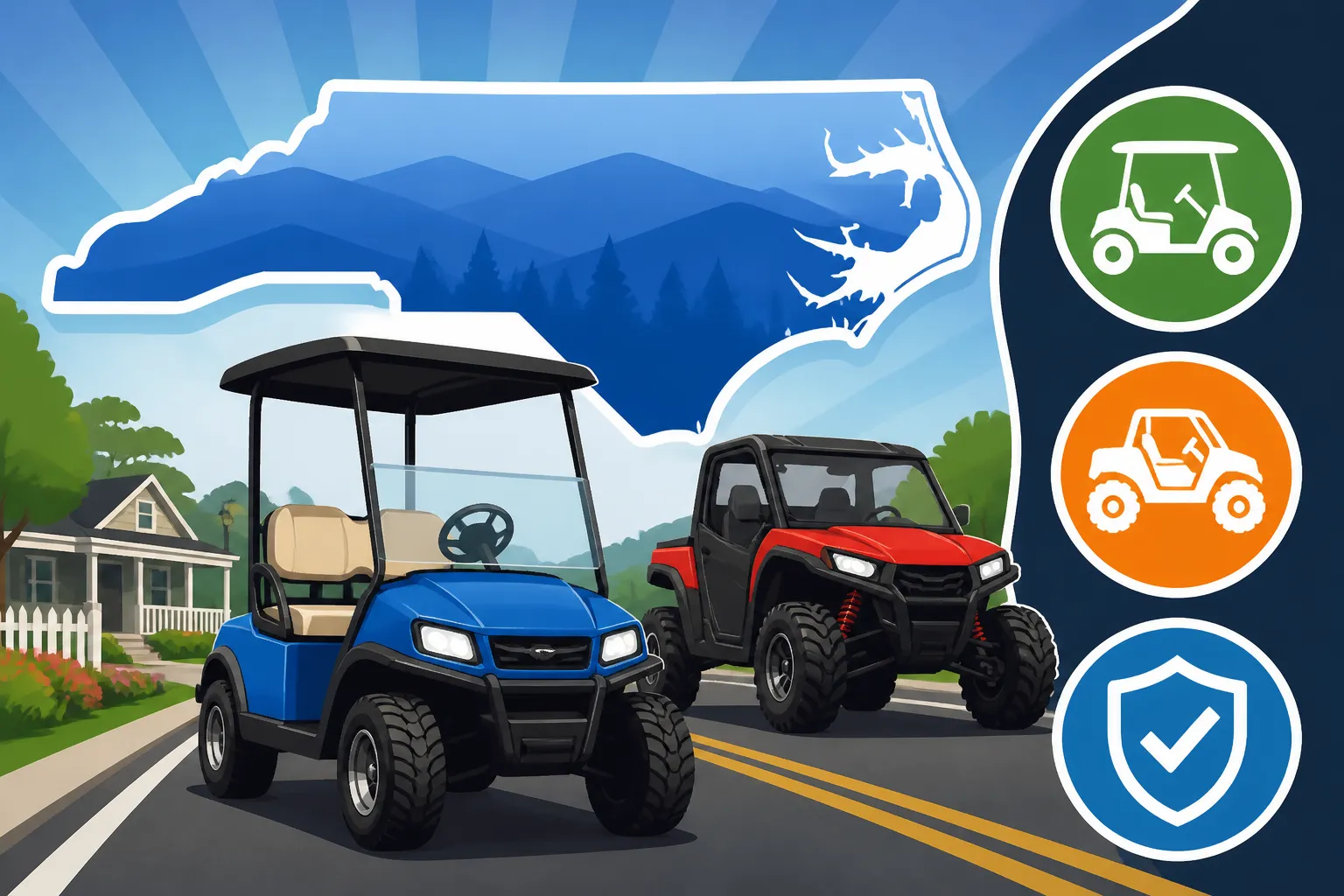
Here's where the plot thickens significantly, and understanding this distinction is absolutely critical if you ever dream of legally driving your golf cart on public roads in North Carolina. A golf cart, as we just discussed, is for the golf course. An LSV, or Low-Speed Vehicle, is an entirely different class of vehicle in the eyes of the North Carolina Division of Motor Vehicles (DMV). An LSV is legally defined as a four-wheeled vehicle whose top speed is greater than 20 miles per hour but not greater than 25 miles per hour, and it must meet specific safety standards established by federal regulations.
Think of it this way: A golf cart is like a blank canvas. To become an LSV, it needs a serious upgrade kit and a full conversion process. This isn't just about adding a horn; we're talking about headlamps, tail lamps, stop lamps, turn signals, reflective tape, mirrors (both interior and exterior), a windshield that meets automotive safety standards, and seat belts for all occupants. Crucially, an LSV also needs a Vehicle Identification Number (VIN) that's been properly assigned or verified, and it must be titled and registered with the DMV, just like a regular car. This also means it requires liability insurance. You can find many aftermarket kits and parts from places like SuperATV that help with these conversions, offering everything from light kits to full enclosures. Without these upgrades, your golf cart, no matter how shiny or new, remains just that – a golf cart – and cannot legally be driven on most public streets. Trying to drive a non-compliant golf cart on a road where an LSV is permitted is still breaking the law, and that can lead to fines and headaches.
Where You Might See Golf Carts on North Carolina Streets (and Why)
So, if state law generally prohibits golf carts on public roads, why do you see them everywhere from the Outer Banks to Lake Norman? This is where local control and specific, limited exceptions come into play. It’s not a free-for-all, but rather a patchwork of rules that can make it tricky to know what’s allowed in any given area.
Local Ordinances and Designated Communities
The primary reason you see golf carts operating on public streets in certain areas of North Carolina is due to specific local ordinances. Many cities and towns, particularly those with a strong tourist presence, large retirement communities, or lakefront/coastal vibes, have enacted their own rules to allow golf carts on certain public roads within their jurisdiction. These are usually roads with low-speed limits (typically 35 mph or less) and are often designated for such use by signage or clear community rules. Imagine a picturesque beach town like Ocean Isle Beach or Bald Head Island, or a lake community around Lake Norman or Lake Lure. These places often thrive on golf cart culture, making it convenient for residents and visitors to get around without a car.
However, it's absolutely vital to understand that these ordinances are hyper-local. What's perfectly legal in Southport might be illegal just a few miles down the road in Oak Island, or vice versa. The responsibility falls on you, the owner, to check with the specific town or county government for their local regulations. You can't assume that because your buddy drives his cart on the street in his retirement community near Pinehurst, you can do the same in your neighborhood outside Charlotte. Failing to do your homework can result in a fine or even having your cart impounded. These local rules often come with their own set of requirements, such as needing a valid driver's license to operate the cart, specific hours of operation (e.g., no night driving), or even local permitting fees. It's a complex dance between state law and local flexibility, and the burden of knowledge is entirely on the rider.
Crossing a Road or Traveling Short Distances
Even without a specific local ordinance, there are very limited circumstances where a golf cart might legally be on a public road, though not for extended travel. North Carolina law provides for brief, direct crossings of roads that divide parts of a golf course. For instance, if a golf course has holes on both sides of a low-speed public road, a golfer might be permitted to drive their cart directly across that road to get from one section of the course to another. This is purely functional, designed to allow the course to operate, not for general street use.
Another very narrow exception involves golf carts being used on private property, and needing to make a minimal, quick transit on a public road to access another piece of private property that's directly across the street. This is usually restricted to very short distances, often just crossing at an intersection or along a block to reach an adjacent private driveway. It's not about driving down the road, but across it. The key here is "minimal and direct," and again, these situations are typically on very low-speed, secondary roads, and often regulated by local authorities. Think of a farmer briefly crossing a quiet country lane to get from one pasture to another that's part of their farm property. This isn't permission to take your golf cart for a spin to the grocery store. Any usage beyond these very limited, functional, and short crossings quickly puts you in violation of state law if your cart isn't a properly converted and registered LSV or operating under a specific local ordinance.
Converting Your Golf Cart for Road Use: The Low-Speed Vehicle Path
If you genuinely want to use your golf cart on public roads with peace of mind, and your local area doesn't have a specific ordinance that covers your needs, then converting it into a Low-Speed Vehicle (LSV) is your primary, state-sanctioned pathway. This isn't just a cosmetic upgrade; it's about meeting stringent safety and legal requirements that transform your recreational vehicle into a street-legal one.
North Carolina Low-Speed Vehicle Rules and Requirements
To be recognized as an LSV in North Carolina, your golf cart needs to meet a very specific list of equipment requirements, primarily mirroring federal safety standards for such vehicles. Here's a breakdown of what you'll need:
- Headlamps: You must have working headlamps that provide adequate illumination for driving after dark.
- Tail Lamps: Red tail lamps are required on the rear, visible from a specific distance.
- Stop Lamps: Functioning brake lights that illuminate when the brake pedal is pressed.
- Turn Signal Lamps: Front and rear turn signals are crucial for indicating your intentions on the road.
- Reflex Reflectors: These provide additional visibility, especially at night.
- Mirrors: You need at least one exterior mirror on the driver's side, and an interior rearview mirror, or two exterior mirrors (one on each side).
- Windshield: The windshield must be made of safety glass that complies with federal motor vehicle safety standards. You can't just slap a piece of plexiglass on there.
- Seat Belts: All seating positions must have seat belts. This is a non-negotiable safety feature, distinguishing it significantly from a basic golf cart.
- Vehicle Identification Number (VIN): If your golf cart doesn't have a VIN, or if it's not recognized for street use, you'll need to apply to the North Carolina DMV to have one assigned or verified. This is a critical step for titling.
- Maximum Speed: The vehicle's top speed must be greater than 20 mph but not exceed 25 mph. This is often achieved by adjusting the governor on gas carts or modifying the controller on electric ones.
- Weight Limit: LSVs are typically limited in weight, usually below 3,000 pounds.
It's a comprehensive list, and places like SuperATV offer kits and individual components that can help you get your golf cart up to these standards. Trying to cut corners here is not only dangerous but will also prevent you from successfully titling and registering your vehicle. The DMV is serious about these requirements because they are directly tied to the safety of operating on public roads alongside other traffic.
The Process of Making Your Golf Cart Street Legal
Once you've equipped your golf cart with all the necessary LSV features, the journey to street legality really begins with the North Carolina DMV. This isn't a quick trip to the local tag office; it requires careful documentation and attention to detail.
- Ensuring Compliance: First and foremost, double-check every single requirement listed above. You might even want to have a professional mechanic or an LSV conversion specialist review your vehicle. An incomplete conversion will only lead to delays and frustration at the DMV.
- VIN Assignment/Verification: If your golf cart doesn't have a valid VIN recognized for highway use, you'll need to apply for one. This often involves an inspection by a DMV agent to verify the vehicle's components and ensure it meets safety standards before a VIN is issued. This step is crucial because without a proper VIN, you can't title or register the vehicle.
- Titling the Vehicle: Once you have a valid VIN, you'll need to apply for a certificate of title using Form MVR-1. This process is similar to [How to Title an ATV in North Carolina]. You'll need proof of ownership, like a manufacturer's certificate of origin (MCO) or a bill of sale. During this process, you will also be subject to North Carolina's 3% Highway Use Tax, which is essentially the state's version of a sales tax on motor vehicles. This tax is based on the purchase price or appraised value of the vehicle.
- Registration and License Plate: After your LSV is titled, you can then register it and obtain a license plate. This involves submitting the appropriate forms and paying registration fees. Your LSV will then be a recognized motor vehicle on North Carolina roads.
- Insurance: Just like any other registered motor vehicle, your LSV must carry the minimum liability insurance required by North Carolina law. You won't be able to register it without proof of insurance.
This whole process can feel a bit overwhelming, and it's certainly an investment of both time and money. Beyond the cost of the parts (which can easily run into hundreds or even a few thousand dollars, depending on what your cart already has and what you buy from places like SuperATV), there are fees for the VIN assignment, titling, and registration. But for many, the ability to legally cruise local streets, visit friends, or run errands without fear of a citation is well worth the effort. It’s about transforming a recreational toy into a practical, street-legal mode of transportation within its defined limits.
Important Considerations and Safety for Street Use
Even once your golf cart is a fully compliant Low-Speed Vehicle and legally allowed on North Carolina streets, the journey isn't over. There are vital ongoing legalities and safety considerations you need to be constantly aware of to ensure smooth and safe operation.
Insurance, Licensing, and Other Legalities
Operating an LSV on North Carolina roads brings with it the full weight of motor vehicle law. It's not just "like" a car; it is a motor vehicle in the eyes of the law, and that means responsibilities.
- Insurance is Mandatory: We touched on this, but it bears repeating: you must carry liability insurance. Just like your car, if you're involved in an accident, this insurance protects you from financial ruin for damages or injuries you might cause to others. Driving without it can lead to severe penalties, including fines, license suspension, and even vehicle impoundment. Don't skip this step. This is much like the [North Carolina ATV Insurance Requirement] for other off-road machines that get converted for specific road use.
- Driver's License Required: Anyone operating an LSV on a public road must possess a valid North Carolina driver's license. This isn't a golf course, where a permit might suffice. It's a public road, and you need to be a licensed driver. Allowing an unlicensed driver to operate your LSV on the street can lead to legal trouble for both the driver and the owner.
- Road Restrictions: LSVs are restricted to roads with posted speed limits of 35 mph or less. You cannot, under any circumstances, operate an LSV on highways, interstates, or any road where the speed limit exceeds 35 mph. Even if a road has a lower limit, if it's considered part of the federal or state highway system that's typically high-speed, an LSV may still be prohibited. Always pay attention to road signage and common sense.
- Operating Rules: All standard rules of the road apply to LSVs: stopping at stop signs and red lights, yielding, using turn signals, and observing speed limits. Operating under the influence (DUI/DWI) laws apply equally to LSV operators as they do to car drivers. There are no special allowances because you're in a smaller, slower vehicle.
Ignorance of these laws is no excuse. The onus is entirely on the LSV owner and operator to know and abide by all state and local traffic laws.
Safety Tips for Driving on Public Roads
Even a fully legal LSV is not a full-fledged car. They are smaller, lighter, and offer less protection in the event of a collision. Therefore, practicing enhanced safety measures is paramount:
- Visibility is Key: LSVs are low to the ground and can be harder for drivers of larger vehicles to see. Consider adding bright, reflective tape (if not already required), a bright flag, or even an aftermarket strobe light kit to enhance your visibility, especially at dawn, dusk, or in inclement weather. Always use your headlights and taillights, even during the day, for maximum visibility.
- Defensive Driving: Assume other drivers don't see you. Drive defensively, anticipate potential hazards, and be prepared to react. Avoid weaving in and out of traffic, and maintain a safe following distance.
- Stick to Low-Traffic Areas: Even on roads posted 35 mph or less, some can be quite busy. Whenever possible, choose quieter, less congested streets. Your LSV is best suited for neighborhood cruising, not heavy commuter traffic.
- Avoid Distractions: Put your phone away. Don't let passengers distract you. Operating an LSV requires your full attention, just like any other vehicle on the road.
- Be Aware of Weather: LSVs offer limited protection from the elements. Rain, fog, or icy conditions can make driving an LSV particularly hazardous. Reduce your speed and consider whether it's truly safe to be on the road in adverse weather.
- Passenger Safety: Ensure all passengers are properly seated and buckled up. Do not overload your LSV beyond its manufacturer's recommended capacity or carry passengers in positions not equipped with seat belts. Children, especially, need to be secured safely. Remember that an LSV does not provide the same crash protection as a passenger car.
Operating an LSV on North Carolina roads can be a fantastic way to enjoy your community, but it demands respect for the law and a constant commitment to safety. It's about blending the fun and convenience of a golf cart with the serious responsibilities of being a legal road user.
| Feature | Standard Golf Cart | Low-Speed Vehicle (LSV) |
|---|---|---|
| Primary Use | Golf courses, private property, restricted communities | Public roads (speed limit ≤ 35 mph), designated communities |
| Top Speed | Varies, typically 15-20 mph | >20 mph but ≤ 25 mph |
| Street Legal (State Law) | Generally NO (unless local ordinance applies) | YES (with proper conversion & registration) |
| Required Equipment | Basic (lights often optional/aftermarket) | Head/tail/stop lamps, turn signals, mirrors, windshield, seat belts, VIN |
| Titling/Registration | Not required for standard use | REQUIRED with NC DMV (Form MVR-1, Highway Use Tax) |
| Liability Insurance | Not required for standard use | REQUIRED by NC law |
| Driver's License | Not required for standard use | REQUIRED (valid NC driver's license) |
Disclaimer
This article is for general informational purposes only and does not constitute professional advice. Laws, prices and regulations vary by location and change over time. Consult a qualified professional for guidance on your specific situation.